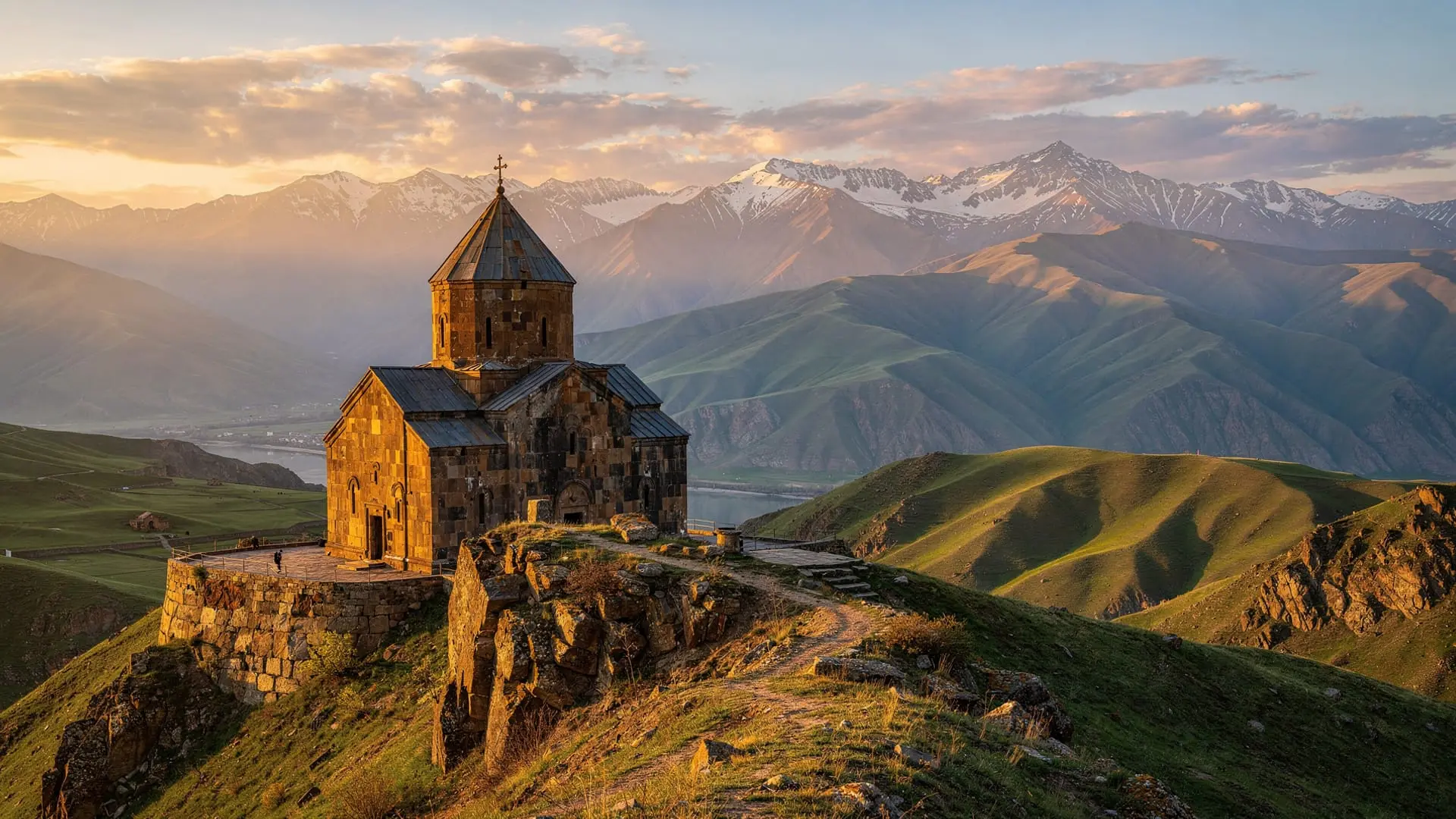
Shirak’s quiet monastery by the river
Marmashen monastery stands on the left bank of the Akhuryan river, 12 km north of Gyumri, in a landscape that is entirely different from the forested valleys of Tavush or the dramatic Debed gorge of Lori. This is the Shirak plateau: open, rolling, wind-exposed country at 1,600–1,800 metres, where the sky feels huge and the horizon extends to the Turkish border ridgeline in the west. The monastery sits in a sheltered bend of the Akhuryan — one of the few places on this plateau where trees grow naturally along the riverbank — and the contrast between the open plateau and the shaded riverside makes the approach one of the more pleasant arrival sequences in western Armenia.
Marmashen is dated to the 10th–13th centuries, with the main church (Katoghike) built in 988–1029 AD under the patronage of the Bagratid prince Vahram Pahlavuni. The complex includes three churches, a gavit, and several funerary chapels in varying states of preservation. It is not in the UNESCO category of Haghpat and Sanahin, and it is not on the standard tourist circuit — which means that on most days you will have the complex largely to yourself.
The monastery is a natural addition to a visit to Gyumri — Armenia’s second city and cultural capital, 12 km south. Most Gyumri day trips from Yerevan can absorb a Marmashen stop without significantly extending the day.
| Where | Shirak province, 12 km north of Gyumri, 140 km from Yerevan |
| Cost | Free entry; no facilities on site |
| Time needed | 40 min–1 hr (combine with Gyumri for a half day) |
| Getting there | Car, taxi from Gyumri, or train to Gyumri + taxi |
| Best time | May–October; avoid strong plateau wind in winter |
Getting to Marmashen from Yerevan and Gyumri
From Yerevan by car: Approximately 2 hours 15 minutes (140 km). Take the M1 highway northwest to Gyumri, then continue 12 km north along the Akhuryan river valley. The monastery is signposted from the main road.
From Gyumri: 12 km north, about 20 minutes by car or taxi. A taxi from Gyumri to Marmashen and back costs approximately 4,000–7,000 AMD. Most Gyumri-based accommodation can arrange this for you.
From Yerevan by marshrutka and taxi: Marshrutkas run from Kilikia terminal to Gyumri throughout the day (around 1,200 AMD, 2 hours). From Gyumri, take a taxi to Marmashen.
By train from Yerevan to Gyumri: The train is one of the recommended ways to reach Gyumri — the journey takes approximately 3 hours through the Shirak plateau and passes through spectacular mountain scenery. From Gyumri station, take a taxi to Marmashen. See our Gyumri by train guide for schedules and the full experience.
By guided tour: Marmashen is occasionally included in tours that cover Gyumri and the Shirak region. Most standard Gyumri day tours from Yerevan do not include Marmashen unless specifically requested.
Yerevan: day trip to Gyumri, Armenia’s second-biggest city
What to see at Marmashen
The Katoghike (main church)
The Cathedral of the Holy Mother of God, built between 988 and 1029 AD, is the oldest and most significant structure at Marmashen. The architectural style belongs to the Armenian Bagratid tradition of the 10th–11th centuries — a cross-in-square plan with a ribbed conical dome, carved portal with palmette and interlace decoration, and dark tuff masonry that has acquired a deep ochre patina over the centuries.
The church is not large, but its proportions are refined and the carved details of the portal are excellent. Look at the cable moulding around the arched portal entrance — a recurring Bagratid decorative element — and the carved khachkars embedded in the exterior walls, several of which date from the original 10th-century construction.
The interior is plain but atmospheric. The original floor is covered in layers of consolidation mortar from various restoration phases; the apse retains the outline of its original decorative programme, though the painted surface is largely lost. Light from the drum windows illuminates the central crossing.
The second and third churches
Two additional churches stand adjacent to the Katoghike: the smaller church of Surb Grigor (11th century) to the north, and a church of Surb Stepanos (12th century) to the east. Both are in varying states of preservation — Surb Grigor is substantially intact, while Surb Stepanos retains only its walls and the outline of its original apse.
The secondary churches show the gradual expansion of the Marmashen complex over the 11th and 12th centuries, as successive noble patrons added structures. The khachkars in the Surb Grigor courtyard area are some of the finest at the site.
The gavit
A gavit (narthex) is attached to the western facade of the Katoghike. Its ceiling has partially collapsed, leaving the interior open to the sky in one section — an effect that is oddly beautiful, with vegetation growing in the gap and the carved stone arches still intact around the opening. This state of partial ruin is characteristic of many provincial Armenian monastery complexes that have not had the benefit of major restoration funding.
The Akhuryan riverbank setting
The monastery’s river setting is a significant part of the experience. The Akhuryan river, which forms part of the border between Armenia and Turkey here (the monument-strewn opposite bank is Turkish territory), runs through a shallow gorge below the monastery. Willow and poplar trees line the bank, and the sound of the water is audible from the monastery courtyard.
In summer, the riverbank below the monastery is used by local families for picnics — a pleasant, unscripted scene of Armenian outdoor culture. The water is cold and clear from the Shirak plateau streams that feed it.
Marmashen in the Shirak plateau context
Marmashen belongs to a wider Shirak province landscape that most Armenia itineraries skip entirely, since the province sits off the standard Yerevan-radiating tourist routes and requires a deliberate detour. That relative obscurity is precisely what makes Marmashen and the surrounding plateau rewarding for travellers who have already done the Garni–Geghard–Khor Virap circuit and want a genuinely different register of Armenia: open steppe, wind, a closed international border a few kilometres away, and monuments that receive a handful of visitors a day rather than busloads.
Anyone drawn to Marmashen for the solitude should also read our dedicated Gyumri architecture and cultural capital guide, which covers the black-tuff 19th-century townhouses that give Gyumri its distinctive character and that most day-trippers from Yerevan only glimpse in passing.
Combining Marmashen with Gyumri
Gyumri is the essential companion to Marmashen — Armenia’s second city and cultural capital is 12 km south, with a historic centre of 19th-century black tuff architecture, the Mother Armenia statue, the Black Fortress, and one of the most vibrant arts scenes outside Yerevan.
A comfortable Shirak day itinerary from Yerevan:
- Yerevan → Gyumri by car (2 hours) or train (3 hours)
- Gyumri: historic centre walk, cathedral, Mher Mkrtchyan museum (2–3 hours)
- Lunch in Gyumri
- Taxi to Marmashen (20 min) → monastery visit (1 hour)
- Return to Gyumri and back to Yerevan
For those wanting to stay overnight in Shirak, the Berlian Hotel in Gyumri is the most comfortable option in the region.
Group tour: Gyumri sightseeing, Black Fortress and Harichavank monastery
Practical tips
It is quiet here: Unlike Haghpat or Geghard, Marmashen sees very few visitors. Don’t expect an on-site café, toilet facilities, or a souvenir shop. Bring water and anything else you need from Gyumri.
The gavit is partially open-roofed: If you are visiting in rain, the central section of the gavit interior will be wet. This is not a problem for the site itself, but it affects photography conditions.
Photography: The main church portal is the best photographic subject. In morning light (the church faces approximately south-west), the carved stonework is well-lit from around 10:00–13:00. The Akhuryan riverbank with the monastery behind it is the best landscape shot and is best in late afternoon.
Altitude: Marmashen sits at about 1,600 metres. Wind on the Shirak plateau can be strong and cold even in summer. Carry a windproof layer.
Border proximity: The Akhuryan river here forms part of the Armenian–Turkish border. The opposite bank is Turkey. The border is closed (it has been since 1993). There are no crossing points in this area, and visiting the monastery is completely normal and unaffected by the border proximity. Simply be aware that you are in a border zone.
Harichavank monastery (20 km south of Gyumri, near Harich village) is another worthwhile Shirak church site that can be combined with Marmashen and Gyumri on the same day if you have a car and time.
Frequently asked questions about Marmashen monastery
When was Marmashen monastery founded?
The main church at Marmashen (Katoghike) was built between 988 and 1029 AD under the patronage of the Bagratid prince Vahram Pahlavuni. The complex continued to expand through the 13th century, with additional churches and the gavit added by subsequent noble patrons. It is therefore a 10th–13th century complex, with the core building dating from the early 11th century.
Is Marmashen in better or worse condition than Haghpat?
Marmashen is in a less well-preserved state than Haghpat or Sanahin. The secondary churches are partially ruined, and the gavit roof has partially collapsed. The main Katoghike church is substantially intact, however, and the carved portal is well-preserved. Marmashen has received less restoration funding than the UNESCO-listed Lori monasteries.
Can I combine Marmashen with the Harichavank monastery on the same day?
Yes. Harichavank monastery (10th–12th century) is located 20 km south of Gyumri near Harich village. Combining Marmashen (12 km north of Gyumri) with Harichavank (20 km south) and a Gyumri city visit in between creates a full Shirak day. The total driving is manageable if you have a car.
How close is Marmashen to the Turkish border?
The Akhuryan river at Marmashen forms part of the Armenian–Turkish border. The distance between the monastery and the border is approximately 1–2 km. The border is closed to crossing and has been since 1993. Visiting the monastery is entirely normal; you are not restricted in any way. However, you will notice that the opposite bank of the river is Turkish territory.
Is Marmashen worth visiting if I have already seen Haghpat and Sanahin?
Yes, for a different reason. Marmashen offers something that Haghpat and Sanahin don’t: complete solitude. You are likely to be the only visitor. The river setting, the partially ruined gavit open to the sky, the views across the Shirak plateau to the Turkish border ridgeline — these are experiences that the busier UNESCO sites cannot replicate. If you are doing a comprehensive Armenia itinerary and including Gyumri, Marmashen adds only 40 minutes to the day and rewards the detour.
Do I need a full day for Marmashen and Gyumri together?
No — a half day is enough for both if you’re efficient. Budget 2–3 hours for Gyumri’s historic centre and museums, 40 minutes to 1 hour at Marmashen, and the 20-minute drive between them. A full day only becomes necessary if you’re also adding Harichavank monastery further south or want unhurried time in Gyumri’s cafés and arts spaces.
Is Marmashen suitable for visitors with limited mobility?
Partially. The main Katoghike church is reachable on relatively flat ground from the parking area, but the site is unpaved and uneven in places, and the gavit’s partially collapsed roof means some areas underfoot are exposed to weather and debris. Visitors with significant mobility limitations can still view and photograph the main church exterior without difficulty.