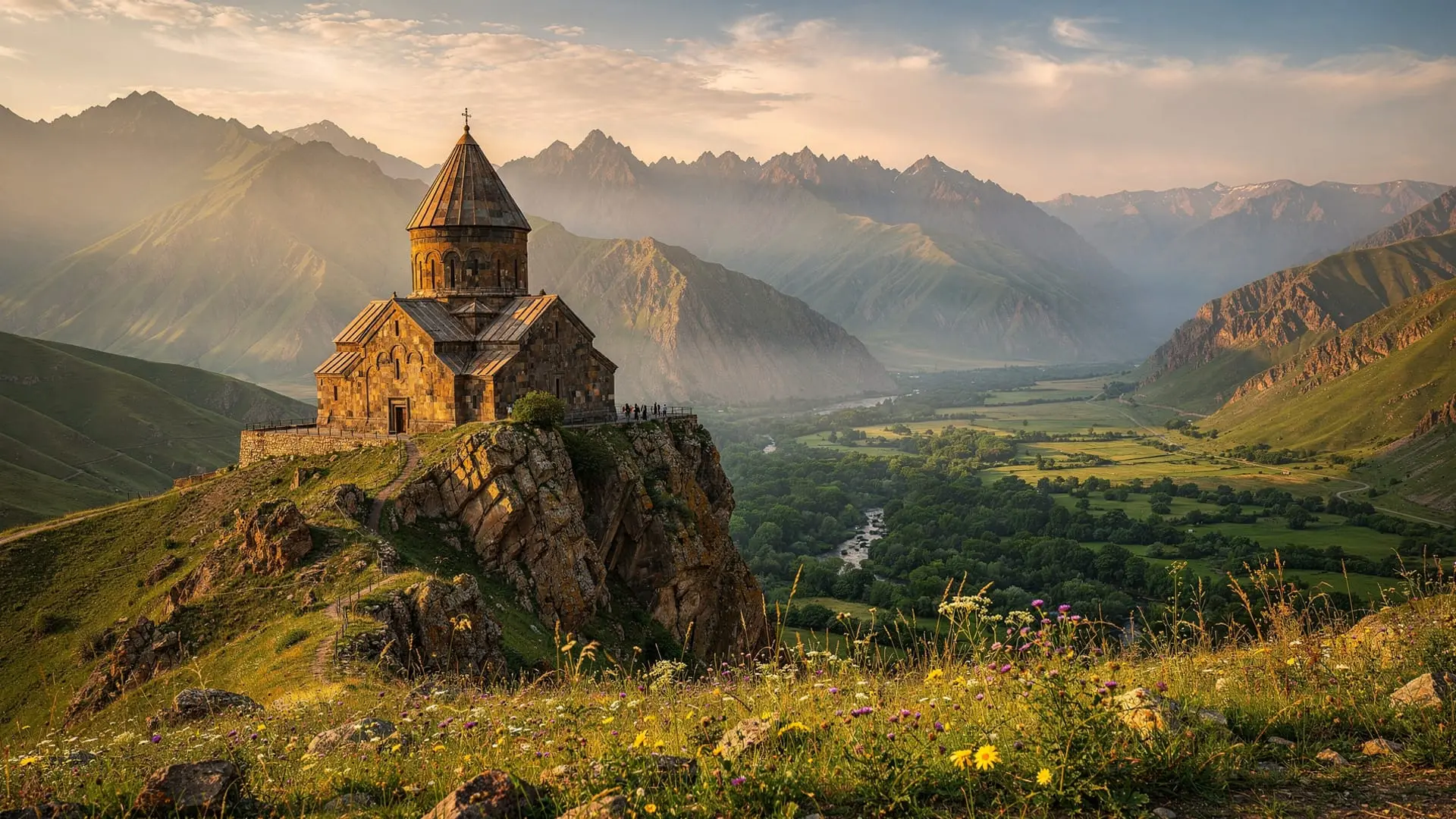
Armenia’s monastery on the gorge edge
The name Saghmosavank translates as “monastery of psalms” — a reference, according to local tradition, to the monks who chanted their hours on this dramatic ridge above the Kasakh river gorge. Whether or not the etymology is accurate, the name suits the site. Saghmosavank sits at the very lip of a deep gorge, its pink tuff walls rising directly from the cliff edge, the Kasakh river far below. The combination of medieval architecture and raw geological drama makes it one of the most visually striking monasteries in the Aragatsotn province.
The complex was founded in the early 13th century under the patronage of Prince Vache Vachutian, a member of the Zakariad aristocracy that controlled much of Armenia during the Georgian golden age. The main church (Church of the Holy Mother of God) was completed in 1215. It was added to throughout the 13th century, with a gavit (narthex) and library building following under different Zakariad patrons. The monastery remained an active scriptorium and spiritual centre until the 17th century.
| Season | Months | What to expect |
|---|---|---|
| Spring | Apr–Jun | Wildflowers on the gorge rim, comfortable temperatures — the strongest window overall |
| Summer | Jul–Aug | Warm and busier with tour groups; mornings before 10:00 are best for the gorge light |
| Autumn | Sep–Oct | Golden light on the pink tuff walls, quieter than summer |
| Winter | Nov–Mar | Accessible year-round; cold and exposed at the cliff-edge terrace, dramatic in snow |
Getting there from Yerevan
By car: From Yerevan, take the main M1 highway north toward Gyumri. After approximately 55 km, turn right toward Aparan town; Saghmosavank is approximately 5 km south of Aparan, well-signposted. Total driving time from Yerevan is about 1 hour.
Alternative route: Some visitors approach from the south via Hovhannavank monastery, which lies 4 km further south along the same gorge. The two monasteries share the same approach road and are almost always visited together.
By guided tour: Both Saghmosavank and Hovhannavank are included in most Aragatsotn day tours from Yerevan, often combined with Amberd fortress and the Armenian alphabet monument.
By marshrutka: Marshrutkas from Kilikia station in Yerevan to Aparan (about 600–700 AMD) leave regularly. From Aparan, a local taxi to Saghmosavank costs approximately 1,000–2,000 AMD. Return transport from the monastery is unreliable — arrange a pick-up or pre-book return transport.
What to see
The main church and gavit
The Church of the Holy Mother of God is a compact single-nave structure with a cylindrical drum and cone roof — the classic 13th-century Zakariad style. The exterior is relatively plain; the interior preserves fragments of medieval fresco and several carved khachkar niches in the side walls. The adjoining gavit (a rectangular narthex, also 13th century) is larger than the church itself and was used as a communal space for monastery activities.
The library building to the north side of the church complex is a notable example of Armenian scholastic architecture: a vaulted hall with carved stone benches where manuscripts would have been copied and stored. The library at Saghmosavank was particularly active in the 13th–14th centuries.
The gorge viewpoint
The monastery stands directly at the canyon rim. From the outer wall on the western side, the view plunges 150–200 metres to the Kasakh river below. Across the gorge, the opposing cliff face is composed of the same volcanic basalt as the Symphony of Stones in Garni gorge — columnar formations lining the canyon walls. The combination of medieval architecture and geological drama is the defining image of Saghmosavank.
In the early morning, mist sometimes fills the gorge below while the monastery catches full sunlight — a photograph worth waking early for.
The khachkars (cross-stones)
Several carved khachkars stand in the monastery courtyard, including a particularly fine 13th-century example with elaborate interlace patterns. Saghmosavank’s khachkars are less famous than those at Noratus cemetery near Lake Sevan, but they are genuine medieval work in excellent condition.
The Zakariad context
Saghmosavank belongs to a wave of monastery-building across northern and central Armenia in the late 12th and 13th centuries, financed by the Zakariad noble families who rose to prominence after Georgian-led campaigns pushed Seljuk forces out of the region. This period — sometimes called the Armenian “silver age” or Zakariad renaissance — produced many of the country’s best-known medieval monasteries, including Haghpat and Sanahin further north, though those were founded earlier under Bagratid and Kiurikian patronage and only renovated in the Zakariad period. Prince Vache Vachutian’s patronage of Saghmosavank reflects the same pattern seen across the region: local aristocratic families competing to fund monastic scriptoria and libraries as both spiritual investment and a display of status. Seeing Saghmosavank alongside Hovhannavank gives a compact, half-day introduction to what that wave of building actually looked like on the ground.
How long to spend
The monastery complex takes about 45–60 minutes to explore thoroughly. Adding the gorge walk along the rim — a rough path runs for 500 metres in each direction before the cliff becomes too steep — adds another 30–45 minutes. With the drive from Yerevan, a half-day is the right allocation for Saghmosavank alone.
Combining with Hovhannavank (4 km south) adds 45 minutes. Adding Amberd fortress (35 km northeast) and the Armenian alphabet monument makes a full Aragatsotn day.
Combining with other sites
Hovhannavank (4 km south): The 13th-century monastery of St John the Baptist lies just 4 km south along the Kasakh gorge. It is structurally similar to Saghmosavank but architecturally more elaborate. The two are almost universally visited together — it would be strange to come all this way and see only one. See Hovhannavank.
Armenian alphabet monument (30 km southeast, near Artashavan): The monument to the 39 Armenian letters by sculptor Jim Torosyan is a 30-minute drive southeast, near the village of Artashavan. Often included in the same Aragatsotn day as both monasteries. See Armenian alphabet monument.
Amberd fortress (35 km northeast): The Amberd fortress at 2,300 metres on Aragats is the most dramatic site in Aragatsotn and pairs naturally with the lower gorge sites for a full day.
Byurakan observatory (15 km south): Byurakan observatory on the lower slopes of Aragats is a 15-minute drive south from Saghmosavank and can be added as a final stop before returning to Yerevan.
Tours and tickets
Entry to Saghmosavank is free. There is no formal ticket office.
For a private tour specifically focused on Saghmosavank, Hovhannavank, and the broader Amberd circuit: this private Armenia tour covers Amberd, Hovhannavank, and Saghmosavank with a driver-guide and full-day logistics from Yerevan.
To add Etchmiadzin and Zvartnots to a Saghmosavank visit for a comprehensive Aragatsotn/Armavir combination: this Hovhannavank, Saghmosavank, Etchmiadzin, and Zvartnots tour covers all four sites with transport included.
Practical tips
- Safety at the gorge edge: the cliff rim has no protective barriers; exercise caution, especially with children
- Entry: free, always accessible; the church interior is sometimes locked outside service hours — a caretaker often has the key
- Photography: the gorge is best photographed before 10:00 when the sun illuminates the near cliff face; afternoon light falls on the monastery walls
- Dress: modest clothing required — cover shoulders and knees; women should have a headscarf available
- Combined visit: it’s 4 km to Hovhannavank; drive rather than walk — the road is not pedestrian-friendly along that stretch
- Facilities: no toilets or café at the site; basic facilities in Aparan (5 km north)
Frequently asked questions about Saghmosavank
Why is Saghmosavank called the “monastery of psalms”?
The etymology is debated. The most common explanation is that the name refers to the monastic practice of chanting psalms (sagh in classical Armenian means “psalm”), with the monastery serving as a major scriptorium where psalters and religious texts were copied. An alternative folk etymology links it to the winds that “sing” in the gorge below — but the scriptural explanation is more widely accepted.
What is the difference between Saghmosavank and Hovhannavank?
Both are 13th-century Zakariad monasteries on the same Kasakh gorge. Saghmosavank (Church of the Holy Mother of God, 1215) is slightly earlier and has the more dramatic gorge-edge position. Hovhannavank (Church of St John the Baptist) has more elaborate decorative stonework. They are stylistically related and were probably built by the same master builders. Visit both — they are 4 km apart.
Is the gorge walk between the two monasteries possible on foot?
The gorge itself is not walkable between the two monasteries — the canyon walls are too steep. You drive the 4 km on the rim road. However, a short walking path runs along the cliff edge from each monastery for several hundred metres.
Can I reach Saghmosavank without a car?
By bus to Aparan and taxi from there, yes — but the return is unreliable. For a day trip, a private car, GG Taxi, or guided tour is much more practical.
Is Saghmosavank an active monastery?
It is periodically active — services are held on major feast days and sometimes on Sundays — but it is not a resident monastery. There are no monks in permanent residence. The site is administered by the Armenian Apostolic Church.