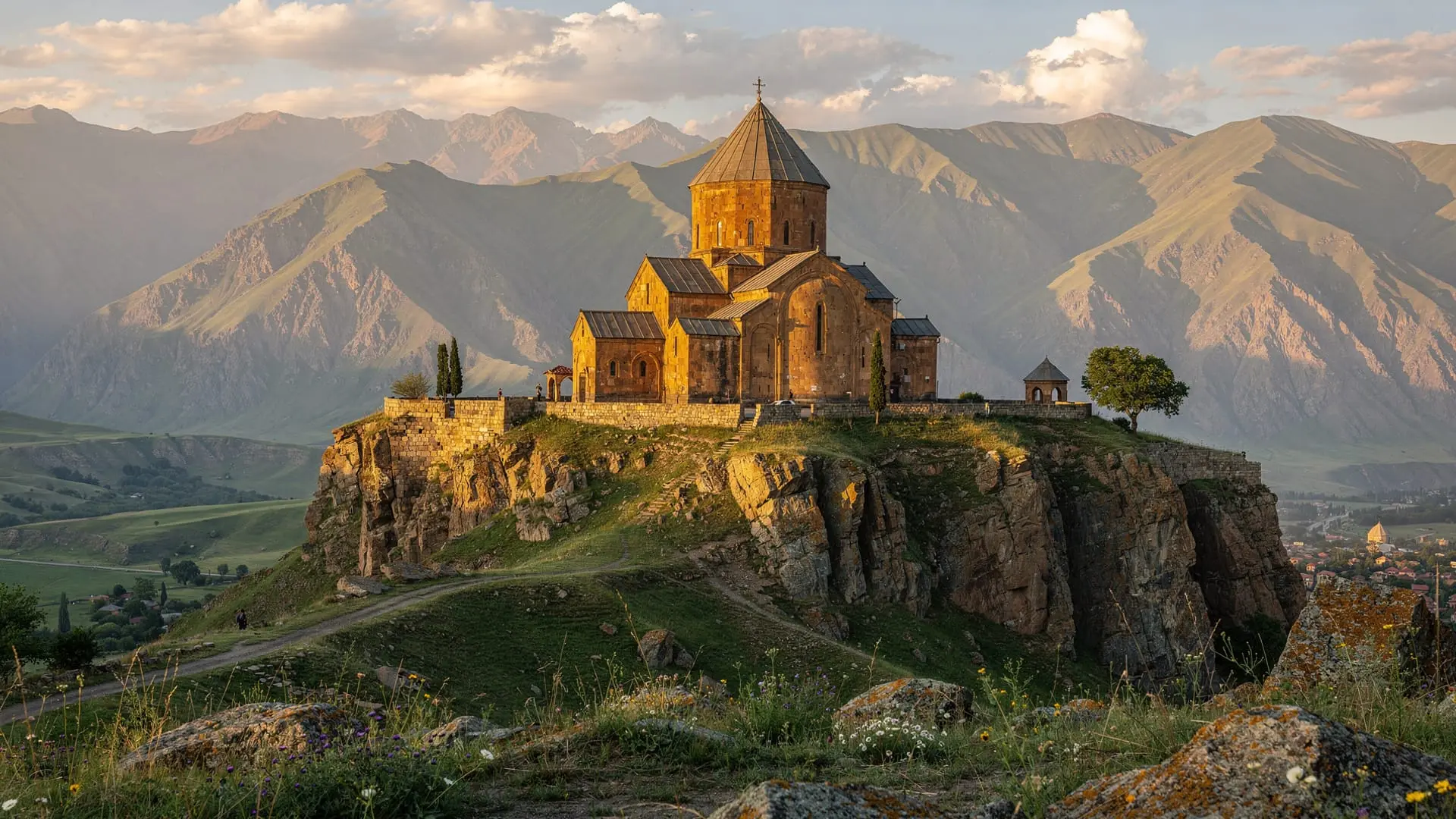
The elaborately carved companion monastery
Hovhannavank — “monastery of St John” in Armenian — stands 4 kilometres south of Saghmosavank on the same rim of the Kasakh gorge, in the village of Ohanavan in Aragatsotn province. The two monasteries were built within decades of each other under the same Zakariad patrons, and they share a stylistic language. But where Saghmosavank is valued for its dramatic gorge-edge position, Hovhannavank is prized for its architectural elaboration — particularly the carved facade of the main church and the proportions of its gavit.
The core church of Hovhannavank (Church of St John the Baptist) dates from the early 13th century and was built by the Zakariad prince Vache Vachutian, the same patron responsible for Saghmosavank. The site is older, however — there is evidence of an early Christian place of worship here from the 6th or 7th century. The 13th-century structures essentially replaced earlier buildings on the same sacred site.
| Where | Kasakh gorge rim, Aragatsotn province, 55 km from Yerevan |
| Cost | Free admission |
| Time needed | 45–60 minutes, 2–2.5 hours combined with Saghmosavank |
| Getting there | Car (~55 min from Yerevan) or a guided Aragatsotn day tour |
| Best time | April–October; spring wildflowers or autumn golden light |
Getting there from Yerevan
By car: From Yerevan, take the M1 highway north toward Gyumri. Turn right toward Aparan after about 55 km, then follow signs south toward Ohanavan village. The monastery is at the edge of the village, beside the gorge rim. Total driving time is approximately 55 minutes.
Combined with Saghmosavank: The two monasteries are 4 km apart on the same road. Almost every visitor covers both — drive between them takes under 10 minutes. The logical order is Saghmosavank first (further north, closer to Aparan), then Hovhannavank on the way back south.
By guided tour: Both monasteries are included in most Aragatsotn day tours. See the tours section below for specific options.
Public transport: Marshrutkas from Kilikia bus station in Yerevan run to Aparan and Ohanavan. Journey time is about 1.5 hours and costs around 600–700 AMD. Return transport is unreliable — pre-arrange or use a tour.
What to see
The main church facade and decorative stonework
The Church of St John the Baptist is a single-nave barrel-vaulted structure with a cylindrical drum, typical of 13th-century Armenian ecclesiastical architecture. The western facade is the architectural highlight: the doorway surround is carved with interlacing vine scrolls, geometric patterns, and small figural reliefs in a style characteristic of the Zakariad period. The quality of execution is noticeably higher than at many comparable rural monasteries.
Inside, the church is relatively bare — frescoes have mostly faded — but the proportions are harmonious and the carved khachkar niches in the walls are worth close attention.
The gavit (narthex)
The large gavit adjoining the western entrance of the church is one of the better-preserved examples of the Armenian gavit type — a vaulted rectangular hall used for communal gatherings, services for laity, and burials. The stone columns supporting the central vault have simply carved capitals; the tomb of one of the Zakariad patrons is believed to be incorporated into the floor.
The gorge views
Like Saghmosavank, Hovhannavank sits at the edge of the Kasakh gorge. The views from the monastery’s western wall are slightly different from those at Saghmosavank — the gorge curves here, giving a longer sightline downstream. The opposite cliff face shows the same columnar basalt formations visible throughout the region.
The village of Ohanavan
The village around the monastery is a typical Armenian highland settlement. The name “Ohanavan” is simply the village form of “Hovhannavank” — village and monastery share their dedication to St John (Hovhan). A few guesthouses in the village offer accommodation for those wanting to stay overnight in the Aragatsotn region.
The Kasakh gorge itself
The gorge that both monasteries overlook is worth appreciating on its own terms, not just as a scenic backdrop. Our dedicated Hovhannavank canyon guide goes into more depth on the geology and the best vantage points along the rim, including spots a short walk from the monastery that most day-trippers never reach. If you’re building this into a longer loop of Yerevan’s monastery day trips, our Garni and Geghard day trip guide and the Geghard monastery complete guide cover the other major half-day options south of the city, useful for comparing how a “monastery day” looks in each direction from Yerevan.
How long to spend
Hovhannavank takes 45–60 minutes to explore. Combined with Saghmosavank (4 km north), allow 2–2.5 hours for both. The full Aragatsotn circuit — both monasteries, Amberd fortress, and the Armenian alphabet monument — fills a comfortable full day.
Combining with other sites
Saghmosavank (4 km north): The companion monastery, with the more dramatic gorge-edge position. Always visit both on the same trip — driving between them takes under 10 minutes. See Saghmosavank.
Armenian alphabet monument (25 km southeast): The monument to the 39 Armenian letters is a 25-minute drive southeast from Hovhannavank. A natural add-on. See Armenian alphabet monument.
Amberd fortress (40 km northeast): Amberd on the slopes of Mount Aragats is the most dramatic site in Aragatsotn. Combining Hovhannavank, Saghmosavank, and Amberd makes an excellent full-day Aragatsotn circuit.
Byurakan observatory (15 km south): Byurakan observatory is a straightforward 15-minute drive south and can be added as the final stop before returning to Yerevan.
Tours and tickets
Entry to Hovhannavank is free. There is no ticket office.
For a tour that also includes Etchmiadzin and Zvartnots cathedral for a broader Armavir/Aragatsotn day: this extended tour covers Hovhannavank, Saghmosavank, Etchmiadzin, and Zvartnots with all transport from Yerevan included.
To combine the monasteries with the Alphabet Monument and Mount Aragats: this guided tour called “Conquering the great fortress” covers monasteries, the Alphabet Monument, and Amberd in a single long day.
Practical tips
- Order of visit: drive Saghmosavank first, Hovhannavank second — this works with the natural flow of the road from Aparan
- Entry: free; the church is sometimes locked — a caretaker or church warden in the village usually has the key
- Dress: modest clothing required; women should bring a headscarf
- Children: the gorge rim has no barriers — maintain close supervision near the western monastery wall
- Combined logistics: if driving independently, both monasteries are easy to cover before lunch, leaving the afternoon for Amberd or the return to Yerevan
- Parking: a small clearing near the monastery entrance serves as a car park
Frequently asked questions about Hovhannavank
Is Hovhannavank better than Saghmosavank?
Neither is objectively superior. Saghmosavank has the more dramatic gorge-edge position and slightly better views. Hovhannavank has more elaborate decorative stonework on its church facade and a better-preserved gavit. Most visitors find them complementary rather than competing — visiting both is the obvious approach given they are 4 km apart.
Why are there two major monasteries so close together?
The Kasakh gorge was a prosperous agricultural zone in the 13th century, and the Zakariad aristocracy who controlled the region were enthusiastic ecclesiastical patrons — building and endowing monasteries was a form of prestige and piety. The proximity reflects the wealth of the region rather than any strategic need.
Is Hovhannavank an active monastery?
Services are held periodically, especially on the feast of St John the Baptist, but it is not a resident monastic community. It functions primarily as a heritage site administered by the Armenian Apostolic Church.
Can I combine Hovhannavank with Garni and Geghard in one day?
Technically yes, but it makes for a very long day with significant driving. Garni and Geghard are south of Yerevan; Hovhannavank is north. A more sensible approach is two separate day trips or a multi-day itinerary with a car.
Are there guesthouses near Hovhannavank?
Ohanavan village has a small number of guesthouses and homestays — basic but clean, with home-cooked meals. Staying overnight allows an early morning visit before the tour buses arrive. Rates are typically 10,000–15,000 AMD per room.
How does Hovhannavank compare to Geghard or Garni?
They’re a different style of experience. Geghard is a partly rock-hewn monastery carved into a cliff face and is more visually dramatic on first impression; Garni is a pagan-era temple, unusual for having no Christian equivalent elsewhere in Armenia. Hovhannavank’s appeal is quieter — refined stone carving and a gorge-rim setting without the tour-bus volume that Geghard and Garni attract, since they sit on the well-worn Yerevan day-trip route.