Traditional Armenian dance: kochari, yarkhushta & more
Dance as memory
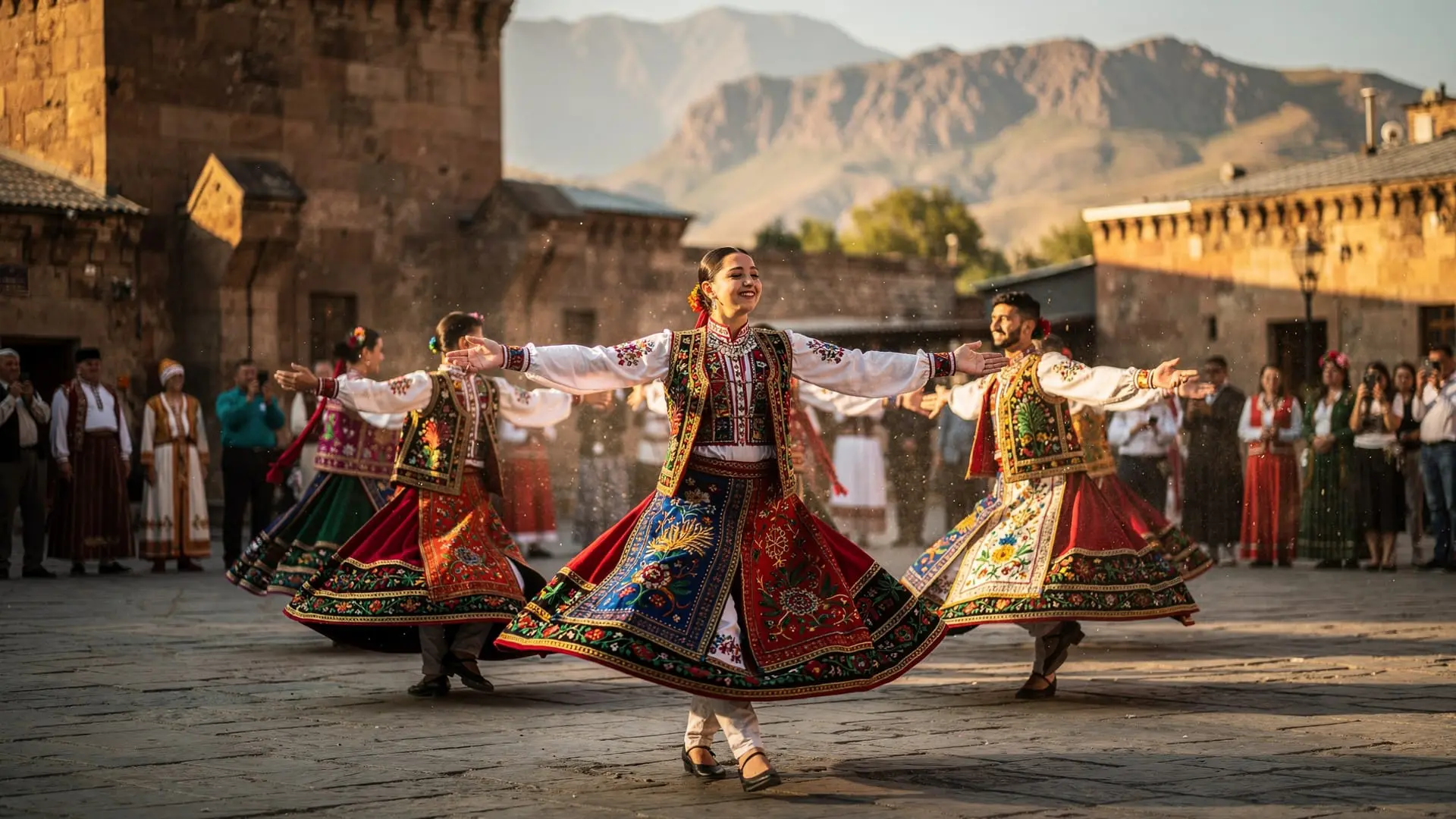
At a traditional Armenian wedding, the kochari begins when the band shifts from ballad to driving 6/8 rhythm and someone steps onto the floor with a raised handkerchief. Within 30 seconds, a line of 20 people has formed. Within a minute, the line is 50 people. The stomping is synchronized, the lateral steps are precise, and the raised handkerchief signals the leader who sets the variations. Grandmothers and university students are doing the same steps; a man in his 70s is doing them better than anyone.
Armenian traditional dance is not a folkloric preservation exercise — not something kept alive in museums and performed for tourists. It is a living practice, present at life events, embedded in community identity, learned from elders by children who will teach it to their own children. Understanding it gives visitors a different entry point into Armenian culture than any museum provides: the culture from inside a body in motion.
| Where | Yerevan (Spendiaryan Theatre, cultural centres); weddings countrywide |
| Cost | Free at public holidays; theatre tickets or workshop fees for staged shows |
| Time needed | 90 minutes for a workshop; an evening for a staged performance |
| Getting there | Central Yerevan venues, easily walkable or a short taxi |
| Best time | National holidays (28 May, 9 May) and around wedding season (spring–autumn) |
Kochari: the collective dance
Kochari (also transliterated as “yerkochari” or “kochari”) is the most widely known and most frequently performed traditional Armenian dance. UNESCO’s listing in 2017 described it as “a collective traditional dance representing identity, history and ethics of the communities practicing it in the highlands of Armenia.”
Origins and meaning: The name comes from the Classical Armenian word for “goat” (koch), and the dance’s origins are believed to connect to pre-Christian ritual practices — specifically, ceremonies related to mountain animals whose movements were mimicked as a form of sympathetic magic or ritual identification. The historical connection is speculative, but the physical vocabulary of the dance — the vigorous kicks that echo a goat’s hoofwork, the stamping into the earth — supports the explanation.
How it’s danced: Kochari is performed in a line or circle (open at one end) with participants linked by held hands, linked arms at shoulder height, or hands on shoulders. The basic step pattern involves:
- A lateral step-together-step pattern moving to the right
- Vigorous stamps on alternate beats
- Kicks alternating right and left at approximately knee height
- A characteristic forward lean in the torso that amplifies the stamp
Variations add complexity: the lead dancer (or a particularly skilled dancer near the front) may add jumps, cross-leg stamps, or rapid footwork sequences that others can follow or not. The baseline rhythm is typically in 6/8 or 4/4, played fast and with driving percussion. The dhol (double-headed drum) and duduk or zurna typically provide the music.
When you will see it: Kochari appears at almost every large Armenian social gathering — weddings, graduation celebrations, national holidays (particularly 28 May, Republic Day; 9 May, Victory and Peace Day), and Genocide Remembrance Day commemorations on 24 April. In Yerevan, the Republic Square occasionally hosts public kochari performances at national events.
Yarkhushta: the warrior dance
If kochari is the dance of communal identity, yarkhushta is the dance of martial heritage. A traditional dance of the Armenian highlands — particularly associated with the Sasun region of historic western Armenia — yarkhushta is performed exclusively by men (in traditional contexts) and involves a specific confrontational vocabulary: two lines of men face each other, advance and retreat in unison, clap their hands together loudly at specific moments, and perform stamps and kicks with a physical aggression that is distinctly martial.
The clapping element of yarkhushta is one of its most distinctive characteristics. The rhythm is partly percussion from the dancers themselves — hands, feet, and bodies creating a complex interlocking pattern. The sound of yarkhushta being performed well is immediately arresting.
Yarkhushta is less widely performed than kochari — it requires specific knowledge and a sufficient number of male dancers who know the pattern. It appears at large weddings, at festivals specifically focused on folk dance, and increasingly at staged cultural performances for visitors. The National Ensemble of Folk Songs and Dances (see below) includes yarkhushta in its programme.
The political dimension: Yarkhushta has become associated with commemorations of Armenian military history and with expressions of national identity in times of stress. Performances of yarkhushta at Genocide commemoration events, at military funerals, and at patriotic rallies carry a specific emotional charge that distinguishes it from recreational folk dance.
Shalakho: the solo expressive dance
Shalakho (also “shalacho” in some transliterations) is a different category of Armenian dance — a solo or small-group expressive dance performed by a skilled individual rather than a collective line. The dancer (traditionally male but now frequently female in performance contexts) displays technical virtuosity: rapid footwork, expressive arm movements, upper body control, and an improvised response to the music.
Shalakho is related to the broader tradition of Caucasian male dance virtuosity (the Georgian chakrulo and the azerbaijani yalli include comparable solo-display elements), but has distinctly Armenian characteristics in its movement vocabulary and musical context. It is the dance form most associated with individual artistic personality — a great shalakho dancer is remembered by name in the community, where a kochari dancer is part of a collective.
Shalakho appears in wedding entertainment (a skilled male relative or hired dancer performs between collective dances), at cultural events, and in staged folk dance programmes.
Bar: the women’s dances
Armenian folk dance has a strong tradition of specifically female collective dances, grouped under the term “bar” (circle dance). Bar dances are typically more lyrical and restrained in movement than kochari — the feet do careful steps, the arms and hands carry more of the expressive weight, and the tempo is often slower.
Bar dances vary significantly by region. The dances from the Lake Van area of historic western Armenia (now part of Turkey, from which Armenian communities were expelled in 1915) have distinct characteristics; Artsakh-style bar dances have different arm patterns; Yerevan-area bar has adapted elements from both. The diaspora communities in France, Lebanon, and the United States maintained regional dance traditions in different forms; the convergence and divergence of these streams in post-independence Armenia is an active area of folk dance scholarship.
Where to see traditional Armenian dance in Yerevan
The State Dance Ensemble of Armenia / National Ensemble of Folk Songs and Dances: The primary institutional carriers of Armenian folk dance tradition are the professional ensembles that perform the repertoire in staged contexts. The National Ensemble of Folk Songs and Dances performs at the Spendiaryan Theatre (see the opera and ballet guide) and at dedicated folk concert venues. Their programme includes kochari, yarkhushta, bar dances, and regional variations. Performance schedule varies; check current programming through the opera house website or cultural event listings.
Cultural centres and folk evenings: Several cultural centres in Yerevan organise folk music and dance evenings, particularly on national holidays. The Malkhas Jazz Club on Pushkin Street occasionally hosts traditional music nights where dance may occur informally. Armenian Cultural Foundation events are another source. The Matenadaran manuscript museum also hosts occasional cultural evenings connected to Armenian heritage.
Weddings: If you have Armenian friends or contacts in Yerevan, an invitation to an Armenian wedding is the most authentic dance experience possible — and spontaneous, not staged. Kochari and bar dances at Armenian weddings last for hours; visitors are enthusiastically included in the line.
Street festivals and national holidays: Republic Day (28 May) typically involves public celebrations in Republic Square or Hraparak Park with folk music and dance. Armenian Genocide Remembrance Day (24 April) has more solemn commemorations — centred on Tsitsernakaberd — but also cultural events in the evening. The Golden Apricot Film Festival (July) occasionally includes cultural programming with traditional dance.
Yerevan: Highlights and Culture Walking Tour with TastingsLearning kochari: can visitors participate?
Yes, and participation is entirely appropriate. Kochari is by nature inclusive — the line expands to welcome whoever wants to join. The basic step pattern can be learned in 10 minutes with a patient teacher; executing it with proper timing and the characteristic stamp requires more practice but errors are entirely tolerated.
Several Yerevan dance schools offer kochari workshops for visitors. These are typically 90-minute sessions that cover the basic step pattern, a few variations, and the hand/shoulder connection protocol. Some guided cultural tours include a brief dance introduction.
For more immersive learning, the Armenian Folk Dance Foundation and several private teachers offer multi-day workshops. If visiting in late spring or summer when Yerevan’s outdoor cultural programme is active, opportunities for informal participation at public events are frequent.
The UNESCO listing and its meaning
UNESCO’s 2017 listing of kochari on the Representative List of the Intangible Cultural Heritage of Humanity was significant for Armenia for reasons beyond ceremonial recognition. The Armenian government had submitted the application partly as a response to Azerbaijan’s listing of the same dance (under the name “yalli”) on the UNESCO list — a dispute about cultural ownership that reflects the broader political tensions between the two countries.
The parallel listings reflect a genuine ambiguity: kochari/yalli and related Caucasian circle dances do not respect modern national borders. The same basic movement vocabulary appears in Armenian, Azerbaijani, Georgian, and Kurdish communities; the question of which community’s version is “original” is unanswerable and in any case misses the point. The dance belongs to a regional culture that predates the modern nation-states that now claim it.
For visitors, the dispute is a useful reminder that Armenian traditional culture cannot be understood in isolation from the broader Caucasian and Near Eastern context — it is part of a regional conversation that has been going on for millennia.
Yerevan: Erebuni, Matenadaran, and Cascade City TourKhochbar and other dances
Beyond kochari, yarkhushta, shalakho, and bar, Armenian folk dance includes:
Khochbar: A dance from the Lori region of northern Armenia, characterised by complex footwork and a slightly different rhythmic feel from kochari. The Lori tradition is considered particularly vigorous and technically demanding.
Tamzara: A line dance with distinctive lateral movements and a specific musical mode associated with Pontian Armenian communities (from the Black Sea coast region of historic Armenia). Tamzara has distinctive arm patterns and is among the most recognisably Armenian of the dances when performed with traditional costume.
Uzundara: A lyrical, relatively slow bar dance from the Karabakh tradition, associated with a specific musical scale. One of the more musically sophisticated traditional dance forms.
Frequently asked questions about Armenian traditional dance
Is kochari difficult to learn?
The basic step pattern of kochari — lateral steps with stamps — can be learned in a single short session. Performing it with correct timing, proper stamp technique, and full coordination with a line of other dancers takes longer. The most common beginner error is hesitation before the stamp; the rhythm is fast and requires committing to the movement.
What is the difference between kochari and the Georgian lekuri?
Both are Caucasian line dances with some structural similarities, but the movement vocabularies, musical contexts, and cultural meanings are distinct. Georgian lekuri dances tend to be more upright in posture; kochari has a characteristic forward lean and heavier foot emphasis. The two traditions have influenced each other historically.
Can women dance kochari?
Yes. Kochari is traditionally a mixed-gender dance — both men and women participate in the same line, often alternating in the formation. Yarkhushta, in its traditional form, is exclusively male; but kochari has no gender restriction.
Where can I watch professional folk dance in Yerevan?
The National Ensemble of Folk Songs and Dances performs regularly at the Spendiaryan Theatre and other venues. The schedule varies; check current listings through the theatre website or through cultural event platforms. Some guided city tours include visits to folk dance rehearsals or brief performances.
How old is kochari?
The precise age is unknown and debated. Dance forms do not leave archaeological evidence; the earliest written references to kochari-type collective dances in Armenian sources are medieval. The ritual origins suggested by the “goat” etymology could place the dance’s beginnings in pre-Christian Armenia, possibly before the 4th century AD. What is certain is that the dance has been documented as a continuous living practice for at least several centuries.
What should I wear or bring if I want to join a dance workshop or a wedding dance line?
Comfortable closed shoes with a flat, stable sole are the main practical requirement — the stamping and lateral steps are hard on unsupported footwear. Loose, non-restrictive clothing helps, though there is no formal dress code for participating; Armenians dancing at weddings wear everything from suits to casual clothes. No special preparation is expected of visitors beyond willingness to join the line.
Is it appropriate for a tourist to join a kochari line at a wedding I’m not personally invited to, such as one visible in a public square?
If the dancing is happening in a public space like Republic Square during a national holiday, joining is entirely appropriate and welcomed — that is precisely the inclusive, expanding-line character of kochari. At a private wedding celebration in a restaurant or hall, wait to be invited or follow the lead of your host; Armenian wedding hosts are typically eager to include foreign guests once the dancing starts.
Combining a dance evening with the wider Yerevan cultural scene
A folk dance performance or workshop pairs naturally with the rest of an evening exploring Yerevan’s cultural offerings. The Malkhas Jazz Club sits within walking distance of the central theatre district and occasionally features traditional instrumentation alongside its regular jazz programme, making a logical late-evening stop after a staged folk performance. For visitors building a full day around Armenian performing arts and heritage, the Yerevan opera and ballet guide covers the Spendiaryan Theatre’s wider programme beyond folk dance, and the Matenadaran manuscripts guide gives useful historical context on the written record that documents these traditions, for travellers who want to understand the culture in more than one register in a single day.