Yerevan opera & ballet: a night out at the theater
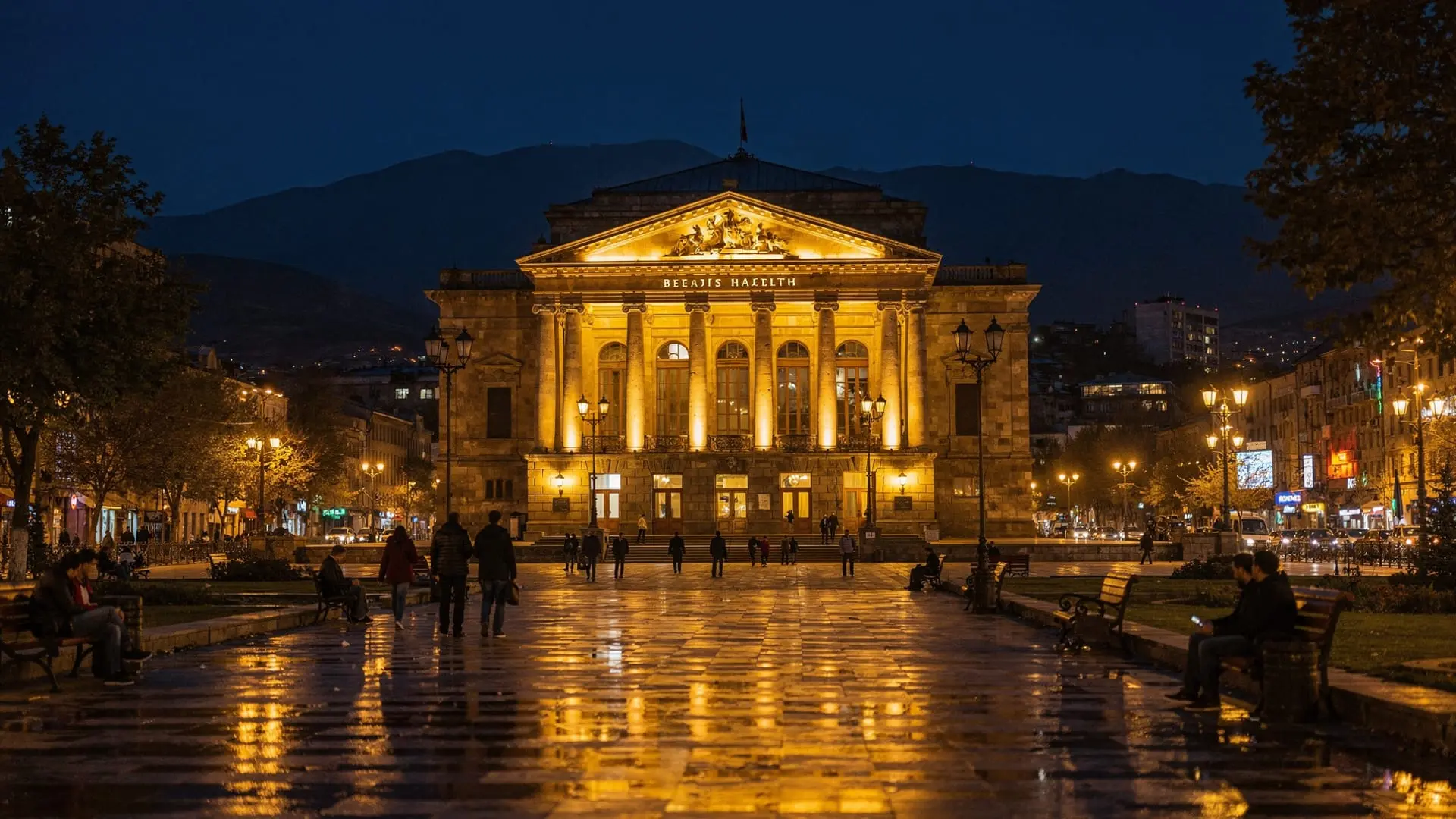
An evening at the heart of Yerevan
There is a particular pleasure in attending the opera or ballet in a city where you did not expect it to be this good. Yerevan is that city. The Spendiaryan Opera and Ballet Theatre — officially the Alexander Spendiaryan National Academic Theatre of Opera and Ballet of Armenia — sits at the southern end of the park between the Republic Square area and the Cascade Complex, in a mid-1930s building that is one of Alexander Tamanyan’s most refined works. The opera house district is in Yerevan’s cultural heart.
Inside, a professional ensemble with decades of training performs opera and ballet to a standard that routinely surprises visitors expecting provincial quality. Ticket prices — starting at around 2,000 AMD (under 5 EUR) for upper-circle seats — make it among the most accessible serious opera and ballet in the world. On a warm September evening, with the park fountains lit outside and the doors of the opera house thrown open for intermission, it is one of the better things you can do with a Yerevan night.
| Where | Aram Street at Sayat-Nova Avenue, ~7 min walk from Republic Square |
| Cost | 2,000–15,000 AMD depending on seat and production |
| Season | September to June; dark July–August |
| Booking | Box office (11 am–7 pm) or theatre website; walk-up often works |
| Dress | Smart casual minimum |
The building: Tamanyan’s most elegant work
Alexander Tamanyan, the architect responsible for the overall plan of modern Yerevan and for Republic Square’s monumental buildings, designed the opera house in the early 1930s. He died before its completion (1939), but the building is considered his most refined achievement — more graceful than the grand civic buildings of Republic Square, more intimate in scale.
The exterior is in Tamanyan’s characteristic style: a colonnade of pink tuff stone pillars, neoclassical proportions, and ornamental details drawn from medieval Armenian architectural motifs. The curved south facade faces the park that stretches north toward the Cascade; the building sits in a formal garden with fountains and benches that becomes a promenade space on performance evenings.
The interior is understated by European opera house standards — no gilt excess, no chandeliers of operatic scale — but the wood-panelled auditorium has excellent acoustics and a strong sight-line design. The upper circle is surprisingly good acoustically; the stalls are intimate. Capacity is approximately 1,200.
The company and its repertoire
The Spendiaryan Theatre has operated continuously since 1933, through the Soviet period and independence. The company maintains a permanent ensemble of soloists, a chorus, and the Armenian Philharmonic Orchestra, which also performs standalone concerts.
The repertoire is international standard: Verdi, Puccini, Mozart, and Donizetti in the opera programme; Tchaikovsky, Prokofiev, and Khachaturian in the ballet. The Aram Khachaturian connection is a point of pride — Khachaturian (1903–1978), the Soviet Armenian composer whose “Sabre Dance” is one of the most recognisable pieces in the classical repertoire, wrote several ballets produced here, and the Yerevan company retains particular expertise in his work. “Gayane” (the ballet containing the Sabre Dance) and “Spartacus” are produced with a fidelity and physical energy that reflects genuine institutional history with the material.
Armenian opera — the works of Alexander Spendiaryan (after whom the theatre is named), Armen Tigranian, and others — appears on the programme less frequently but is worth attending if a run coincides with your visit. Spendiaryan’s “Almast” is the national Armenian opera; productions tend toward the elaborate.
The ballet is generally the stronger half of the programme. The Yerevan ballet company has produced internationally touring soloists and maintains a technique standard that reflects the Soviet classical training tradition at its best. Attending “Swan Lake,” “The Nutcracker,” or a Khachaturian ballet here is more rewarding than the tourist-grade opera productions sometimes found in comparable venues elsewhere in Eastern Europe.
Season and what’s on
The season runs from September to June. July and August are dark (the company takes summer break). This should factor into your visit planning: Yerevan in July and August has no opera or ballet.
The programme is published on the theatre’s official website (in Armenian and partial English). Productions typically run in series of 3–5 performances over a week, so any given work may be playing for only a few evenings during your visit. Checking the current schedule before arriving in Yerevan and booking ahead is strongly recommended for specific productions.
Typical monthly programming:
- 4–6 different productions per month, each running 1–3 performances
- Mix of opera and ballet throughout the season
- Occasional guest soloists from Russia, France, and Italy
- Gala concerts and Armenian composer evenings, usually 1–2 per month
Tickets and booking
Ticket prices: 2,000–15,000 AMD depending on seat category and production. Upper circle starts around 2,000 AMD; stalls are 6,000–12,000 AMD; premium stalls for gala productions reach 15,000 AMD. At April 2026 exchange rates (410 AMD = 1 EUR), even premium tickets cost under 40 EUR. This is exceptional value by European or North American opera standards.
Booking: Tickets are available at the theatre box office (open 11 am–7 pm on performance days, 11 am–5 pm on non-performance days), at select Yerevan ticket outlets, and through the theatre’s website. Online booking in English is available but can be unreliable for credit card processing from foreign banks; buying at the box office is straightforward.
Last-minute availability: For many productions, tickets are available at the box office on the day of performance. If you are flexible about which production to see, walking up to the box office 2–3 hours before curtain often yields good seats. The exceptions are major gala performances and productions featuring internationally known guest artists, which sell out days in advance.
Dress code: Smart casual is the minimum; evening dress is worn by some Armenian patrons for gala performances. The standard for most evening performances is business casual — no shorts, no trainers. Arriving in a jacket or dress is entirely appropriate.
What to do before and after the performance
The opera house sits in a park with fountains that runs between Republic Square to the south and the Cascade area to the north. On performance evenings, the park is animated — families, couples, and pre-theatre diners take the air. The routine of a good Yerevan opera evening:
Before: Dinner at one of the restaurants on Mashtots Avenue (Mashtots Alley, a pedestrianised street parallel to Mashtots Avenue, has several good options including Gusto for contemporary Armenian cooking). Allow 90 minutes for dinner before a 7 pm curtain.
Intermission: The theatre’s bar-café is open during intermission. In warm weather, the front colonnade is opened and patrons spill onto the steps and into the garden. The intermission architecture of an Armenian opera evening is more social than in most European contexts.
After: The cafes around the opera house are busy until midnight. In summer, the Cascade terraces are a 10-minute walk north and still animated at 10:30 pm.
The Magic and Secrets of Yerevan Walking TourAram Khachaturian and the cultural significance
The opera house is physically adjacent to the Aram Khachaturian Concert Hall and the statue of the composer, making this corner of Yerevan specifically associated with Armenian classical music. Khachaturian’s international fame — his works are performed worldwide — gives the local performing arts scene a connection to the global classical repertoire that is sometimes missing in smaller national capitals.
The “Sabre Dance” (from the ballet “Gayane,” 1942) is probably the most widely recognised piece of music associated with Armenia by international audiences; attending a production of “Gayane” or “Spartacus” in the theatre where the composer is honoured on the surrounding streets has a particular resonance.
Frequently asked questions about the Yerevan Opera House
Can I visit the opera house if I do not have tickets?
The exterior is public space at all times. The lobby and foyers are accessible to ticket holders before performances and during intermission. Organised backstage tours are occasionally available through cultural agencies; ask at the box office or through guided city tour operators.
Are subtitles available for non-Armenian speakers?
Subtitles in Armenian appear for foreign-language productions; English subtitles are not standard. For opera productions in Italian or Russian, the libretto is the guide; for ballet, language is not relevant. The theatre sometimes provides English programme notes; ask at the box office.
Is the Yerevan opera house comparable to European opera houses?
For ballet, yes — the technical standard is consistently high. For opera, the comparison is more nuanced: the ensemble is strong for core repertoire but lacks the international soloist depth of Vienna, Milan, or Paris. For the price point (tickets at 5–40 EUR), the quality is exceptional. For music professionals, the level is genuinely impressive; for non-specialist visitors, the question is irrelevant — a Yerevan “Swan Lake” is a beautiful evening.
What is the opera house address?
The Spendiaryan Opera and Ballet Theatre is on Aram Street at the corner of Sayat-Nova Avenue, approximately 7 minutes’ walk north of Republic Square along the park. It is easy to find — the colonnade is visible from a distance.
What if there are no performances during my visit?
If visiting in summer (July–August) or if the schedule does not suit your dates, the Aram Khachaturian Concert Hall (adjacent, same artistic direction) runs a concert programme that sometimes continues into summer. The Malkhas Jazz Club on Pushkin Street is the best live music alternative — Armenian and international jazz, open most evenings.
Are there performances specifically featuring Armenian music?
Yes, typically 1–2 per month during the season. Armenian classical composers (Khachaturian, Komitas, Spendiaryan) and Armenian folk music arrangements appear in gala concerts and themed evenings. These are worth attending if your visit coincides — they offer a different experience from the international repertoire and more direct connection to Armenian musical heritage.
What should I do near the opera house if there’s no performance on?
Walk the surrounding park and fountains, then head either 7 minutes south to Republic Square or 10 minutes north to the Cascade Complex — both are free and open regardless of the theatre’s schedule. In the evening, the Yerevan nightlife guide covers the wine bars and jazz clubs within the same walkable radius.
The season in detail: September to June
The Spendiaryan Theatre’s season structure follows a pattern familiar from European houses but with Armenian rhythms:
September: Opening month. The company tends to open with flagship productions — Swan Lake and Spartacus are common September choices because they guarantee full houses after the summer break. Guest soloists from Russia or France often appear in the first weeks.
October–November: The most varied programming. New productions and revivals alternate with the Khachaturian-focused repertoire. The Ararat Wine Festival in early October means an influx of visitors who have not planned for the opera — if you are coming for Areni, check the theatre schedule and add an evening in Yerevan.
December: Pre-New Year gala performances, often featuring Armenian folk-classical crossover. The theatre’s New Year production (usually The Nutcracker) is the highest-demand performance of the year — tickets sell out 3–4 weeks in advance.
January 6 — Armenian Christmas: Special concert programming around the Armenian Christmas (Surb Dzrnund). Worth attending if in Yerevan; the cultural atmosphere is unique.
February–March: Deepest winter, lowest tourist numbers. This is actually an excellent time to attend — prices unchanged, crowds minimal, and the experience of an opera house that is half-filled with Yerevan regulars rather than tourists has its own character.
April–June: The season’s final stretch. April 24 (Genocide Remembrance Day) typically sees a commemorative concert, sometimes at the opera house, sometimes at Tsitsernakaberd. May and June programming runs until mid-June, after which the theatre closes for its summer recess.
Five productions worth planning around
If you can align your Yerevan visit with specific productions, these are the ones most worth prioritising:
Spartacus (Khachaturian): The Yerevan company’s signature ballet. Khachaturian wrote Spartacus in 1954 and it was premiered in Leningrad; the Yerevan production maintains a physical intensity and ensemble precision that reflects the company’s institutional pride in the work. The famous “Adagio of Spartacus and Phrygia” — one of the most beautiful moments in 20th-century ballet music — lands differently when performed by Armenian dancers in the city where Khachaturian grew up.
Gayane (Khachaturian): The earlier Khachaturian ballet (1942), source of the “Sabre Dance.” Full productions of Gayane are rarer than Spartacus in the international repertoire, which makes Yerevan one of the better places in the world to see it staged completely. The Armenian folk dance elements within the choreography have particular resonance here.
Almast (Spendiaryan): The national Armenian opera, composed by Alexander Spendiaryan (1871–1928), after whom the theatre is named. Productions are occasional rather than regular — perhaps once or twice a season. Almast is based on an Armenian epic poem; the orchestration reflects Spendiaryan’s synthesis of Russian Romantic opera style with Armenian folk melodies. Attending this is a genuine insight into Armenian national cultural identity.
Swan Lake (Tchaikovsky): The company’s technical benchmark. The Yerevan ballet has produced internationally competitive Swan Lake productions since the Soviet era, and the corps de ballet’s training standard shows in the white acts. If you have seen Swan Lake at Covent Garden or the Bolshoi, the Yerevan version is smaller in scale but not in quality — and at a tenth of the ticket price.
Gala evenings (Armenian composers): The 1–2 monthly gala concerts featuring Khachaturian, Komitas, and Spendiaryan alongside Armenian folk music are not to be underestimated. These evenings can include the duduk (the Armenian double-reed instrument, UNESCO intangible heritage) alongside the orchestra, creating a sound that is unique to this part of the world.
Seat categories at a glance
| Seat category | Approx. price | What you get |
|---|---|---|
| Upper circle | ~2,000–3,500 AMD | Good acoustics, distant view; best value |
| Mid stalls | 6,000–9,000 AMD | Balanced sightline and price |
| Premium stalls | 10,000–15,000 AMD | Closest to the stage; gala productions |
| Gala/guest-artist premium | up to 15,000+ AMD | International soloists, New Year performances |
Even the top end of this range is under 40 EUR at April 2026 exchange rates — exceptional value compared with equivalent seats in Vienna, Milan, or Paris.
Tamanyan’s architecture: a closer look
Alexander Tamanyan (1878–1936) was the dominant architect of Soviet-era Yerevan, responsible for the city’s overall master plan, the Government House on Republic Square, and the opera house. He worked primarily in what is sometimes called “Armenian classical style” — a synthesis of neoclassical European forms with decorative motifs drawn from medieval Armenian architecture: interlaced stone knotwork patterns, deeply carved column capitals referencing Urartu and medieval Christian iconography, and the characteristic pink-to-orange tufa stone that gives Yerevan its nickname, the “Pink City.”
The opera house, begun in 1932 and completed in 1939 (three years after Tamanyan’s death), is his most refined work. The circular plan — unusual for opera houses, which are conventionally rectilinear or horseshoe-shaped — creates a curved colonnade that wraps around the park-facing south elevation. The columns are smooth, Doric in proportion, but with Armenian decorative bands at the capitals. At dusk, when the theatre is lit for a performance and the park fountains are running, the composition feels almost as if a piece of ancient Armenia has been transported to the 20th century.
The interior is deliberately understated: dark wood panelling, modest plasterwork, and a ceiling that achieves good acoustic diffusion without the elaborate gilt decoration of its European counterparts. Tamanyan apparently believed that the music should be the spectacle, not the room — and the acoustics bear this out.
Pre-show dinner: where to eat near the opera
The opera house is on Aram Street, a short walk from several excellent restaurants. Practical suggestions:
Gusto (Abovyan Street, 10 minutes’ walk): Contemporary Armenian cooking with good wine list. Reservations recommended for weekend evenings. Budget 8,000–15,000 AMD per person with wine.
Sayat-Nova (Sayat-Nova Avenue, 5 minutes): Traditional Armenian cuisine in a slightly formal setting appropriate for a theatre evening. Excellent khorovats, good wine selection. Moderate pricing (6,000–10,000 AMD per person without wine).
Wine Republic (Mashtots Avenue area): Predominantly wine-focused, good mezze, no loud music — the right place for a quiet pre-show conversation. 8,000–14,000 AMD per person.
The fountained park between the opera house and Republic Square has several outdoor cafés that are pleasant for a coffee or glass of wine before curtain in warm months (May–September).
Yerevan: Highlights and Culture Walking Tour with Tastings Wine, Jazz and Magic: A Night at Malkhaz Jazz ClubCombining an opera evening with the rest of Yerevan
The opera house sits at the midpoint between two of Yerevan’s other major landmarks, which makes it easy to build a full day around a performance. Start the afternoon at Republic Square, 7 minutes south, for the pink-tuff architecture and, if it’s the right season, the evening fountain show can bookend a pre-theatre stroll. Walk north instead and the Cascade Complex is about 10 minutes away — a natural afternoon stop before dinner and curtain. Charles Aznavour Square, a small plaza with a statue of the French-Armenian singer, sits roughly midway and is worth a five-minute detour.
For visitors staying multiple nights in Yerevan, pairing an opera evening with the city’s broader nightlife scene — a late cocktail at +374 or a nightcap on the Cascade terrace — extends the evening naturally once the curtain falls.