Yerevan's Republic Square: history & visitor guide
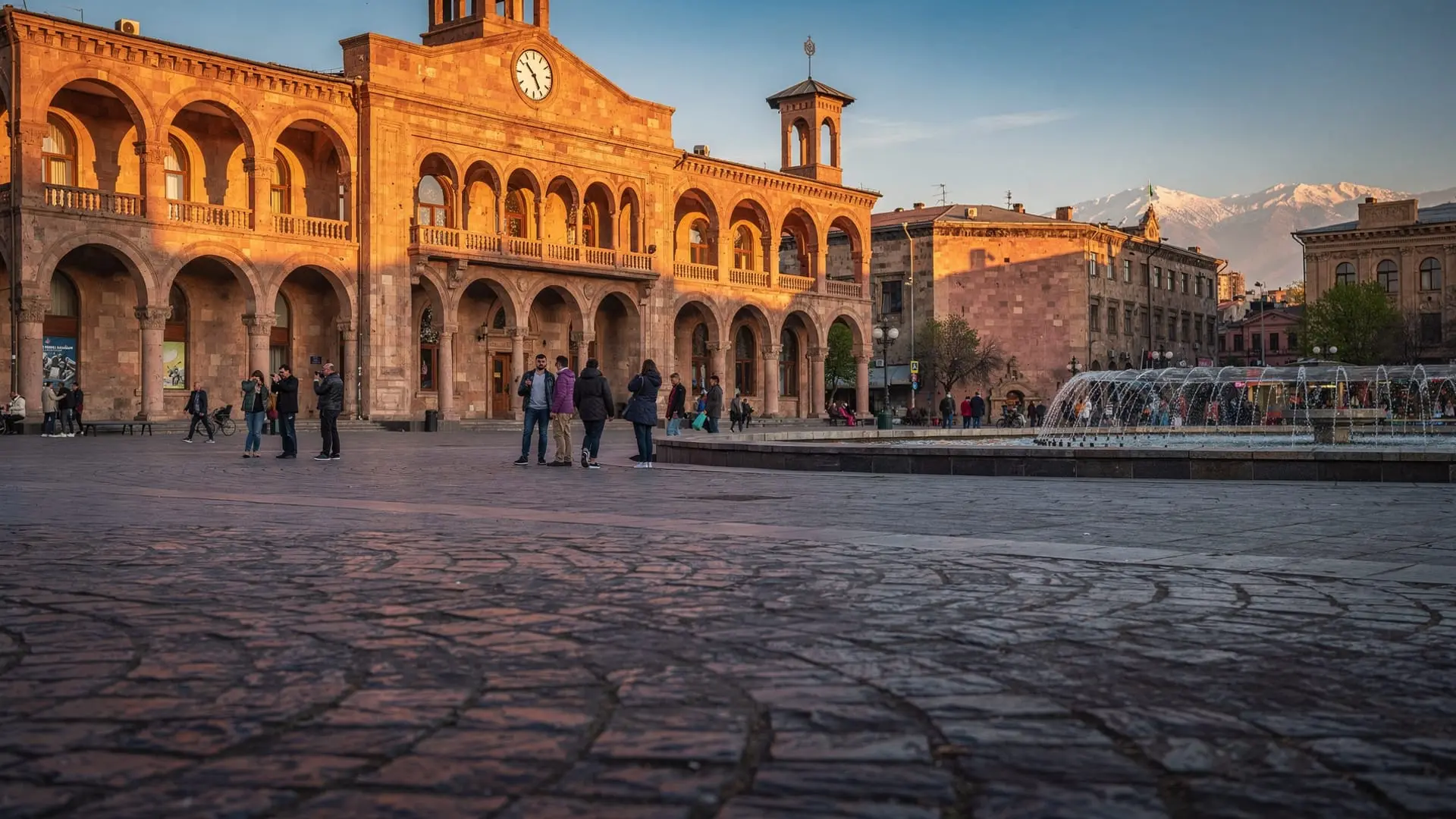
The heart of a city built in pink stone
There is a moment, arriving at Republic Square for the first time, when Yerevan stops feeling like a place you have read about and becomes real. The arc of buildings in honey-coloured pink tuff stone, the twin jets of the fountains catching the evening light, the cafes spilling onto the wide travertine paving — it all coheres into something that is unmistakably itself. No other capital in the Caucasus has a central square that feels this considered.
Republic Square (Hanrapetutyan Hraparak in Armenian) is the ceremonial and civic core of Yerevan. It is where state parades march, where the fountains dance on summer evenings, and where Yervanites walk just to be among other Yervanites. For the visitor it is the natural starting point for every day in the city — and a landmark worthy of time on its own terms.
| Where | Central Yerevan, terminus of Northern Avenue |
| Cost | Free; History Museum/National Gallery ~1,500 AMD each |
| Time needed | 20–30 min for the square alone; add 2–3 hrs for the museums |
| Getting there | Hanrapetakan Hraparak metro (red line) or a short walk from most central hotels |
| Best time | Early morning for photos; ~8:45–10 pm summer for the fountain show |
Alexander Tamanyan and the pink tuff vision
The square’s origins lie in a single architect’s ambition. Alexander Tamanyan, the most significant figure in Armenian urban planning, drew his first sketches for a rebuilt Yerevan capital in 1924. The Russian tsarist city he inherited was a dusty provincial town of 30,000. His plan imagined a semicircular square of monumental public buildings aligned on a central axis, all clad in the pink and rose-tinted volcanic tuff stone quarried from the mountains around Yerevan.
Construction began in earnest during the 1930s and continued through to 1958. The result is one of the most coherent examples of Soviet-era monumental architecture in the South Caucasus — but it is Armenian rather than Stalinist in character. Tamanyan drew explicitly on medieval Armenian decorative motifs: the carved stone ornaments, the arched colonnades, and the proportional rhythms of monasteries like Geghard and Haghpat. Look closely at the facades and you will find rosette patterns and interlaced geometric forms that would not be out of place on a 13th-century khachkar.
Five major buildings frame the square, arranged in an extended arc around the central fountains:
- History Museum of Armenia and National Gallery — the twin-institution northern anchor, the most visited building on the square
- Government House No. 1 — the seat of the Armenian prime minister’s office, on the eastern side
- Armenia Marriott Hotel (formerly the Hotel Armenia) — occupying the western flank, a recognisable yellow-pink mass
- Ministry of Foreign Affairs building — southeastern corner
- Post Office building — completing the arc to the south
Each building was designed by Tamanyan or his close collaborators, using variants of the same architectural vocabulary. The effect is unusually unified for a construction project spanning three decades.
The History Museum and National Gallery
The most rewarding building to enter on Republic Square is the combined History Museum of Armenia and National Gallery, occupying the northern wing behind the main fountain basin. Both institutions share the building but have separate entrances and ticket desks.
The History Museum traces Armenian civilisation from the Palaeolithic to the 20th century across four floors. The Urartu collection — bronze weapons, ceremonial helmets, carved stone inscriptions from the kingdom that would give Yerevan its name (Erebuni, 782 BCE) — is the star attraction. Urartian goldsmithing, in particular, is extraordinary: delicate filigree work from a culture that flourished around Van and the Ararat plain from the 9th to 6th centuries BCE. Admission is around 1,500 AMD (under 4 EUR at April 2026 rates).
The National Gallery focuses on Armenian and European fine art from the 17th to 20th centuries. The Armenian wing is strongest: Vardges Sureniants, Martiros Saryan (whose vivid, almost Matisse-like colours are the opposite of what you might expect from a mountainous country), and Hakob Kojoyan. Entry is also around 1,500 AMD; a combined ticket saves a small amount.
Set aside a full morning for both institutions if art and archaeology interest you. The History Museum alone repays two hours of attention. If you are short on time, the Urartu room and the Saryan canvases are the non-negotiables.
The dancing fountains
The fountains in the central basin of Republic Square are one of Yerevan’s best-known evening spectacles, and entirely free. The “dancing” refers to a choreographed water and light show — jets of water pulse and sweep in patterns synchronised to music, which ranges from Armenian folk songs to classical Armenian composers. On warm evenings the surrounding travertine fills with families, couples, and groups of teenagers. It is unselfconsciously festive.
The show runs every evening from approximately 9 pm to 11 pm during summer, typically late May through September. In spring and autumn the fountains operate but without the choreographed show. In winter they are usually drained and switched off. The best vantage point is from the History Museum steps, elevated enough to see the full basin, or from the terrace of the Marriott if you are willing to pay for a drink.
The original fountain design dates from the 1950s but has been rebuilt and upgraded multiple times; the current LED and projection system was installed in the 2010s.
Practical visitor information
Getting there: Republic Square is the terminus of the main pedestrian axis of Yerevan, Northern Avenue. From the Cascade Complex it is a 15-minute walk south along Tamanyan Street. The Metro’s Hanrapetakan Hraparak station (red line) delivers you directly to the square’s perimeter. From most central hotels you are within walking distance.
When to go: Any time of day works, but the square has three peak moments. Early morning (before 9 am) it is almost empty and the pink stone glows in the low light — the best time for photographs. Midday it fills with office workers and tourists. Evening, from around 8 pm, is the liveliest; arrive by 8:45 pm if you want a good position for the 9 pm fountain show.
Cafes and restaurants: The square is ringed by cafes, most of them expensive by Yerevan standards and average by any other. Avoid the white-tablecloth restaurants directly on the square itself — they trade on location rather than quality. Better options are a five-minute walk: Lavash restaurant on Tumanyan Street for traditional Armenian, or Gusto around the corner on Abovyan Street for something more contemporary.
Combining with other sites: Republic Square is within easy walking distance of the Vernissage flea market (Saturday–Sunday, across the road), the Matenadaran (uphill to the northwest, 20-minute walk), the Parajanov Museum (10 minutes east), and the Cascade Complex (15 minutes north). A half-day circuit on foot can cover all of them at a comfortable pace.
The square in Armenian political life
Republic Square is not merely picturesque. It has been the stage for the defining moments of modern Armenia’s political history. In 1988, one million people gathered here in the final years of the Soviet Union to demand recognition of the Nagorno-Karabakh issue — at the time the largest demonstration in Soviet history. In 1991, Armenians voted for independence and celebrated in the square. In 2018, the square hosted the peaceful mass demonstrations of the Velvet Revolution, which brought Nikol Pashinyan to power.
Standing on the travertine paving with the fountain jets rising around you, that weight of history is easy to overlook. But it is there, woven into the stone.
Yerevan: Erebuni, Matenadaran, and Cascade City TourDay-trip context: what else is nearby
If Republic Square is your first stop in Yerevan, it pays to plan the rest of the day around it. The city radiates outwards from the square in a way that makes walking logical.
Heading north up Mashtots Avenue brings you to the opera house (the Yerevan Opera and Ballet Theatre) within five minutes. Continue to Tamanyan Park and the Cascade Complex is another 10 minutes. East along Abovyan Street leads to the bohemian cafe district of Saryan Street and eventually to the Parajanov Museum. West along Tigranyan leads eventually to the Ararat brandy factory and the Genocide Memorial at Tsitsernakaberd — though that is a longer walk or better by GG Taxi.
For a structured introduction to the city combining Republic Square with the other major landmarks, the guided walking tours departing from the square each morning are a reliable option.
Yerevan: Walking Tour with a Local GuideSoviet modernism and what came after
Republic Square belongs to the first phase of Tamanyan’s vision — monumental, classicising, confident. But walk five minutes in any direction and you enter a different architectural register: the brutalist concrete of the Soviet modernism era from the 1960s and 1970s, which sits in sometimes jarring contrast to the pink tuff.
This architectural tension — between Tamanyan’s romantic nationalism and the harsher utilitarian modernism that followed — is one of the defining visual arguments of Yerevan as a city. Republic Square won that argument, at least aesthetically. It remains the image of Yerevan that appears on every postcard, the backdrop to every official photograph, the place that visitors return to on their last evening to say goodbye to the city.
Understanding it fully means reading it as an act of cultural assertion — the decision, made under Soviet rule but shaped by Armenian architects and Armenian stone, to build a capital that looked undeniably Armenian.
A full day built around Republic Square
Because Republic Square sits at the geographic and symbolic centre of Yerevan, it works well as the fixed point of an entire day rather than a single stop. A realistic plan:
Morning: Arrive before 9 am while the square is quiet and the light is best for photographs, then spend an hour or two in the History Museum and National Gallery.
Midday: Walk 10 minutes east along Abovyan Street to Charles Aznavour Square and the bohemian cafés around Saryan Street for lunch, or continue further to the Vernissage flea market if it’s a weekend.
Afternoon: Head north on Mashtots Avenue to the Yerevan Opera and Ballet Theatre, about 7 minutes’ walk, then continue to the Cascade Complex for the sculpture garden and art galleries.
Evening: Return to Republic Square by 8:45 pm in summer for the dancing fountain show, then move on to dinner or the bars covered in the Yerevan nightlife guide.
This loop covers most of central Yerevan’s essential sights within a comfortable walking radius of the square, with the fountains as a natural closing act to the day.
Frequently asked questions about Republic Square
Is Republic Square free to visit?
Yes, the square itself is entirely free and open at all times. The fountain shows are free. The History Museum and National Gallery inside the northern building charge separate admission (around 1,500 AMD each, roughly 3.60 EUR at April 2026 rates).
What is the square made of?
The buildings are faced with volcanic tuff stone quarried near Yerevan — a soft, porous stone that ranges in colour from pale yellow to deep rose-pink. The paving is travertine marble. Both materials are characteristic of Yerevan architecture and give the city its warm, honeyed colour.
Can I photograph the square at night?
Yes, and night photography is particularly rewarding during the fountain show when the water is lit with coloured LEDs. Tripods are permitted in the open square. Photographing the Government House (east side) close up may attract attention from security guards; photograph from the fountain side and you will have no issues.
How long should I spend at Republic Square?
Twenty to thirty minutes is enough to walk the perimeter and absorb the architecture. Add two to three hours if you plan to visit the History Museum or National Gallery. Arrive around 8:30 pm on a summer evening and plan to stay until 10 pm for the best fountain experience.
Are there Soviet mosaics or artworks inside the buildings?
The most accessible interior with Soviet-era art is the Metro station below the square — Hanrapetakan Hraparak station has bas-relief panels and mosaic work worth a look even if you are not travelling by metro. The History Museum has Armenian archaeological art; Soviet-era decorative panels appear in the government buildings but those are not open to the public.
Is the Vernissage market near Republic Square?
Yes, the Vernissage weekend market runs in the park immediately adjacent to the square on Saturday and Sunday. See the Vernissage guide for what to buy, what to avoid, and how to bargain.
What is the best hotel near Republic Square?
The Armenia Marriott occupies the western face of the square itself — the most atmospheric address, though priced accordingly. Mid-range options within a five-minute walk include Republica Hotel on Abovyan Street and several boutique guesthouses on Nalbandyan. The square is well served by Yerevan’s walkable centre, so almost any central accommodation puts you close.
What else is within easy walking distance of Republic Square?
Quite a lot. Charles Aznavour Square and the Yerevan Opera and Ballet Theatre are both under 10 minutes on foot, the Cascade Complex is about 15 minutes, and the Vernissage market sits right beside the square on weekends. Most visitors can cover all of them in a single well-planned day.