Armenia visa requirements 2026: by nationality
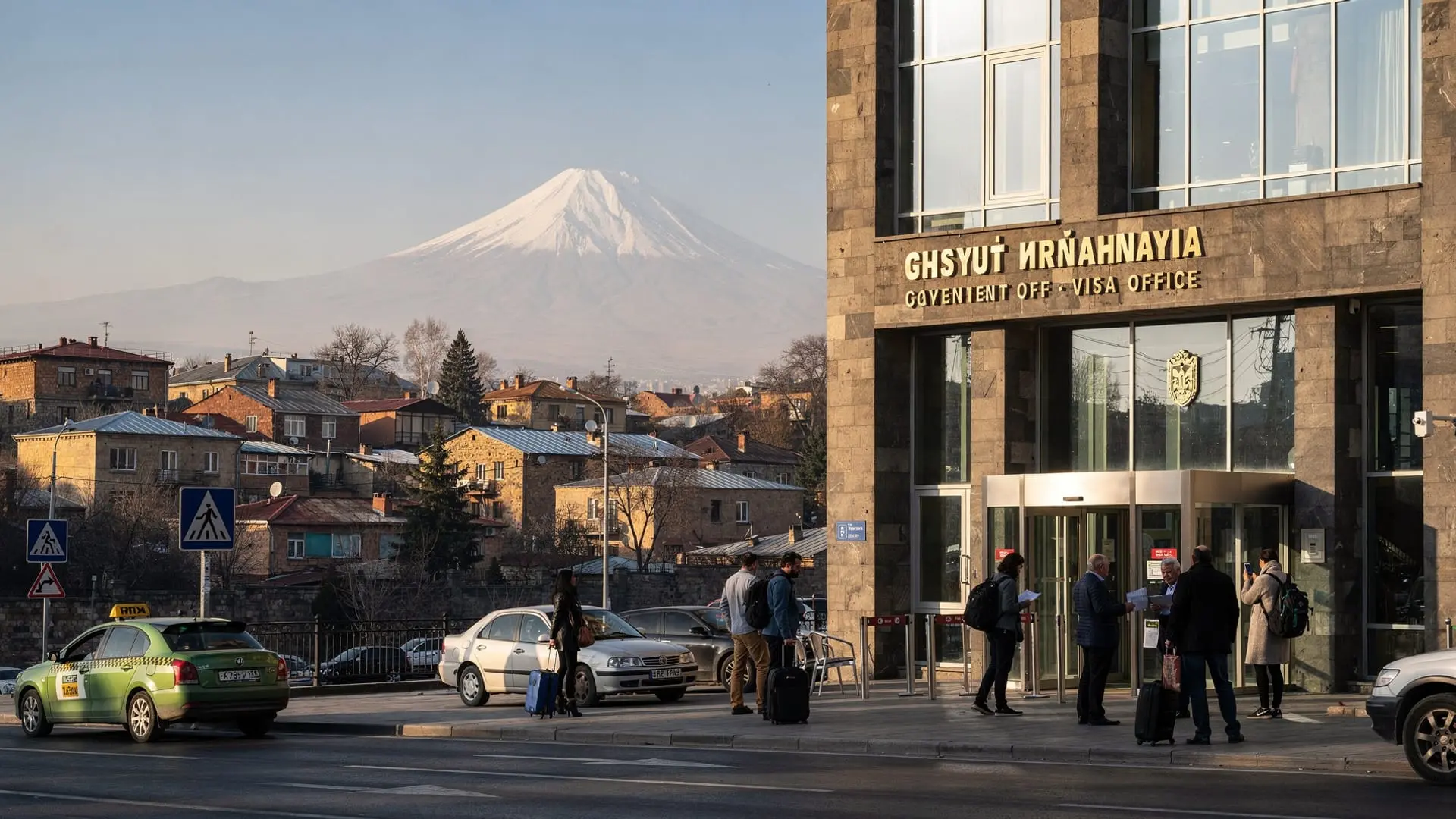
Who can enter Armenia without a visa
| Visa-free | EU, UK, US, Canada, Australia, Switzerland, Japan, South Korea — 180 days |
| e-Visa | around 39 other nationalities, evisa.mfa.am, ~$30–90 |
| Processing | 3 business days standard; 1 day express |
| Closed borders | Turkey (since 1993), Azerbaijan (since 1991) |
| Open borders | Georgia (3 crossings), Iran (Meghri–Norduz) |
Armenia has one of the most open visa policies in the Caucasus. Citizens of the following countries can enter and stay for up to 180 days in any 365-day rolling period without any pre-arranged visa or registration requirement:
- European Union — all 27 member states
- United Kingdom
- United States
- Canada
- Australia
- Switzerland
- Japan
- South Korea
If you hold a passport from any of these countries, you need nothing more than a valid travel document. Armenia does not stamp a mandatory entry/exit card. The 180-day count resets each rolling year, not each calendar year — keep that in mind if you plan multiple visits.
Russian citizens and most CIS countries can enter with a national ID card rather than a passport. This group is outside the primary scope of this guide, but it’s worth noting for travelers who may be crossing from Georgia with Russian companions.
Passport validity
Armenia requires your passport to be valid for the duration of your intended stay. There is no formal “six months validity” rule that many other countries impose, but it is good practice to have at least three months of validity beyond your planned departure date.
e-Visa: who needs one and how to apply
Nationals of approximately 39 countries that are not on the visa-free list can apply for an e-Visa through Armenia’s official Ministry of Foreign Affairs portal at evisa.mfa.am. This is the only official channel — do not use third-party “visa agencies” that charge inflated fees for the same service.
e-Visa costs (as of April 2026)
| Type | Duration | Fee |
|---|---|---|
| Single-entry, 21-day stay | 120 days from issue | approx. $30 |
| Single-entry, 120-day stay | 120 days from issue | approx. $65 |
| Multiple-entry, 120-day stay | 365 days from issue | approx. $40 |
| Multiple-entry, 365-day stay | 365 days from issue | approx. $90 |
Fees are indicative as of April 2026 — verify the current schedule on the official portal before applying. Payment is made by credit card. Processing takes 3 business days for standard applications and 1 business day for express (with an express fee).
e-Visa application checklist
- A valid passport scanned as a JPEG or PDF
- A passport-size photo meeting the specified dimensions
- Your travel itinerary (dates, accommodation address)
- A credit or debit card for payment
- An email address to receive the e-Visa document
Print or download your e-Visa to your phone before travelling. Border officers at Zvartnots Airport will ask to see it alongside your passport.
Visa on arrival
Armenia also offers visa on arrival at Zvartnots International Airport (EVN) for most nationalities not already covered by the visa-free or e-Visa scheme. The process involves filling in a form at the visa desk before passport control and paying in cash (USD or EUR accepted). Processing takes 15–30 minutes during off-peak hours but can be slower on busy international arrival waves.
If you are eligible for an e-Visa, applying in advance is strongly recommended — it saves time at arrival and provides certainty.
Closed borders: Turkey and Azerbaijan
Two of Armenia’s four neighbours have closed borders that travellers cannot legally cross:
- Turkey: The Turkey–Armenia land border has been closed since 1993. There are no direct overland crossings available to anyone. If you are travelling between Turkey and Armenia, you must fly (Istanbul or Ankara to Yerevan Zvartnots, or via a connecting hub).
- Azerbaijan: The border has been closed since 1991. Do not attempt to cross.
Having an Armenian entry stamp in your passport was historically a complication for travel to Azerbaijan. This situation evolves — check current guidance from your country’s foreign ministry if you plan to visit both countries in a single trip. Given the current state of the peace process, most travellers planning a Caucasus trip that includes both countries choose to visit Azerbaijan first if it is on the itinerary at all, precisely to sidestep this uncertainty.
Open borders: Georgia and Iran
Georgia is the most popular land crossing. Three official points connect Armenia with Georgia:
- Bagratashen–Sadakhlo (main route, north of Yerevan via the M6): the busiest crossing, open 24/7. Used by marshrutkas running Yerevan–Tbilisi daily. Drive time Yerevan to Tbilisi: approximately 6 hours including the crossing.
- Bavra–Ninotsminda: a secondary crossing in Shirak province, quieter, used by those heading to Akhalkalaki.
- Gogavan–Guguti: a minor crossing in Lori province.
For more on the overland route, see our Yerevan to Tbilisi overland guide.
Iran borders Armenia in the far south at the Meghri–Norduz crossing, near Kapan in Syunik province. This is theoretically accessible but is outside the scope of mainstream independent travel. Overlanders and experienced independent travellers should consult specialist resources and current FCO/State Department advisories.
Entry at Zvartnots Airport
Zvartnots International Airport (IATA: EVN) in Yerevan is the main point of entry for international visitors. Direct flights operate from:
- Paris CDG
- Vienna
- Rome FCO
- Amsterdam
- Frankfurt
- Athens
- Dubai, Abu Dhabi (Middle East connections)
- Moscow, Saint Petersburg (suspended or limited as of 2026 — verify)
The airport is modern and relatively efficient for a mid-sized international hub. Passport control queues at peak hours (evening arrivals from Europe) can take 20–40 minutes. There is no e-gate system; all passports are processed manually.
After clearing passport control, you will reach the arrivals hall with ATMs (use Inecobank or ACBA for fair rates), a currency exchange desk (rates are poor — use a bank in Yerevan instead), a SIM card counter, and taxi/transfer services. For stress-free arrivals, pre-booking an airport transfer is worth considering. See our Armenian dram currency guide for ATM and exchange tips, and our GG Taxi guide for the best way to reach the city.
Health requirements and practical entry notes
As of April 2026, Armenia has no mandatory health documentation requirements (no vaccination certificates, no COVID-related forms). This can change — check current requirements with your airline before travelling.
Customs: You may bring personal quantities of alcohol and tobacco without declaration. Amounts exceeding personal use thresholds, or cash above $10,000 USD equivalent, must be declared. Armenian customs authorities do occasionally check bags; declared antique khachkars or cultural items may be subject to export restrictions. Armenian rugs and modern crafts are generally fine to export.
Registration: Visitors staying in hotels, guesthouses, or Airbnb properties registered with Armenian tax authorities are automatically registered by their host. Those staying with private individuals for more than 3 days should technically register with the Police Passport Division, though enforcement for short trips is rare. This is most relevant for long-term visitors.
Digital nomads and remote workers
Armenia has attracted a growing remote worker community since 2020, partly due to its visa-free access for most Western nationals and its relatively low cost of living. See our Armenia budget travel guide for cost-of-living breakdowns. Specific practical points for remote workers:
Tax residency: A stay of 183+ days in a calendar year can trigger Armenian tax residency considerations. Armenian personal income tax on foreign-sourced income is 20%. Consult a tax adviser if you plan to stay 6+ months and work for foreign employers.
The “Republic of Armenia Digital Nomad” status: As of 2026, Armenia does not have a formal digital nomad visa in the way Estonia or Portugal does. Remote workers typically enter on the standard visa-free 180-day allowance and operate informally. This is widely practised and generally unproblematic for short to medium stays.
Coworking spaces in Yerevan: A growing ecosystem of coworking spaces (TUMO Centre, Impact Hub Yerevan, various private spaces near the Cascade and Northern Avenue) provides reliable internet, professional environment, and community. Day passes typically run 5,000–10,000 AMD.
Longer-stay logistics: Remote workers planning 2–6 month stays typically handle the visa side with the standard 180-day visa-free allowance and focus their planning energy instead on accommodation (monthly furnished apartment rentals in Yerevan are widely available and considerably cheaper than short-term booking platforms), mobile data (a local SIM or the Armenia eSIM data guide covers most needs), and banking (opening a local bank account is possible but not necessary for most stays under 6 months — international cards work at the majority of Yerevan merchants).
Entry for families with children
Armenia has no specific additional requirements for families travelling with minors. Children require their own valid passport (or travel document) unless they are on a parent’s passport (uncommon for modern passports). There are no specific consent letter requirements for international travel into Armenia (some countries require these when a child travels with only one parent — Armenia does not impose this at its own borders, but your home country may require it for your child’s departure). Families planning a longer itinerary around these entry basics may find the Armenia family itinerary or the 5-day school holiday trip plan useful for the logistics beyond the border.
Long-term stays and extensions
The 180-day visa-free limit is generous, but travellers planning longer stays have options:
- Leave and re-enter: Departing to Georgia and returning resets the practical clock, though the 180-day-in-365 rolling rule still technically applies.
- Temporary residence permit: Available for those studying, working, or investing in Armenia. Apply through the Police Passport and Visa Department in Yerevan.
- Real estate ownership: Foreign nationals who own property in Armenia can often extend their stay under specific residence provisions. Consult a local lawyer.
For most travellers visiting for tourism, the 180-day limit is more than sufficient — the average trip runs 7–14 days.
Combining Armenia with Georgia: visa logistics
Many visitors combine Armenia with Georgia in a single trip, and the visa logistics are straightforward for most nationalities — Georgia offers similarly generous visa-free access for EU, US, UK, Canadian, and Australian citizens, typically for up to 365 days. The practical sequencing question is which country to enter first: flying into Yerevan and exiting overland via Bagratashen–Sadakhlo to Tbilisi (or the reverse) both work equally well visa-wise, so the decision usually comes down to flight prices and which capital has better direct connections from your home airport. See the Armenia–Georgia combined trip guide and the Georgia border crossing guide for the fuller route planning picture.
What to do before you travel: a pre-departure checklist
If visa-free: Confirm your passport has at least 3 months of validity beyond your planned departure, and that’s genuinely all you need to prepare on the visa front.
If e-Visa required: Apply at least 1–2 weeks before departure to allow for standard processing plus a buffer for any resubmission if your first application is rejected for a fixing-able reason (photo dimensions, name mismatch — both covered below). Download the approved e-Visa PDF to your phone and print a paper copy.
For everyone: Screenshot or print your accommodation address for the first night, since border officers occasionally ask for it even for visa-free entrants. Register for your government’s travel advisory notifications if available, particularly relevant given the Azerbaijan border context described in the Armenia safety guide.
Pre-booked private airport transfer from ZvartnotsFrequently asked questions about Armenia visa requirements
Can I get an Armenian visa at the border if I arrive by car from Georgia?
Yes. The Bagratashen–Sadakhlo crossing offers visa on arrival for most nationalities. However, the process can be slower than at the airport. If you know you will need a visa, apply for an e-Visa before your trip.
Is there a visa fee for EU or US citizens?
No. Citizens of EU member states, the United States, Canada, the United Kingdom, Australia, Switzerland, Japan, and South Korea enter Armenia free of charge and without any visa formalities.
Does Armenia have a tourist tax or entry fee?
No. Armenia does not charge a tourist tax, departure tax, or airport entry fee as a separate charge. Taxes are included in airline tickets.
Can I work or volunteer in Armenia on a tourist visa-free entry?
Technically, visa-free entry is for tourism and visits. Paid employment or long-term volunteer work requires a separate residence permit and work authorisation. Short-term volunteer stints are generally tolerated, but check with the organization you are working with.
My passport has an Israeli stamp — will I have problems entering Armenia?
No. Armenia has good diplomatic relations with Israel and does not refuse entry based on Israeli passport stamps or visas.
What if I overstay the 180-day limit?
Overstaying the visa-free period can result in a fine at departure and complications for future entries. The fine amount varies. It is best to depart before your permitted period expires or to arrange a residence permit if you plan to stay longer.
Is Armenia safe to travel to? Are there any current travel advisories?
Armenia is generally considered safe for tourists. The main area of concern is the border with Azerbaijan, which should not be approached. See our full Armenia safety travel guide for current context and precautions.
Visa requirements by nationality: top 20 source markets
The table below covers the 20 nationalities most commonly travelling to Armenia for tourism (April 2026). Requirements are based on official Armenian MFA policy and may change — always cross-check with the evisa.mfa.am portal before travel.
| Nationality | Entry type | Max stay | Notes |
|---|---|---|---|
| Germany | Visa-free | 180 days | All EU passports |
| France | Visa-free | 180 days | All EU passports |
| United States | Visa-free | 180 days | No registration required |
| United Kingdom | Visa-free | 180 days | Post-Brexit status unchanged |
| Italy | Visa-free | 180 days | All EU passports |
| Spain | Visa-free | 180 days | All EU passports |
| Canada | Visa-free | 180 days | — |
| Australia | Visa-free | 180 days | — |
| Switzerland | Visa-free | 180 days | Not EU, but visa-free |
| Japan | Visa-free | 180 days | — |
| South Korea | Visa-free | 180 days | — |
| Netherlands | Visa-free | 180 days | All EU passports |
| Poland | Visa-free | 180 days | All EU passports |
| India | e-Visa | 120 days | Apply at evisa.mfa.am, ~$65 |
| China | e-Visa | 120 days | Apply at evisa.mfa.am, ~$65 |
| Thailand | e-Visa | 120 days | Apply at evisa.mfa.am |
| Philippines | e-Visa | 120 days | Apply at evisa.mfa.am |
| Brazil | Visa-free | 90 days | MERCOSUR agreement |
| Argentina | Visa-free | 90 days | — |
| Israel | Visa-free | 180 days | No restriction on prior stamps |
For nationalities not listed, check the official Armenian MFA visa tool at mfa.am under “Consular Services.”
e-Visa step-by-step: how to apply
Applying through evisa.mfa.am takes 15–20 minutes if you have your documents ready. Here is what the process looks like:
Step 1 — Choose your visa type. On the portal’s home page, select your nationality from the dropdown. The system will confirm whether you are eligible for e-Visa and display available options: 21-day single-entry, 120-day single-entry, and 120-day multiple-entry.
Step 2 — Fill in your personal details. Name (exactly as in your passport), date of birth, passport number, and passport expiry date. Double-check these — errors cause rejection.
Step 3 — Upload your documents. You will need: (a) a scan of the biographical page of your passport in JPEG or PDF format, under 2 MB; (b) a passport-size photograph (35×45 mm, white background, face clearly visible). The portal provides a photo spec guide — follow it carefully. Blurry or incorrectly cropped photos are the most common cause of rejection.
Step 4 — Enter your itinerary. Planned entry date, planned exit date, and the address of your first night’s accommodation in Armenia. You do not need a confirmed hotel booking — an address is sufficient.
Step 5 — Pay online. Credit or debit card (Visa and Mastercard accepted). The portal uses a secure payment gateway. If your card is declined (some international cards flag the Armenian payment processor as unusual), try a different card or use a card without international transaction restrictions.
Step 6 — Wait for approval. Standard processing is 3 business days. An express option (1 business day) is available for an additional fee. You will receive an email with the e-Visa as a PDF attachment.
Step 7 — Print or download. Border officers at Zvartnots Airport will ask to see the e-Visa alongside your passport. Download it to your phone and also print a paper copy as backup — phone batteries die at inconvenient moments.
Land border crossings: what actually happens
Georgia border (Bagratashen–Sadakhlo): This is the crossing most independent travellers use. Marshrutkas from Yerevan’s Kilikia station (and from Tbilisi’s Ortachala station) stop here — the crossing is built into the route. You present your passport to Armenian immigration on exit (typically 5–10 minutes), walk or take a shuttle 200–300 metres across no-man’s land, and present to Georgian immigration on entry (or Armenian, if arriving). The crossing is open 24/7. For those arriving from Georgia who need an Armenian e-Visa, there is technically visa-on-arrival processing at the border, but it is slower and less predictable than at the airport.
Practical reality: If you need a visa (i.e., your nationality is not visa-free), apply for the e-Visa before your trip. The border visa desk exists but operates with fewer staff, no guaranteed English speakers, and variable wait times. An e-Visa holder walks straight through in minutes.
Iran border (Meghri–Norduz): Open to Armenian and Iranian citizens and to some Western nationalities. The situation changes based on geopolitics — check your government’s travel advisory and the current Iranian visa requirement before planning this crossing. This is not a casual tourist option; it requires advance planning and is appropriate only for experienced independent travellers.
Common e-Visa rejection reasons — and how to fix them
The Armenian e-Visa portal rejects a small percentage of applications. The most common reasons:
Photo dimensions incorrect: The most frequent issue. Many applicants upload a cropped portrait instead of a true passport-size photo with the correct background and dimensions. Use the portal’s photo checker or a pharmacy-style photo service.
Name mismatch: Your name on the application must match your passport exactly, including middle names if they appear in the passport. “John M. Smith” and “John Smith” can cause a mismatch flag.
Passport near expiry: The portal may reject applications if your passport expiry is close to your planned exit date. Armenia has no formal minimum validity requirement beyond your stay, but if your passport expires within 3 months of your planned departure, renew it before applying.
Payment declined: A card that works at home but is blocked for international online transactions is the most common payment issue. Use a bank card with confirmed international online transaction capability, or contact your bank before applying.
Incorrect nationality listed: Some dual-nationality travellers select the wrong passport. The e-Visa is linked to the specific passport number you enter — use the same passport at the border.
If your application is rejected, the portal will usually specify the reason. You can reapply immediately after correcting the issue.
Transfer from Zvartnots Airport to Your HotelDo I need travel insurance to enter Armenia?
No, travel insurance is not a formal entry requirement, though it is strongly recommended for any trip regardless of visa status. See the Armenia safety guide for insurance guidance covering medical evacuation and activity cover.
Can I extend my e-Visa once I’m already in Armenia?
Not directly. e-Visas are issued for a fixed duration and type. If you need to stay longer than your e-Visa allows, the practical options are leaving and re-entering (subject to the visa’s entry count) or applying for a temporary residence permit through the Police Passport and Visa Department before your current visa expires.
Does having visited Nagorno-Karabakh or Azerbaijan affect my Armenia entry?
Armenia does not restrict entry based on prior Azerbaijan travel history in your passport, unlike the historical Armenia-stamp complication for Azerbaijan entry described above. Armenian border officials are focused on your current documents, not your travel history with other countries.