Yerevan to Tbilisi overland: train, bus, taxi or tour?
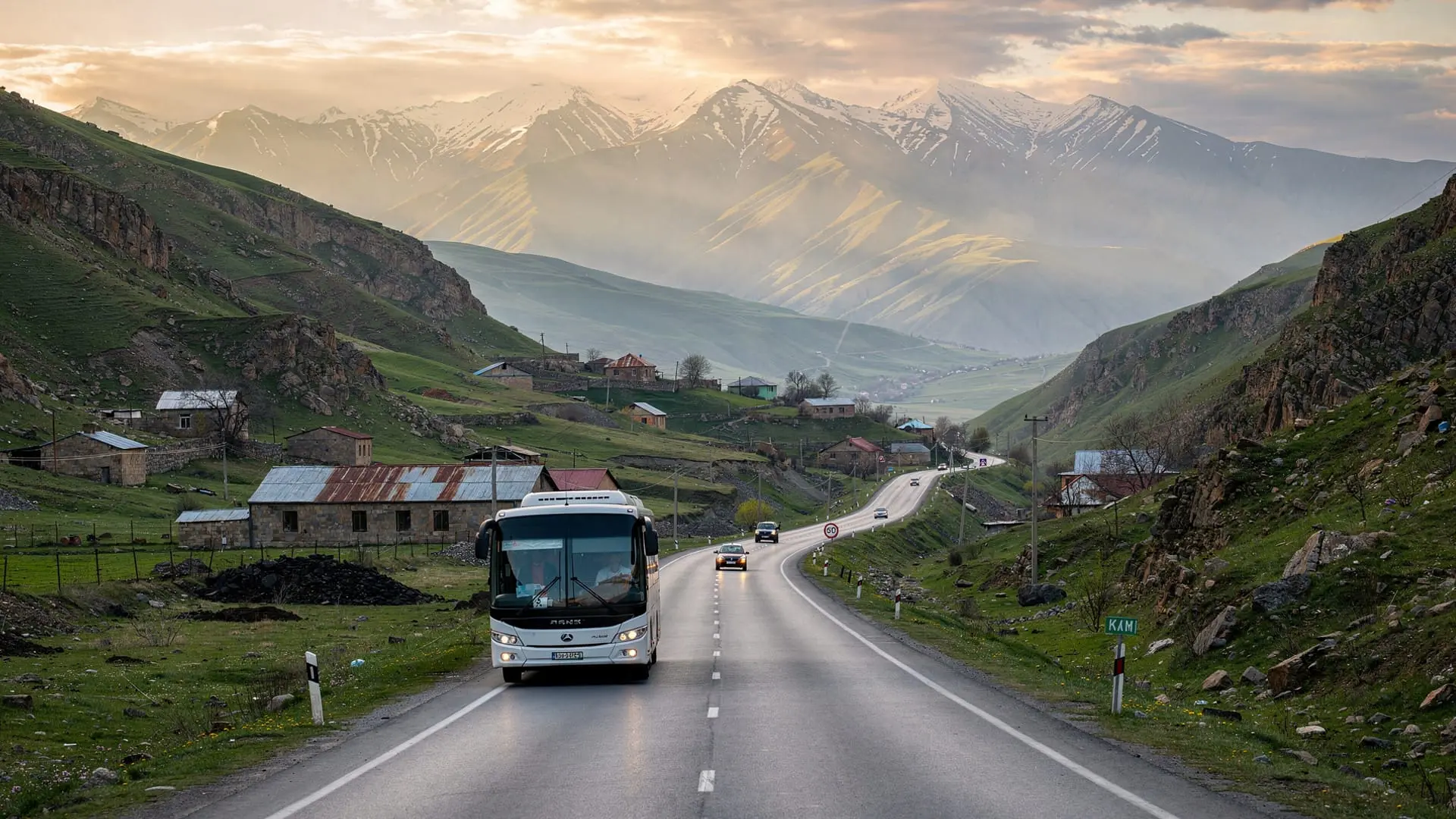
The journey between Yerevan and Tbilisi is the most travelled overland route in the Caucasus — two capitals connected by 270 kilometres of road through the Armenian highlands, the Debed canyon, and the Georgian plains. For travellers combining both countries (which is increasingly popular and highly recommended — see Combining Armenia and Georgia), the transit between them is not just a logistical necessity but part of the experience.
You have four main options: the overnight train, a shared marshrutka (minibus), a private taxi or transfer, or a guided tour that combines sightseeing stops between the two cities. Each has a different character, price point, and comfort level. This guide lays out every option honestly so you can choose based on your actual priorities.
| Where | Yerevan (Sasuntsi David / Kilikia stations) to Tbilisi, via Bagratashen |
| Cost | $30–50 (train) to 100–300 EUR (private/guided) |
| Time needed | 6 hours (marshrutka/private) to 10 hours (overnight train) |
| Getting there | Yerevan’s Kilikia bus station or Sasuntsi David rail station |
| Best time | Book the train 2–3 days ahead in July–August; marshrutka needs no booking |
Option 1: The night train (recommended)
The Yerevan–Tbilisi night train is the most atmospheric way to make this journey. Operated jointly by the Armenian and Georgian railway companies, it departs Yerevan’s Sasuntsi David station at 21:30 and arrives at Tbilisi’s Tbilisi Central station at approximately 07:30 — a 10-hour overnight journey.
What the journey looks like:
- Comfortable 4-berth couchette compartments (platzskart) with fold-down bunks, clean bedding (usually available for a small fee), and a samovar in each carriage for tea.
- The border stop at Bagratashen–Sadakhlo takes place around 1:30–2:30am — passport control comes to the train, you hand over your documents without leaving your bunk in most cases, and the train continues.
- You wake up in Georgia, arriving in Tbilisi in time for breakfast.
Prices (April 2026):
- 4-berth couchette (platzskart): approximately $30–50 USD (12 000–20 000 AMD) per person
- 2-berth coupe: approximately $50–80 USD per person (more private)
- Prices vary by season; book via the Armenian Railway website or at Sasuntsi David station.
Practical notes:
- Buy tickets 2–3 days in advance in peak season (July–August). The train is popular.
- Bring a padlock for your compartment luggage if you have valuables.
- The dining car operates in the evening before the border stop; quality is basic.
- The train runs several times per week (not daily every week — confirm the current schedule).
The full experience of the night train — including what to expect at the border — is covered in detail in the Yerevan–Tbilisi night train guide.
Book a Transcaucasian railway adventure from Armenia to Georgia
Option 2: Shared marshrutka from Kilikia
The shared marshrutka (minibus) is the cheapest and most local-feeling option. Several operators run daily departures from Yerevan’s Kilikia bus station in the direction of Tbilisi via the Bagratashen border crossing.
Details:
- Departs: multiple times daily, typically from early morning (around 7–9am) until midday. Departures when full rather than on a fixed schedule.
- Journey time: approximately 6 hours Yerevan to Tbilisi centre (depending on border wait times — see the Bagratashen border crossing guide).
- Cost: approximately 9 000 AMD (~22 EUR) per person.
- Comfort: seated minibus (Sprinter or similar), no assigned seats, luggage in the back. Long journey but manageable.
Border procedure: All passengers exit the marshrutka at the Armenian border post, clear passport control on foot, re-board, drive to the Georgian post, exit again, clear Georgian immigration, and re-board. The whole process typically takes 30–60 minutes, but can reach 2 hours in peak summer season.
Practical notes:
- No advance booking needed or usually possible. Just show up at Kilikia and buy a seat.
- Have your passport and any visas ready (EU, US, Canadian, UK, Australian citizens are visa-free for both Armenia and Georgia — 180 days per year).
- Marshrutka will drop you at a point in Tbilisi (usually near Isani/Liberty Square metro) — negotiate drop location if you have a specific address.
Option 3: Private taxi or transfer
A private transfer from Yerevan to Tbilisi takes the same 6 hours as the marshrutka but in a comfortable car with a driver who stops where you ask. Several GYG-listed transfer services operate this route daily.
Cost: approximately 80 000–120 000 AMD (200–300 EUR) per car one way — reasonable split between 3–4 people.
Private transfers often stop at sightseeing points along the route (Haghpat, Sanahin, or Alaverdi) for no extra charge if arranged with the driver in advance. This makes it the best option if you want sightseeing along the way.
Book a one-way private transfer Yerevan to Tbilisi
Option 4: Guided tour with sightseeing stops
Several operators offer a hybrid: a private car or small group that departs Yerevan, stops at the UNESCO monasteries of Haghpat and Sanahin in the Debed canyon (both are on or near the route), and arrives in Tbilisi in the early evening.
This is the most expensive but most content-rich option — essentially converting the transit into a one-day excursion. Perfect for travellers who have already spent time in Yerevan and want to make the most of the drive north.
Cost: 40 000–80 000 AMD per person (100–200 EUR), depending on group size and inclusions.
Book a Yerevan to Tbilisi tour via Sanahin, Haghpat & Akhtala
The route north: what you pass
The Yerevan–Tbilisi overland route via Bagratashen crosses some stunning scenery regardless of transport mode:
- Ararat plain (Yerevan → Spitak): Flat valley floor with Mount Ararat visible to the south, mountains rising on both sides.
- Debed canyon (approaching the border): The road descends into a dramatic gorge where the Debed River has carved sheer walls from dark volcanic rock. The UNESCO monasteries of Haghpat and Sanahin perch above on forested ridges here.
- Bagratashen border (the crossing itself — see the border crossing guide for full details).
- Georgian plains (Sadakhlo → Tbilisi): The road levels out and broadens as you descend toward the Kura river valley and Tbilisi.
Comparison table
| Option | Duration | Cost per person | Book in advance? | Best for |
|---|---|---|---|---|
| Night train | 10 h (overnight) | $30–50 USD | Yes (2–3 days) | Budget/mid, scenic lovers |
| Shared marshrutka | 6 h | ~22 EUR | No | Budget travellers |
| Private transfer | 6 h | ~80–100 EUR/car | Yes | Groups, families |
| Guided tour with stops | 8–10 h | 100–200 EUR | Yes | Culture travellers |
When Georgia enters the picture
Once in Tbilisi, you are in a completely different country with its own culture, cuisine, and itinerary logic. Our sister site georgia-spirit.com covers all of Georgia’s top destinations, itineraries, and practical travel information — from Tbilisi’s old town to Kazbegi, the wine regions of Kakheti, and the cave city of Vardzia. If you are combining both countries, the Armenia & Georgia combined trip guide provides the full planning framework.
The Debed canyon monasteries en route
For travellers on the daytime road option, the most rewarding addition to the Yerevan–Tbilisi drive is a detour into the Debed canyon to visit the UNESCO monasteries of Haghpat and Sanahin. This adds 45–60 minutes to the driving time but converts a blank transit into one of the best cultural experiences in northern Armenia.
Haghpat monastery sits on a forested ridge above the Debed river gorge, 200 km from Yerevan and 15 km from the Georgian border. Founded in the 10th century, it is one of the most complete medieval Armenian monastery complexes — main church, gavit (narthex), belltower, and an exceptional collection of khachkars. Entry is free; allow 60–90 minutes.
Sanahin monastery is 5 km away across the gorge (the town of Alaverdi bridges them). Another UNESCO site of comparable quality, with a different emphasis: Sanahin was the intellectual centre of medieval northern Armenia, home of scholars and scribes.
Akhtala monastery is 35 km further north (actually closer to the border than Haghpat), and contains the finest surviving Byzantine-style medieval frescoes in Armenia. If you choose only one stop, Akhtala’s frescoes are arguably the most visually striking.
A guided Yerevan–Tbilisi transfer that includes these three stops is the best single-day way to see northern Armenia’s greatest monastic sites. See the Tbilisi to Armenia day trip guide for the perspective from the Georgia side.
Day tours from Yerevan to Tbilisi (the hybrid option)
Several operators offer a specific product that sits between “transit” and “day trip”: a Yerevan to Tbilisi guided transfer that departs Yerevan in the morning and arrives in Tbilisi in the evening, with monastery or sightseeing stops along the Debed canyon route.
This is not a round trip — you end in Tbilisi and need to arrange onward accommodation. But it converts the transit into a day of sightseeing. Typical itineraries include stops at:
- Haghpat monastery (UNESCO): 90 minutes, 200 km from Yerevan
- Sanahin monastery (UNESCO): 60 minutes, 5 km from Haghpat
- Akhtala monastery (frescoes): 45 minutes, near the border
The tour arrives in Tbilisi around 7–8pm. Cost per person for a small group: approximately 40 000–70 000 AMD (100–170 EUR), depending on group size. This is the ideal option for travellers who want to make the transit meaningful and arrive in Georgia having already seen three of northern Armenia’s finest sites.
Book a Yerevan to Tbilisi day tour with transcultural stops
Packing for the overland crossing
A few practical items that make the crossing easier:
Documentation: Carry your passport (not just a national ID for EU citizens — both Armenia and Georgia require passports for entry). Have your onward travel information ready if asked.
Cash: Exchange AMD for GEL before leaving Yerevan. Border exchange rates are poor. Alternatively, use an ATM at the first Georgian bank in Sadakhlo or Alaverdi. Euros and USD work as backup.
Phone settings: Your Armenian SIM will stop working for data once you cross into Georgia (unless you have a roaming plan). If you need navigation data in Georgia, either activate international roaming before departure or buy a Georgian SIM on arrival in Tbilisi. For the overnight train, download Tbilisi offline maps before boarding.
Snacks for the marshrutka: The shared bus doesn’t stop for meals. Bring food from Yerevan’s Yerevan City or SAS supermarket. The journey is 6 hours.
Before you leave Yerevan: last stops worth planning around
If your departure is in the afternoon or evening, the morning or early afternoon is enough time for a last look at central Yerevan. Republic Square and the Cascade Complex are both within a 15-minute taxi ride of Kilikia bus station and Sasuntsi David rail station, so a final walk through the city before boarding is realistic without cutting it close. If you are taking the night train, an early dinner near Charles Aznavour Square or on Abovyan Street before heading to the station is a good way to close out your time in Armenia.
Frequently asked questions about the Yerevan–Tbilisi journey
Do I need a visa to cross from Armenia to Georgia?
Citizens of EU countries, USA, Canada, UK, Australia, Switzerland, Japan, South Korea, and many other countries are visa-free in both Armenia and Georgia for 180 days per year. No advance visa application required. Just show your passport at the border.
How long does the Bagratashen border crossing take?
Typically 30–60 minutes for the crossing itself. In peak summer season (July–August) and on weekend afternoons, waits of 1.5–2 hours are possible. See the Bagratashen border guide for detailed advice on timing.
Can I take the marshrutka back from Tbilisi to Yerevan?
Yes — marshrutkas run daily from Tbilisi’s Didube bus terminal to Yerevan. Same price (~22 EUR), same 6-hour journey, same procedure at the border. Ask at Didube for the Yerevan departures.
Is the night train safe?
Yes, thoroughly. The train is used regularly by travellers, expats, and business travellers between the two countries. Keep valuables in your daypack or use a small lock on your luggage. The border stop at 2am is the only disruption to sleep.
What currency should I carry for the journey?
Armenian drams are not widely accepted in Georgia, so exchange at Yerevan before departure or at a bank/ATM in Tbilisi on arrival. The Georgian currency is the lari (GEL). Euros and USD are useful as backup at border exchange offices. See georgia-spirit.com for Georgia-specific money guidance.
Can I drive from Yerevan to Tbilisi in my own rental car?
Check your rental agreement carefully. Some Armenian rental companies prohibit cross-border use; others permit it with advance notice and an additional fee. If allowed, driving your own route gives maximum flexibility — including stops at Haghpat and Sanahin which aren’t on the bus/marshrutka route.
Should I spend my last day in Yerevan before crossing, or push straight through?
If your schedule allows it, spend the morning in central Yerevan — Republic Square or the Cascade Complex are both a short taxi ride from either departure station — and take an afternoon or evening departure. Pushing straight through only makes sense if you’re tight on days elsewhere in your itinerary.