Armenian rug weaving: tradition & where to buy
| Where (reliable) | Megerian Carpet Factory, Yerevan Carpet Factory |
| Where (avoid) | “Antique” stalls at Vernissage flea market |
| Small piece | From around 500 EUR |
| Room-size, hand-knotted | Roughly 4,000–10,000 EUR |
| Shipping | Freight for large rugs, 2–4 weeks to Europe |
A craft that predates the nation-state
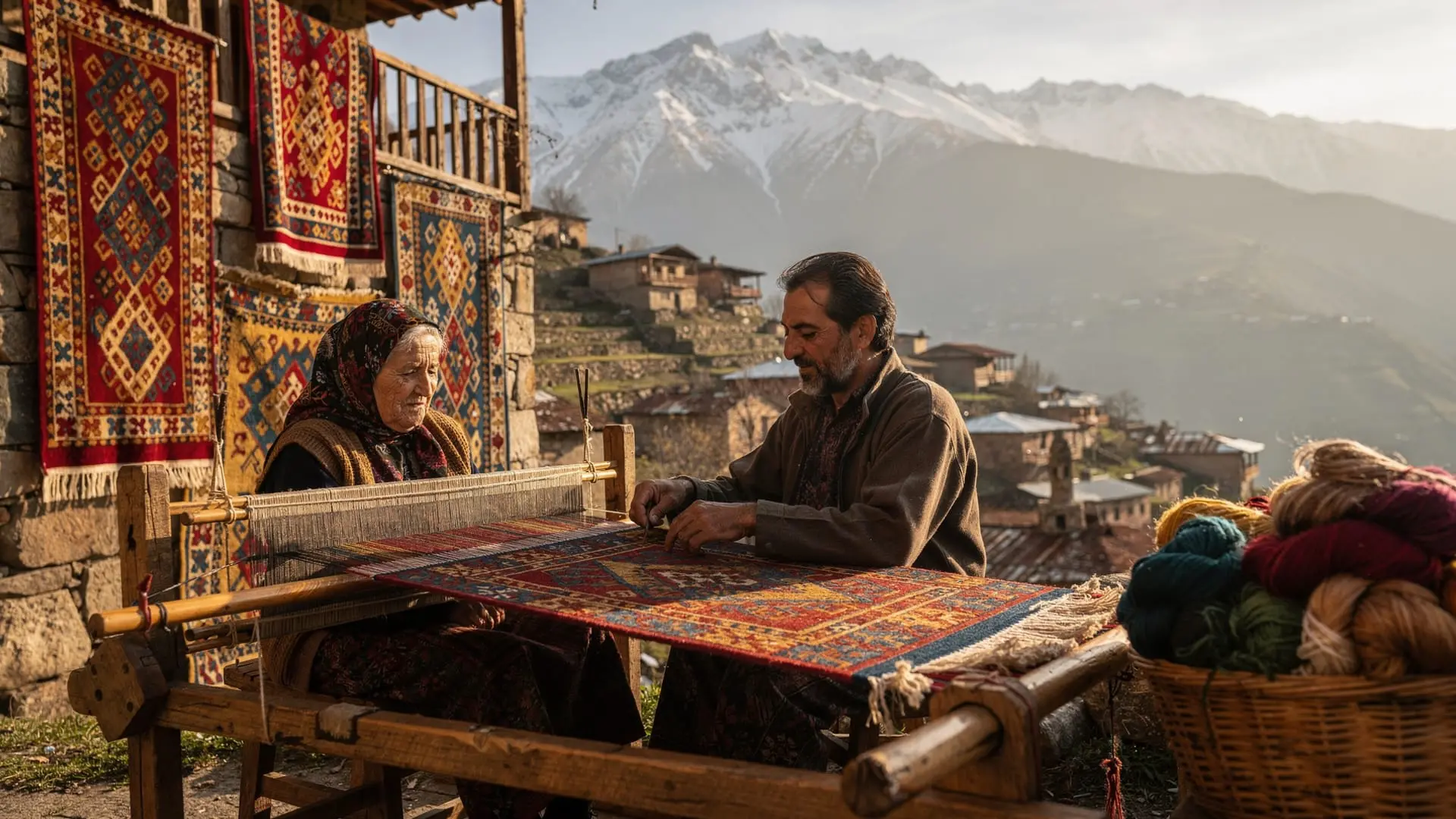
Armenian carpet weaving is documented from at least the 5th century AD, and there is material evidence suggesting textile production in the Armenian highlands going back much further. The Armenian word for carpet — “gabar” — appears in medieval manuscripts; Armenian rugs were traded across the Silk Road; 17th-century European paintings occasionally show what scholars identify as Armenian-woven floor coverings. When you buy an Armenian rug today, you are participating in a commercial tradition of extraordinary depth.
That tradition nearly broke in the 20th century. The Armenian Genocide of 1915 destroyed the weaving communities of western Armenia — the Kars, Van, and Karabakh regions where the most elaborate Armenian carpet traditions had flourished. Soviet collectivisation disrupted the remaining workshops in eastern Armenia. What survived, and was subsequently revived after independence, is a combination of reconstructed historical patterns and living craft traditions maintained by a relatively small number of master weavers.
This guide explains what makes Armenian rugs distinctive, where to buy them honestly in Yerevan, how much to pay, and how to avoid the fakes and near-fakes that fill tourist markets.
What makes an Armenian rug Armenian
Armenian carpets — in the strict sense — are distinguished from Persian, Turkish, and Caucasian rugs by a specific combination of:
Pile technique: Traditional Armenian rugs use the symmetrical (Turkish) knot rather than the asymmetrical (Persian) knot, though exceptions exist in different regional traditions. The pile is typically cut to a medium height, producing a surface that is firm rather than plush.
Design vocabulary: Armenian carpet patterns draw on a repertoire that includes the “dragon carpet” (vishapagorg) tradition — bold, stylised dragon figures in a structured field — the “eagle carpet” (artzivagorg), pomegranate motifs (the pomegranate is the Armenian national symbol), and geometric medallion compositions influenced by medieval Armenian stone carving and manuscript illumination.
Dye tradition: Pre-industrial Armenian rugs used vegetable dyes: madder root for reds and oranges, weld for yellows, indigo for blues, walnut shell for browns, pomegranate rind for yellows and tans. These natural dyes fade to mellow, integrated tones over time — what rug dealers call “abrash” (the slight variation in colour that indicates hand-dyeing). Synthetic dyes, used from the late 19th century, tend to fade less evenly and with less grace.
Wool quality: The finest Armenian rugs use wool from mountain sheep, which produces a longer, more lustrous fibre than lowland breeds. The handling of mountain wool — washing, carding, spinning — in traditional workshops differs from industrial processing and results in a pile that has a characteristic soft resilience.
The major rug-producing traditions and regions
Armenian carpet production historically concentrated in specific regions, most of which are now either in Turkey or Azerbaijan — regions from which Armenian populations were expelled in the 20th century. The surviving traditions accessible from Yerevan today include:
Karabakh-style rugs: The Karabakh region (now inaccessible as a tourist destination) was historically one of the most significant Armenian carpet-weaving centres. Karabakh designs — bold, dark-ground floral compositions, often with a central medallion and elaborate borders — are still produced by Armenian weavers working from historical patterns. Several workshops in Yerevan and smaller Armenian towns produce Karabakh-style work.
Kazakh-type designs: The Kazakh district of what is now western Azerbaijan was home to Armenian and Turkic weavers working in related but distinct traditions. Armenian Kazakh designs tend toward bold geometric forms, strong reds and blues, and a distinctive stepped-diamond composition. These are among the most graphically powerful Armenian carpet types.
Artsakh and contemporary production: Post-Soviet Armenian rug production has largely moved to Yerevan and other western Armenian cities. Contemporary workshops often produce revivals of historical patterns in traditional materials; the quality in the best workshops (Megerian being the gold standard) is excellent.
Where to buy in Yerevan
Megerian Carpet Factory
The Megerian family has been weaving and selling Armenian carpets since the 19th century, with roots in the Armenian communities of Constantinople. The Yerevan branch is the most significant quality carpet operation in Armenia today.
The Megerian showroom on Abovyan Street (near the Opera House) functions as both a shop and a working display: you can see weavers at work on traditional vertical looms, examine the wool and dye processes, and then view the finished products in a dedicated gallery space. The range runs from:
- Small decorative pieces (50 x 80 cm, traditional designs): from approximately 500 EUR
- Mid-size room rugs (150 x 200 cm, production line): 1,500–4,000 EUR
- Large room rugs (200 x 300 cm): 4,000–10,000 EUR
- Museum-quality antique or antique-recreation pieces: 8,000–15,000 EUR and above
Megerian’s prices are not cheap, but they reflect genuinely hand-knotted rugs made with natural dyes and quality wool. If budget is a constraint, ask to see the “second quality” pieces or the smaller traditional items — the value at the lower end of the range is real.
Megerian also ships internationally and is experienced in handling customs paperwork for exports. Staff speak English.
Yerevan Carpet Factory
The state-era Yerevan Carpet Factory has survived as a working operation producing a range of carpets in Armenian designs. The quality is generally lower than Megerian’s bespoke production but higher than most market stalls. The factory showroom is less tourist-oriented but prices are correspondingly lower.
For mid-range purchases — a solid, genuinely hand-made Armenian carpet without the premium of Megerian’s brand — the factory showroom is worth visiting.
The Cascade and museum shops
Several shops in the Cascade Complex area sell smaller textile items — kilims, woven cushions, and decorative pieces — of variable quality. These are better than the market but generally not the quality of specialist carpet workshops.
What to avoid at the Vernissage market
As noted in our Vernissage guide, the “antique” rugs sold at the weekend market are predominantly Iranian or Turkish industrial carpets, artificially aged and presented as old Armenian work. There is no reliable way for a non-specialist to distinguish genuine antique Armenian rugs from these imitations without significant expertise.
If a vendor at Vernissage offers you an “original 19th century Armenian carpet” for 100–300 EUR, it is not. A genuine 19th-century Armenian carpet in good condition would sell for 10–50 times that amount at specialist auction in London or New York. The arithmetic of the offer tells you what you need to know.
Yerevan: Walking Tour with a Local GuideHow to assess a rug before buying
If you are considering a significant purchase, these practical checks apply regardless of where you are buying:
Turn the rug over: Hand-knotted rugs have an irregular, slightly fuzzy reverse where the individual knots show. Machine-made rugs have a perfectly uniform grid of loops on the reverse, usually with a backing fabric. The distinction is obvious once you know what to look for.
Check the fringe: On authentic hand-knotted rugs, the fringe is an extension of the foundation warps — it grows from the body of the rug. On machine-made rugs, the fringe is often sewn or glued on. Pull very gently on a fringe end; if it seems attached rather than integral, be suspicious.
Look for abrash: Natural dye variation (abrash) appears as slight colour shifts in a single colour across the rug’s field. This is a sign of hand-dyeing and is considered a quality indicator, not a defect.
Examine the pile: Run your hand across the pile in both directions. Quality hand-spun wool has a slight resilience; industrial fibre feels flatter. If the pile feels unusually stiff or shiny, synthetic dye or fibre is likely.
Ask about provenance: A legitimate seller will know where a rug was made, approximately when, and in what tradition. Vague answers or dramatic provenance stories (“my grandfather’s village, pre-genocide, unique piece”) should prompt caution.
Deep history: Armenian carpet symbols and the dragon rug tradition
The most emblematic form of Armenian weaving is the vishapagorg — the dragon carpet. The term comes from vishap (dragon or serpent-monster in Armenian mythology) and gorg (carpet). These rugs feature large, highly stylised interlocking serpentine or dragon-like figures set against a structured field, typically in deep reds, dark blues, and ivory. The earliest surviving examples date from the 16th century, though scholars believe the tradition goes back considerably further.
What makes the dragon carpet distinctly Armenian — rather than simply Caucasian — is the specific design grammar. The “dragons” in these rugs are angular and geometric rather than sinuous, often reading more like interlocking S-shapes or lattice forms than literal serpent figures. This abstraction reflects the Armenian carpet’s roots in medieval stone carving: the same knotwork patterns that appear on 12th-century Armenian khachkars (cross-stones) appear transformed into the borders of dragon carpets. The connection is direct — many of the weavers were the same communities that carved the monastery stones.
Other canonical Armenian design motifs include: the pomegranate (nur, national symbol — signifying fertility and resurrection, appearing in borders and field fill); the eagle (artzivagorg, associated with the Arsacid and Bagratid dynasties); the royal medallion derived from Armenian manuscript illumination; geometric eight-pointed stars filtered through Armenian visual vocabulary; and the S-border and running dog patterns that appear consistently across Karabakh, Kazakh, and Yerevan-region traditions.
The distinctiveness of Armenian carpet vocabulary is no longer seriously disputed by specialists, even as debates continue about specific regional attributions.
Key weaving regions: Gyumri, Etchmiadzin, and the Karabakh legacy
Gyumri
Before the 1988 earthquake, Gyumri maintained workshops producing Kazakh-type rugs — bold, geometric, strong primary colours. Post-earthquake reconstruction brought NGO investment in craft revival, and the city today has several small weaving cooperatives. If visiting Gyumri (highly recommended — the Russian Imperial-era stone architecture is extraordinary), ask locally about textile workshops in the Kumayri historic district. Our Gyumri architecture guide covers the city’s cultural heritage in full.
Armenia's Cultural Capital: GyumriEtchmiadzin (Vagharshapat)
The seat of the Armenian Apostolic Church has historically been a centre of ecclesiastical textile production. Armenian vestments are embroidered rather than knotted, but the design vocabulary — pomegranate motifs, medallion compositions, interlaced knotwork — overlaps directly with the carpet tradition. The Etchmiadzin Treasury displays examples of medieval Armenian embroidery if you wish to trace this connection.
The Karabakh tradition (and its current status)
The Karabakh region was historically the most significant single Armenian carpet-weaving centre. Karabakh rugs are characterised by: dark-ground compositions (deep reds, near-blacks, dark blues); highly elaborate floral and geometric field patterns; borders of unusual complexity; and — in the finest examples — a density of knotting that produces designs of extraordinary intricacy. The Karabakh tradition produced several distinct sub-styles, of which the “Shusha” type (named for the regional capital) is the most prestigious.
Since September 2023, Karabakh is entirely inaccessible as a tourist destination. Armenian weavers from Karabakh have relocated primarily to Armenia proper — many to Yerevan, Goris, and Syunik province. Some have brought their weaving traditions with them, and you may encounter Karabakh-style work produced by displaced artisans now working in Armenia. These pieces carry an additional layer of historical and human significance.
How to identify hand-knotted vs. machine-made rugs
The practical skill of distinguishing a genuine hand-knotted rug from a machine-made or machine-woven imitation is learnable in about ten minutes of handling. These are the key tests:
The back test: Turn the rug over. Hand-knotted rugs show individual knots — a slightly irregular, textured surface. Machine-made rugs have a perfectly uniform grid, often with a backing fabric glued on. The distinction is unmistakable once you know what you are looking for.
The fringe test: On authentic hand-knotted rugs, the fringe is an extension of the warp threads — it is the same thread that runs through the entire length of the rug. On machine-made rugs, the fringe is either sewn on separately or glued. Pull very gently on a single fringe end: if it seems to come from the body of the rug, it is likely genuine. If it seems attached to a backing strip, it is sewn-on fringe.
The knot count: Low-knot-count hand-knotted rugs (tribal types) have 10–20 knots per sq cm; fine workshop production runs to 30–60+. Count the knots on the back in a 2×2 cm section. Machine-made pile is so regular that counting individual knots is difficult — the loops are all identical.
Colour irregularity (abrash): Slight colour variation in a single colour field is a sign of hand-dyeing. A rug where every centimetre of red is exactly the same shade was almost certainly machine-dyed. Abrash is not a flaw — in fine rugs it is evidence of authenticity.
The pile feel: Quality hand-spun wool has a resilience and lanolin softness that industrial fibre does not reproduce. Run your hand across the pile — it springs back. Synthetic or industrially-processed pile feels flat or stiff.
Price ranges in AMD and EUR by size and quality
Understanding what you should expect to pay helps you evaluate whether a price is genuine or inflated for tourist traffic.
| Size | Machine-made (market stall) | Hand-knotted (workshop quality) | Megerian equivalent |
|---|---|---|---|
| Small (50×80 cm) | 20,000–80,000 AMD (50–200 EUR) | 200,000–400,000 AMD (490–975 EUR) | 500 EUR+ |
| Medium (100×150 cm) | 60,000–200,000 AMD (150–490 EUR) | 400,000–1,200,000 AMD (975–2,925 EUR) | 1,500–3,000 EUR |
| Room size (160×230 cm) | 200,000–500,000 AMD (490–1,220 EUR) | 1,600,000–4,100,000 AMD (3,900–10,000 EUR) | 4,000–10,000 EUR |
| Large (200×300 cm) | 400,000–1,000,000 AMD (975–2,440 EUR) | 3,280,000–8,200,000 AMD (8,000–20,000 EUR) | 8,000–20,000 EUR+ |
Note: “workshop quality” refers to genuine hand-knotted production with natural or high-quality synthetic dyes from reputable sources in Armenia or the region. Village cooperative production (from Vayots Dzor or Syunik) may sit at the lower end of the hand-knotted range and can represent exceptional value.
If a price seems too good: A 150×200 cm rug offered for 150 EUR at a market stall is machine-made. A hand-knotted rug at that size for 150 EUR does not exist — the labour alone (typically 3–6 months of weaving) makes it impossible.
Shipping and customs: getting a rug home
Getting a rug from Yerevan to your home country is manageable with basic preparation.
Carry-on or checked baggage: Small rugs (up to ~70×120 cm rolled) can travel as checked baggage. Roll with pile facing inward, wrap in plastic and fabric, secure with straps. Megerian will pack for you on request.
Freight shipping: For room-size and larger rugs, workshops use experienced freight forwarders. The seller provides export documentation; you handle import declaration at your end. Transit to Europe: typically 2–4 weeks by sea.
Customs duties: Most EU countries apply zero or low import duty on handmade rugs for personal import. A rug valued above ~4,000 EUR must typically be declared. EU customs duty on handmade rugs is generally 0–5%; VAT at your home country’s rate may apply above the personal import threshold.
Export permits for antiques: Rugs over 100 years old may require an export permit from the Armenian Ministry of Culture. Megerian handles this automatically for genuine antiques. Be wary of any dealer who sells a “certified antique” without export documentation.
Yerevan: A Tour through the Flea MarketsCaring for a rug once you own it
A genuine hand-knotted Armenian rug is a durable object if treated correctly, and neglect is the most common way owners shorten its life. Vacuum in the direction of the pile (not against it) and avoid beater-bar attachments, which can loosen knots over years of use. Rotate the rug every six to twelve months if it sits in direct sunlight, since UV exposure fades natural dyes unevenly — the abrash that is prized in an old rug should come from age, not from one half of the rug baking in a window. Professional hand-washing every three to five years (never machine washing) removes ground-in dust that ordinary vacuuming cannot reach; ask the Megerian showroom for a referral if you are based abroad and want a specialist who understands hand-knotted construction. Small moth damage, if caught early, is treatable — do not discard a rug over a small hole before consulting a restorer, as reweaving a damaged corner is a routine repair for workshops that still employ traditional knotting techniques.
Valuing and insuring a significant purchase
For purchases above a few thousand euros, get a written appraisal at the point of sale — Megerian will provide one for their pieces, stating size, materials, approximate age or production date, and price paid. This document matters for two practical reasons: customs valuation on import, and insurance. Standard home contents insurance often caps “single item” claims well below the value of a fine hand-knotted rug, so a dedicated fine-art or valuables rider may be worth arranging once you know the appraised value. Keep photographs of the rug (full piece, close-up of the knotting on the reverse, and any label or workshop mark) alongside the appraisal — useful both for insurance claims and for resale years later, when provenance documentation materially affects what a rug is worth.
Negotiating price: what actually works
Bargaining norms differ sharply between Megerian and Vernissage. At Megerian and the Yerevan Carpet Factory, prices on tagged pieces are close to fixed — modest movement (5–10%) is sometimes possible on larger purchases or when paying in cash, but this is not the freewheeling bazaar experience some visitors expect. At Vernissage, prices are opening offers by design, and 40–60% reductions from the first quote are common for genuinely negotiable stallholders; the skill is less in aggressive haggling and more in walking away calmly, since a seller who wants the sale will often call you back with a lower number. Either way, decide your maximum price based on the size and quality checks above before you start talking numbers, not after you have fallen in love with a specific piece — emotional attachment is the single biggest driver of overpaying for carpets anywhere in the world, not just in Armenia.
A short history of Soviet-era production
Understanding the Soviet period helps explain some oddities in what you will encounter today. Soviet economic planning consolidated Armenian carpet weaving into state factories from the 1930s onward, prioritising volume and standardised patterns for domestic Soviet consumption over the individualised, family-workshop production that had characterised the pre-Soviet tradition. The Yerevan Carpet Factory, still operating today, is a direct descendant of this Soviet industrial model — which is why its output, while genuinely hand-knotted, tends toward more uniform, less individually distinctive designs than boutique contemporary production. Quality control was inconsistent across the Soviet period: some factory-era rugs from the 1960s–1980s are excellent and are now collected as vintage Soviet-Armenian pieces in their own right, while others were produced to meet quotas rather than aesthetic standards. If you encounter a rug described as “Soviet vintage” at a reputable dealer, it is a distinct and legitimate category — different from both the ancient hand-knotted tradition and from contemporary tourist-market fakes — worth evaluating on its own terms rather than dismissing or over-romanticising. Ask the seller directly whether a piece is pre-Soviet, Soviet-factory, or contemporary workshop production — a knowledgeable dealer will answer without hesitation, and vague or shifting answers are themselves a useful warning sign.
Frequently asked questions about Armenian rugs
What is the difference between an Armenian rug and a Persian rug?
Both traditions use knotted pile technique and have similar design vocabularies in some respects. Armenian rugs are generally distinguished by: use of the symmetrical (Turkish) knot; specific design motifs (dragon, eagle, pomegranate) that are distinctly Armenian; a stylistically bolder and less naturalistic design approach than classical Persian work. Historically, the two traditions influenced each other through trade and shared cultural space.
Are there “silk rugs” in the Armenian tradition?
The Armenian carpet tradition is primarily a wool tradition. Silk rugs are associated more with Persian and Turkish court production. You may encounter silk or silk-blend rugs in Yerevan shops, but these are generally Persian or Turkish in origin and should be evaluated as such.
How do I know if a rug is genuinely old?
Age assessment requires expertise. Indicators of age include: abrash and fading consistent with natural dye age; wear patterns on high-traffic areas consistent with actual use; foundation threads (cotton or wool) showing brittleness; pile height variation with low areas from use. Artificial ageing (washing with chemicals, mechanical distressing) is difficult to detect without laboratory analysis. For any significant antique purchase, consider having the rug assessed by an independent expert.
Can I get an Armenian rug as a small, affordable souvenir?
Yes. Kilims (flat-woven textiles without pile), small decorative pieces, and wall-hanging tapestries in Armenian motifs are available in the 100–300 EUR range from reputable sources and make excellent souvenirs. The Megerian shop has a range of smaller pieces specifically targeted at visitors. Embroidered cushion covers and small decorative textiles with Armenian motifs are even more affordable.
Is carpet weaving still practiced outside Yerevan?
Yes. Several villages in Vayots Dzor and Syunik provinces maintain local weaving traditions, usually in cooperatives supported by NGOs or cultural organisations. If you are visiting those regions, asking locally about weaving cooperatives can lead to direct-from-maker purchases that are both more meaningful and often better priced than Yerevan showrooms.