Vernissage flea market: souvenir shopping done right
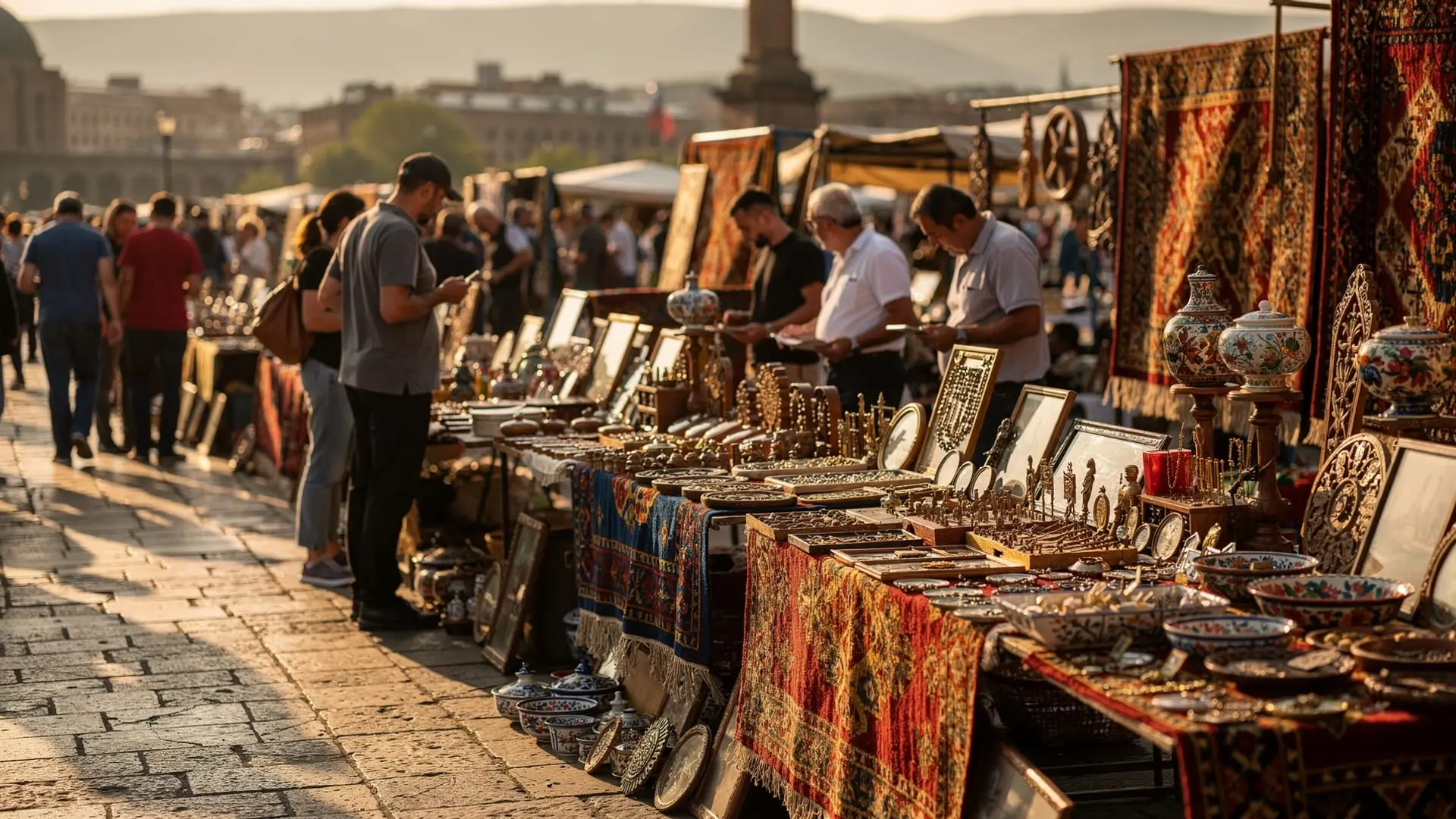
Saturday morning, Vernissage, coffee in hand
The best way to arrive at Vernissage is early on a Saturday morning, with a coffee from one of the small cafes on Abovyan Street and no particular agenda. The market opens as the vendors set up their trestles — around 9 am, though some are there from 8 — and the first hour has a quality the later crowds destroy: vendors arranging their merchandise with the careful attention of people who know exactly what they have, the smell of old paper and metal and wood, a light that is soft and unmercantile.
Vernissage (the word is French, used in Armenian as the name for a formal art opening — the market’s name reflects its origins as a weekend artists’ market) is in the park immediately adjacent to Republic Square, off Aram Street. It runs every Saturday and Sunday, year-round, in all weather. It is the best place in Yerevan to buy something genuinely Armenian, and — if you go in knowing what you are doing — one of the more enjoyable shopping experiences in the South Caucasus.
| Where | Park off Aram Street, next to Republic Square |
| Days | Saturday and Sunday only, year-round |
| Cost | Free entry; budget 5,000–20,000 AMD for souvenirs |
| Best time | 9–11 am, before the tour-group crowds arrive |
| Getting there | 3-minute walk from Republic Square metro |
What you will find
Vernissage is a mixed market. On any given Saturday, the same 100 metres of trestle tables might hold a genuine 1920s Armenian painting, a pile of Soviet-era tin toys, a reproduction khachkar carved from tuff, a grandmother selling lace doilies, and a professional antique dealer with serious Soviet military items priced accordingly. The range is the point. Here is what is worth your attention:
Handicrafts and decorative arts
Armenian artisans work in wood, stone, ceramic, and textile to a generally high standard, and Vernissage is where many of them sell directly to the public. Look for:
Khachkar carvings: The Armenian cross-stone (khachkar) is one of the most distinctive art forms in Armenian culture — a cross set within elaborate interlaced stone carving. At Vernissage you will find khachkars in sizes from palm-sized to desk-object, carved in basalt, tuff, or wood. The best are clearly hand-carved with genuine craftsmanship; the worst are mass-produced in factories and sold as handicrafts. Price is a reasonable guide — a hand-carved wooden khachkar for 3,000–5,000 AMD is likely authentic; one for 800 AMD is not.
Hand-painted ceramics: Yerevan has a lively ceramics tradition. Plates, bowls, and decorative tiles with Armenian motifs — pomegranates, arabesques, the Ararat mountain — are made to a range of quality levels. The best pieces have clean, confident brushwork; avoid anything where the painting looks hurried or the glaze application uneven.
Silver jewellery: Armenian silversmithing is an old craft. At Vernissage you find both antique pieces (with genuine patina and irregularities that suggest age) and new work in traditional styles. Old silver is usually better value than the market in home countries would suggest; new silver is often reasonably priced and makes a good gift.
Backgammon sets: Armenia and the South Caucasus have a serious backgammon culture. Vernissage has several vendors specialising in wooden backgammon boards, ranging from simple travel sets to handmade inlaid pieces in walnut and fruitwood. A well-made board makes an excellent souvenir.
Soviet memorabilia
This is where Vernissage distinguishes itself from tourist souvenir markets elsewhere. The Soviet-era material — still abundant in Armenia three decades after independence — is one of the better sources of authentic 20th-century memorabilia anywhere in the post-Soviet world.
Look for:
- Enamel pins (znachki): Soviet-era collectible pins depicting factories, sports achievements, anniversaries, and political figures. Small, cheap (200–500 AMD each), and genuinely old. Easily transported.
- Soviet cameras: Fed, Zenit, Kiev — the Soviet camera industry produced millions of cameras, some of which work beautifully and all of which make atmospheric table objects. Check shutter and light seal before buying.
- Mechanical watches: Pobeda, Vostok, Slava — Soviet watches of various quality levels. The better ones keep good time and have genuine collector appeal.
- Maps and printed ephemera: Soviet-era maps, propaganda posters (reproductions are common; originals are rare and priced accordingly), postcards, and printed material.
- Military medals and insignia: Some vendors have serious military collections. Prices range from a few hundred AMD for common pins to several thousand for significant campaign medals.
Books and printed matter
A section of the market specialises in old books — Armenian, Russian, and occasional European titles from the Soviet period and earlier. For Armenian cultural interest, look for illustrated books on Armenian art, architecture, or carpet weaving; Soviet-era children’s books (often beautifully illustrated); and pre-Soviet Armenian Cyrillic or Armenian-script texts if you can read them or want them as objects.
What to avoid
Honest shopping advice at Vernissage requires being equally clear about what not to buy:
“Antique” carpets at unrealistically low prices: Vernissage has carpet sellers, but buyers should be extremely cautious. Genuine antique Armenian carpets (pre-1900) are rare and valuable; what most vendors are selling is industrial-produced carpet from Iran or Turkey, aged artificially and presented as old Armenian work. If you want a genuine Armenian carpet, go directly to Megerian Carpet Factory or the Yerevan Carpet Factory — see our dedicated rug-buying guide. At Vernissage, treat carpet sellers’ claims with appropriate scepticism.
Bottled cognac: This is the most important tourist trap in all of Yerevan to know about. The Armenian Ararat cognac sold in bottles at Vernissage — and by street vendors around Republic Square — has a high counterfeit rate. The bottles may look authentic, but the liquid inside is frequently not the product it claims to be. Buy Armenian cognac only at: the Yerevan Brandy Company visitor centre, the SAS or Yerevan City supermarket chains, or duty-free at Zvartnots airport. Never from a market stall or street vendor, however confident they seem.
“Genuine” Soviet military medals with spectacular provenance stories: The Soviet medal market globally has significant fraud issues. At Vernissage, medals are generally genuine but the stories vendors attach to them (Hero of the Soviet Union awards, Stalin-era personal decorations) should be treated with scepticism. Common medals — campaign ribbons, anniversary decorations — are reliably genuine; extraordinary claims require extraordinary evidence.
Reproductions sold as originals: Some painting vendors sell reproduction lithographs as original works. This is not unique to Vernissage, but at an outdoor market it requires care. An “original oil painting” for 5,000 AMD is almost certainly not one; an original for 50,000–200,000 AMD from a vendor who can discuss the painter and technique has more credibility.
Vendor categories in depth
Vernissage is large enough that a first-time visitor can feel overwhelmed. Knowing the layout helps. The market divides, loosely, into zones:
The painting and art section runs along the northern edge of the market. Here you find everything from original oils (mostly landscapes and portraits by Armenian painters, priced from 30,000 AMD to several hundred thousand) to Soviet-era lithographic prints, reproduction prints sold in ornate frames, and handmade drawings and watercolours. Quality ranges enormously. The best strategy: spend time looking before buying, note the prices across multiple vendors, and treat any claim of “original Soviet poster” with mild scepticism unless the paper shows genuine age (yellowing, brittleness, printing irregularities).
Rugs and textiles occupy a section of the market but, as noted below, require extreme caution. What is reliably good here: small kilims and woven table runners, embroidered textiles (hand-embroidered tablecloths and runners are common and often genuinely handmade), and felt products from rural artisans. For anything described as a “traditional Armenian carpet,” redirect to a specialist dealer.
Soviet militaria and memorabilia clusters in the western section and is the segment with the most serious collectors on both vendor and buyer sides. The better vendors have organised displays with items in protective cases. You can reliably find: infantry insignia (common, cheap), tank crew patches and aviation pins, anniversary medals (Victory Day, October Revolution), factory worker achievement pins, and Soviet space programme pins — a particularly popular category. More expensive items — Hero of the Soviet Union stars, Guards badges, early NKVD insignia — are present but require knowledge to authenticate. The counterfeit market for high-value Soviet decorations is global; at Vernissage, the lower-priced items are overwhelmingly genuine.
Books and printed matter concentrate in the centre of the market. The best finds for non-Armenian readers: Soviet-era art books (large-format books on Armenian art, architecture, and carpet weaving, published in Russian with image-heavy content that needs no translation), Soviet children’s books with distinctive illustration styles from the 1950s–70s, and maps (Soviet-era topographic and tourist maps of Armenia and the Caucasus). Prices are low: most books are 500–3,000 AMD.
Jewellery and silverwork is spread throughout but concentrates near the southern entrance. New silver in traditional patterns is common and reliable; genuine antique pieces require more expertise to identify. The tell for antique Armenian silver: heavier weight than modern pieces, slight irregularities in casting, and a patina that cannot be replicated by modern chemical aging (which leaves an uneven, slightly tacky finish). Turquoise, coral, and garnets are traditional stones in Armenian jewellery; any piece using these in traditional settings has a higher probability of authenticity.
Ceramics and decorative arts from contemporary artisans tend to be near the centre and east of the market. These are among the safest purchases: the artisans are often present, the work is clearly contemporary, and the prices reflect the quality of craft rather than any claim of antiquity.
The carpet question: what you can and cannot trust
The carpet section of Vernissage deserves its own treatment because it is the source of the most expensive mistakes tourists make. Here is what the market actually has:
What vendors claim: antique Armenian carpets, sometimes described as “from the 1800s,” “pre-Soviet,” or “from a village grandmother.” These claims are almost always false. Genuine antique Armenian carpets — woven before 1920, from the traditional weaving areas of historic Armenia — are rare, museum-quality objects that do not appear at outdoor markets for several hundred dollars.
What they are actually selling: machine-produced carpets from Iran or Turkey, washed in chemicals to simulate aging, or Soviet-era (1950s–80s) production carpets from Armenian factories, which are neither antique nor hand-knotted. These can be attractive floor coverings, but they are not what is claimed.
What is actually worth buying at Vernissage in the textile category: small kilims and sumaks (flat-woven rugs without pile, genuinely handmade, often by rural vendors), felt products, embroidered textiles, and woven table runners and bags. These are modern, handmade, and priced honestly.
Where to buy a genuine Armenian carpet: Megerian Carpet Factory (with showrooms in Yerevan) is the most reliable option. They weave carpets on traditional looms, can show you the process, and provide provenance documentation. The Yerevan Carpet Factory has a shop near the Republic Square area. Both are significantly more expensive than Vernissage — which is precisely the sign of authenticity.
Fake cognac: the most important warning in Yerevan
This is worth repeating from the overview section because the risk at Vernissage is real and the consequences are unpleasant. Bottles sold as Armenian Ararat cognac at the market have a documented counterfeit problem. The bottles are real; the liquid is sometimes a cheaper Armenian brandy, sometimes a non-Armenian spirit decanted and resealed, sometimes worse. The seals can be reproduced convincingly.
The rule is simple: never buy Armenian cognac at Vernissage or from street vendors. The correct places to buy are: the Yerevan Brandy Company visitor centre on Admiral Isakov Avenue (they sell directly, authenticity guaranteed, tours available), SAS supermarket chain, and Yerevan City supermarket. Duty-free at Zvartnots Airport is also reliable.
A guided tour to the brandy factory itself — which includes tasting of multiple age expressions — is a better souvenir experience than any bottle purchased at a market.
Yerevan Brandy Factory: Armenian Brandy Tasting TourCurrency, payment, and customs declarations
Currency: Vernissage is a cash market. Armenian dram (AMD) is the standard; euros and US dollars are sometimes accepted but at unfavourable rates (vendors typically use a rate 10–15% worse than the official rate to compensate for exchange risk). Russian roubles are accepted by some vendors, reflecting the significant Russian tourist presence. Bring AMD from an ATM before arriving — several machines are on Abovyan Street, 2 minutes from the market entrance.
Pre-payment: Never pay in full before inspecting an item carefully. For larger purchases, it is entirely acceptable to ask to hold an item while you continue browsing, with a partial deposit if the vendor requires it.
Customs declarations for antiques: This is a significant practical concern for serious buyers. Armenia’s customs law requires an export permit for any item classified as a “cultural object” more than 100 years old. At the border or airport, customs officers have the authority to confiscate items without proper documentation. In practice, enforcement is variable — small, low-value items rarely attract attention — but for anything expensive or significant (genuine Soviet medals, old coins, books or manuscripts that might qualify as cultural artefacts), obtain a declaration from the vendor and, if in doubt, consult the Ministry of Culture’s cultural goods export office in Yerevan before departure. The vendor’s assurance that “there is no problem” is not a substitute for documentation.
Hours in detail and best timing
The market is open Saturday and Sunday only. Vendor setup begins from around 08:00; the market is effectively open from 09:00. The best selection and least crowded conditions are between 09:00 and 11:00. From 11:00 to 14:00 is peak tourist time — busier, but vendors are also more energised for sales.
From 14:00 onward, vendors begin packing if they have sold well. By 16:00 on a hot summer day, the market has thinned noticeably. On winter Saturdays, the market is smaller (fewer vendors, particularly in the art and textile sections) but genuinely atmospheric — the cold keeps crowds low and vendors more patient.
Sunday follows a similar pattern but is typically 20–30% smaller in vendor numbers than Saturday, with the art and book sections most reduced.
Yerevan: A Tour through the Flea MarketsHow to bargain
Bargaining is expected at Vernissage for most categories of goods, though the degree varies. The general approach:
- Start at 60–70% of the asking price for most items. This is not aggressive; it is the expected opening.
- Be cheerful and patient. Soviet-era vendors in particular often enjoy the social ritual of bargaining; a dour negotiation goes nowhere.
- Walk away if the price doesn’t move enough. If a vendor calls you back, there is usually more room. If they don’t, the price was genuine.
- For high-value items (carpets, jewellery, cameras), take time to examine the item carefully before beginning to negotiate. Showing genuine interest raises the vendor’s confidence and often improves the final price.
- Carry small denominations. Arriving with a 10,000 AMD note for a 2,000 AMD purchase is not a bargaining advantage.
Bargaining is less expected for handicrafts from the artisans who made them. Offering 10% less is fine; opening at 50% of asking price from an artisan who has a visible booth and made the item themselves is disrespectful. Use judgment.
Yerevan: Highlights and Culture Walking Tour with TastingsPractical information
Location: Off Aram Street, immediately adjacent to Republic Square park. The entrance is on the Aram Street side. The Republic Square Metro station is a 3-minute walk.
Days and hours: Saturday and Sunday only. Hours are roughly 9 am–7 pm; the market is busiest from 10 am to 2 pm and the best selection is in the morning. Some vendors pack up by mid-afternoon if sales have been good.
Year-round: Vernissage operates in all weather, though the number of vendors is reduced in heavy rain or very cold January/February conditions. Summer is the busiest and most atmospheric time.
Currency: Dram (AMD). Some vendors accept euros or dollars but the exchange rate will not favour you. ATMs are 2 minutes away on Abovyan Street.
Bags: Bring a bag you can sling across your body rather than a backpack — it makes browsing easier and is more secure in crowds.
Photographing vendors and their merchandise: Generally fine, but ask permission before photographing vendors directly. Most are happy to have their crafts photographed.
Photography at Vernissage
The market is a genuinely rewarding place to photograph, but it rewards courtesy over opportunism. Vendors are proud of their merchandise and generally happy to have it photographed — the khachkar carvings, the trays of Soviet pins laid out in neat rows, the backgammon sets stacked by grain and colour all make strong images in the soft morning light. What changes the dynamic is photographing a vendor’s face without asking; a simple gesture or a word of Armenian or Russian (“mi kani panorama?” or just pointing at your camera with a questioning look) is enough, and most people say yes. Avoid photographing the militaria sellers’ most valuable pieces up close without permission — some are wary of drawing attention to expensive items in an open-air setting. The painting section, with canvases leaning in rows against improvised easels, photographs particularly well between 9 and 10 am before the crowds and the midday sun flatten the light.
Seasonal character: Vernissage through the year
Vernissage changes noticeably with the seasons, and knowing what to expect helps set realistic expectations. Summer (June–August) is the busiest and most crowded version of the market — every vendor who has stock turns up, tour groups arrive by the coachload from around 11 am, and the atmosphere is at its most commercial. Autumn (September–October) brings noticeably fewer tourists but the same vendor density, arguably the best combination of selection and calm browsing. Winter (December–February) thins the vendor ranks significantly — expect roughly half the stalls of a summer Saturday, concentrated in the art, jewellery, and militaria sections rather than bulkier goods like carpets and large ceramics — but the cold keeps casual shoppers away and serious collectors get more attention from vendors who have fewer customers to serve. Spring (March–May) sits between the two, building back toward summer crowds by May. If your main goal is unhurried browsing and genuine negotiation rather than a lively atmosphere, a cold Saturday in January is, perversely, one of the best times to visit. Rain thins the crowd on any Saturday regardless of season — vendors with covered stalls stay, casual sellers with trestle tables often pack early, so an overcast forecast is not a reason to skip the trip if you are already in Yerevan.
Combining Vernissage with nearby attractions
Vernissage is on the eastern side of Republic Square, which makes it a natural first stop before a morning exploring the square and History Museum. If you are combining it with the Parajanov Museum (10 minutes east), the Saturday morning Vernissage + lunch on Saryan Street + afternoon Parajanov Museum is one of the most enjoyable Yerevan days possible. From here you can also walk to Charles Aznavour Square in 8 minutes.
Frequently asked questions about Vernissage
Is Vernissage only open on weekends?
Yes. Vernissage is a Saturday and Sunday market only. On weekdays, the park where it operates is empty. Do not plan your Yerevan shopping around Vernissage unless you have a Saturday or Sunday available.
Are the crafts at Vernissage made by Armenians?
Most handicrafts are Armenian-made, though some mass-produced ceramics and textiles are imported from neighbouring countries (particularly Iran) and not always clearly labelled as such. The best approach is to buy directly from vendors who are visibly making or have made the items themselves — artisans with tools or unfinished work at their booth.
Can I bring large carpet purchases home on the plane?
Small carpets and kilims can be rolled and checked. For larger pieces, Vernissage vendors rarely offer shipping; dedicated carpet shops like Megerian will arrange shipping. Check customs regulations for your home country — some antique textiles have import restrictions.
Is it safe to carry cash at Vernissage?
Vernissage is generally safe. Pickpocketing is possible in peak crowds (Saturday midday in summer); use a cross-body bag with a zip closure and keep large notes separate from small ones. There are no particular safety concerns beyond normal urban market precautions.
What is the best single thing to buy at Vernissage?
Soviet enamel pins (znachki) offer the best combination of authenticity, affordability, and transportability. A selection of 10–15 pins chosen carefully will cost 2,000–5,000 AMD (under 15 EUR) and makes a distinctive, genuinely Armenian souvenir. For larger items, a hand-carved wooden backgammon set from one of the specialist vendors is both beautiful and functional.
Is Vernissage worth visiting if I don’t plan to buy anything?
Yes. Even without buying, browsing the painting section, the Soviet militaria displays, and the ceramics stalls is a genuine window into Armenian material culture and craft that most museums don’t offer. Combine it with a walk to Republic Square or the Parajanov Museum so the visit fits into a broader Saturday rather than standing alone.
How does Vernissage compare to buying souvenirs elsewhere in Yerevan?
Fixed-price souvenir shops around Republic Square and the Cascade sell similar handicrafts at higher prices with no room to negotiate, though with less risk of misrepresented goods (fake antiques, uncertain provenance). Vernissage rewards buyers who take time to compare vendors and ask questions; shops reward buyers who want speed and certainty. Serious purchases — carpets in particular — are safer at a dedicated dealer regardless of the price difference.
A first-timer’s 90-minute route through the market
If you have never been and want a structured way to see the market without missing its best sections, this route works well starting from the Aram Street entrance:
- 0–15 min: Walk the painting section along the northern edge first, while the light is best for viewing canvases and before crowds build. Note prices without buying yet.
- 15–35 min: Cross to the Soviet militaria and memorabilia cluster in the west. This is the most distinctive section and rewards unhurried browsing — enamel pins, cameras, watches.
- 35–50 min: Work through the ceramics and jewellery stalls near the centre and south entrance — the safest purchases on the market, and a good place to buy gifts.
- 50–70 min: Visit the book section in the middle of the market for Soviet-era art books and maps, even if you can’t read Armenian or Russian — the illustrations alone are worth it.
- 70–90 min: Circle back to anything you noted earlier and negotiate seriously. Prices often soften once a vendor has seen you return.
This sequence deliberately leaves carpets for last (or skips them) — decide whether you want a genuine Armenian carpet from a specialist dealer before you get drawn into a market stall negotiation.