The Cascade Complex: Yerevan's art-filled stairway
| Steps | 572, or escalators inside |
| Outdoor sculpture garden | Free, open at all hours |
| Gallery ticket | Approx. 1,500–2,500 AMD |
| Time needed | 45 min (exterior only) to 2–3h (full visit) |
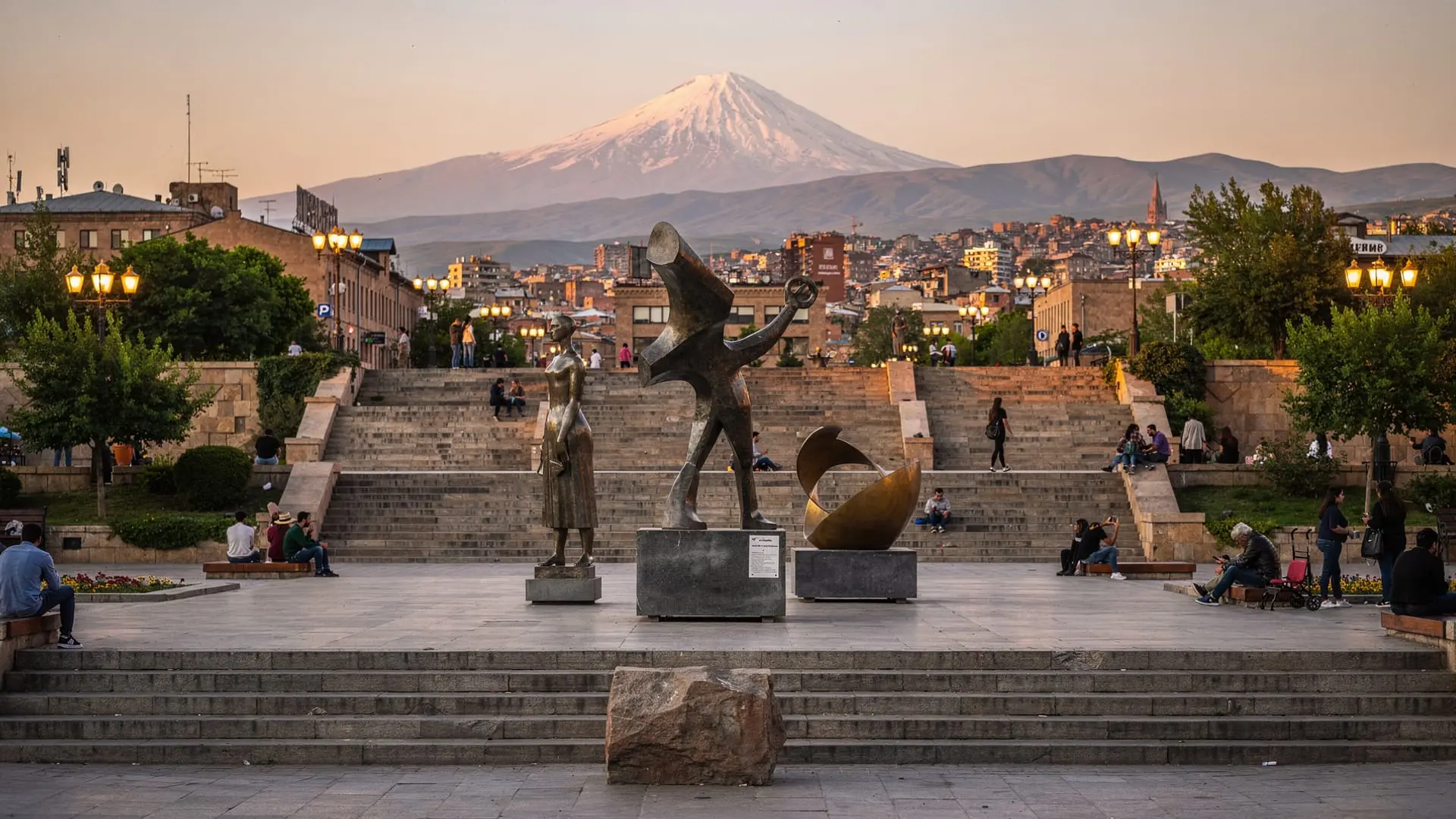
| Best time | Early morning or sunset for Ararat views |
Five hundred and seventy-two steps to the best view in Yerevan
The Cascade is the kind of urban intervention that sounds unlikely on paper: a giant staircase cut into a hillside north of central Yerevan, lined with modern sculpture, housing an art collection inside its concrete belly, and culminating in a panorama over the pink rooftops of the city towards Mount Ararat. It works better than almost any comparable project in the post-Soviet world, and it has become the defining contemporary symbol of Yerevan.
Walking up (or riding the escalators inside) is an experience unlike anything else in the South Caucasus. At every level there is art: a Fernando Botero bronze cat weighing two tonnes, Lynn Chadwick’s angular figures, a Colombian stone hippopotamus, glass fountains, and outdoor terraces with cafes and bookshops. At the top, if the sky is clear, Ararat floats above the city like a fact you had to earn.
History: from Soviet ambition to American philanthropy
The Cascade was conceived in 1971 by Armenian architect Jim Torosyan as part of a plan to connect central Yerevan with the residential hilltop neighbourhoods above. The Soviet authorities approved the project; construction began but stalled repeatedly over decades due to funding gaps and the catastrophic 1988 earthquake and its aftermath. The bare concrete skeleton stood half-finished well into the 2000s, a monument to interrupted ambition.
The transformation came through an Armenian-American philanthropist named Gerard Cafesjian. Born to an Armenian immigrant family in the United States, Cafesjian had become wealthy in printing and chose to invest much of that wealth in Yerevan. Starting in the 1990s and accelerating through the 2000s, his Cafesjian Family Foundation funded the completion of the Cascade structure and filled its interior galleries with his personal art collection.
Construction of the escalator system and interior galleries finished in stages between 2002 and 2010. The Cafesjian Center for the Arts, which administers the collection, opened formally in 2009. Cafesjian died in 2013; his name and the institution are now inseparable from the Cascade.
The relationship between the Cafesjian Foundation and the Armenian state has had difficult chapters — legal disputes over property and management arose after Cafesjian’s death — but the collection itself remains and the building functions as one of Yerevan’s most-visited cultural institutions.
The outdoor sculpture garden
Even if you never step inside the building, the outdoor spaces of the Cascade are worth an hour of your time. The approach from Tamanyan Park at the base passes through a formal garden with bronze and stone sculptures of increasing scale. The largest and most photographed is Fernando Botero’s “Cat” — a massive, rounded bronze figure in Botero’s characteristically inflated style. The Colombian sculptor donated several works to the Cascade, making this one of the better outdoor Botero collections outside South America.
Other notable outdoor pieces include works by Lynn Chadwick (British sculptor, angular iron figures from the 1950s–60s), Colombian sculptor Edgar Negret, and a revolving sculpture garden at successive terrace levels. Each landing on the exterior staircase has its own set of artworks, so the climb is never visually boring.
The terraces also house several cafes and one excellent bookshop (Zangak Books, which stocks Armenian history, art, and travel titles in multiple languages). On warm evenings the Cascade terraces become an informal promenade — locals come to sit, drink coffee, and watch the sun set behind the mountains.
Inside the Cafesjian Center for the Arts
The interior galleries occupy the core of the Cascade structure, accessible via escalator from the ground-floor entrance on the north side (the base, facing the city). Admission to the galleries is paid; as of 2026, tickets are approximately 1,500–2,500 AMD depending on current exhibitions, and the escalators are free for gallery ticket-holders.
The permanent collection centres on three main bodies of work:
Glass art: An exceptional collection of studio glass from American and European artists, including Dale Chihuly-adjacent works and significant pieces from the 20th-century American art glass movement. This is among the finest public collections of studio glass outside the United States.
Modern and contemporary sculpture: The indoor galleries continue the outdoor theme with smaller bronzes, mixed-media works, and pieces specifically commissioned for the space. Several works by Armenian-American and diaspora Armenian artists appear here alongside international names.
Temporary exhibitions: The ground-floor and mid-level galleries host changing exhibitions, often featuring contemporary Armenian artists or thematic shows on Armenian history and diaspora experience. The quality varies but the space is excellent.
The Sergei Parajanov connection: The Cafesjian Center has hosted significant exhibitions relating to Sergei Parajanov, the visionary Armenian-Soviet filmmaker whose museum sits a short distance away in Yerevan. If you plan to visit the Parajanov Museum — and you should — any Parajanov exhibition at the Cascade offers useful context.
The view from the top
The summit platform, reached after 572 steps (or a series of escalator rides), sits below the Victories Monument — a Soviet-era triumphal arch dating from 1950. From here, on a clear day, the view south takes in the entire city laid out in terraces of pink stone, then the Ararat plain, and beyond it the twin volcanic cones of Masis and Sis (Mount Ararat, 5,137 m and 3,896 m respectively) dominating the horizon in Turkey.
Clear views require clear air, which Yerevan does not always have. Summer heat and dust reduce visibility on many afternoons. The best time for the Ararat view is early morning (the mountain tends to disappear into haze by midday), or after autumn rain when the air is washed clean. November and March can give extraordinary clarity.
Even without Ararat, the urban panorama is worthwhile. You can see the full arc of Yerevan’s pink rooftops, the dome of the opera house, the spike of the Matenadaran tower on its hill, and — on a clear day — the mountains of Georgia far to the north.
Tamanyan’s original 1971 vision and the decades of interruption
The Cascade was not originally conceived as an art complex. Jim Torosyan’s 1971 design — commissioned by the Soviet Armenian government — was a piece of urban infrastructure: a grand staircase connecting the lower city (then as now centred on Republic Square and the streets of Kentron) with the residential hilltop districts of Kanaker-Zeytun above. Yerevan had grown rapidly during the Soviet period, expanding onto surrounding hills, and the Cascade was intended as a ceremonial pedestrian link — a way to give the hillside residents a monumental entry into the city centre, and to give the city centre a dramatic viewpoint.
The Cascade’s design language references both Tamanyan’s neoclassical legacy (the formal geometry, the symmetry, the monumental staircase as civic gesture) and the Soviet modernism of the 1970s (the use of raw concrete, the escalator technology, the integration of mass infrastructure with public space). It sits at the intersection of two Yerevan architectural identities, which is partly why it reads so distinctively.
Construction began in 1971 but stalled almost immediately. Soviet-era infrastructure projects in Armenia were chronically underfunded, particularly as the 1970s gave way to the stagnant Brezhnev period. By 1988, when the catastrophic earthquake struck, the Cascade was a bare concrete skeleton — five escalator shafts without escalators, a staircase without sculptures, a terrace without views because the upper sections were unbuilt. The earthquake, which devastated Gyumri and Spitak and redirected all available resources to emergency response, effectively ended any possibility of Soviet-era completion.
Independent Armenia in 1991 inherited the skeleton. For most of the 1990s, it stood as a monument to interrupted ambition — Yerevan’s most visible unfinished building, an urban landmark precisely because of its incompletion.
Gerard Cafesjian and the rescue of the Cascade
Gerard Cafesjian arrived in Yerevan for the first time as an independent state in the early 1990s. Born in Troy, New York in 1925 to Armenian immigrant parents, he had built his fortune through West Publishing (a major legal publishing company) and had been a serious collector of contemporary art — particularly studio glass — for decades. What he saw in Yerevan was a city in economic crisis but with extraordinary cultural assets and an unfinished masterwork at its centre.
Cafesjian’s initial intervention was modest: funding for some restoration work on the lower sections of the Cascade and the adjacent Tamanyan Park. But the project grew. By the early 2000s, the Cafesjian Family Foundation had committed to completing the Cascade in full — installing the escalator system, building out the unfinished upper sections, landscaping the terraces — and simultaneously filling it with his art collection.
The escalator system required engineering work of some complexity: the Cascade’s internal shafts had been designed in 1971 for escalators that were never installed, and the technology of 2002 required adaptation to a structure built for 1970s specifications. The five escalator sections now move visitors from the ground floor to the upper levels of the interior in approximately five minutes, covering the full 118-metre height of the complex.
The exterior work — cleaning and repairing the concrete, landscaping the terraces, commissioning new sculptures — was completed in stages between 2002 and 2009. The Cafesjian Center for the Arts opened formally in 2009, seventeen years after the fall of the Soviet Union and nearly four decades after the Cascade’s original design.
Cafesjian died in 2013. The years after his death were complicated by legal disputes between the Cafesjian Foundation and the Armenian government over ownership and management terms — disputes that reflected the broader tensions in post-Soviet cultural philanthropy between foreign donors seeking control over their gifts and states asserting sovereignty over national institutions. As of 2026, these disputes have largely been resolved administratively, and the collection is open and functioning.
The escalator levels: what to see at each floor
The interior is organised around five escalator sections, each corresponding to a gallery level. Moving from ground floor upward:
Ground floor (entrance level): The main gallery entrance faces the city (north side of the building at the base). This level houses the ticket desk, the bookshop, and the first gallery space — typically used for temporary exhibitions by Armenian and international artists. The ground-floor cafe is here.
Level 2: The first permanent collection galleries begin here — primarily large-scale sculpture, mixed-media works, and the beginning of the glass art collection. Several significant works by diaspora Armenian artists are permanently displayed at this level.
Level 3: The heart of the glass collection occupies much of this level. The gallery cases contain pieces from the American studio glass movement — works dating from the 1960s to the 2000s, spanning the movement’s development from early studio experiments to mature monumental works. The light in these galleries is controlled to maximise the internal luminescence of the glass; the effect is striking.
Level 4: Mixed sculpture and works on paper. Several international artists represented here alongside Armenian contemporaries. Temporary exhibitions sometimes occupy level 4 when the ground floor is insufficient.
Level 5 and the roof terrace: The topmost interior level leads to an outdoor viewing terrace below the Victories Monument arch. From here the full panorama is available: the city spread south toward the Ararat plain, and on clear days, the volcanic cones of Masis and Sis rising beyond the Turkish border.
The outdoor sculpture trail: specific works
The outdoor sculpture garden between the base terrace and the staircase levels is the Cascade’s most democratic space — free, open at all hours, and containing some of the most significant works in the collection.
Fernando Botero’s “Cat” at the base terrace is the most photographed work: a massive bronze in Botero’s characteristic inflated style, the cat seated with the self-satisfaction of an animal five times its natural proportions. Botero (1932–2023) donated several works to the Cascade; the cat and several accompanying figures make this one of the better outdoor Botero collections outside Colombia. Botero visited Yerevan personally to oversee the placement.
Lynn Chadwick’s angular figures: Chadwick (1914–2003) was one of the major British sculptors of the post-war period, known for his welded iron and bronze figures with geometric, insect-like forms. Several Chadwick works are placed on the lower terraces, their angular darkness contrasting effectively with the pale concrete.
Edgar Negret: The Colombian abstract sculptor’s works appear on the mid-terraces — painted metal constructions in his characteristic geometric, mechanical style. Negret (1920–2012) was a significant figure in Latin American modernism; his presence at the Cascade reflects Cafesjian’s transatlantic collecting interests.
Works by Armenian-American artists: Several pieces by diaspora Armenian sculptors and artists appear on the upper terraces, representing the 20th-century diaspora artistic tradition that paralleled Aznavour’s musical contribution in a different medium.
Zangak Books occupies a terrace level cafe-bookshop: the best selection of English-language books on Armenia in Yerevan, alongside Armenian-language art and history publications. Worth 20 minutes regardless of whether you intend to buy.
Best photography spots at the Cascade
The Cascade offers several distinct photography opportunities:
From the base looking up: A wide-angle shot from Tamanyan Park at the southern base captures the full scale of the staircase with Botero’s cat in the foreground. Best in afternoon light when the sun is behind the photographer.
From mid-level looking south: Around Level 3 on the exterior staircase, looking south across the city toward Mount Ararat. This is the classic postcard angle — city in middle ground, Ararat (when clear) filling the southern horizon. Best in early morning before haze builds.
The escalator interior: The glass-walled escalator shafts offer an unusual geometry — the escalator mechanics visible through transparent panels, the city appearing through the openings at each level. A long-exposure photograph from the base of an escalator shaft captures the movement of light.
The top terrace at sunset: In summer, the Victories Monument arch frames the setting sun when the sun is in the north-west — an unusual effect for this latitude. The view from the top at sunset, with the city below and the arch above, is the Cascade’s most theatrical visual moment.
Free vs paid: All exterior areas including the sculpture garden and all staircase levels are free. The interior galleries require a ticket (approximately 1,500–2,500 AMD depending on current exhibitions). Escalators are free with a gallery ticket. If you only have 30 minutes, walk the exterior staircase and the sculpture garden for free and you will see the most significant outdoor works.
Best of Yerevan: A Private Cultural Walking TourPractical information
Entrance: The main entrance to the interior galleries is from the base (Tamanyan Park side, on Alexander Tamanyan Street). The outdoor staircase can be accessed from any level. There is no gate on the stairs — you can walk up for free, outside only.
Opening hours: The Cafesjian Center galleries are open Tuesday–Sunday, approximately 11 am to 7 pm (hours vary by season and exhibition; check current times before visiting). The outdoor areas are accessible at all hours.
Escalators: The interior escalators run when the galleries are open. They cover the full height of the structure in around five minutes. If you want to walk up outside and ride down inside (or vice versa), this is easy to arrange — just buy a gallery ticket.
Getting there: Tamanyan Park at the Cascade base is a 10-minute walk north from Republic Square along Mashtots Avenue, or a short GG Taxi ride. Metro users: Yeritasardakan station is the closest, about 10 minutes’ walk.
Best time to visit: Summer evenings are the most atmospheric, with the terraces busy and Mount Ararat visible at sunset if the day has been clear. Early mornings offer quiet and potentially better mountain views. Avoid midday in July and August when the steps become very hot.
Accessibility: The escalators make the Cascade accessible to visitors who cannot climb 572 steps. The indoor galleries are fully accessible. The outdoor terraces have slopes between levels; some uneven surfaces on lower terraces.
Yerevan City Tour: Discover an Old and New YerevanCombining the Cascade with other Yerevan sights
The Cascade sits at the northern edge of Yerevan’s compact cultural centre. Combining it with other sites is easy on foot:
- Matenadaran: 15-minute walk west and uphill from the Cascade base. Armenia’s manuscript museum sits on its own hill and the two make a natural pairing for a cultural morning.
- Republic Square: 15 minutes south on foot, or a pleasant downhill walk along Tamanyan Street.
- Parajanov Museum: 20 minutes on foot to the east. The combination of the Cascade’s contemporary art collection with Parajanov’s intensely personal visual world is one of the best cultural days Yerevan offers.
- Yerevan Opera House: 8 minutes’ walk south on Mashtots Avenue. If you have tickets for an evening performance, the Cascade terrace at sunset beforehand is a near-perfect way to start.
For a ranked comparison of all Yerevan museums and how the Cascade fits against the Matenadaran, History Museum, and Parajanov Museum, see our dedicated overview.
Yerevan: Walking Tour with a Local GuideFrequently asked questions about the Cascade Complex
Is the Cascade free?
The outdoor staircase and sculpture garden are entirely free. The indoor galleries and escalators require a ticket (around 1,500–2,500 AMD for gallery access; escalators are free with a gallery ticket).
Who founded the Cascade art collection?
Gerard Cafesjian, an Armenian-American philanthropist and businessman, funded both the completion of the Cascade structure and the art collection housed inside it through his Cafesjian Family Foundation. The collection and building are now managed by the Cafesjian Center for the Arts.
How long does it take to visit the Cascade?
Allow 45 minutes to an hour for a walk up the outdoor steps with stops at the sculpture terraces, without entering the galleries. Add another hour to 90 minutes for the interior galleries. A full visit including the view from the top, outdoor sculptures, and interior collection takes two to three hours comfortably.
Can I take photos inside the Cascade galleries?
Photography for personal use is generally permitted in the permanent collection. Some temporary exhibitions may restrict photography — check signage on arrival.
What is the Botero cat at the Cascade?
“Cat” is a large bronze sculpture by the Colombian artist Fernando Botero, known for his “inflated” figurative style in which all subjects — human, animal, or object — appear rounded and enlarged. Botero donated several works to the Cascade; the cat is the most photographed, sitting at the base of the staircase in the sculpture garden.
Is there a cafe at the Cascade?
Several. There is a cafe inside the ground-floor gallery space, a terrace cafe at mid-level, and a bookshop-cafe (Zangak) on the lower terrace. All are popular in the evening. Prices are reasonable by international standards.
Is the Cascade suitable for visitors with limited mobility?
Yes, more than the “572 steps” framing suggests. The interior escalator system covers the full height of the structure and is the intended route for anyone unable or unwilling to climb the exterior staircase. The indoor galleries themselves are fully accessible, flat-floored, and served by the same escalators. The main caution is the outdoor terraces between levels, which have some uneven paving and slopes rather than flat, uniform surfaces — manageable for most visitors but worth knowing in advance if mobility is a significant concern.
How does the Cascade compare to similar “art staircase” projects elsewhere?
Few cities have attempted anything quite like the Cascade at this scale — a functioning piece of urban infrastructure doubling as a major art museum, built into a hillside rather than added onto flat ground. Comparisons are sometimes made to Barcelona’s Park Güell for its integration of art and civic space, but the Cascade’s combination of a working escalator system, a research-grade sculpture and glass collection, and a genuinely functional pedestrian route sets it apart from projects that are primarily decorative. Locals actually use the Cascade daily to get between the lower and upper city, which gives it a lived-in quality that purely tourist-oriented “art walks” elsewhere often lack.
What should I see first if I only have 45 minutes?
Start at the base with Botero’s Cat, walk the exterior staircase to at least the third or fourth terrace level (the classic Ararat-view angle), and finish by riding the escalator back down through the ground-floor gallery space, glancing at whatever temporary exhibition is on without committing to the full ticketed collection. This route captures the outdoor sculpture, the signature view, and a taste of the interior architecture within a genuinely tight 45-minute window, though it will leave you wanting to come back for the glass collection and the full Ararat-view terrace if the weather is clear — most visitors who do the short version end up returning for a longer one before they leave Yerevan.
What is the Victories Monument at the top?
The arch at the summit of the Cascade is a Soviet-era triumphal structure dating from 1950, dedicated to Armenian soldiers who fought in the Second World War. It is architecturally unremarkable but provides a useful orientation marker for the top platform and the Ararat viewpoint.
Cascade vs Yerevan’s other major museums: where to spend limited time
If you only have one museum-length block of time in Yerevan, it’s worth knowing how the Cascade compares. The Matenadaran offers depth in a single, narrow area — medieval Armenian manuscripts — and rewards visitors with an interest in religious history and calligraphy. The Parajanov Museum is intensely personal and surreal, better suited to visitors drawn to cinema and outsider art than to a conventional “highlights” museum experience. The Cascade sits between these: broader in scope than either, more accessible to visitors without prior art-history context, and unique in offering a panoramic city view as part of the same visit. For a first-time visitor with only a few hours, the Cascade’s combination of free outdoor sculpture, an accessible indoor collection, and the best skyline view in the city makes it the single most efficient cultural stop — though seeing all three across a full day remains the ideal for anyone with the time.
The Cascade at different times of day
The character of a Cascade visit changes considerably depending on when you go. Early morning (before 9am) is quiet, cool, and offers the best odds of a clear Ararat view before summer haze builds — locals doing their morning exercise on the steps are the main company you’ll have. Midday in summer is the least pleasant time: the bare concrete steps radiate heat and the terraces are at their most crowded with tour groups. Late afternoon into evening is when the Cascade comes alive socially — cafes fill, the light turns warm on the pale stone, and by sunset the terraces are genuinely one of the best people-watching spots in the city. If your schedule allows only one visit, evening is the better all-round choice for atmosphere; if photography of Ararat specifically is your priority, prioritise an early morning visit instead.