Erebuni museum & fortress: Yerevan's 2,800-year origin
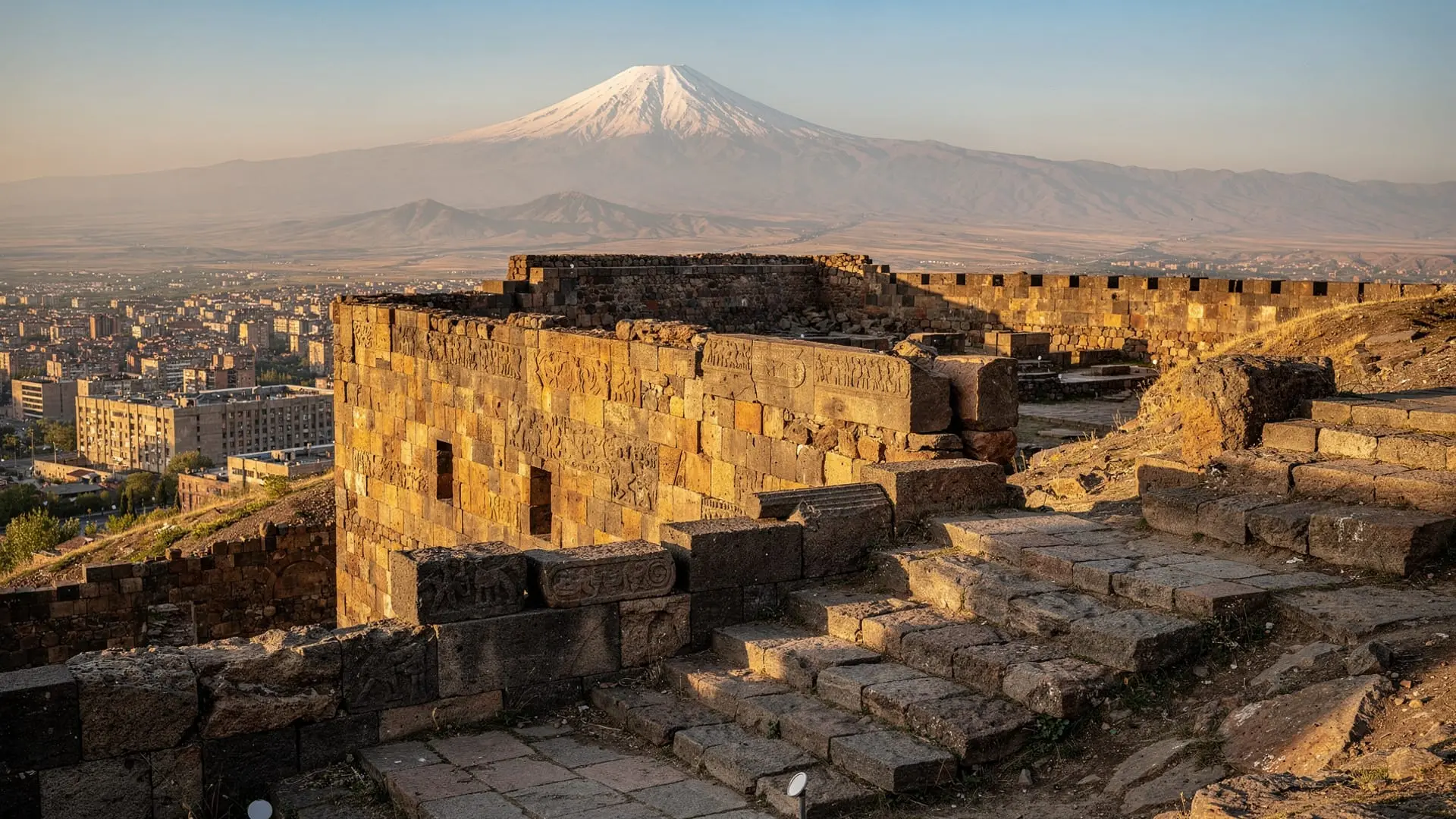
The fortress that named a city
Yerevan is one of the world’s oldest continuously inhabited cities. Not many cities can say their name traces back 2,800 years to a specific foundation inscription carved in stone. Yerevan can. The fortress of Erebuni, built on a rocky hill in the southeastern suburbs of the modern city in 782 BCE, was named in cuneiform script by its founder, the Urartu king Argishti I. That name — Erebuni — evolved through millennia of linguistic drift into Erevan and eventually Yerevan.
| Where | Erebuni district, ~8 km southeast of Republic Square, Yerevan |
| Cost | around 2,500 AMD combined museum + fortress ticket |
| Time needed | 1–1.5 hours self-guided |
| Getting there | GG Taxi (~800–1,200 AMD) or Metro to Garegin Nzhdeh Square + taxi |
| Best time | Early morning (8:00–10:00) for light and quiet; closed Mondays |
Standing on the reconstructed citadel walls and looking out over the modern city spreading below you to the north, it takes an effort of imagination to connect the two: the Iron Age hilltop fort and the Soviet-Armenian capital of 1.1 million people. But the connection is there, inscribed in stone, and the Erebuni Museum at the base of the hill is the most direct way to understand it.
The Urartu kingdom: Armenia’s oldest civilisation
To understand Erebuni, you need a basic map of the Urartu kingdom. The Urartians — whose name the Bible records as “Ararat” — built one of the most sophisticated civilisations of the ancient Near East between approximately the 9th and 6th centuries BCE. Their capital was at Tushpa (modern Van, in eastern Turkey); their territory at peak expansion covered what is now eastern Turkey, northwestern Iran, and the Armenian plateau.
Urartu was a literate, urban civilisation that built elaborate irrigation systems, produced fine metalwork (the Matenadaran has examples), and constructed dozens of fortified cities across the Ararat plain. Erebuni was one of those cities — a military and administrative centre on the western frontier of the kingdom, positioned to control the Ararat valley.
The fortress was built by Argishti I (reigned c. 785–763 BCE), one of the most expansionist Urartu kings. A basalt stele found on the hill carries the inscription: “By the greatness of Khaldi [the Urartu deity], Argishti, son of Menua, built this mighty fortress and called it Erebuni.” That stele is in the museum at the base of the hill and is the single most important object on the site.
The Urartu kingdom fell to the Medes around 590 BCE. Its material culture and population became the foundation of later Armenian civilisation — the continuity between Urartu and Armenia is complex and debated by scholars, but the physical sites remain, and Erebuni is the most accessible.
The museum at the base of the hill
The Erebuni Historical-Archaeological Museum sits at the foot of the fortress hill and should be visited before climbing to the citadel — it provides the context that makes the ruins legible.
The museum’s collection centres on objects excavated from the Erebuni site during systematic archaeological digs from the 1950s onwards. Key exhibits include:
The founding inscription: The basalt stele recording Argishti I’s construction of the fortress. This is the object that anchors Yerevan’s origin story. Even if you cannot read cuneiform, the inscription is moving for what it represents: a legible act of foundation, still readable after 2,800 years.
Bronze and iron weapons: Urartu warriors were equipped with sophisticated iron weapons, and the Erebuni excavations yielded a substantial arsenal. The spearheads, helmets, and shields on display show an advanced military technology.
Ceramic vessels: Large storage jars (some over a metre tall), drinking vessels, and oil containers give a vivid picture of the fortress’s domestic and administrative functions. The painted pottery in particular shows sophisticated Urartian decorative traditions.
Frescoes: The palaces within Erebuni were decorated with wall paintings, fragments of which survive. The museum displays reconstructions and some original fragments showing geometric patterns and procession scenes in the characteristic Urartian style — formal, hierarchical, using strong primary colours.
Scale model: A detailed architectural model of the fortress at its peak, showing the palace complex, temple, storage facilities, and defensive walls, is enormously useful for understanding what the ruins on the hill once looked like.
Admission to the museum is approximately 1,500 AMD (around 3.65 EUR at April 2026 rates). Allow 45 minutes to an hour.
The hilltop citadel
From the museum, a path leads up the hill to the fortress itself. The climb is gradual and takes about 10 minutes. The hilltop covers several hectares and includes partially reconstructed walls, the outlines of the original palace and temple complex, and sweeping views over the Ararat plain.
What you see at the top is a combination of original foundations (excavated and left in situ, marked by the characteristic volcanic stone), partial reconstruction (some walls have been rebuilt to waist height to suggest their original form), and informational panels explaining each area.
The main architectural elements of the fortress include:
The palace complex (Apadana): The central royal residence had a large columned hall — the Apadana — used for ceremonial functions. The column bases are visible; the hall would have been roofed with timber. The scale suggests a court of genuine sophistication.
The Susi temple: A temple dedicated to the Urartu god of storms and war, Teisheba. The temple’s sacred precinct has been excavated and partially marked.
Defensive walls: The perimeter walls, built of large basalt blocks, gave the fortress its military character. Some sections stand to significant height; others are reduced to foundations. The thickness of the walls — several metres in places — reflects the fortress’s role as a frontier stronghold.
The granary and wine storage: Large storage rooms at the base of the hill held wine (Urartu was an early wine-producing culture; Armenia’s viniculture tradition runs directly from this) and agricultural produce to supply the garrison through sieges.
The views from the hilltop are an underrated part of the Erebuni visit. On clear days you see Mount Ararat to the south (best visibility in the morning) and the entire spread of modern Yerevan to the north — a 2,800-year panorama compressed into one sweeping glance.
How busy is Erebuni compared with the Cascade?
Pleasantly uncrowded. Erebuni is one of the most historically significant sites in Yerevan but receives far fewer visitors than the Cascade or Matenadaran. On most mornings, especially weekdays, you may have the hilltop almost to yourself. This makes it one of the better places in Yerevan for unhurried exploration and photography.
The combination of relative quiet, genuine archaeological importance, and exceptional views makes Erebuni one of the most rewarding experiences in the city for historically-minded visitors — arguably more rewarding, hour for hour, than the busier central attractions.
Yerevan: Erebuni, Matenadaran, and Cascade City TourGetting to Erebuni
The museum and fortress are in the Erebuni district in southeastern Yerevan, about 8 km from Republic Square. Getting there independently requires a GG Taxi (around 800–1,200 AMD from the city centre, 10–15 minutes) or Metro to Garegin Nzhdeh Square station (red line) followed by a further taxi. There is no convenient bus route for most visitors.
Alternatively, the guided city tours that include Erebuni typically combine it with the Matenadaran and Cascade in a single half-day, which is the most time-efficient way to visit if you are not driving yourself.
Yerevan City Tour: Discover an Old and New YerevanErebuni and the Genocide Memorial
Erebuni is on the southern side of Yerevan; the Genocide Memorial at Tsitsernakaberd is also in the southern part of the city, about 5 km to the northwest. The two are logical to combine in a half-day, though emotionally they occupy very different registers — one is an ancient military foundation, the other a memorial to the most traumatic event of modern Armenian history. Allow time between them.
Frequently asked questions about Erebuni
Why is Yerevan named after Erebuni?
The fortress founded in 782 BCE was called “Erebuni” in cuneiform. Over 2,800 years, through Armenian, Persian, Arabic, and Russian phonological influences, Erebuni evolved into Yerevan. The connection is confirmed by the founding inscription and by archaeological continuity showing settlement in the area from the Urartu period onwards.
Who were the Urartu people?
The Urartu were a people of the ancient Near East who built a sophisticated kingdom on the Armenian plateau roughly between 860 and 590 BCE. Their language was distinct from Armenian (though written in a modified Assyrian cuneiform). Modern scholars see Urartu as a direct cultural predecessor of later Armenian civilisation, though the ethnic and linguistic continuity is complex. The Urartu built cities, produced fine metalwork, maintained sophisticated irrigation, and left cuneiform inscriptions across the Armenian plateau.
Is Erebuni worth visiting with children?
Yes, particularly for older children (8+) who can engage with the archaeology. The museum has physical objects — weapons, ceramics, helmets — that are visually immediate. The hilltop walk is easy and the views are impressive. There are no interactive children’s exhibits, but a good guide can make the ancient military context engaging.
How does Erebuni compare to the History Museum of Armenia?
The History Museum on Republic Square has a larger Urartu collection drawn from multiple sites across Armenia, including objects from Erebuni. Erebuni has the advantage of physical context — standing on the actual site gives the objects a resonance the History Museum cannot replicate. Ideally visit both: the museum for depth, Erebuni for atmosphere and authenticity. See our museum ranking for a fuller comparison.
Are there other Urartu sites I can visit in Armenia?
Several. The most significant Urartu remains outside Yerevan are at Karmir Blur (“Red Hill”), another fortified city about 5 km from Erebuni and visible from the highway (less accessible than Erebuni, less visitor infrastructure). Argishtihinili, near Armavir, is another Urartu foundation, though it receives minimal visitors. For the richest Urartu museum collection, the Van Museum in eastern Turkey (outside Armenia) is the standard reference, though obviously inaccessible from Yerevan.
| Site | Accessibility | What you’ll find |
|---|---|---|
| Erebuni | Easy — museum, marked trails, taxi 10–15 min | Founding inscription, reconstructed walls, best views |
| History Museum (Republic Sq.) | Very easy — central Yerevan | Largest Urartu collection, objects from multiple sites |
| Karmir Blur | Difficult — minimal infrastructure | Unexcavated-feeling ruins, no crowds |
| Argishtihinili (Armavir) | Difficult — rarely visited | Urartu foundation site, minimal signage |
Can I combine Erebuni with a Yerevan day-trip to other archaeological sites?
Erebuni pairs naturally with the History Museum for an archaeology-focused day. For a broader ancient Armenia experience, combine Erebuni with Garni Temple (Hellenistic, 1st century AD) in Kotayk province — about 30 km east — for a full day showing the sweep from Urartu through to the pagan Armenian kingdom of Artaxiad and beyond. See the Garni and Geghard day-trip guide for logistics.
Is Erebuni included in the Yerevan City Card or similar passes?
Coverage varies by pass provider and changes periodically — check the current terms of any city card before relying on it, since some cover only central-Yerevan sites. Independent tickets are inexpensive enough (~2,500 AMD combined) that most visitors simply pay on arrival rather than planning around a pass.
How does Erebuni compare to visiting Garni Temple for a first-time ancient-history stop?
They cover different periods and are complementary rather than substitutes — Erebuni is Iron Age Urartu (8th century BCE), Garni is Hellenistic-Roman (1st century AD). If forced to choose one, Garni has the more visually dramatic single structure (a standing colonnaded temple), while Erebuni has the deeper historical resonance as the literal origin point of Yerevan. Most itineraries with two or more days in the region fit both.
The cuneiform inscriptions: what they actually say
The stele found at Erebuni is not the only cuneiform text associated with the site. Several inscriptions were discovered during the excavations of the 1950s through 1980s, each adding detail to the picture of how the fortress functioned.
The founding inscription — the most important — records Argishti I’s construction of the city, its dedication to the god Khaldi (the supreme Urartu deity), and the number of workers brought to build it. The inscription notes that 6,600 soldiers from conquered Hatti and Tsupani were resettled at Erebuni to populate the city. This was standard Urartu practice: captured populations were not killed but moved to frontier cities to provide labour and eventually integrate into Urartu society. Erebuni was, in part, a city built by displaced peoples — a history that resonates differently in a region that has seen its own displacements.
Other inscriptions at the site record military campaigns, dedications to Khaldi and Teisheba (the storm god), and administrative records of stored goods. The cuneiform script used is a modified version of Assyrian cuneiform, adapted to write the unrelated Urartu language (sometimes called Urartian or Nairi). The Urartian language is not related to Armenian; it was extinct by the time recognisably Armenian-speaking populations emerge in historical sources.
Deciphering these inscriptions has been a decades-long international scholarly effort, drawing on Assyriologists as much as Armenian archaeologists, since the cuneiform script itself was borrowed rather than native. For visitors, the practical takeaway is simpler: even without reading a word of cuneiform, standing beside a stone that has recorded a city’s founding for 2,800 continuous years carries its own weight, independent of the philology behind it.
Guided tour vs self-guided: which to choose
Self-guided is perfectly viable at Erebuni, and the informational panels on the hilltop are reasonably detailed. The museum has object labels in Armenian and English, though some translations are dated in style. Allow 30–45 minutes for the museum and 30–45 minutes for the citadel. Total: 1.5 hours at a relaxed pace.
Guided tour adds genuine value here because the archaeological context is dense and the ruins require imagination to interpret. A good guide can explain which ground-level stone outlines correspond to which parts of the palace, where the wine storage was (and why Urartu wine production matters for Armenian viticulture history), and how to read the cuneiform inscription for someone with no prior exposure. The difference between visiting Erebuni alone and with a knowledgeable archaeologist or guide is significant.
Group tours from Yerevan typically combine Erebuni with the Matenadaran (manuscript museum) and the Cascade — a logical pairing that covers 2,800 years of Armenian cultural history in a single half-day.
Group Tour: Yerevan Highlights, Erebuni Museum & FortressThe half-day Yerevan archaeology circuit
For visitors with a genuine interest in ancient history, the following sequence works well as a half-day (roughly 5–6 hours including travel):
9:00 — Erebuni Museum and Fortress. Start early when the light on the hilltop is best for photography and the site has minimal other visitors. Spend 1.5 hours.
11:00 — Matenadaran Manuscript Museum (Northern Avenue, 30 minutes by taxi from Erebuni). The Matenadaran holds one of the world’s most important collections of ancient manuscripts, including Urartian-era and early medieval Armenian documents. The collection gives a 3,000-year perspective on Armenian literacy that pairs well with Erebuni’s cuneiform inscriptions. Allow 1.5 hours.
13:00 — Lunch. The Cascade district (10 minutes’ walk north of the Matenadaran) has several good mid-range restaurants. Gusto and Sherep are both in this area.
14:30 — Cascade Complex and Cafesjian Museum. The Cascade’s sculpture garden and the modern art in the Cafesjian Museum provide the 21st-century Armenian cultural counterpoint to the morning’s ancient sites. The walk up the Cascade levels (free) takes 20–30 minutes.
The entire circuit costs under 10,000 AMD (24 EUR) including entrance fees, and covers Armenian cultural history from 782 BCE to the present.
Photography tips at Erebuni
Best light: Early morning (8:00–10:00) provides low-angle light that picks out the texture of the basalt stone walls and creates shadows in the foundation outlines that help the ruins read clearly in photographs. Midday is flat and hot.
Mount Ararat framing: On a clear morning, Ararat is visible from the hilltop behind you as you face north toward the city — it appears as a white cone above the urban sprawl. The composition of Urartu walls in the foreground with Ararat in the distance is striking and thematically resonant (the Urartu king Argishti controlled this plain precisely because Ararat dominated it). Best visibility for Ararat: spring (April–May) and autumn (October) mornings.
The founding inscription stele: Photograph it through the glass in the museum in early morning when exterior light bounces into the room. Avoid flash (prohibited) and use a tripod or brace against the display case edge.
Drone note: Erebuni is within the Yerevan urban zone and is classified as a restricted flight area. Do not fly a drone here without explicit Armenian Civil Aviation Committee permission.
Practical details: opening hours and admission
The museum and fortress share a site and a combined ticket. As of May 2026:
- Hours: Tuesday–Sunday, 10:00–18:00. Closed Mondays.
- Combined ticket (museum + fortress): approximately 2,500 AMD (6 EUR)
- Children under 7: free
- Photography permit: included in admission
The site has a small café at the base of the hill (open in high season) and basic toilet facilities. There is no cloakroom — travel light. The hill path is paved gravel and manageable in ordinary walking shoes; high heels are inadvisable.
The Erebuni district has a few local restaurants near the metro station (Garegin Nzhdeh Square), mostly neighbourhood places without tourist menus, which are authentic and cheap if you want lunch before or after.
Erebuni for visitors on a tight Yerevan schedule
If you have only one day in Yerevan and are weighing whether Erebuni earns a place on it, the honest calculation depends on your interests. History-minded travellers get outsized value here — 1.5 hours delivers 2,800 years of context that reframes everything else you see in the city, including Republic Square and the Cascade. Visitors more interested in food, nightlife, or Soviet-modernist architecture may reasonably prioritise the Cascade art collection or a Soviet modernism tour instead and treat Erebuni as a second-day addition if time allows. For a first-time visitor building a 7-day Armenia itinerary, Erebuni fits comfortably into a Yerevan city day alongside the Matenadaran without feeling rushed.
Why Erebuni matters beyond archaeology
Erebuni’s significance extends past its objects and walls. It anchors Armenia’s claim to continuous urban civilisation reaching back further than most European capitals — a point of genuine national pride that comes up often in conversations with Armenian guides and hosts. The site also illustrates a recurring pattern in the region’s history: population movement and resettlement, visible here in the 6,600 workers relocated from conquered territories to build the city, echoed in different forms throughout Armenian history down to the 20th century. Visitors who want the fuller historical arc from Urartu through to the modern Armenian state should pair Erebuni with the Genocide Memorial at Tsitsernakaberd and the History Museum — together they sketch a continuity of Armenian presence on this plain that spans nearly three millennia.