Garni & Geghard: the perfect day trip from Yerevan
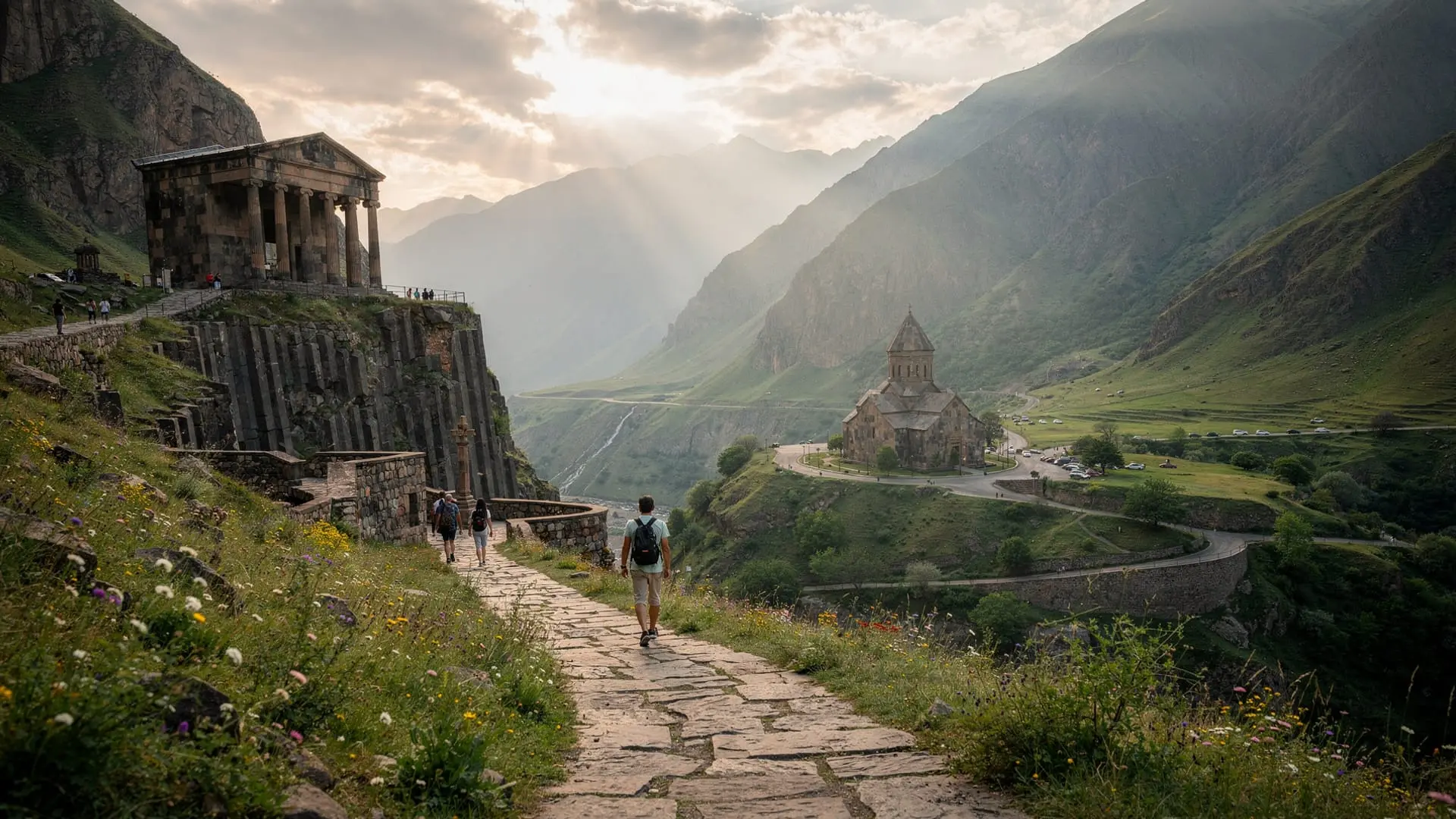
| Where | Garni (28 km) and Geghard (37 km) east of Yerevan |
| Cost | Garni ~1,000 AMD; Geghard free (donation customary) |
| Time needed | 6–8 hours round trip including stops |
| Getting there | Marshrutka + local taxi, GG Taxi round trip, or organised tour |
| Best time | April–May or September–October; arrive before 10am to avoid crowds |
Armenia packs a remarkable amount of history into a small area, and nowhere is that more obvious than on the short road east of Yerevan. Within 50 kilometres you step from Armenia’s only surviving Hellenistic pagan temple — built when Julius Caesar still lived — into a medieval cave monastery carved so deeply into volcanic basalt that daylight barely reaches the inner chapels. Throw in a gorge full of hexagonal basalt columns that look like a giant’s pipe organ, and you have the most compelling day trip in the entire country.
The Garni–Geghard loop is the route that earns Armenia its reputation. Tour operators run it daily; independent travellers rent a car or share a taxi for the morning. Either way, the distances are short enough that even a half-day works if you arrive early. This guide covers every decision: transport options, entry fees, what to eat, seasonal warnings, and how to combine the route with Lake Sevan if you want a longer day.
Why these two sites belong together
Garni temple and Geghard monastery sit 9 kilometres apart along the Azat river gorge, which makes combining them completely natural. The contrast is also part of the appeal. Garni is Armenia’s sole pagan survivor — a Greco-Roman temple dedicated to the sun god Mihr, reconstructed in the 1970s after a 1679 earthquake reduced it to rubble. It stands on a dramatic basalt promontory above the Azat river canyon, the columns gleaming white against ochre cliffs.
Geghard (meaning “spear” in Armenian, after the lance said to have pierced Christ at the Crucifixion) is the opposite extreme: a UNESCO World Heritage Site carved partly into the living rock, founded in the 4th century and expanded into elaborate grottoes and khachkar-lined halls throughout the medieval period. Where Garni is open, sunny, and geometric, Geghard is dark, acoustic, and ancient beyond words.
The Symphony of Stones — a natural formation of vertical basalt columns that lines the Azat gorge floor below Garni — acts as the third element: purely geological, genuinely surreal, and reached by a short walk down from the temple.
Getting there from Yerevan
Yerevan → Garni: 28 km, about 40 minutes by car. The road is good asphalt the entire way, heading east on the M5 through Yerevan’s suburbs before climbing into the Kotayk hills.
Garni → Geghard: 9 km, about 15 minutes along a narrow valley road that threads through the village of Goght.
Options:
- Shared marshrutka (minibus): From Yerevan’s Kilikia bus terminal, marshrutkas run to Garni roughly hourly (8000–10 000 AMD return, schedule variable). From Garni to Geghard, local taxis wait at the temple — negotiate 2 000–3 000 AMD. No direct marshrutka connects Garni to Geghard.
- GG Taxi from Yerevan: A round trip with waiting time at both sites costs roughly 20 000–30 000 AMD (about 50–75 EUR). Perfectly reasonable split between two or three people.
- Rental car: Easiest option if you want full flexibility. Roads require no 4WD; standard cars handle both sites comfortably year-round.
- Organised tour: Group tours departing Yerevan daily typically cost 8 000–15 000 AMD per person and include a guide at both sites. Private tours run higher but offer door-to-door service.
Book a guided Garni & Geghard day trip from Yerevan
The Garni temple: what to expect
Garni opens daily; the site charges a small entry fee (1 000 AMD per adult, April 2026). Plan 45–60 minutes here. The temple itself is compact — only eleven columns wide — but the promontory setting and the gorge view are extraordinary. Walk around the perimeter walls for the best perspectives, then take the footpath down into the gorge to reach the Symphony of Stones.
The Symphony of Stones requires a descent of roughly 20 minutes on a stepped path (steep in places — wear shoes with grip). At the bottom, the hexagonal basalt columns rise 50 metres from the riverbed, their geometric precision utterly unlike anything else in Armenia. Allow another 20–30 minutes here before climbing back up.
Practical notes: The promontory gets hot in summer; carry water. The gorge path is icy in January and February — consider avoiding the descent in winter.
Just outside the temple gates, several houses offer lavash baking experiences (Armenian flatbread baked on the wall of a tonir clay oven). This is not a tourist trap — local families have done this for decades and the participation is genuine. Budget 3 000–5 000 AMD per person and 45 minutes.
Garni & Geghard tour with lavash baking experience
Geghard monastery: navigating the rock
Entry to Geghard is free. The monastery complex unfolds in layers: a 13th-century gavit (narthex) leads into the main church, and from there narrow passages cut into the cliff open into two rock-hewn chambers filled with khachkars, spring water, and the sound of chanting if a service is in progress. The acoustics in the innermost grottos are extraordinary — voices carry and multiply in a way that makes the darkness feel inhabited.
Allow 60–90 minutes. The site becomes crowded between 11am and 3pm in peak season (June–August); arriving before 10am or after 3pm makes for a much calmer experience. In winter, the rock-hewn chambers stay surprisingly warm even when the valley is cold.
Honest note on crowds: Weekend mornings bring bus groups from Yerevan. If you arrive at 9am on a weekday, you may have the inner chambers almost to yourself. On a Saturday in July, the courtyard fills completely.
Combining with the Symphony of Stones and a village lunch
Many visitors miss the gorge descent and the village side entirely, which is a shame. The ideal sequence for a full but unhurried day:
- Yerevan departure 8:30–9:00
- Garni temple + gorge descent to Symphony of Stones (2 h)
- Lavash baking at a village house in Garni (45 min)
- Drive to Geghard (15 min)
- Geghard monastery, inner grottos, courtyard (90 min)
- Lunch at one of the roadside restaurants in Goght village or back in Garni
- Return to Yerevan by 3:30–4:00
Lunch options near the route are basic but satisfying: khorovats (Armenian barbecue), herb salads, lavash, and cold matsun (yoghurt). Budget 3 000–6 000 AMD per person.
Extending to Lake Sevan
If you want a longer day, the road from Geghard continues north-east through the Kotayk hills toward Lake Sevan, adding another 45 minutes of driving. This works best with a private car or taxi, as marshrutka connections between Geghard and Sevan are non-existent. The Lake Sevan & Dilijan day trip guide covers the logistics in full. For the best beaches at Sevan, the Lake Sevan beaches guide has a full comparison.
Garni, Geghard & Lake Sevan combined day tour
Seasonal considerations
- April–May: Ideal — wildflowers in the gorge, mild temperatures (15–22°C), few crowds.
- June–August: Hot (30–35°C on the promontory), crowded, but the gorge stays cool. Arrive early.
- September–October: Second-best window — golden light, comfortable temperatures, some foliage colour in the gorge.
- November–March: Garni and Geghard remain open. The gorge path can be icy January–February. The Geghard grottos are fully accessible year-round.
What it costs: budget breakdown
| Item | Cost (AMD) | Cost (EUR approx.) |
|---|---|---|
| Garni entry | 1 000 | ~2.50 |
| Geghard entry | Free | — |
| Marshrutka from Yerevan (return) | 8 000–10 000 | ~20–25 |
| GG Taxi, full round trip | 20 000–30 000 | ~50–75 |
| Group tour per person | 8 000–15 000 | ~20–37 |
| Lavash baking experience | 3 000–5 000 | ~7–12 |
| Lunch in village | 3 000–6 000 | ~7–15 |
Guided tour or independent: which is better?
The question comes up for almost every Armenia day trip and the honest answer depends on what you want. For Garni and Geghard specifically:
Choose a guided tour if:
- You want historical context explained at both sites (Garni’s Hellenistic connections, Geghard’s medieval carving history, the symbolism of the khachkars)
- You prefer not to deal with transport logistics
- You’re travelling solo and group tours mean meeting other travellers
- You want lavash baking included in a single booking
Group tours departing Yerevan typically include hotel pickup, a local guide at both sites, the lavash experience, and sometimes lunch. They start between 8:30 and 10am — for the best light at Garni, try to find a tour with an 8:30 departure.
Choose independent travel if:
- Flexibility matters more than cost — you want to spend 2 hours at the Symphony of Stones rather than the 30 minutes most group tours allow
- You want a dawn departure to avoid crowds
- You’re with two or more people (splitting GG Taxi costs makes it competitive with group tour pricing)
- You want to linger at the lavash house or explore the village
The independent route is perfectly achievable. The marshrutka to Garni from Kilikia runs roughly hourly from 7am. At Garni you can flag or arrange a local taxi to Geghard (15 minutes, negotiate the fare: 2 000–3 000 AMD). Return marshrutkas to Yerevan from Garni run until early evening.
Photography guide for Garni and Geghard
These two sites are among the most photographed in Armenia. A few tips that separate mediocre from excellent results:
Garni temple:
- Best light is from the east in early morning (8–10am) when the sun hits the main colonnade directly and the columns glow. Arrive before tour groups descend.
- The gorge viewpoint behind the temple (walk 100 metres north along the perimeter) gives a wide shot with the temple in the foreground and the Azat canyon below — one of the classic Armenia compositions.
- The Symphony of Stones from the gorge floor benefits from mid-morning side light (10am–noon) which makes the individual columns read clearly.
- Avoid shooting at high noon in summer — harsh overhead light flattens the columns.
Geghard monastery:
- The interior grotto chambers require a wide aperture and slow shutter speed or a small tripod. No flash in religious spaces — ask before photographing during services.
- The exterior gavit doorway in late afternoon (3–5pm in summer) catches warm light on the carved stone. The carved birds and biblical panels in the tympanum reward a telephoto shot.
- The courtyard with the main church door and surrounding khachkars: shoot from low angle looking up to compress the monastery walls against the mountain behind.
What to eat on this day trip
Food options cluster around the Garni area — the Geghard valley has minimal infrastructure.
In Garni village: Several family-run restaurants and guesthouses serve traditional Armenian food — tolma (stuffed vine leaves), khorovats (grilled meat), herb salads, fresh lavash, matsun (strained yoghurt). Quality is generally good and prices are low (2 500–5 000 AMD for a full meal). Look for places with outdoor seating on the canyon rim.
Lavash baking: The best “food experience” of the day doesn’t come from a restaurant but from a village home. Several families near the Garni temple gate welcome visitors to their tonir (clay oven) for lavash baking. You roll the dough, slap it against the oven wall, and eat the result immediately with local cheese and honey. This is authentic — not a performance. Budget 3 000–5 000 AMD per person.
In Goght village (between Garni and Geghard): a roadside grill and a small café serve basic food. Good for a quick lunch stop when driving the loop.
The Garni Gorge restaurant: A larger restaurant at the Garni gorge entrance serves Armenian food with a terrace view. Reliable but pricier than village options.
Families and older travellers: what to expect
The Garni-Geghard loop is generally manageable for families and older travellers, but the two sites make different physical demands. Garni’s temple platform and perimeter walls are flat and easy; the Symphony of Stones descent, by contrast, is a genuine 20-minute stepped hike each way and is not suitable for anyone with significant mobility limitations or very young children in a stroller. Geghard’s main church and gavit are reached by a short, level walk from the car park, making the monastery itself accessible even for visitors who skip the Garni gorge descent. Families with children old enough to enjoy the acoustics and khachkar carvings (roughly 6 and up) tend to find Geghard genuinely engaging rather than just another old building — the semi-dark grottoes have a natural sense of adventure that appeals to kids. See the kid-friendly monasteries guide for more on which Armenian religious sites work best with children.
Combining with a wider Kotayk province exploration
Garni and Geghard sit within Kotayk province, which has more to offer travellers with an extra day. The village of Bjni, with its own ruined fortress and medieval church, lies within reach for those who enjoyed Garni’s dramatic setting and want a quieter, less-visited equivalent. Travellers interested in extending the pagan-to-Christian theme of the day should also consider Yerevan’s Erebuni fortress, which predates both Garni and Geghard by over a thousand years and gives useful context for how far back organised settlement in this part of Armenia actually goes.
Frequently asked questions about the Garni and Geghard day trip
Can I visit Garni and Geghard without a tour?
Yes, entirely. Either take the Garni marshrutka from Kilikia terminal and a local taxi for the final 9 km to Geghard, or use GG Taxi for the full loop. No guide is required at either site, though a guide adds significant depth to Geghard’s medieval history.
How much does a round trip taxi cost from Yerevan?
A GG Taxi or negotiated private taxi for the round trip — including waiting time at both sites — typically runs 20 000–30 000 AMD (50–75 EUR). Shared among two or three people it becomes very reasonable. Always agree on the price before departure.
Is there an entry fee for Geghard?
No. Geghard monastery charges no admission fee (as of April 2026). Garni temple charges 1 000 AMD per adult. A small donation box inside Geghard is customary.
Is the Symphony of Stones worth the descent?
Strongly yes. The 20-minute descent is steep but well-maintained. The scale of the basalt columns is genuinely impressive and the gorge floor is peaceful. The only reason to skip it is mobility limitations or winter ice on the path.
What should I wear to Geghard?
Women should carry a headscarf (available for purchase at the gate). Shoulders and knees should be covered to enter the main church. The rock grottos are cool even in summer — bring a light layer.
Can I visit in winter?
Both sites are accessible in winter. The main risk is the gorge descent to the Symphony of Stones, which can be icy in January and February. Geghard’s rock-cut chambers are frost-free and often uncrowded in winter months.
What is the best time of day to visit?
Before 10am avoids tour groups at Geghard’s inner chapels. For photography, early morning light hits the Garni temple’s east-facing columns beautifully between 8 and 10am. Late afternoon (after 4pm in summer) is also excellent and less crowded.
Is Garni and Geghard better than Khor Virap and Noravank for a first-time visitor’s single day trip?
They cover different themes rather than competing directly — Garni/Geghard is the pagan-to-medieval-Christian story close to Yerevan, while Khor Virap and Noravank is further south and pairs an Ararat-view monastery with a dramatic red-cliff site. If forced to choose one day trip on a short first visit, Garni/Geghard has the edge on convenience (shorter drive, easier logistics) and the Symphony of Stones adds a natural-wonder element the southern route lacks. With two or more days available, do both.
Can I combine Garni and Geghard with Yerevan city sightseeing in the same day?
It’s possible but tight. A focused Garni-Geghard trip with the recommended pacing above fills 6–8 hours, leaving only a couple of hours for the city on the same day — realistic for an evening stroll around Republic Square or the Cascade, but not for a full museum visit. Most itineraries treat this as a dedicated day and save Yerevan’s cultural sites for a separate day.
Choosing your Garni-Geghard transport option
| Option | Cost | Flexibility | Best for |
|---|---|---|---|
| Marshrutka + local taxi | 8,000–10,000 AMD + 2,000–3,000 AMD | Low — fixed schedule | Budget solo travellers comfortable with logistics |
| GG Taxi round trip | 20,000–30,000 AMD | High | Pairs or small groups wanting flexibility |
| Group tour | 8,000–15,000 AMD/person | Low — fixed itinerary | Solo travellers, first-timers wanting context |
| Rental car | Varies + fuel | Highest | Those extending to Lake Sevan or exploring further |