Etchmiadzin & Zvartnots: UNESCO half-day trip
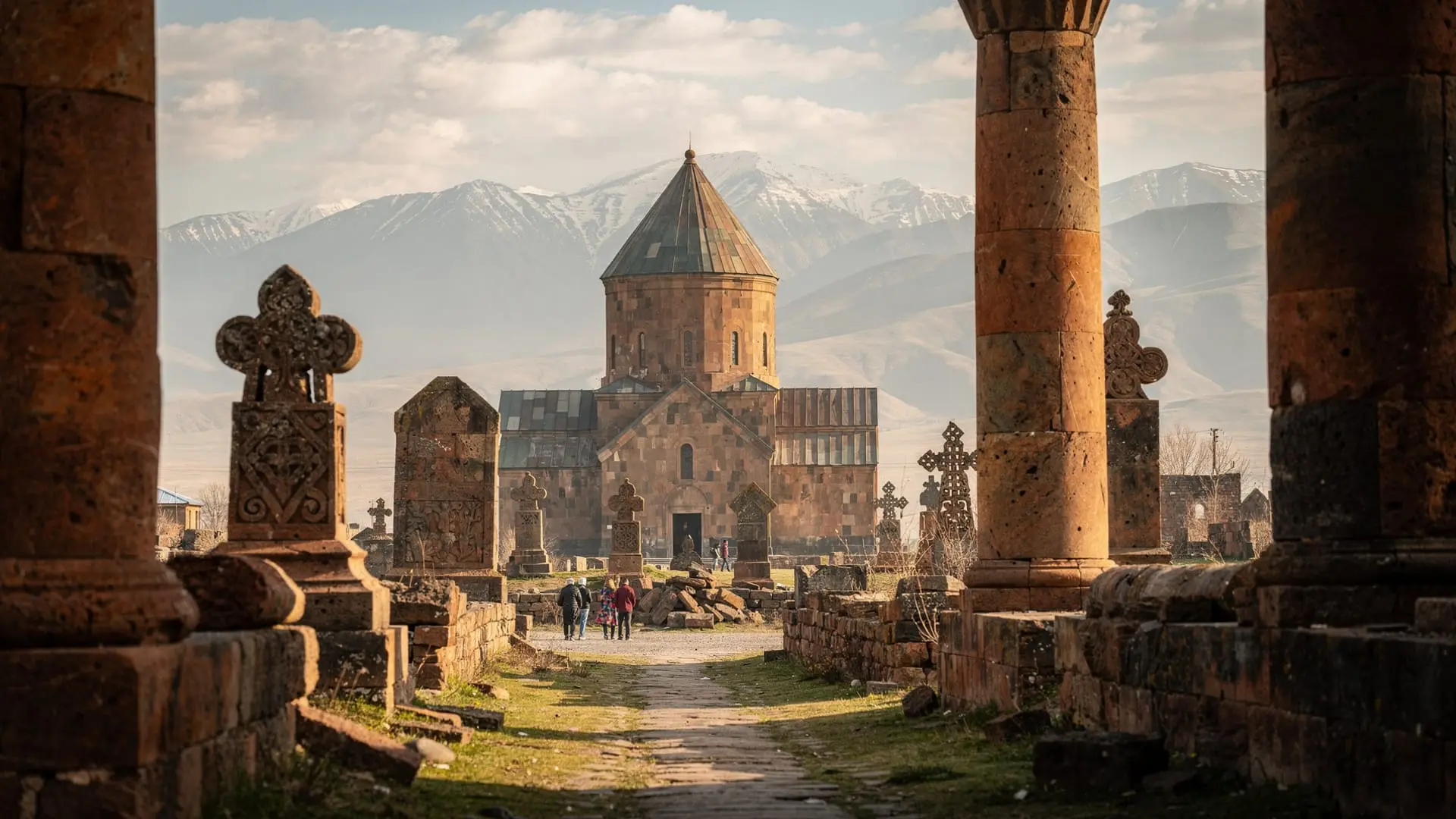
Of all the day trips from Yerevan, the Etchmiadzin and Zvartnots run earns the highest “significance per kilometre” ratio. In 25 kilometres west of the capital, you reach the spiritual heart of Armenian Christianity: a complex of UNESCO World Heritage churches built between the 4th and 7th centuries, including the mother cathedral of the Armenian Apostolic Church — one of the oldest Christian churches still in use on Earth — and the spectacular ruins of a 7th-century cathedral that once stood 45 metres tall.
| Where | Etchmiadzin (25 km) and Zvartnots (12 km further) west of Yerevan |
| Cost | ~1,000 AMD Treasury + ~1,500 AMD Zvartnots; cathedral free |
| Time needed | Half-day (4–5 hrs including travel) |
| Getting there | Marshrutka 106/107 (~300 AMD) or GG Taxi round trip (~8,000–12,000 AMD) |
| Best time | Morning departure; avoid major feast days for a quieter Treasury visit |
The half-day version of this trip is among the most efficient in Armenia. This guide covers what to prioritise, what the entry fees are, and how to extend the trip into a full day if history is your main interest.
Etchmiadzin: more than just a cathedral
The name Etchmiadzin (formally Vagharshapat) refers both to the small city and to its cathedral complex, which serves as the headquarters of the Armenian Apostolic Church. The name means “the only-begotten descended” in Armenian, referring to a vision in which Gregory the Illuminator saw Christ strike the earth to indicate where the cathedral should be built.
What the complex contains:
- Mother Cathedral of Etchmiadzin: Built in 301–303 AD (the original structure; extensively modified since), this is the oldest state-built church in the world and the seat of the Catholicos, the head of the Armenian church. The interior is rich with gold, dark wood, and frescoes. Entry is free; a modest donation is appropriate.
- Cathedral Treasury Museum: A separate building within the complex contains relics including the Holy Lance (claimed to be the spear that pierced Christ at the Crucifixion) and a fragment of Noah’s Ark timber from Mount Ararat. Entry approximately 1 000 AMD. Worth 30–45 minutes.
- Church of St Hripsime (618 AD): A UNESCO site in its own right, 1 km from the main cathedral — a perfect example of early Armenian church architecture with a characteristic conical dome. Free entry.
- Church of St Gayane (630 AD): 500 m from the cathedral, a smaller but beautifully preserved church with fine stone carving.
- Church of St Shoghakat: A later addition but part of the UNESCO cluster.
Practical notes: The cathedral complex opens from 8am. Sunday services attract large congregations of worshippers and diaspora visitors — atmospheric but crowded. Photography inside the cathedral is permitted but be respectful during services.
Book a private Etchmiadzin & Zvartnots day trip from Yerevan
Getting to Etchmiadzin from Yerevan
Distance: 25 km west of central Yerevan. Drive time: 30 minutes by car or taxi via the A1 highway.
Options:
- Marshrutka 106 or 107 from Yerevan’s Admiral Isakov Avenue runs to Vagharshapat/Etchmiadzin regularly — cheapest option (~300 AMD), about 40–45 minutes.
- GG Taxi: approximately 2 000–3 000 AMD one way. Round trip with waiting: 8 000–12 000 AMD.
- Organised tour: Numerous day tours depart daily; most combine Etchmiadzin with Zvartnots and sometimes Khor Virap.
Zvartnots: the cathedral that fell
Zvartnots cathedral (meaning “cathedral of the vigelant forces” — possibly referring to celestial watchmen) was built by Catholicos Nerses III between 641 and 661 AD. It was one of the most ambitious architectural projects of the early Armenian church: a triple-tiered rotunda rising to an estimated 45 metres, with elaborately carved pomegranate and vine-scroll reliefs on its exterior columns. It was destroyed by an earthquake in 930 AD and lay buried and forgotten for nearly 1 000 years until excavations in 1901–1907 revealed its foundations and scattered column capitals.
What you see today is extensive archaeological ruins: the circular foundation plan, column bases and capitals, fragments of the exterior vine carving, and a small museum on the north side of the site that reconstructs the original appearance via models and finds. The ruins are genuinely beautiful in a melancholy way — circular foundations in a flat field with Ararat visible to the south on clear days.
Zvartnots details:
- Location: 12 km east of Etchmiadzin (near Zvartnots Airport), about 10–15 minutes by car.
- Entry: approximately 1 500 AMD
- Hours: 10am–5pm (closed Mondays)
- Time needed: 45–60 minutes
Book a group tour to Etchmiadzin cathedral and Zvartnots
Recommended sequence for the half-day
The ideal sequence depends on whether you are coming from Yerevan or returning:
Yerevan → Zvartnots (en route) → Etchmiadzin → Yerevan:
- Zvartnots is passed on the way from Yerevan, so visiting it first avoids backtracking.
- Arrive Zvartnots at 10am (when it opens), spend 45–60 minutes, continue to Etchmiadzin for the main cathedral, churches, and museum.
- Lunch in Vagharshapat town (several cafés on the main square) before returning.
Yerevan → Etchmiadzin → Zvartnots → Yerevan:
- Suits those whose primary interest is the cathedral and want the main experience first.
- Works fine either way — the detour to Zvartnots adds about 20 minutes of driving.
Is the Armenian Apostolic Church Catholic or Orthodox?
This question comes up constantly and deserves a clear answer. The Armenian Apostolic Church is neither Catholic nor Eastern Orthodox. It belongs to the Oriental Orthodox tradition — a distinct family of ancient churches (also including the Coptic, Ethiopian, Syriac, and Malankara churches) that split from what became Eastern Orthodoxy and Catholicism at the Council of Chalcedon in 451 AD. The Catholicos of All Armenians, based at Etchmiadzin, is the head of the church and is fully autonomous — not in communion with Rome or Constantinople.
Understanding this distinction matters when visiting Etchmiadzin: the liturgy, vestments, and calendar differ from both Catholic and Eastern Orthodox traditions. Christmas, for example, is celebrated on January 6 rather than December 25.
Extending to a full day
If you have more time or a deep interest in Armenian history:
- Sardarapat memorial (20 km north of Etchmiadzin): a massive Soviet-era monument commemorating the 1918 Battle of Sardarapat, with a good ethnographic museum. Adds 1–1.5 hours.
- Khor Virap monastery (35 km south of Etchmiadzin): combining all three makes for a full day through Armavir and Ararat provinces. The Khor Virap & Noravank guide covers the southern extension.
A combined Garni + Geghard + Etchmiadzin + Zvartnots in a single day is possible but feels rushed unless you start very early. Better to prioritise.
What this half-day costs
| Item | Cost (AMD) | EUR approx. |
|---|---|---|
| Etchmiadzin cathedral | Free | — |
| Cathedral Treasury Museum | ~1 000 | ~2.50 |
| Zvartnots entry | ~1 500 | ~3.70 |
| GG Taxi round trip with waiting | 8 000–12 000 | ~20–30 |
| Group tour per person | 8 000–14 000 | ~20–35 |
| Lunch in Vagharshapat | 3 000–5 000 | ~7–12 |
Combining with Khor Virap: the two-religion half-day
For travellers interested in contrasting religious sites in a single morning, Etchmiadzin and Khor Virap share a thematic connection: both are foundational to the story of Armenian Christianity. Etchmiadzin is where the faith was officially established; Khor Virap is where its founder was imprisoned.
The distance between them is modest — Etchmiadzin is 25 km west of Yerevan, Khor Virap is 35 km south. Driving between them (bypassing Yerevan via the orbital road or through the city) takes about 50–60 minutes.
A half-day itinerary:
- 7am: Khor Virap at dawn (Ararat views before haze, pit descent, 60 min)
- 8:30am: Drive to Etchmiadzin
- 9:30am: Etchmiadzin cathedral complex and treasury (90 min)
- 11:30am: Zvartnots ruins (45 min)
- 12:30pm: Return to Yerevan
This gives you the two most significant Christian heritage sites in Armenia before noon. It requires an early start but no more than half the day, leaving the afternoon for Yerevan itself.
Getting the most from the treasury museum
Many visitors to Etchmiadzin enter the main cathedral, admire the interior, and leave without visiting the Treasury Museum — a mistake for anyone interested in Armenian religious art and history.
The treasury contains:
- The Holy Lance (Geghard): One of two relics claimed to be the spear that pierced Christ at the Crucifixion. Armenia’s relic has been here since the 7th century.
- The Hand of St Gregory: The mummified right hand of the founding saint. Used by the Catholicos to consecrate holy myron (anointing oil) to this day.
- A fragment of Noah’s Ark timber: Claimed to be from Mount Ararat, brought to Etchmiadzin by a 6th-century bishop.
- Vestments and liturgical objects from across 1 700 years of the church’s existence — embroidered robes, jewelled reliquaries, gospel covers in silver and gold.
The exhibition is modest by Western museum standards but the objects are extraordinary for their age and continuous use. Entry is approximately 1 000 AMD, well worth 30–45 minutes.
Etchmiadzin’s place in Armenian identity
Understanding Etchmiadzin properly requires knowing something about what the Armenian Apostolic Church means to Armenians worldwide. The church is not merely a religious institution — it is one of the primary anchors of Armenian national identity, particularly for the diaspora scattered across dozens of countries since the Genocide of 1915.
For the approximately 10 million Armenians living outside the Republic of Armenia (in Russia, the United States, France, Lebanon, Syria, and elsewhere), Etchmiadzin represents the continuity of a civilisation that has been threatened, dispersed, and survived. The Catholicos who sits in the cathedral complex is simultaneously a religious leader and a symbol of cultural persistence.
Visiting Etchmiadzin as a traveller, rather than as a pilgrim, means engaging with this weight. The atmosphere on a Sunday morning — the congregation filling the cathedral, the chanting in Classical Armenian (Grabar), the procession of clergy in richly embroidered vestments — is not just picturesque. It is a 1 700-year-old institution still functioning as its founders intended.
The churches of Hripsime and Gayane
Many visitors to Etchmiadzin focus only on the mother cathedral and miss the two nearby UNESCO-listed churches that are, architecturally speaking, equally significant.
Church of St Hripsime (618 AD): Named for one of the 37 Christian missionaries who came to Armenia from Rome and were martyred by King Tiridates III before his conversion. The church is a masterpiece of early Armenian architecture — its central dome, cylindrical drum, and the careful proportions of its exterior make it one of the most studied buildings in Armenian art history. The interior is simple and powerful. It stands 1 km east of the main cathedral complex.
Church of St Gayane (630 AD): Half a kilometre from Hripsime, slightly smaller and less studied but equally fine. The carved stone details on the exterior — particularly the niches and decorative arches — are in excellent preservation. Usually quieter than Hripsime.
Both churches are free to enter and are almost never crowded outside of major feast days. Allow 20–30 minutes at each.
Sardarapat: the national memory site
If you extend the Etchmiadzin visit into a full day, Sardarapat memorial is 25 km north of Etchmiadzin and one of the most important symbolic sites in modern Armenian history. In May 1918, the Armenian volunteer forces defeated an Ottoman advance at Sardarapat — a battle that, had it gone differently, might have resulted in the complete elimination of the Armenian people in Anatolia. The victory created the breathing room for the short-lived First Republic of Armenia.
The Soviet-era memorial (1968) is architecturally bold: a monumental gate flanked by two enormous stone bulls, with a raised platform and a bell tower visible for miles across the flat Ararat plain. The adjacent ethnographic museum (Sardarapat State Historical Museum) is the best traditional culture museum outside Yerevan.
Together, Sardarapat + Etchmiadzin + Zvartnots make a full day focused on the layers of Armenian history — pagan, Christian, and modern national.
Where this trip fits in a longer Armenia itinerary
For visitors planning a full trip rather than a single day, the Etchmiadzin–Zvartnots half-day sits naturally alongside other Yerevan-based excursions. Those building a 7-day classic Armenia itinerary or the dedicated 5-day monastery pilgrimage route will find this half-day slots in easily on a Yerevan base day, freeing a full day elsewhere for the more demanding southern circuit through Khor Virap and Noravank or the Garni and Geghard day trip. Travellers with limited time sometimes ask whether to prioritise this trip or Garni/Geghard if forced to choose one pagan-versus-Christian day — the honest answer is that both are essential and different enough (one a living cathedral complex, the other a Hellenistic temple and cave monastery) that skipping either leaves a real gap in understanding Armenia’s layered religious history.
Frequently asked questions about Etchmiadzin and Zvartnots
What is the significance of Etchmiadzin for Armenian Christianity?
Etchmiadzin is the Vatican City of Armenian Christianity — the seat of the Catholicos (supreme head of the church) and the symbolic centre of a faith that has defined Armenian identity for 1 700 years. It was the first state-established Christian church in the world, predating the Vatican by several centuries.
Is there a dress code at the cathedral?
Yes. Women must cover their heads inside the cathedral (scarves available at the entrance gate). Both men and women should have covered shoulders and knees. The dress code is enforced by church guardians.
What is inside Zvartnots that makes it worthwhile?
The ruins themselves, the small museum with its 3D model reconstruction, and the view of the surrounding plain with Ararat in the background. For those interested in Armenian architectural history, the pomegranate-column capitals and the circular plan are fascinating. For non-specialists, 45 minutes is enough.
Can I attend a service at Etchmiadzin?
Sunday services are public. The main liturgy starts at 10am. The experience is atmospheric — chanting in Classical Armenian (Grabar), incense, elaborate vestments — though not structured for tourist participation. Arrive quietly and observe from the sides.
How do Etchmiadzin and Geghard compare?
Etchmiadzin is more historically significant and architecturally grand; Geghard is more visually dramatic and atmospheric. If forced to choose, most first-time visitors prefer Geghard for the experience; scholars and religious travellers prefer Etchmiadzin for its depth and living tradition. Ideally visit both.
Is Zvartnots near the airport?
Yes — Zvartnots cathedral ruins sit approximately 1 km from Zvartnots International Airport (EVN). If you have a long layover at the airport, a quick taxi to the cathedral ruins and back is entirely feasible.
Is this trip suitable as a first day trip in Armenia, or should it come later in a longer itinerary?
It works well as a first day trip precisely because it’s efficient and low-effort — a 30-minute drive, clear structure, and a manageable half-day. Many first-time visitors do Etchmiadzin and Zvartnots on day one or two before tackling more demanding trips like Tatev or Dilijan. It also sets useful context: understanding the Armenian Apostolic Church here makes later monastery visits (Geghard, Noravank, Tatev) read more clearly.
Can I do Etchmiadzin and Zvartnots without a car or organised tour, using only marshrutkas?
Yes, though it takes more planning. Marshrutka 106 or 107 from Admiral Isakov Avenue reaches Vagharshapat, but there’s no direct public transport onward to Zvartnots — you’d need a local taxi for that 12 km leg (relatively cheap, ~1,500–2,500 AMD one way). Budget extra time for waiting and connections compared with a taxi or tour doing the whole loop.
Choosing your transport option
| Option | Cost | Flexibility | Best for |
|---|---|---|---|
| Marshrutka + local taxi for Zvartnots | ~300 AMD + ~2,000 AMD | Low — fixed routes, waiting | Budget travellers with time to spare |
| GG Taxi round trip | 8,000–12,000 AMD | High — your own schedule | Small groups, flexible timing |
| Organised group tour | 8,000–14,000 AMD/person | Low — fixed itinerary | Solo travellers, those wanting a guide |
| Private tour/driver | Higher, varies | Highest — fully custom | Combining with Sardarapat or Khor Virap |