Khor Virap & Noravank: the southern monasteries day
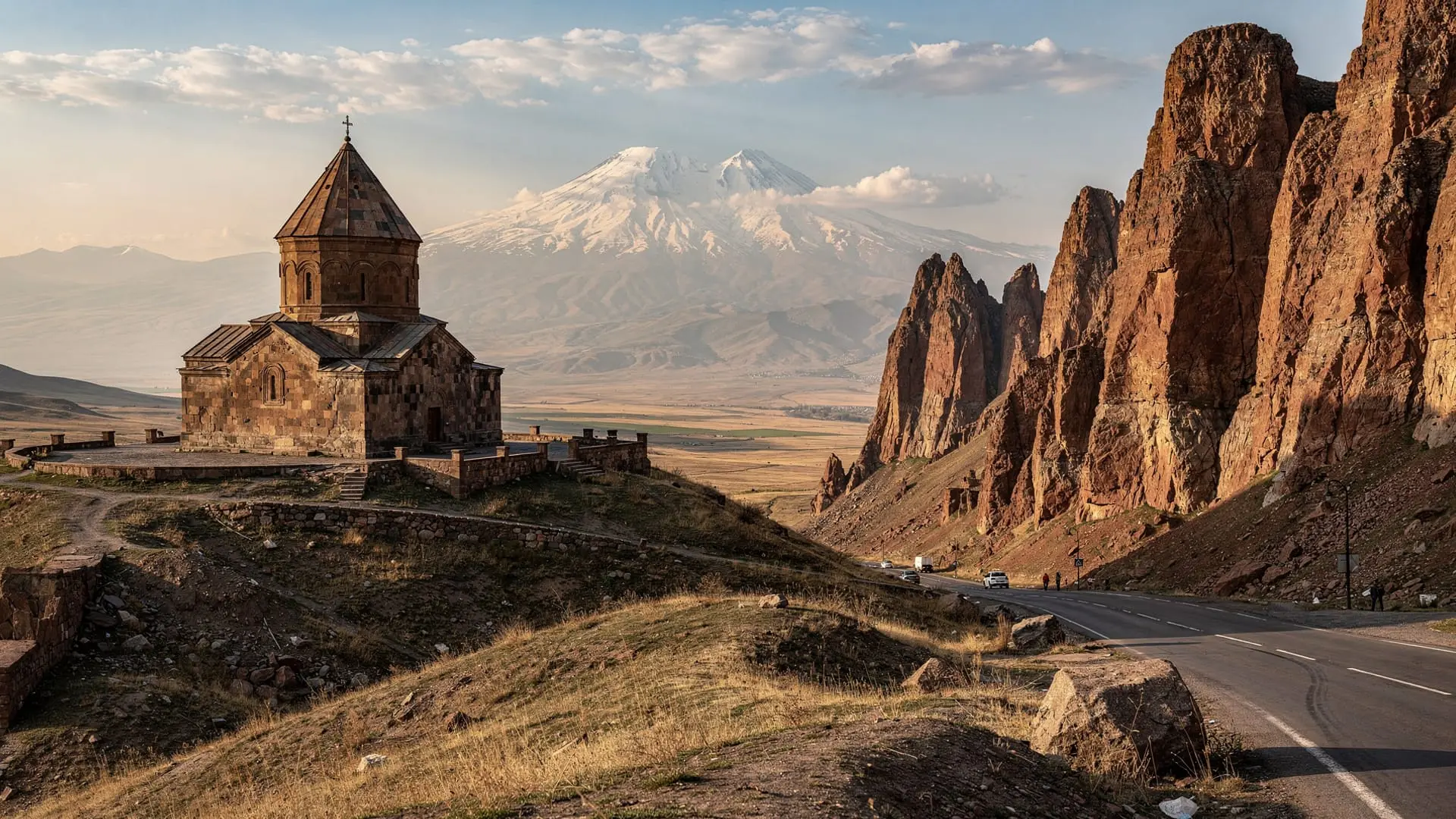
The road south of Yerevan is one of the most emotionally loaded drives in the Caucasus. It takes you past the biblical outline of Mount Ararat — visible from Armenian soil but sitting just across the closed Turkish border — to a monastery built above a pit where Christianity’s founding saint was imprisoned for thirteen years. An hour further on, a canyon of red limestone cliffs frames a 13th-century monastery perched on a ledge so improbable it looks assembled by hand on a film set.
Khor Virap and Noravank represent the spiritual and aesthetic extremes of Armenian religious heritage, and the day trip that connects them is one the country’s most satisfying routes. This guide tells you what to expect, when to go, and what the tour brochures leave out — including the honest truth about Ararat visibility.
| Where | Ararat marz and Vayots Dzor, south of Yerevan |
| Cost | Sites free; wine tasting 3,000–6,000 AMD; tour 10,000–18,000 AMD |
| Time needed | 8–9 hours, ~280 km roundtrip |
| Getting there | Car, GG Taxi, or organised tour |
| Best time | Dawn departure (5:00–5:30am) for Ararat views |
The honest truth about Mount Ararat and morning haze
Every operator selling a Khor Virap tour promises “views of Mount Ararat.” What they don’t always mention: Ararat disappears in afternoon haze on most days between May and October. By midday, particularly in summer, the mountain vanishes behind a blue-grey screen of atmospheric moisture. The only reliable window for clear views is the first two hours after sunrise.
This is why a dawn departure from Yerevan is the single best decision you can make for this trip. Leave at 5:00–5:30am, arrive at Khor Virap around 6:00–6:30am, and you will almost certainly see Ararat — both peaks, the glaciers, the whole 5 165-metre mass of it, filling the southern sky in a way that stops conversation. Stay an hour, let the sun climb, then continue south to Noravank when the light is good but the day is still fresh.
Honest caveat: Ararat is sometimes obscured even at dawn in winter (fog) and during spring rains. There is no guarantee. If your primary reason for visiting Khor Virap is Ararat, accept that 20–30% of visits disappoint regardless of timing.
Getting there: distances and options
- Yerevan → Khor Virap: 35 km, about 50 minutes south on the M2 highway. The road is excellent.
- Khor Virap → Areni (wine stop): 60 km, about 1 hour, continuing south and east through the Ararat valley.
- Areni → Noravank: 9 km into the Amaghu gorge, 15 minutes.
- Noravank → Yerevan: 130 km, about 1.5–2 hours return via the M2.
Total: approximately 280 km, 8–9 hours including stops.
Transport options:
- Organised tour: The most popular choice. Group tours run daily from Yerevan, typically starting 8–9am (too late for ideal Ararat light). Cost: 10 000–18 000 AMD per person. Private tours with earlier departures cost more but solve the haze problem.
- GG Taxi round trip: 35 000–50 000 AMD for the full loop with waiting time, depending on how long you linger at each stop. Shared between two people it competes well with tour pricing.
- Rental car: Ideal for flexibility, especially for a dawn departure. The road south requires no special vehicle.
- Marshrutka: Marshrutkas from Kilikia serve Noravank area but schedule and connections are inconvenient for a dawn departure.
Book a Khor Virap and Noravank day tour from Yerevan
Khor Virap: what the site holds
Khor Virap (meaning “deep pit” in Armenian) is a functioning monastery perched on a hillock in the Ararat plain, its walls the colour of honey against the brown valley floor. The monastery itself dates from the 17th century, but the site’s history reaches back to 301 AD, when Gregory the Illuminator converted the Armenian king Tiridates III to Christianity after thirteen years of imprisonment in the pit below the current church.
That pit is accessible via a near-vertical iron ladder descending about 6 metres into a circular stone chamber. It is extremely claustrophobic, dark, and damp. Pilgrims descend to pray; tourists descend for the experience. If you have claustrophobia, stay above — the view from the monastery walls is the point regardless.
Entry is free. Allow 45–60 minutes including the pit descent if you choose it.
Photography note: The classic Khor Virap shot — monastery with Ararat filling the background — is taken from outside the walls, walking a short distance north along the perimeter fence to a slight rise that eliminates foreground clutter.
Private tour to Khor Virap with Mount Ararat view
The wine stop at Areni
The village of Areni sits at the junction where the main road meets the Noravank gorge turnoff, making it a natural stop. Areni is the home of Armenia’s indigenous Areni Noir grape and the site of the world’s oldest known winery (Areni-1 cave, dating to 4 100 BC). Several tasting rooms operate near the village:
- Hin Areni winery (just outside the village) is the most visitor-ready, with English-speaking staff and a tasting room overlooking vineyards. Cost: 3 000–6 000 AMD per person for a 3-wine tasting.
- Roadside wine sellers at the Areni junction offer bottles and basic tastings — less formal but cheaper.
Budget 30–45 minutes for a winery stop. This is not the place for a full wine-touring session (that warrants its own day — see the Vayots Dzor wine route guide), but a glass of local Areni Noir before entering Noravank gorge is a pleasure.
Noravank: the red-cliff monastery
The approach to Noravank is cinematic: a narrow road threads 9 km into an increasingly vertical canyon of red and ochre limestone until the monastery appears on a ledge, its pale pink tuff walls glowing against the cliff face behind. The monastery complex dates from the 13th–14th centuries and is considered one of the finest examples of Armenian medieval architecture.
Entry is free. Allow 60–90 minutes. The upper church — dedicated to St John — has a famous external staircase leading to a narrow door on the second level, accessible only to those willing to climb stone steps without a handrail against the cliff face. The views from the ledge are disorienting and extraordinary.
The canyon itself is worth exploring: a short walk north of the monastery follows the gorge floor between the cliffs, passing small caves and strange formations in the rock.
Avoid Noravank on Saturdays and Sundays in July–August: the canyon road becomes a one-lane traffic jam of tour buses. Weekday visits are dramatically quieter.
Suggested timeline for the full day
| Time | Stop | Duration |
|---|---|---|
| 5:30am | Depart Yerevan | — |
| 6:15am | Arrive Khor Virap (dawn, Ararat views) | 60–75 min |
| 8:00am | Drive south via M2 | 1 h |
| 9:00am | Areni wine tasting | 30–45 min |
| 9:45am | Drive to Noravank | 15 min |
| 10:00am | Noravank monastery & gorge | 90 min |
| 11:30am | Lunch near Areni or begin return | — |
| 1:30pm | Return drive to Yerevan | 1.5–2 h |
| 3:30pm | Arrive Yerevan | — |
If you prefer a 9am departure and skip the dawn, plan to spend only 30 minutes at Khor Virap (Ararat likely obscured) and arrive at Noravank around noon — still perfectly valid, especially if the canyon light is your priority.
What this day costs
| Item | Cost (AMD) | EUR approx. |
|---|---|---|
| Khor Virap entry | Free | — |
| Noravank entry | Free | — |
| Areni wine tasting | 3 000–6 000 | 7–15 |
| Group tour per person | 10 000–18 000 | 25–44 |
| Private car + driver | 35 000–50 000 | 85–122 |
| Lunch roadside | 3 000–6 000 | 7–15 |
Internal connections and extensions
For travellers with more time, Noravank sits at the threshold of the Vayots Dzor wine region — continuing south adds Yeghegnadzor, the Selim caravanserai, and the spa town of Jermuk at 1 600 metres altitude. This extension turns the day trip into a two-day southern loop. See the Tatev day trip guide for the full southward extension through Syunik province.
What to wear and bring
The southern route passes through the Ararat valley (hot and exposed in summer) and the Noravank canyon (shaded but rocky underfoot).
- Footwear: Closed-toe shoes with grip for the Noravank canyon walk and the Khor Virap monastery approach. Sandals are fine at both sites for those who prefer them.
- Sun protection: The Ararat plain is flat and open. At Khor Virap especially, there is no shade. SPF 50, hat, sunglasses are not optional in summer (May–September).
- Dress code: Both monasteries are active religious sites. Shoulders and knees should be covered for entry to the main churches. Women should carry a headscarf — available at the monastery gate but bring your own to avoid fuss. Men can enter in shorts.
- Water: Carry at least 1 litre per person. The route between sites has limited shops.
- Camera: Do not miss the early morning light at Khor Virap. A polarising filter significantly improves Ararat shots by reducing atmospheric haze and deepening the sky.
The tourist trap warning: Ararat tour sellers
At Khor Virap’s parking area, you will encounter vendors selling bottled water, souvenirs, and in some cases offering additional tours. One specific trap: sellers claiming to arrange “helicopter tours over Ararat” or “special permits to visit the Turkish side” — neither is available from this location. Mount Ararat is in Turkey and the border has been closed since 1993. No Armenian company can arrange access.
The legitimate vendors (cold water, basic food, postcards) are perfectly fine to use. Just don’t be drawn into conversations about special access.
Noravank canyon: the walk beyond the monastery
Most visitors come specifically for the monastery on its ledge, see it, photograph it, and leave. But the canyon is wider and stranger than the monastery suggests.
From the monastery, a short path continues north into the gorge for about 20 minutes. The canyon walls become increasingly vertical and the rock colour deepens from orange to deep red to almost purple in places depending on light angle. At a bend in the gorge, the path ends at a viewpoint where the cliff faces rise on both sides. No monastery, no signage — just the geology. Most people never walk this far.
If you have a spare 40 minutes at Noravank (walk 20 min in, 20 min back), the canyon walk is well worth it.
Combining with a Jermuk extension
For travellers with more than one day in southern Armenia, the road from Noravank/Areni continues east and south to Jermuk — a Soviet-era spa town at 1 760 metres with a waterfall and mineral water galleries. Jermuk is 60 km and 1.5 hours from Areni, turning the day trip into an overnight.
A Jermuk stay also positions you well for the next day’s drive south toward Tatev and Syunik. This two-day southern extension is the most rewarding way to see the Vayots Dzor wine country without rushing. The Tatev day trip guide covers the full logistics of continuing south.
Frequently asked questions about the Khor Virap and Noravank day trip
What is the best time of year for Ararat views at Khor Virap?
November through March gives the clearest air and the most reliable Ararat visibility — even at midday. Summer (June–August) is the most problematic: haze sets in by 9am on most days. Spring (April–May) is variable. Always aim for early morning regardless of season.
Is the pit descent at Khor Virap safe?
The iron ladder is steep (nearly vertical, roughly 6 metres) but has been used by pilgrims for decades and is structurally sound. The chamber below is small and dark — not suitable for claustrophobic visitors. Children can descend with an adult.
Can I visit Areni-1 cave on this day trip?
Areni-1 cave (the world’s oldest winery site) sits a few kilometres beyond Areni village and requires a separate visit. Adding it extends the day by 1–1.5 hours. It’s a remarkable archaeological site but less visually dramatic than Noravank. Best combined on a dedicated wine tour.
Is there a direct marshrutka from Yerevan to Noravank?
No direct service. The closest marshrutka runs to Yeghegnadzor (from Kilikia terminal, roughly 2 hours). From there, local taxis serve Noravank. For most independent travellers, a taxi or organised tour is simpler.
Can I add Tatev monastery to this day?
Not as a comfortable day trip — Tatev is 4 hours from Yerevan and is best visited on an overnight basis from Goris. See the Tatev day trip feasibility guide for a frank assessment.
Should I book a tour or go independently?
Independent travel (rental car or GG Taxi) works perfectly for both sites and gives you full control over departure time — critical for Ararat photography. Group tours are cheaper but start too late for ideal morning light at Khor Virap.
Are the monasteries open every day?
Both Khor Virap and Noravank are open daily year-round. Services take place on Sundays and religious feast days, which adds atmosphere but also increases crowds.
Is this day trip suitable for visitors with limited mobility?
Partially. Khor Virap’s approach is flat and paved, though the grounds inside are uneven and the dungeon descent requires a vertical ladder not suitable for limited mobility. Noravank’s upper church is reached via an external staircase without a handrail, which is not accessible for wheelchair users or those with significant mobility restrictions — the lower church and the gorge views from ground level remain accessible and worthwhile on their own.
What is the single best change I can make to this itinerary if I can only do one thing differently?
Leave at dawn. Every other decision on this itinerary — tour versus independent, wine stop length, Noravank canyon walk — matters less than the departure time. A 5:00–5:30am start solves the Ararat haze problem, avoids Noravank’s weekend traffic jam in the canyon road, and gets you back to Yerevan with the afternoon still free.
What makes this specific pairing work so well
Khor Virap and Noravank are often bundled together by tour operators simply because they sit on the same southbound road, but the pairing works for a deeper reason: they represent genuinely different registers of Armenian religious architecture and landscape. Khor Virap is modest in scale, dramatic through its history and its plain-and-mountain setting rather than its stonework; Noravank is the opposite, a masterwork of medieval carving in a landscape so vertical and colourful it borders on theatrical. Seeing both in a single day gives a far more complete sense of what “Armenian monastery” can mean than either alone.
The Areni stop in between reinforces this contrast usefully — a village built around wine rather than stone, low-key and agricultural, that resets the pace between two intense architectural and historical experiences. Skipping Areni to save 30–45 minutes is possible but removes a natural breathing point from the day that most visitors, on reflection, are glad they kept.