Gyumri by train: the perfect cultural day trip
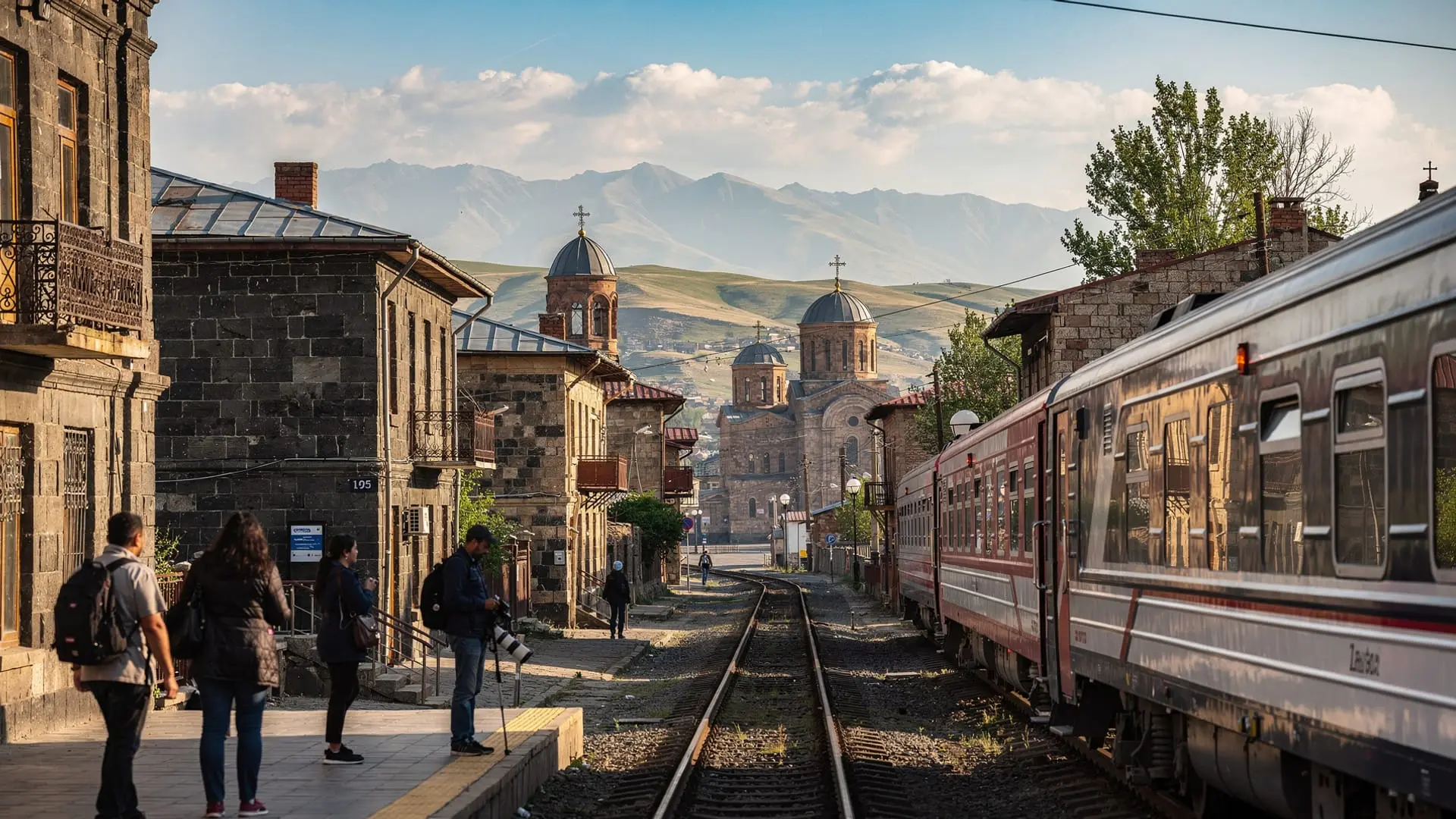
Armenia’s second city doesn’t get the attention it deserves, and that is partly what makes a day there so rewarding. While most visitors to Armenia spend their time on the southern monastery circuit or in Yerevan’s café-lined streets, Gyumri quietly does what it has always done: produce artists, architects, craftspeople, and humourists at a per-capita rate that locals cite as a point of genuine pride.
Gyumri (population ~120 000) is Armenia’s cultural capital in the most lived-in sense of the phrase. The city’s historic core of pink and black tuff stone buildings survived both the 1988 earthquake (which destroyed much of the modern residential areas) and Soviet-era neglect. Walking those streets feels like inhabiting a 19th-century Russian provincial city transplanted to the Caucasus — except the khachkars, the duduk music from an open window, and the conversation at the café table remind you exactly where you are.
The best way to arrive is by train.
| Where | Shirak province, 120 km north of Yerevan |
| Cost | ~10,000–14,000 AMD all-in for the day |
| Time needed | Full day (6–7 hours in Gyumri), overnight is better |
| Getting there | Train from Sasuntsi David station, ~3 hours each way |
| Best time | Morning light (9–11am) or golden hour for the tuff stone |
Why the train beats the road
Gyumri is 120 km from Yerevan by road — about 2 hours by car or marshrutka. That’s perfectly reasonable. But the train offers something the road does not: the chance to arrive without a driver, without navigation stress, and with 3 hours of Caucasus scenery rolling by at eye level — crossing the Ararat plain, climbing into the Shirak plateau, and arriving at Gyumri’s elaborate tsarist-era station as if you’re in a 19th-century novel.
Train details (April 2026):
- Departs Yerevan (Sasuntsi David station): approximately 8:10am
- Arrives Gyumri: approximately 11:10am (3 hours)
- Return from Gyumri: approximately 5:00–6:00pm (check current schedule at the station or the Armenian Railways website — schedules change seasonally)
- Ticket price: approximately 2 500 AMD second class (~6 EUR)
- The train is clean, reasonably comfortable, and rarely crowded on weekdays.
Note: Armenia’s train network has limited frequency. Always check current departure times before planning — there is usually one morning departure and one evening return, but schedules have shifted occasionally. Missing the return train means an overnight stay (not a tragedy) or a marshrutka back.
What to see in Gyumri
Gyumri rewards wandering more than any other Armenian city outside Yerevan. The key areas:
The historic centre: Kumayri
The Kumayri Historic District is a preserved neighbourhood of tuff stone buildings — pink volcanic tuff that glows copper in evening light, black tuff that gives the walls a distinctive striped appearance when the two are combined. The architecture reflects the 19th-century Russian provincial style, with Armenian carved details in the window frames and doorways.
Wander without a map: every third street produces a carved door, a stone courtyard, or a church façade worth pausing over. The central square (Vardanants Square) is flanked by the Mother Armenia statue, the Black Fortress, and the St. Saviour Church (Surb Amenaprkitch) — a massive tuff basilica restored after the 1988 earthquake.
The Black Fortress (Sev Berd)
The 19th-century Russian fortress on the north side of the city offers panoramic views over Gyumri and toward the Shirak plateau. The fortress itself is partially accessible; the walls and towers are evocative even in their semi-ruined state.
The Aslamazyan Sisters Museum
One of the most unexpected small museums in Armenia: the house-museum of the sisters Mariam and Eranuhi Aslamazyan, two Armenian painters from the early Soviet period whose work combined folk art motifs with modernist colour. The collection is in their original Gyumri home. Small admission fee; worth 30–45 minutes.
The Dzitoghtsyan Museum of Social Life and National Architecture
Gyumri’s main ethnographic museum is housed in a beautifully restored Kumayri building. Traditional textiles, silverwork, daily objects from the pre-Soviet and Soviet periods. About 45 minutes.
Book a guided Gyumri day trip by train from Yerevan
Harichavank monastery
18 km east of Gyumri, Harichavank — actually Harichavank — is a 7th-century monastery complex surrounded by orchards in the Shirak hills. Requires a taxi from Gyumri (about 3 000–4 000 AMD return with waiting). If you have time after the city walk, it’s a pleasant 90-minute addition.
Where to eat in Gyumri
Gyumri has a strong local food culture and some excellent traditional restaurants — cheaper and less tourist-oriented than Yerevan equivalents.
- Bavariats Boon (Old Gyumri): local food in a restored Kumayri house, affordable and excellent.
- Karmir Tapan (near central square): traditional grills, local wine, unpretentious atmosphere.
- Any café on the main square for Armenian coffee (soorj) and local pastries in the morning.
Budget 3 000–6 000 AMD for a proper lunch with drinks.
Suggested itinerary for the train day
| Time | Activity |
|---|---|
| 8:10am | Depart Yerevan by train |
| 11:10am | Arrive Gyumri station |
| 11:30am | Walk to Kumayri district (15 min) |
| 11:30am–1:00pm | Explore Kumayri: tuff streets, churches, Black Fortress |
| 1:00pm | Lunch in old town |
| 2:00pm | Aslamazyan Sisters Museum or Dzitoghtsyan Museum |
| 3:00pm | Continue wandering Kumayri, find a café |
| 4:30pm | Walk back to station |
| 5:00–6:00pm | Train returns to Yerevan |
| 8:00–9:00pm | Arrive Yerevan |
The private car or marshrutka alternative
If the train schedule doesn’t work for your plans, several alternatives exist:
- Marshrutka from Kilikia: about 2 500–3 000 AMD, departs when full, arrives in 2 hours on the highway. Less comfortable than the train but faster.
- Private car: Allows you to add Marmashen monastery (a beautiful 11th-century complex 10 km from Gyumri, almost never crowded) or a detour through the rural Shirak plateau. See the Gyumri architecture and cultural capital guide for a deeper exploration of the city.
- Organised day tour: Several Yerevan-based operators run Gyumri day trips including a local guide. Costs around 15 000–20 000 AMD per person.
Book a Yerevan to Gyumri day trip tour
Practical notes
Getting from Gyumri station to Kumayri: The station is about 15 minutes’ walk from the historic centre. Local taxis wait outside the station (600–800 AMD).
Buying train tickets: Tickets can be bought at Sasuntsi David station in Yerevan the day before or on the morning of travel. The train rarely sells out on weekday mornings but can fill up on weekend.
Mobile data: Works fine throughout Gyumri with Armenian SIMs.
Weather: Gyumri sits on a high plateau (1 550 m) and is noticeably cooler than Yerevan in all seasons. The wind can be sharp. Bring an extra layer even in summer.
What this day costs
| Item | Cost (AMD) | EUR approx. |
|---|---|---|
| Train Yerevan–Gyumri (one way) | ~2 500 | ~6 |
| Return train | ~2 500 | ~6 |
| Taxi station to Kumayri | ~600–800 | ~1.50–2 |
| Museum entries | ~1 000–2 000 | ~2.50–5 |
| Lunch | 3 000–6 000 | ~7–15 |
| Total approximate | ~10 000–14 000 | ~24–35 |
The Kumayri Historic District in detail
The Kumayri district is not a museum — it’s a living neighbourhood — which is both its greatest quality and the reason it rewards slow walking over rushed sightseeing.
The tuff stone architecture: Gyumri’s buildings use two types of volcanic tuff (compressed volcanic ash) that define the city’s visual identity. Pink tuff (volcanic tuff from the Artik quarries) gives a warm rose glow in afternoon light. Black or dark grey tuff (basalt-adjacent stone from local quarries) provides contrast in walls where the two are alternated horizontally — a characteristic Gyumri pattern called “black and white.”
The combination of these two stones in the 19th-century buildings — houses, workshops, churches, even walls — gives the old quarter a visual coherence unlike any other Armenian city. The closest analogue elsewhere might be the black-and-white striped facades of some Sienese churches, but the Gyumri effect is entirely different in scale and texture.
What to look for as you walk:
- Carved doorframes with traditional Armenian vine and pomegranate motifs — some dating to the 1830s–1880s, still in excellent condition
- Courtyard houses where the gate leads to a shared inner court surrounded by several family apartments — the traditional urban dwelling type, still inhabited
- The blacksmiths and metalworkers who continue the city’s craft traditions in small workshops on back streets — you’ll hear them before you see them
- The tuff carvers who produce decorative elements (khachkars, architectural ornaments) using techniques unchanged for centuries
Practical tip for photography: Gyumri’s pink tuff buildings are most beautiful in morning light (9–11am) and in the hour before sunset (6–7pm in summer). Midday overhead light kills the warm stone quality.
Gyumri’s art scene and why it matters
Armenia’s second city has a claim to cultural primacy that its size doesn’t immediately suggest. The Gyumri art scene emerged from the specific social conditions of a city that has been through extreme trauma (the 1988 earthquake killed 17 000–25 000 people and left 50 000 in containers for years) and came out the other side with an intensified culture of self-expression.
Several things worth knowing:
The craft tradition: Gyumri has historically been Armenia’s centre for iron work, woodcarving, ceramics, and stone cutting. The black tuff stone buildings of the Kumayri district were built by local craftsmen whose descendants still practice the trades. Walking the old quarter, you’ll encounter open workshops where craftspeople make traditional items — not for tourists but for the local market.
The humourist tradition: Gyumri people are famous throughout Armenia for their dry, self-deprecating humour. The city’s position as Armenia’s “second city” in a country where everything gravitates to the capital has produced a particular form of ironic self-awareness that locals wear as a badge. Gyumri jokes are a distinct genre in Armenian culture.
Contemporary art: Since the mid-2010s, Gyumri has developed a modest but real contemporary art scene. The GYUMRI ART HUB (near the main square) shows rotating exhibitions of young Armenian artists working in the city. The café culture around it is young, local, and interesting.
The 1988 earthquake: understanding what you see
The 1988 Spitak earthquake (7 December) is impossible to ignore in Gyumri and understanding its legacy helps make sense of the city’s current geography.
The earthquake (magnitude 6.8) struck at 11:41am on a Tuesday — school was in session, factories were running. In Gyumri (then called Leninakan), the modern Soviet-era apartment blocks collapsed in large numbers. The historic Kumayri tuff stone buildings largely survived because their flexible stone construction behaved better under earthquake stress than the rigid prefabricated concrete panels of Soviet housing.
You will notice the contrast walking from the historic centre to the residential periphery: the beautifully preserved 19th-century stone core gives way to gaps, temporary structures, and half-rebuilt Soviet blocks. Recovery took decades — some families lived in “domiks” (metal shipping containers converted to housing) for 10–15 years after the earthquake. Some still do.
This is not dark tourism — it is the context that makes the city’s cultural resilience comprehensible.
The Gyumri food experience
Gyumri food is traditional Armenian food at its most unpolished and its most genuine. Several things to seek out:
Khashlama: A slow-cooked lamb and vegetable soup-stew that is the quintessential Gyumri comfort food. Several restaurants in the old town specialise in it. Order it for lunch with bread and strong tea.
Ishkhan trout also appears in Gyumri restaurants (trucked in from Lake Sevan) — though you’re far from the lake, the fish is still excellent here. See the Lake Sevan trout and ishkhan ethics guide before ordering.
Local bakeries (hatsagordzaran): Buy fresh lavash and matnakash (a thick leavened flatbread) directly from a bakery. Prices are tiny; quality is excellent.
Café culture near the main square: The Gyumri café scene is more casual and local-feeling than Yerevan’s. Strong Armenian coffee (soorj), homemade pastries, and conversations that include you even if you don’t speak Armenian.
Making the most of a tight train window
Because the train schedule bookends the day fairly firmly, planning your route through Kumayri before you arrive helps you avoid wasted backtracking. A sensible sequence from the station: walk the 15 minutes into the historic centre, anchor the morning around Vardanants Square and the surrounding streets (Abovyan, Gyuzalyan), take lunch centrally rather than travelling out of the old town, then use the early afternoon for whichever single museum interests you most rather than trying to fit two. If Harichavank or Marmashen monastery is a priority, it is worth arranging a taxi with waiting time before you set off from the station, since finding one on short notice in the late afternoon can eat into your remaining window before the return train.
Comparing your Gyumri transport options
| Option | Time each way | Cost (one way) | Comfort |
|---|---|---|---|
| Train | ~3 hours | ~2,500 AMD | Relaxed, scenic, fixed schedule |
| Marshrutka | ~2 hours | ~2,500–3,000 AMD | Cramped, departs when full |
| Private car/tour | ~2 hours | 15,000–20,000 AMD total | Flexible, allows Marmashen/Harichavank |
The train is the best choice if the schedule fits your plans and you value the journey itself; a marshrutka suits those prioritising speed and flexibility over comfort; a private tour or car is the only realistic way to add outlying sites like Marmashen without a rushed taxi negotiation.
Gyumri’s café culture, slowed down
If you have any flexibility in your itinerary, resist the urge to move constantly. Gyumri café culture rewards sitting still — locals linger for an hour or more over a single cup of soorj, and the conversation at neighbouring tables (even if you don’t understand it) is part of the atmosphere. Choosing one café near the main square and returning to it for both a mid-morning coffee and a late-afternoon one before the train back gives you a small anchor point in a day that otherwise moves quickly between sights.
Frequently asked questions about the Gyumri day trip by train
Is the train comfortable?
Second class on the Yerevan–Gyumri train is reasonably comfortable — fixed seats in a clean coach, air conditioning (on newer rolling stock) or open windows (on older). The 3-hour journey passes pleasantly with a book. First class exists and costs slightly more.
What is Gyumri’s connection to Parajanov?
The filmmaker Sergei Parajanov — director of The Colour of Pomegranates, one of the great films of world cinema — was born in Tbilisi but deeply associated with Armenian culture and the sensibility of Gyumri’s artisan traditions. The Parajanov Museum is in Yerevan, but Gyumri’s craft culture is the wellspring that informed his visual language.
Was Gyumri badly damaged in 1988?
Yes — the 1988 Spitak earthquake (magnitude 6.8) devastated northern Armenia and killed an estimated 25 000 people. Gyumri suffered severe damage, particularly to its Soviet-era apartment blocks. The historic Kumayri tuff stone buildings fared better. Reconstruction continued for decades and is ongoing in some areas.
Can I visit Marmashen monastery on this day trip?
Yes, if you rent a car or arrange a Gyumri taxi. Marmashen is 10 km north-east of Gyumri — a 10th–13th century monastery in a river valley, almost always uncrowded, architecturally excellent. Add 1.5–2 hours to the day.
Should I stay overnight in Gyumri?
One night in Gyumri makes the experience more complete and lets you see the city in evening and morning light. Several small guesthouses operate in the Kumayri district. For most visitors, however, a full day is sufficient.
Is the train or a private tour better for a first-time visitor?
The train is the better choice for travellers who want the scenic journey and don’t mind a fixed schedule; it also forces a relaxed, unhurried pace since you can’t easily extend the day. A private tour or car is better if you want to add Marmashen or Harichavank monastery, or if the train timetable doesn’t suit your other plans — see the Gyumri architecture and cultural capital guide for a deeper look at what a longer visit adds.
What if I miss the return train?
It is not a crisis. Several small guesthouses operate in the Kumayri district for an impromptu overnight, and a marshrutka back to Yerevan’s Kilikia terminal runs into the early evening as a backup. Build in enough buffer at the station beforehand so this scenario stays a remote possibility rather than a likely one.