Zorah & Yacoubian-Hobbs: high-altitude Armenian wines
The wines that changed how the world sees Armenia
In 2010, Italian-Armenian fashion designer and entrepreneur Zorik Gharibian released the first vintage of Zorah Karasi — an Areni Noir grown at 1,700 metres above sea level near the village of Rind in Vayots Dzor, fermented and aged in clay amphorae, and made with essentially no external intervention. The wine arrived at a moment when natural wine was gaining international attention and when Armenian wine was almost entirely unknown outside the diaspora.
Within three years, Karasi had been featured in Robert Parker’s Wine Advocate, The Wine Spectator, and Jancis Robinson’s column in the Financial Times. It was cited as evidence that the South Caucasus — Armenia specifically — was home to some of the most exciting unrecognised wine in the world. Zorah did not merely launch a single successful winery; it effectively inaugurated international interest in Armenian wine as a category.
Not long after, a parallel project emerged. Alex Yacoubian, an Armenian-American businessman with deep family ties to Vayots Dzor, partnered with Paul Hobbs — the Californian winemaker famous for elevating Argentinian Malbec to global prestige — to create Yacoubian-Hobbs Wines. Their debut release, Faraway, was an Areni Noir from vineyards at similarly extreme elevations, and it drew immediate comparisons to the best of Burgundy.
This guide covers both estates: their wines, their philosophies, and the practical details of visiting.
| Where | Rind village area, Vayots Dzor, ~30 km from Areni |
| Cost | Karasi ~20,000–25,000 AMD/bottle; Faraway ~22,000–28,000 AMD/bottle |
| Visits | By appointment only, book 3–4 weeks ahead (harvest: earlier) |
| Getting there | Winding mountain road; 4x4 advisable after rain |
| Best time | September–October (harvest) is most interesting but hardest to book |
Zorah Wines
The founder and philosophy
Zorik Gharibian is Italian-born but of Armenian descent. The family connection to Vayots Dzor is genuine — relatives had farmed in the region for generations before the upheavals of the twentieth century. When he returned to Armenia in the early 2000s to explore winemaking, he found pre-phylloxera old vines (some over a century old) still producing Areni Noir at high altitude on the slopes above Rind village.
The philosophy Gharibian adopted was shaped by his exposure to natural and biodynamic winemaking in Italy and France: no synthetic chemicals in the vineyard, indigenous yeasts, no additions in the cellar, and ageing in large clay amphorae (karaslar in Armenian — the same word in the wine’s name) rather than oak barrels. The result is a wine of startling purity.
The Karasi Areni Noir
Karasi is the flagship and the wine that established Zorah’s international reputation. It is made from Areni Noir grown at 1,700 to 1,800 metres on volcanic basalt soils, aged for twelve to fourteen months in clay amphorae without temperature control, and bottled unfiltered. Production is small — typically 8,000 to 12,000 bottles per vintage, varying with yields.
The wine’s profile is unlike any other Areni Noir on the market. It is elegant to the point of fragility in some years, with a translucent ruby colour, and aromas of dried pomegranate, red cherry, dried rose petals, volcanic stone, and a distinctive iron-mineral note that is specific to Zorah’s high-altitude basalt soils. On the palate it is tense, precise, and energetic, with fine but present tannins and an acid spine that carries the wine through a long, complex finish.
It ages exceptionally well — the best vintages (2012, 2015, 2017) continue developing in bottle and will reward cellaring for fifteen years or more.
Current retail price in Yerevan: approximately 20,000 to 25,000 AMD (49 to 61 EUR). Available internationally through importers in the United States, France, Germany, and the United Kingdom.
Vagharshak (second wine)
Zorah also produces Vagharshak, a second wine made from younger vines and fruit from parcels not included in the Karasi blend. It is more approachable in its youth and retails for approximately 12,000 to 15,000 AMD (29 to 37 EUR) in Yerevan. The name references a traditional Armenian figure and is an indicator of Gharibian’s commitment to local cultural identity.
Visiting Zorah
Zorah does not operate a public-facing tasting room in the conventional sense. Visits are by prior appointment only and must be arranged well in advance — ideally at least two weeks before your intended date, and more lead time is advisable during harvest season (September to October).
The estate is located near Rind village in the mountains above the main Vayots Dzor road, approximately 30 km from Areni. The drive involves a winding mountain road that is passable in a standard car in dry conditions but requires caution. In wet or icy conditions, a 4x4 is advisable.
A typical appointment involves a vineyard walk with a member of the team, a visit to the cellar and its clay amphorae, and a formal tasting of the current and previous vintages. The experience is more intimate and intellectually engaged than a standard winery visit — expect substantive conversations about biodynamic farming, indigenous varieties, and the role of the Areni-1 archaeological discovery in shaping Armenian winemaking ambition.
Yacoubian-Hobbs Wines
The partnership and wines
Alex Yacoubian’s family connection to Armenia’s Vayots Dzor region is direct — his grandparents farmed grapes there before emigrating. When he returned to explore the possibility of making wine, he brought Paul Hobbs into the project. Hobbs was already internationally famous for his work in Napa Valley and for pioneering premium Malbec production in Argentina’s Mendoza region; applying that eye for terroir to Armenian indigenous varieties was a natural extension.
The Faraway Areni Noir is the headline wine. Like Zorah Karasi, it is grown at high altitude (1,600 to 1,750 metres) on ancient terraces above Vayots Dzor. Unlike Zorah, Yacoubian-Hobbs uses French oak barrels rather than clay amphorae for ageing, which gives the wine a slightly different structural profile: a little more tannin, a slightly more European-inflected finish, but the same essential expression of high-altitude Areni Noir — pomegranate, dried cherry, violet, and volcanic mineral.
Faraway is produced in even smaller quantities than Karasi — typically 3,000 to 6,000 bottles per vintage — and sells out rapidly. Current price in Yerevan: approximately 22,000 to 28,000 AMD (54 to 68 EUR). US importers handle most of the international distribution.
Visiting Yacoubian-Hobbs
Visits to Yacoubian-Hobbs are strictly by appointment, arranged months in advance due to limited availability. The estate does not have a permanent tasting facility in the conventional sense; visits are conducted at the vineyard and cellar locations with direct involvement from the local team.
Given the appointment requirements for both estates, the most practical approach is to contact both Zorah and Yacoubian-Hobbs at least three to four weeks before your travel dates and to build your Vayots Dzor itinerary around whichever appointment times are available.
How to experience these wines without an appointment
If scheduling an estate visit proves impossible, there are excellent alternatives in Yerevan.
The Armenian wine tasting at In Vino in Yerevan offers structured tastings of Armenian wines by the glass. In Vino maintains one of the best cellars in the country and typically stocks both Zorah Karasi and Yacoubian-Hobbs Faraway for tasting by glass or bottle.
The Armenia Wine Talks event in Yerevan includes presentations on premium Armenian producers including both estates.
Wine shops in Yerevan (particularly Fine Wine Bar on Sayat-Nova Avenue and several outlets in the GUM market area) stock both labels. Buying a bottle to open in your hotel is a legitimate alternative to a winery visit if logistics do not cooperate.
Zorah vs Yacoubian-Hobbs at a glance
| Zorah Karasi | Yacoubian-Hobbs Faraway | |
|---|---|---|
| Ageing vessel | Clay amphora (karas) | French oak barrel |
| Style | Mineral, precise, biodynamic | Richer, more oak-inflected |
| Annual production | ~8,000–12,000 bottles | ~3,000–6,000 bottles |
| Yerevan retail price | ~20,000–25,000 AMD | ~22,000–28,000 AMD |
| Visit lead time | 2+ weeks | 3–4 weeks |
| Best entry point if new to Areni Noir | For mineral, natural-wine fans | For Burgundy/Napa-trained palates |
High altitude and its effects on Areni Noir
The extreme elevation at which both Zorah and Yacoubian-Hobbs farm their vines is not incidental to the wines’ character — it is fundamental. At 1,700 to 1,800 metres, the average growing temperature is significantly cooler than the valley floor, extending the growing season and delaying the accumulation of sugar. This means lower potential alcohol (typically 12.5 to 13.5%) and higher natural acidity.
The volcanic basalt soils at these elevations also differ from the limestone and alluvial soils lower down. Basalt retains heat during the day and releases it slowly at night, moderating temperature swings and adding a distinctive iron-mineral quality to the wines. Wine drinkers familiar with great volcanic terroirs (Etna, Santorini, Jura) will recognise the family resemblance in Karasi and Faraway.
The combination of altitude and volcanic soil is, in the view of many wine writers who have visited, the reason why Vayots Dzor is one of the world’s genuinely original wine terroirs — not merely an interesting curiosity, but a place producing wines that taste like nowhere else on earth. See the Vayots Dzor wine route guide for other producers to visit in the region.
The context: Armenia as wine origin
Both Zorah and Yacoubian-Hobbs operate in conscious awareness of Armenia’s role as the oldest documented wine-producing culture on earth. The Areni-1 cave — the world’s oldest winery, dated to approximately 4100 BCE — sits in the same valley where their vineyards grow, less than 30 km away. The indigenous Areni Noir vine they both farm has been growing in these hills in some form for over 6,000 years.
This is not just a marketing narrative. The genetic continuity between the grape varieties found at Areni-1 and the contemporary Areni Noir being farmed today is a matter of archaeological record. When you drink Zorah Karasi or Yacoubian-Hobbs Faraway, you are drinking something that connects, however indirectly, to the oldest known wine tradition on earth.
For the full story of that tradition, see the Armenia wine country overview and the Areni-1 cave guide.
Practical tips for visiting both estates
- Book appointments at least three to four weeks in advance, preferably more
- Harvest season (September to October) is both the best time to visit and the hardest time to get an appointment; plan accordingly
- Both estates are in mountain terrain — dress in layers regardless of season; temperatures at 1,700 metres can be 10 to 15 degrees Celsius cooler than in Yerevan
- The road to Rind village (Zorah) requires careful driving; a 4x4 is advisable after rain
- Neither estate sells wine readily on-site; your best option for purchasing is Yerevan wine shops or online importers
Frequently asked questions about Zorah and Yacoubian-Hobbs
How do Zorah and Yacoubian-Hobbs compare in style?
Both produce high-altitude Areni Noir of exceptional quality, but with different characters. Zorah Karasi (clay amphora ageing, biodynamic) has more mineral purity, higher natural tension, and a more angular structure in youth. Yacoubian-Hobbs Faraway (French oak ageing) has slightly more textural richness and an oak spice element that makes it more accessible in its first three to four years. Both age beautifully.
Are these wines available in duty-free shops at Yerevan’s airport?
Occasionally, but stock is unreliable. The specialty wine shops in Yerevan city centre (especially Fine Wine Bar near Abovyan Street) are more reliably stocked and at better prices than duty-free.
Is Zorah certified biodynamic?
The estate follows biodynamic principles and has described its approach as biodynamic in multiple interviews, but as of 2026 it does not hold formal Demeter certification. The practical approach — cover crops, no synthetic inputs, lunar planting calendar, composting — is consistent with biodynamic agriculture.
What do the wines cost to import internationally?
US retail prices for Zorah Karasi typically range from USD 35 to USD 55 per bottle depending on the vintage and retailer. Yacoubian-Hobbs Faraway is in a similar range. European prices are comparable. Both are considered good value for the quality level.
Can I organise a combined Zorah and Yacoubian-Hobbs visit in one day?
The two estates are in close proximity geographically, but since both require appointments and the appointment windows are limited, combining them in a single day requires careful advance planning. Contact both estates early and explain your itinerary — they may be able to coordinate appointment times to make it feasible.
What if I can’t get an appointment at either estate?
Book a structured tasting at In Vino in Yerevan, which typically stocks both Karasi and Faraway by the glass, or visit smaller wineries closer to Yerevan that don’t require weeks of lead time. Buying a bottle from a Yerevan wine shop to open at your hotel is also a perfectly reasonable fallback.
The international reception: how Zorah changed Armenian wine’s reputation
Before Zorah Karasi appeared on the market in 2010, Armenian wine was largely invisible to international critics and buyers. Georgian wine had begun attracting serious attention in the mid-2000s, particularly for its qvevri amber wines; Armenian wine had no equivalent international champion.
Karasi changed that within three years. Robert Parker’s Wine Advocate gave it a score in the low 90s — not extraordinary by top Burgundy standards, but transformative in the context of a completely unknown wine region. Jancis Robinson wrote about the discovery of Areni Noir as a genuinely exciting development in global wine. American sommeliers and buyers began seeking out the few bottles available in the US market.
The effect on the broader Armenian wine scene was immediate and lasting. Wineries that had been selling domestically at modest prices began fielding enquiries from export markets. The Areni Wine Festival attracted its first significant international press coverage. Young Armenian winemakers who had been hesitating between a career in wine and other professions decided that Armenian wine had a future worth investing in.
Zorah did not create Armenian wine. But it proved to the world that Armenian wine deserved attention, and it gave every producer in Vayots Dzor a new international reference point to aspire to.
Clay amphora ageing: what it does to Areni Noir
Zorah’s Karasi is named after the Armenian clay vessel — karas — used for fermentation and ageing. The choice is deliberate and technical, not merely aesthetic.
Clay amphora ageing behaves differently from oak barrel ageing in several important ways. Clay is porous, allowing a slow micro-oxidation of the wine similar to oak — but without the vanilla and spice compounds that oak contributes. The result is a wine that develops complexity and integration over time without the “woodiness” that characterises barrel-aged wine. In Karasi, the absence of oak influence allows the pure fruit character of Areni Noir — the pomegranate, dried rose, and volcanic mineral — to emerge without interference.
Clay also regulates temperature naturally; a karas buried in the ground maintains a more consistent temperature than a steel tank in a temperature-variable cellar. This stable environment supports slow, even fermentation and ageing, which contributes to the wine’s characteristic precision and integration.
The karas vessels used by Zorah are produced by Armenian craftsmen in the traditional form — large-bellied, with a narrow neck — and typically hold between 300 and 1,000 litres. They are sealed with beeswax between vintages when not in use. The vessels themselves can last for many decades if properly maintained; some of the oldest karaslar in Armenian cultural collections date back several centuries.
The Rind village landscape: what the visit looks like
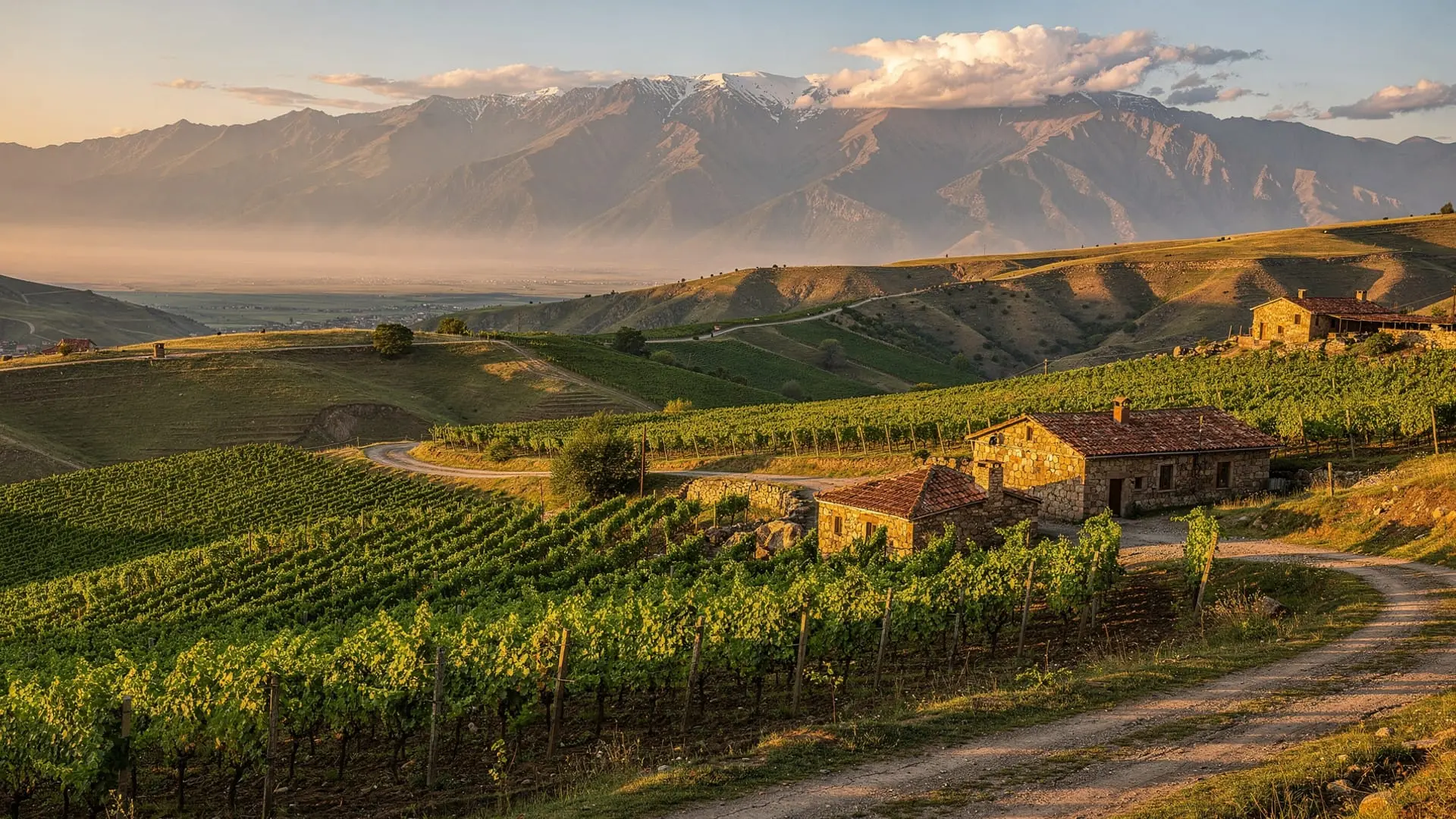
For visitors who secure an appointment at Zorah, the landscape of the visit deserves preparation. Rind is a small mountain village approximately 30 km from Areni, sitting at around 1,500 to 1,600 metres elevation. The road from the main Vayots Dzor highway climbs steadily through increasingly dramatic terrain — basalt walls, ravines with fast-running streams, old pear and apple trees lining the village lane.
The vineyards surrounding Rind are immediately striking: old vines on steep, narrow terraces without any irrigation infrastructure, entirely dependent on snowmelt and rainfall. Some of these vines — pre-phylloxera, ungrafted — are over 100 years old and produce tiny yields of extraordinarily concentrated fruit. The combination of vine age, elevation, and volcanic soil that gives Karasi its character is visible in the landscape before you taste a drop.
Zorah’s team will walk you through the vineyard before the cellar visit. The conversations here — about the geological history of the site, about the decision not to graft onto phylloxera-resistant rootstock (accepting the risk of phylloxera infestaiton in exchange for the direct soil connection of own-rooted vines), about the biodynamic principles that guide the farming — are as interesting as the wines themselves.
Yacoubian-Hobbs: the California-Armenia connection
The partnership between Alex Yacoubian and Paul Hobbs deserves slightly more elaboration than the winery summary provides. Hobbs is not merely a consultant hired for technical input; he is a creative partner who has spent time in Vayots Dzor understanding the terroir.
Hobbs’s background in Napa Valley and Argentina is relevant to how Faraway is made: he applies a New World sensibility to Old World material. Where Keushguerian at Zorah moves toward minimal intervention and maximum terroir expression, Hobbs is more comfortable with strategic winemaking decisions — choosing specific barrels, making blending decisions that reflect his palate as well as the vineyard. The result is a wine that is more immediately approachable than Karasi in its youth, slightly richer, and structured in a way that European and American wine drinkers trained on Burgundy and Napa Valley will find familiar.
This is not a lesser approach — it is a different one, and for many wine drinkers it may be the more accessible entry into high-quality Armenian wine. Both Karasi and Faraway are remarkable achievements; they are also a useful illustration of the range of philosophical approaches now being applied to Areni Noir by serious producers.
If you can’t get an appointment: more of Armenia’s wine country
Zorah and Yacoubian-Hobbs are the two most celebrated names, but they are far from the only reason to spend time in Vayots Dzor and Areni. If your travel dates fall in autumn, the Areni Wine Festival is the region’s biggest annual event, and our vendanges (harvest) dispatch covers what the season actually looks like on the ground for visitors who want to experience it beyond a single winery appointment.
For travellers based in Yerevan who don’t have time to make the drive to Vayots Dzor at all, several smaller producers closer to the capital offer walk-in or lightly-booked tastings — see our guide to wineries near Yerevan for options that don’t require the multi-week lead time that Zorah and Yacoubian-Hobbs demand.