Areni-1: visiting the world's oldest winery
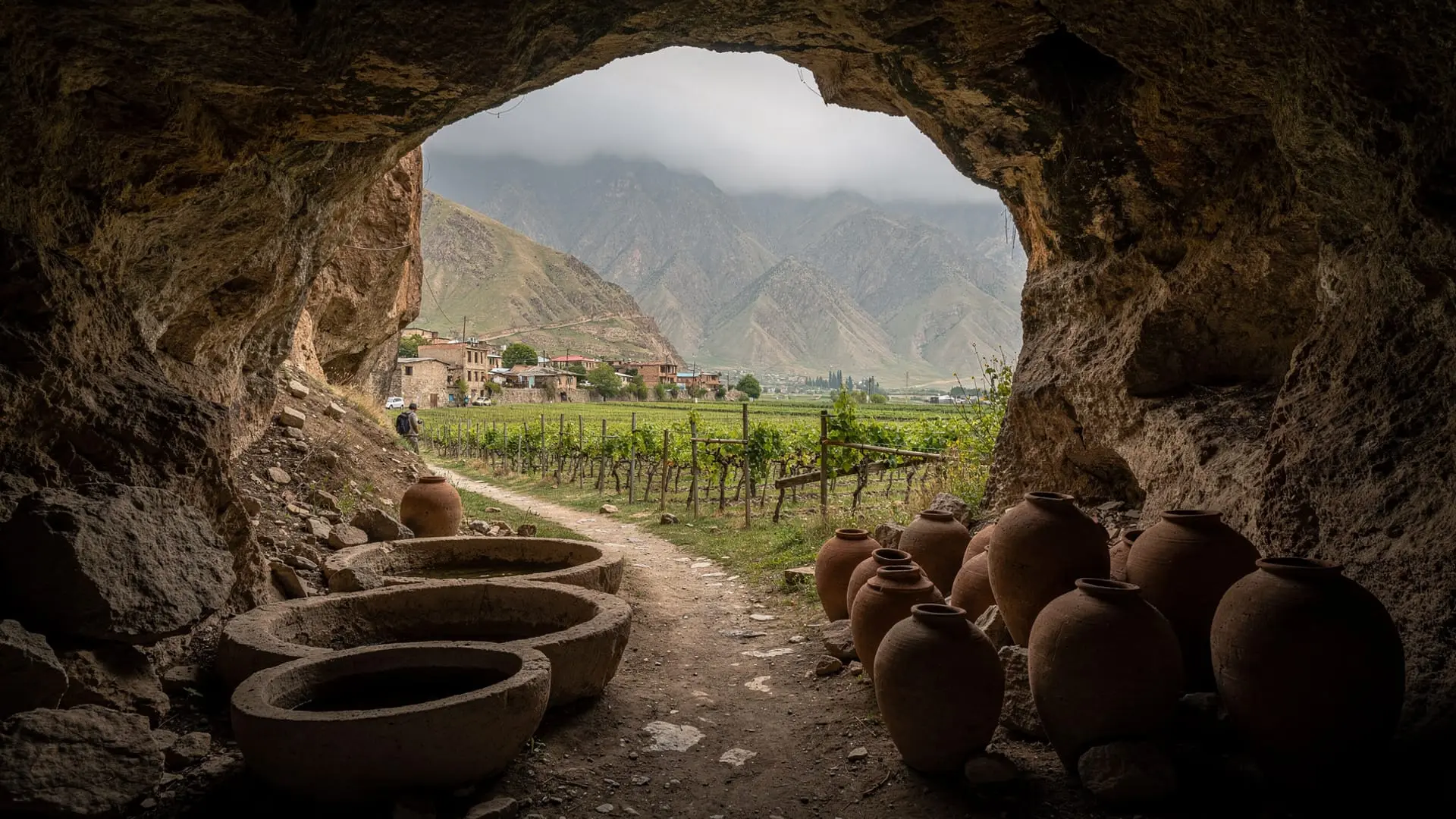
A cave that rewrote the history of wine
In 2007 a joint team of Armenian, Irish, and American archaeologists began clearing sediment from a series of limestone chambers near the village of Areni in southern Armenia’s Vayots Dzor province. What they found over the following years quietly transformed our understanding of human civilisation. Beneath layers of goat dung, dried plant material, and collapsed roof debris lay an intact winery — not a few grape seeds or a stained amphora, but a complete installation with press, fermentation vessels, drainage, and storage — dated confidently to approximately 4100 BCE. That is around 6,100 years ago, and it is the oldest such complex ever discovered.
The finding did not merely push back the date of wine production by a millennium or two. It placed wine’s origins firmly in the South Caucasus — in Armenia specifically — and gave scientific grounding to a cultural identity that Armenians had long maintained as a matter of heritage and pride. Today, visiting Areni-1 is as much a pilgrimage for wine lovers as it is a tick on an archaeological checklist, and the cave is fully accessible to independent travellers as well as tour groups.
| Where | Areni village, Vayots Dzor, ~120km south of Yerevan |
| Cost | Around 1,000 AMD entry; guide 2,000–3,000 AMD extra |
| Time needed | 30–60 minutes at the cave; half a day with village and winery |
| Getting there | ~1h45–2h by car via M2; marshrutka via Yeghegnadzor is slower |
| Best time | April–October; September–October for harvest and the wine festival |
What the excavations revealed
The winery installation inside Areni-1 is not a single dramatic room but a series of related features spread across one of the cave’s principal chambers. The key elements are:
The pressing platform. A shallow clay basin approximately one metre in diameter, with slightly raised edges to contain the pressed juice. Grape seeds of Vitis vinifera — the wine grape species — were found concentrated around it. The pressing would have been done by foot, exactly as was common in Mediterranean winemaking up to the twentieth century.
Fermentation vessels. Several large clay jars were set into the floor of the cave. Analysis of their interiors showed tartaric acid residue — a fingerprint of wine — along with plant material and grape seeds. The vessels closely resemble wine-storage jars found at Bronze Age sites across the Near East.
A drainage channel. Juice from the pressing platform drained through a simple clay-lined channel into the fermentation vessels. This level of intentional engineering implies experience accumulated over generations, not an accidental discovery.
Storage jars. Deeper in the cave, additional pottery held dried fruit, seeds, and residue consistent with long-term wine storage. The fact that multiple steps of production are represented in one location suggests this was a regular, seasonal operation rather than a one-time event.
The leather shoe. In a separate section of the cave, archaeologists found a leather shoe stuffed with grass, radiocarbon-dated to approximately 3500 BCE — making it the oldest known intact shoe in the world. Alongside it were human skulls, which led researchers to conclude that the cave served both as a practical winery and as a site of funerary or ritual activity. Wine and death have been linked in virtually every culture that produces it; Areni-1 suggests that relationship dates to the very beginning.
The principal academic publication of the findings appeared in the Journal of Archaeological Science in 2011, authored by Gregory Areshian and colleagues. The lead archaeologist on the Armenian side, Boris Gasparyan, continues to work in the region.
Visiting the cave: practical information
The cave entrance is located approximately 2 km south of Areni village, signposted from the main M2 highway. The site is managed by the Armenian government and is open to visitors year-round, though conditions inside can be muddy after rain.
Opening hours. The site is generally open daily from around 09:00 to 18:00 in summer (April through October). In winter months opening hours are reduced and the site occasionally closes — call the local tourism office in Yeghegnadzor to confirm before making a special journey.
Entry fee. Admission is approximately 1,000 AMD (about 2.40 EUR) per adult. There is no additional fee for photography inside the cave, though tripods and bright flashes should be used considerately around the fragile formations.
Guided tours. On-site guides are available for a small additional fee (typically 2,000 to 3,000 AMD, around 5 to 7 EUR) and provide context that significantly enhances the visit. English-speaking guides are not always available; if this matters to you, arrange a guide through your accommodation in Areni or Yeghegnadzor in advance.
What to wear. The cave interior maintains a constant cool temperature regardless of season. Bring a layer. The floor can be uneven and damp — sturdy shoes rather than sandals are advisable.
Time needed. The visit itself takes 30 to 60 minutes including time with a guide. Combine it with the Areni wine village and a tasting at one of the nearby wineries (Hin Areni is a ten-minute walk) for a satisfying half-day programme.
Getting to Areni-1
Areni village sits on the M2 highway running south from Yerevan toward Goris and Tatev. It is approximately 120 km from Yerevan.
By car. The most flexible option. From Yerevan, take the M2 south through Yeghegnadzor and continue to Areni; the journey takes about 1 hour 45 minutes to 2 hours in normal traffic. The cave is signposted from the village.
By marshrutka. Marshrutkas from Yerevan’s Kilikia bus station run to Yeghegnadzor (the provincial capital) throughout the day. From Yeghegnadzor, take a local taxi or a second marshrutka to Areni (about 20 km). The full journey can take three hours each way, so budget a full day.
By organised tour. The most efficient approach for first-time visitors. A guided day tour from Yerevan typically combines the Areni-1 cave, a winery tasting, and Noravank monastery into a single itinerary. The Khor Virap, Areni-1 Cave and Noravank private day trip (6 to 9 hours, from USD 88) is a popular option. Alternatively, the Khor Virap, Noravank and Areni-1 Cave day tour covers the same highlights in a group format.
Combining Areni-1 with the surrounding area
The cave rarely stands alone as a destination — it is the archaeological anchor for a rich cluster of experiences in Vayots Dzor.
Areni village and its wineries. A ten-minute walk from the cave entrance brings you into the village itself, where Hin Areni winery and several smaller producers offer tastings. The village’s reputation rests on the Areni Noir grape, which grows on terraces above the Arpa River gorge. For a complete guide to the wineries in walking distance, see Hin Areni winery: tour, tasting and tips.
Noravank monastery. One of Armenia’s most spectacular religious sites, Noravank sits 12 km from Areni in a narrow canyon of brilliant red cliffs. The monastery dates from the thirteenth and fourteenth centuries and is one of the finest examples of medieval Armenian architecture. It is included in virtually every day-tour itinerary that visits Areni. See the Noravank destination page at /destinations/noravank-monastery/ for visiting details.
The Vayots Dzor wine route. The full wine route extends beyond Areni to include Trinity Canyon Vineyards, Zorah’s vineyard near Rind village, and smaller producers in Yeghegnadzor. A comprehensive itinerary covering all stops is in the Vayots Dzor wine route guide.
Jermuk. If you are heading south after Areni, the spa town of Jermuk is another 65 km along the road, with its famous waterfall and mineral water galleries. The destination page is at /destinations/jermuk/.
The Areni-1 cave and Armenian cultural identity
For Armenians, Areni-1 is more than an archaeological site — it is evidence of a civilisation’s depth. When you have been invaded, conquered, deported, and in 1915 subjected to genocide, the ability to point to unbroken human activity in your homeland reaching back six thousand years carries enormous emotional weight. The cave’s discovery sparked a national conversation about heritage tourism, indigenous grape varieties, and the relationship between Armenia’s ancient past and its post-independence present.
Several of the country’s most ambitious winemakers have spoken publicly about how the Areni-1 discovery shaped their approach. Vahe Keushguerian of Zorah and Gago Gevorkyan of Trinity Canyon Vineyards both cite it as a motivating factor in their decision to work exclusively with indigenous Armenian varieties rather than international ones. The cave is not just a tourist attraction; it is a founding myth made tangible.
What nearby excavations are still in progress
The Areni-1 cave is part of a broader archaeological landscape. The Ararat Plain, Lake Sevan basin, and Vayots Dzor gorges have all yielded Bronze Age and Chalcolithic winemaking evidence, albeit less complete than Areni-1. Excavations continue at several sites in Vayots Dzor under Boris Gasparyan’s direction, and periodic discoveries — new pottery, additional grape residue, further storage vessels — are reported in the academic literature.
The Magellan Cave, located a few kilometres from Areni and managed as a separate tourist attraction, is open for guided caving experiences (separate from the archaeological site) and offers a different perspective on the region’s extraordinary geology. Tickets for the Magellan Cave cost approximately 3,500 AMD (about 8.50 EUR); you can book the Magellan Cave entry ticket through GetYourGuide.
Frequently asked questions about Areni-1
Is the Areni-1 cave the same as the Magellan Cave?
No. They are two separate cave systems near Areni village. Areni-1 (also known locally as “Birds’ Cave” or “Trchunkaber”) is the archaeological winery site managed as a heritage monument. The Magellan Cave is a natural cave open for tourist caving experiences. Both are worth visiting if you have time, but they have different characters and different ticketing arrangements.
Can I see the original artefacts from the excavation?
The most significant artefacts — the leather shoe, pottery fragments, and preserved organic material — have been transferred to the History Museum of Armenia in Yerevan and to conservation facilities. The cave itself still contains the structural features (press basin, embedded vessel positions), but the portable finds are in museum storage or on display in Yerevan. The History Museum at Republic Square is open Tuesday to Sunday.
How long does the visit take?
Allow 30 to 60 minutes for the cave itself. If you combine it with a walk through Areni village, a winery tasting, and Noravank monastery, plan for a full day (six to eight hours total from Yerevan).
Is the site wheelchair accessible?
The cave interior is not wheelchair accessible — the entrance requires descending steps on an uneven rock face, and the interior floor is irregular. The area outside the cave and the village itself are generally accessible. Contact the Yeghegnadzor tourism office for the most current accessibility information.
What is the best time of year to visit Areni-1?
Any time from April through October is suitable. The coolest and most atmospheric visiting conditions are in September and October, when the harvest is underway in the vineyards surrounding the cave and the Areni Wine Festival takes place in the first weekend of October. Avoid visiting after heavy rain, when the cave floor becomes slippery.
Are there restaurants near the cave?
Areni village has several small restaurants and guesthouses that serve traditional Armenian food alongside local wine. Expect to pay 3,000 to 6,000 AMD (7 to 15 EUR) for a full meal. The restaurant at Hin Areni winery is a good option for a post-tasting lunch.
Is Areni-1 worth visiting if I am not especially interested in archaeology?
Yes, for most travellers. Even without deep archaeological interest, standing inside a 6,100-year-old winery installation carved into rock is a striking, tangible experience, and the visit is short enough (30–60 minutes) that it never overstays its welcome. Pairing it with a winery tasting in the village afterward gives the visit an immediate, sensory payoff that complements the historical one.
Can I visit Areni-1 as a standalone trip, or should I always combine it with other sites?
A standalone round trip from Yerevan just for Areni-1 is possible but not the most efficient use of a day, given the 1h45–2h drive each way. Nearly every visitor combines it with at least one of the village wineries, Noravank monastery, or Khor Virap, since all sit within a reasonable driving loop and the extra stops add relatively little time for considerably more content.
The academic significance: what Areni-1 proved
Before 2007, the oldest known winery was a site in Hajji Firuz Tepe, Iran, dated to around 5400 BCE (approximately 7,400 years ago). The discovery at Areni-1 — 1,300 years older — shifted the timeline significantly and simultaneously shifted the geography. The South Caucasus, not the Zagros Mountains of Iran, emerged as the most ancient confirmed site of industrialised wine production.
This matters beyond national pride. The location reinforces genetic and archaeological evidence that the South Caucasus is one of the primary centres of grape domestication — the region where wild Vitis sylvestris vines were first selectively cultivated into the wine-bearing Vitis vinifera. DNA studies of modern Armenian and Georgian grape varieties show exceptional diversity suggesting thousands of years of in-situ selection and cultivation. Areni-1 puts human agents in that landscape at the right time.
The academic literature has also grappled with the cave’s dual function. The presence of human skulls alongside the winery installation, and the careful placement of the pressing basin in a sealed inner chamber, suggests that wine was from the earliest times associated with ritual as well as nutrition. Libations — wine poured as offering to deities or ancestors — appear to have been standard practice in the Chalcolithic South Caucasus. The 6,100-year tradition of Armenian wine is therefore inseparable from the spiritual and ceremonial dimensions that Armenians continue to associate with it today.
How Areni-1 connects to living winemaking tradition
One of the remarkable aspects of Vayots Dzor’s landscape is that the archaeological past and the commercial present are literally visible from the same vantage point. Standing near the cave entrance, you can see active vineyards on the terraces above the Arpa River gorge. Those terraces have been worked, in some form, for most of the six thousand years since the cave was in use. The Areni Noir grape variety grown there today is genetically ancient — while its precise lineage cannot be traced to 4100 BCE, the grape family it belongs to has been cultivated in Vayots Dzor without interruption.
Modern winemakers like Vahe Keushguerian of Zorah have spoken at length about the weight of this continuity. For Keushguerian, producing wine from pre-phylloxera old vines — some over a century old, on terraces above the valley — at 1,700 metres above sea level in the same valley as Areni-1 is a deliberate act of cultural connection. The cave is not a distant historical curiosity; it is the prologue to every bottle of Areni Noir.
For visitors who want to understand that connection viscerally rather than intellectually, the ideal sequence is: cave tour first, then a tasting at Hin Areni or Trinity Canyon Vineyards while the images of the six-thousand-year-old pressing basin are still fresh.
Seasonal conditions and what to expect throughout the year
The cave maintains a near-constant internal temperature of approximately 12 to 14 degrees Celsius regardless of external conditions — the same cool stability that made it ideal for wine storage in the Chalcolithic period. This means the visit itself is comfortable even in summer, when the exterior temperature in Vayots Dzor can reach 32 to 35 degrees Celsius.
Spring (April to May): the surrounding landscape is at its most lush, with wildflowers on the slopes and fresh green growth in the vineyards. Tourist crowds are moderate. Good light conditions for photography at the cave entrance.
Summer (June to August): peak tourist season in Armenia. The cave interior remains cool; the exterior is hot. Arrive early (before 10:00) to avoid the midday heat and the maximum tourist crowds in the afternoon.
Autumn (September to October): the optimal window. Harvest energy permeates the valley; grapes hang heavy on the terraces surrounding the cave. The Areni Wine Festival (first Saturday of October) falls in this period. The combination of archaeological visit and active harvest is unmatched anywhere else in the wine world.
Winter (November to March): the cave is open but rarely visited. The valley is quiet, cold, and atmospheric in a different way — snow occasionally dusts the upper vineyards. The cave interior is the same temperature as always. A winter visit is quite possible for prepared travellers and offers a completely different (and more solitary) experience.
Photography at Areni-1
The cave is photogenic but technically challenging. The interior is dimly lit; bring or borrow a torch, and set your camera to a high ISO or long exposure. The key compositional elements:
- The entrance shaft, where light penetrates from above and illuminates the cave floor in natural shafts
- The pressing basin itself, best photographed from slightly above to show its form
- The clay vessel positions in the floor, where the original pots were embedded
- The cave ceiling with its calcite formations — particularly striking if your torch picks out the textures
Photography outside the cave — the limestone cliff face, the signage, the surrounding gorge with vineyards — is straightforward in good light. Early morning (before 09:00) and late afternoon (after 16:00) give the best light on the cliff faces.
No artificial lighting is installed in the cave itself; your own light source is essential for meaningful interior photography.
What locals mean when they call it “Birds’ Cave”
Before the archaeological finds made it famous internationally, local villagers knew the cave complex as “Trchunkaber” — Birds’ Cave — a reference to the swallows and other birds that nested in its upper chambers and the shaft where light enters from above. That older name still appears on some regional maps and in conversation with residents of Areni village, and it is worth knowing if you are asking for directions locally rather than relying on GPS: not everyone in the village uses “Areni-1” in daily speech, since it is primarily an academic designation rather than a folk name.
Doing it without a car
Independent travellers without a car can reach Areni by marshrutka from Yerevan’s Kilikia bus station to Yeghegnadzor, then a local taxi or shared minibus onward — but as noted above, the full journey can take three hours each way, so this is realistically a full-day commitment rather than a quick stop. For most travellers the organised day tour is the better value: it bundles Areni-1, a winery tasting, and often Noravank or Khor Virap into one efficient itinerary with a driver who already knows the route and timing. The getting around Armenia by marshrutka guide has the fuller picture of when public transport works well in Armenia and when it does not — Vayots Dzor’s spread-out sites are one of the clearer cases for a tour or private driver.
Pairing Areni-1 with Khor Virap
Many day tours from Yerevan combine Areni-1 with Khor Virap monastery, the closest viewpoint of Mount Ararat from Armenian soil, since both sit along the same M2 corridor south of the capital. The pairing works well precisely because the two sites offer such different experiences — a Chalcolithic archaeological cave versus a working monastery with a dramatic mountain backdrop — within a single manageable driving loop. See the Khor Virap monastery and Ararat views guide for what to expect there, and the Khor Virap and Noravank day trip guide for how the full loop typically runs.