Yerevan to Tbilisi by night train: a 2022 experience
The Armenia-Georgia combination as a trip structure
Before getting to the train itself, it’s worth saying something about the broader structure that makes the night train relevant. Combining Armenia and Georgia in a single trip is one of the more satisfying travel structures in the region. The two countries are different enough to make the juxtaposition interesting and similar enough — in the sense that both have ancient Christian traditions, extraordinary landscapes, and food cultures worth taking seriously — to feel coherent.
A typical combination might run like this: fly into Yerevan, spend two to three days in the city and its surroundings (Garni, Geghard, Khor Virap), travel to the south for Tatev and the Syunik region, then take the night train to Tbilisi for four to five days in Georgia before flying home from Tbilisi. Or the reverse, arriving Tbilisi and departing Yerevan.
The Armenia-Georgia combined itinerary guide has structured versions of this for different durations. The flagship itinerary — 14 days covering both countries — includes both the Caucasian highlights on each side and gives sufficient time in each place to do more than tick sites off a list.
What the night train does in this structure is serve as the hinge: the moment of transition between the two countries, handled while you sleep, so that both the Armenian days and the Georgian days feel complete rather than one being cut short by travel.
| Route | Yerevan Central to Tbilisi Central Station |
| Duration | ~10 hours, departs ~21:30, arrives ~07:30 |
| Cost | Around 8,000-12,000 AMD for a 4-berth couchette |
| Border crossing | Bagratashen/Sadakhlo, around 2 a.m., ~20 min off-season |
| Booking | South Caucasus Railways office in Yerevan, in advance |
Why the train
There are three obvious ways to get from Yerevan to Tbilisi: the morning marshrutka from Kilikia station (about six hours, cheap, uncomfortable, views of the Debed canyon), a private or shared taxi (similar time, more comfort, similar route), or the night train. The marshrutka and taxi options arrive in Tbilisi in the afternoon; the night train arrives at 7:30 in the morning having used the night for transit rather than for sleeping.
I have done the marshrutka. It is fine. The canyon road is genuinely beautiful, especially the stretch through Lori province past Haghpat and Sanahin — the two UNESCO monasteries visible from the road, the gorge dropping to the Debed River below. But six hours on a minibus is six hours, and you arrive tired.
The night train is different. You board in Yerevan, you sleep (more or less), and you wake up in Georgia. The 270 kilometres between the two capitals dissolve in darkness. When the train pulls into Tbilisi station at 7:30 a.m., you have a full day ahead and, assuming you managed to sleep, most of your energy intact.
I took the night train in March 2022, booking a couchette berth in advance at the South Caucasus Railways office near the train station in Yerevan. The ticket cost about 8,000-12,000 AMD depending on class — the 4-berth couchette being the middle option, cheaper than the 2-berth but more sociable than the seat carriages.
Departure at 9:30 p.m.
The train departs Yerevan at approximately 21:30. I arrived at the station — Yerevan Central, on Marshal Baghramyan Street — about forty minutes early, which was more than necessary but gave me time to find the platform and locate my carriage in the long line of Soviet-era wagons.
My compartment held four berths — two upper, two lower — and three of them were occupied by the time the train moved: me in the lower right, a Georgian man in his fifties named Giorgi in the upper right (he told me this immediately, offered me an orange from a bag, and went to sleep before the train had cleared the city), and a young Armenian couple who spoke quietly in the lower left berth.
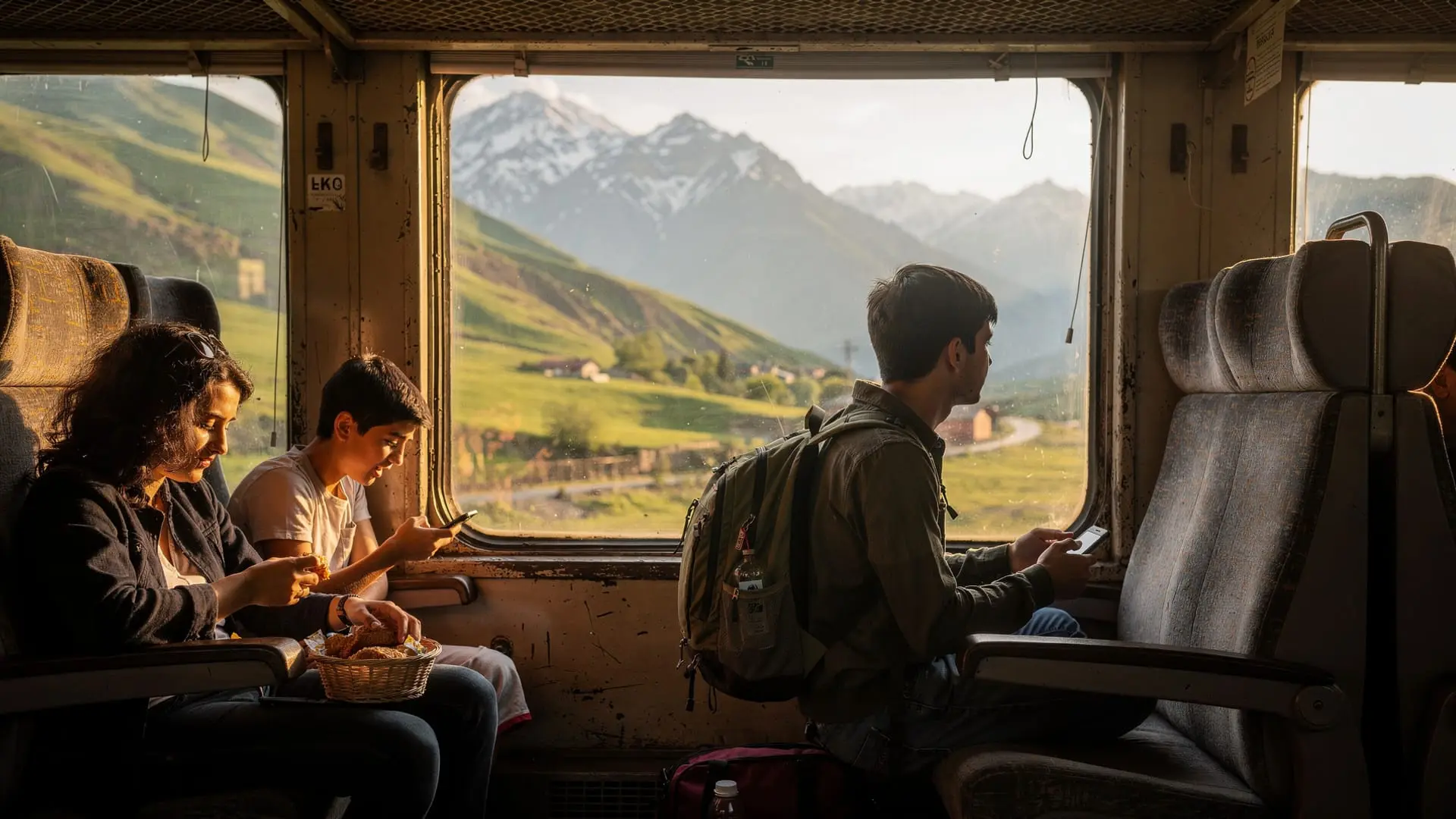
The beds in the couchette are approximately what you’d expect from a train that was built in the Soviet period and has been maintained since: functional, not luxurious, with a foam mattress, pillow, and sheet. The compartment was warm, probably too warm, as Soviet-heritage train carriages tend to be. I left the door slightly open to the corridor.
The train wound through the Yerevan suburbs, then north into the dark. The lights of the Ararat valley disappeared. I read for a while and then turned off the light above my berth. The motion of the train was the specific slow rhythm of old track — a rock-and-sway, with the occasional jolt at a junction. I slept reasonably well.
The 2 a.m. border crossing
At some point in the middle of the night — I had the impression it was around 2 a.m., which I confirmed later was correct — the train slowed and stopped. This is the border crossing at Bagratashen (Armenia) / Sadakhlo (Georgia). Two sets of border guards board: first Armenian, then Georgian, working the carriages in sequence.
The process is orderly. An Armenian border guard came through the compartment, checked passports, stamped, moved on. A Georgian guard did the same ten minutes later. Giorgi in the upper berth handed his passport down without waking up fully. The young couple in the lower berth were already awake and had their documents ready. The whole process for our compartment took about twenty minutes.
Then silence, then the train moved again. I looked at my watch: 2:17 a.m. I went back to sleep.
The thing I had been told about this crossing — that it could take up to an hour and a half at peak times — did not apply in March. In summer, apparently, when the train is full and the flow of passengers is heavier, the crossing takes longer. March, off-season, was quick.
Arriving in Tbilisi
The train arrived at Tbilisi Central Station at 7:28 a.m. — two minutes ahead of schedule. I was awake by then, having been woken by the increasing daylight and the changing character of the landscape outside the window. Georgia and Armenia look different in ways you notice at the geographic border: the vegetation shifts, the terrain opens up, and after the long gorge of the Debed, the road into the Kura valley is more expansive.
Tbilisi at 7:30 a.m. in March is cold and beginning to wake up. The station is central and a short taxi ride (or metro) from the old city. I ate breakfast in a café near the station — khinkali, the Georgian dumplings that are the correct breakfast choice at any hour — and was walking through the old town by 9 a.m., which felt like having had something for free.
The contrast with Yerevan is immediately noticeable and not just in the architecture (though the architecture is very different: Tbilisi’s carved wooden balconies and Art Nouveau facades versus Yerevan’s tuff and Soviet modernism). The atmosphere of the two cities is different in less definable ways — the pace, the soundscape, the ratio of Russian-language signage to Georgian and Armenian. After several days in Yerevan, Tbilisi felt like a shift rather than just a continuation.
What you see in the morning
After the border crossing, the train continues north through the Georgian countryside. The landscape becomes visible as dawn approaches — I was awake by about 5:30, when the sky was light enough to see. The Kura valley opens up after the gorges of the Debed; there are vine-covered hills, old churches on hilltops, the occasional Soviet-era roadside building. The terrain is greener than Yerevan’s surroundings, even in March.
About forty minutes before Tbilisi, the city’s outskirts begin: factories, apartment blocks, the first signs in Georgian script — the distinctive round letters that look unlike any other alphabet in the world, including Armenian, though both countries have their own scripts of similar antiquity. I was looking forward to Georgian food in the way that you look forward to things that are good in themselves: khinkali, khachapuri, the Kakheti wines that are different in style from Armenian ones, the way the old city of Tbilisi climbs the hills above the Kura.
The arrival into Tbilisi Central Station is unremarkable as arrivals go — an urban terminal, platforms, the usual station noise. But having arrived by night train, with the border behind you and the morning ahead, there’s a specific quality of arrival that daytime transfers don’t produce. You slept in one country and woke up in another. The geography feels earned.
The Lori corridor: what you pass through
The marshrutka and taxi route between Yerevan and Tbilisi goes through the Debed canyon in Lori province — a dramatic gorge with the UNESCO monasteries of Haghpat and Sanahin visible from the road. The night train follows a different alignment, partly through tunnel, and you miss this scenery in the dark.
This is worth knowing if the Lori monasteries are on your list. The way to see them is to stop in Haghpat or Alaverdi (the junction town in the canyon) on the way — either going north by marshrutka and stopping for a night, or doing Haghpat and Sanahin as a day trip from Yerevan before your Tbilisi travel. The night train, by its nature, isn’t designed for sightseeing.
The Yerevan to Tbilisi overland guide addresses the tradeoffs between all the options in detail.
The case for the night train
If you’re doing a Caucasus combination — Armenia and Georgia together, which is the natural and recommended structure for a two-week trip — the night train solves a logistical problem with some elegance. You don’t lose a day to transit. You don’t arrive exhausted. And the journey itself, including the 2 a.m. border check, has the specific quality of a travel experience that was available to an earlier generation of travellers and is still available, unchanged, if you choose to take it.
The train is not romantic in the way that travel writing sometimes makes night trains sound. The berths are Soviet-era functional. The dining car, when it’s operating, serves basic food at unremarkable prices. The scenery between the two countries is invisible in the dark. What you’re buying is primarily the time-shift: boarding in one capital and waking in the other.
For the corresponding perspective from Tbilisi and the Georgia side of the combination, georgia-spirit.com covers the Georgian end of the route in detail — Tbilisi orientation, the Kakheti wine region, and the logistics of moving within Georgia after arriving from Armenia.
The Yerevan to Tbilisi overland guide covers all the options — train, marshrutka, taxi, and the various transfer services — with current prices and timing. The night train schedule is confirmed seasonally; check before booking, as it’s occasionally suspended for maintenance.
A note on the post-2022 context
I took this train in March 2022, a few weeks after the Russian invasion of Ukraine began. The train had an unusual passenger mix that month: alongside the usual Yerevan-Tbilisi travelers, there were Russian and Ukrainian passengers moving through Georgia to reach other destinations, using the South Caucasus as a transit route. Tbilisi was receiving large numbers of Russian emigrants. The political atmosphere in both countries was more charged than usual.
This context has since evolved in complex ways. Travel between Armenia and Georgia remains straightforward and accessible. The route is open, the infrastructure works, and the combination of the two countries remains one of the more rewarding travel structures in the Caucasus region.
Packing and comfort notes
A few things I’d do differently or recommend based on that trip: bring earplugs, since Soviet-era carriages carry sound between compartments more than modern trains do, and a light scarf or sleep mask, as compartment lighting isn’t always adjustable to fully dark. The carriages run warm, so pack a layer you can shed rather than a heavy jumper. Bring snacks and water — the dining car is inconsistent and not something to rely on for a proper meal. If you’re travelling as a couple or with friends, booking all four berths of a compartment (rather than leaving it open to strangers) costs more but guarantees privacy, worth considering if budget allows.
Combining the train with Lori en route
Since the train itself skips the Lori scenery in darkness, a good structure for travelers who want both the monasteries and the night train is to see Haghpat and Sanahin as a day trip from Yerevan earlier in your Armenia leg, then take the night train from Yerevan on a separate evening once you’ve finished the Armenia portion of your trip. This way you get the Debed canyon scenery in daylight and still get the efficient overnight transfer to Tbilisi rather than losing a travel day to the marshrutka.
Private transfer tour from Yerevan to Tbilisi, with stops en routeFAQ
Is the night train comfortable enough for a light sleeper? It’s functional rather than luxurious — Soviet-era foam mattresses, a warm compartment, and the sounds of a shared carriage. Light sleepers should bring earplugs and a sleep mask. If privacy and quiet matter more than budget, book all four berths of a compartment rather than sharing with strangers.
Does the night train run year-round? It generally does, but the schedule is confirmed seasonally and it’s occasionally suspended for maintenance, so check current timetables before booking rather than assuming it runs every night indefinitely.