Combining Armenia & Georgia: 14-day Caucasus planner
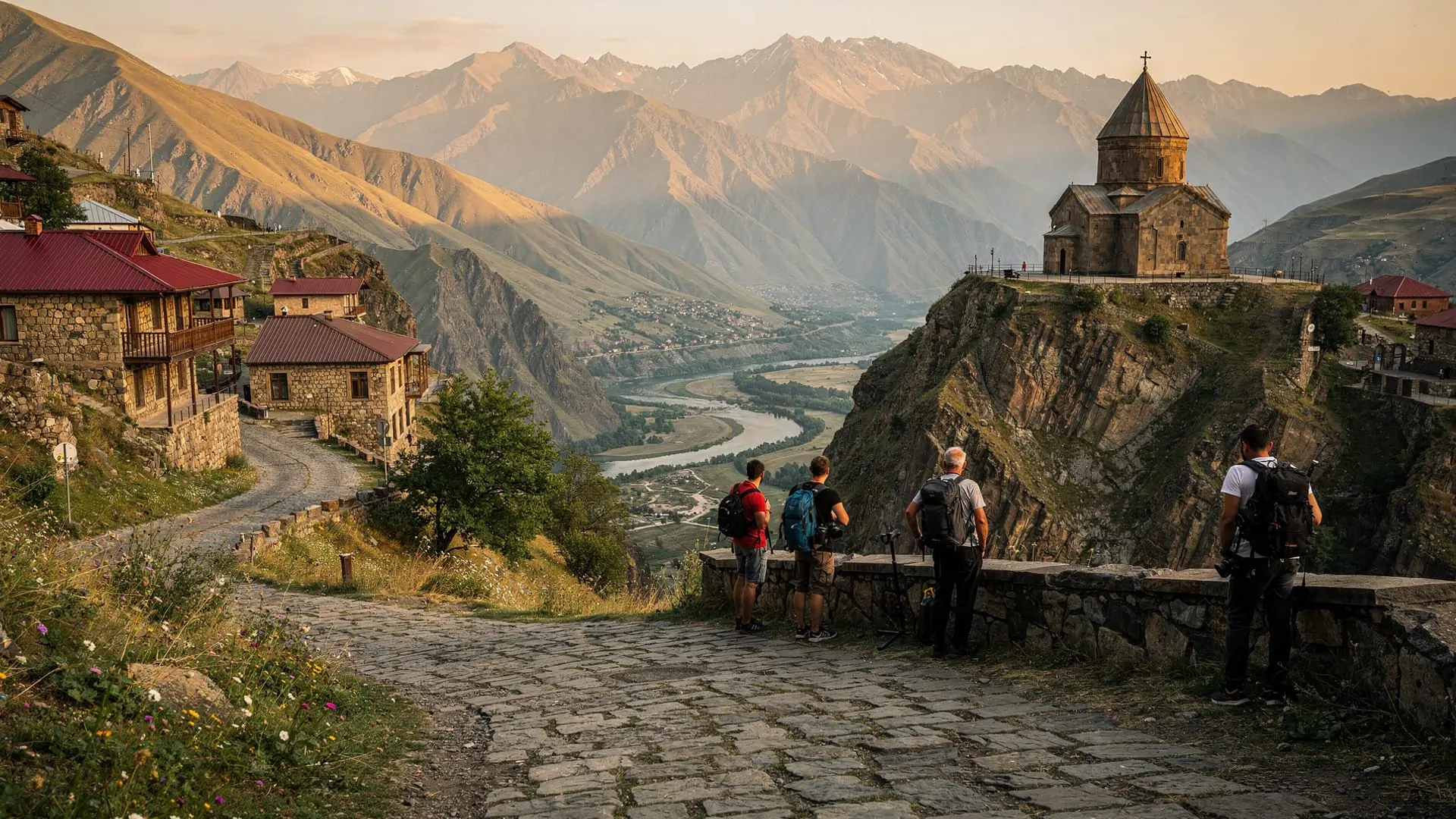
The South Caucasus contains two countries that were made to be visited together. Armenia and Georgia share a border, a general cultural frame (both ancient Christian civilisations with unique alphabets, polyphonic music, and extraordinary church architecture), and a combined overland journey that is one of the finest in the former Soviet world. Yet they are strikingly different in character — different alphabets, different cuisines, different landscapes, different rhythms.
Armenia is the older, more self-contained experience: a country where monasteries perch above gorges and the weight of a 1 700-year Christian tradition is felt everywhere. Georgia is more varied, more gastronomically celebrated, and more travelled by international tourists. Together they cover the full Caucasus experience in a way that neither can provide alone.
This guide is a practical framework for combining both. It covers what minimum time makes sense in each, how to structure the 14-day version, and what the 10-day compressed version looks like.
| Minimum time | 10 days (4 Armenia + 6 Georgia) |
| Ideal time | 14 days (7 + 7) |
| Border crossing | Bagratashen/Sadakhlo, 6 hrs road or 10 hrs overnight train |
| Budget (mid-range, 14 days) | Around 1,600 EUR/person, excl. flights |
| Best flight pattern | Fly into EVN, out of TBS (or reverse) |
Why combine Armenia and Georgia?
Geography: The countries are adjacent, with multiple open land crossings — Bagratashen/Sadakhlo being the main one. The crossing from Yerevan to Tbilisi takes 6 hours by road, or you can take the spectacular 10-hour overnight train.
Complementarity: Armenia’s greatest strengths (Garni, Geghard, Khor Virap, Tatev, the Ararat plain, the medieval monastery network) are very different from Georgia’s (Tbilisi’s old town, Kazbegi’s mountain drama, Kakheti’s wine region, the cave city of Vardzia). You don’t repeat yourself.
Economy: Both countries are excellent value for Western European and North American travellers. A 14-day combined trip can be done for 1 200–2 000 EUR all-in (accommodation, food, transport, activities) at a mid-range budget.
Visa: Citizens of EU, USA, Canada, UK, Australia, Switzerland, Japan, South Korea are visa-free in both countries for up to 180 days per year. No advance application needed.
The 10-day minimum (4 Armenia + 6 Georgia)
If you have exactly 10 days, the split should favour Georgia for one reason: Georgia has more to see within a manageable distance of Tbilisi. Armenia is more compact — the core sites are all within day-trip range of Yerevan.
Rough 10-day structure:
- Days 1–4 (Armenia): Yerevan (1 night) → Garni & Geghard day trip → Khor Virap & Noravank → overnight train to Tbilisi (night 4)
- Days 5–10 (Georgia): Tbilisi (2 nights) → Kazbegi day trip → Kakheti wine region (1 night) → Tbilisi → fly out
This works but leaves most of southern Armenia (Tatev, Syunik) and northern Georgia (Svaneti, Vardzia) unexplored.
The full 14-day Caucasus itinerary
Armenia: Days 1–7
Day 1: Arrive Yerevan
- Airport transfer, settle in, walk the Cascade complex in the evening.
- Evening: dinner at Sherep or Lavash restaurant.
Day 2: Yerevan city day
- Morning: Tsitsernakaberd Genocide Memorial (sober, essential). Afternoon: Matenadaran manuscript library, Republic Square, Vernissage market.
Day 3: Garni & Geghard
- Leave by 9am. Temple, Symphony of Stones, lavash baking, monastery. Back by 4pm. See the full guide.
Day 4: Khor Virap & Noravank (dawn)
- Leave by 6am for Ararat views. Khor Virap, Areni wine, Noravank in the red canyon. Back by 4pm. See the full guide.
Day 5: Etchmiadzin & Lake Sevan
- Morning: Mother Cathedral of Etchmiadzin and Zvartnots ruins. Afternoon: drive to Lake Sevan, Sevanavank, ishkhan trout dinner.
Day 6: Drive south to Goris via Jermuk
- Scenic southern drive. Stop at Areni cave (world’s oldest winery site). Evening in Goris.
Day 7: Tatev & Wings of Tatev
- Cable car from Halidzor, full morning at Tatev monastery. Afternoon: drive to Goris, overnight train Yerevan–Tbilisi departing 21:30 (arrange return to Yerevan for train, or a transfer to Tbilisi directly from Goris).
Alternatively: skip the train and drive the Debed canyon route to Tbilisi via Haghpat and Sanahin.
Book a Yerevan to Tbilisi tour stopping at Sanahin & Haghpat
Transition: the Debed canyon route (Day 8 morning)
If driving rather than taking the overnight train, consider stopping at:
- Haghpat monastery (UNESCO) — 200 km from Yerevan, 3.5 hours. One of the great Armenian medieval monasteries, usually uncrowded, above a dramatic forested gorge. See the Haghpat & Sanahin guide.
- Sanahin monastery (UNESCO) — 5 km from Haghpat, equally fine.
- Akhtala monastery — 20 km further, Byzantine-period frescoes inside a medieval fortress.
This route arrives in Tbilisi by evening, having seen three UNESCO monasteries en route.
Georgia: Days 8–14
For Georgia’s itinerary, our partner site georgia-spirit.com covers the full range of options — Tbilisi old town, the mountain village of Kazbegi, the wine-producing Kakheti region, and the cave monastery complex of Vardzia. The caucasus-armenia-georgia-14-days itinerary on this site maps out the combined route in detail.
Rough Georgia days:
- Days 8–9: Tbilisi (Narikala fortress, old town, Sulfur baths, Georgian feast at a traditional restaurant)
- Day 10: Kazbegi day trip (3-hour drive, Mount Kazbek, Gergeti Trinity Church)
- Days 11–12: Kakheti wine region (Sighnaghi, Telavi, winery visits)
- Day 13: Vardzia cave monastery or Borjomi spa town
- Day 14: Tbilisi, fly home
Practical combined trip logistics
Crossing the border
The main crossing is Bagratashen (Armenia) / Sadakhlo (Georgia) on the M6 highway. Open 24/7. See the Bagratashen border guide for crossing procedure and timing advice.
Alternative crossings: Bavra/Ninotsminda and Gogavan/Guguti are smaller and less congested but less served by public transport.
Currency
Armenia uses the AMD (Armenian dram); Georgia uses the GEL (Georgian lari). Both accept card payment widely in cities; carry cash in rural areas. Do not rely on exchanging AMD to GEL at the border — rates are poor. Exchange EUR or USD to GEL at a bank in Tbilisi.
Getting around within Georgia
Georgia is slightly larger and has better public transport between cities than Armenia. Marshrutkas, trains (Tbilisi–Batumi and Tbilisi–Zugdidi are reliable), and taxis all work. Car rental in Georgia provides great flexibility, especially for Kakheti and the military highway to Kazbegi.
For comprehensive Georgia travel information — destinations, hotels, tours, and practical tips — visit georgia-spirit.com.
Accommodation budget
Armenia:
- Budget guesthouses: 6 000–12 000 AMD per night (~15–30 EUR)
- Mid-range hotels: 20 000–40 000 AMD (~50–100 EUR)
- Luxury (Republica Hotel Yerevan, Tufenkian guesthouses): 60 000–120 000 AMD+ (~150–300 EUR)
Georgia:
- Tbilisi budget hostels: ~15–25 EUR
- Mid-range Tbilisi hotels: 50–100 EUR
- Kazbegi guesthouses: 25–50 EUR
Should I start in Armenia or Georgia?
Either works logistically, but most travellers recommend starting in Armenia for two reasons:
- Armenian culture requires slightly more context to fully appreciate — having Georgia as a comparator makes the return to Armenian sites (if you revisit) richer.
- Flying into Yerevan’s Zvartnots (EVN) and out of Tbilisi’s Shota Rustaveli (TBS) — or vice versa — allows one-way overland travel without backtracking.
Direct flights to Yerevan from London, Paris, Vienna, Amsterdam, Rome, Athens, and Frankfurt make EVN an easy entry point from Europe.
Key planning decisions for the combined trip
Fly into which city?
Yerevan (EVN) has direct flights from Vienna (Austrian Airlines), Paris CDG (Air France/Transavia), Rome FCO (Wizz Air), Athens (Aegean), Amsterdam (KLM/Transavia), Frankfurt (Lufthansa), and London Gatwick (Wizz Air). For most Western European travellers, Yerevan is a convenient entry point.
Tbilisi (TBS) has direct connections from similar European hubs plus Middle Eastern routes via Doha and Dubai. It handles higher passenger volumes and has a slightly wider route network.
One-way ticket option: The most efficient structure for a combined trip is fly into EVN, fly out of TBS (or vice versa). This eliminates backtracking across the border — you travel Armenia to Georgia overland and fly home from Tbilisi. One-way international flights on this pattern are now readily available from most European cities.
Which country first?
Experienced Caucasus travellers generally recommend Armenia first. The reasoning: Georgia is more immediately accessible (English more widely spoken, tourist infrastructure more developed) and easier to appreciate on arrival. Armenia rewards time and context — having Georgia as a subsequent comparator makes the Armenian experience richer in retrospect.
The exception: if you have Georgian contacts or a specific reason to start in Tbilisi (arriving at TBS, meeting someone), the reverse order works fine.
Transport between countries
The three practical options are:
- Night train (21:30 departure, 07:30 arrival) — romantic, economical, space-efficient
- Daytime shared marshrutka (6 hours, 9 000 AMD) — cheapest, flexible departure
- Private transfer with monastery stops — most content-rich option
See the Yerevan to Tbilisi overland guide for the complete comparison.
What a 14-day combined trip costs (mid-range)
| Category | Armenia (7 days) | Georgia (7 days) |
|---|---|---|
| Accommodation | ~350 EUR | ~450 EUR |
| Food | ~150 EUR | ~180 EUR |
| Transport (local) | ~100 EUR | ~120 EUR |
| Tours & entry fees | ~150 EUR | ~100 EUR |
| Total per person | ~750 EUR | ~850 EUR |
Combined mid-range total: approximately 1 600 EUR per person for 14 days, excluding international flights.
The cultural contrasts that make the combination valuable
One of the pleasures of the combined Armenia–Georgia trip is the constant, illuminating contrast between two civilisations that share a general framework (ancient Christian churches, mountain geography, wine traditions, complex histories under larger empires) but are deeply different in expression.
Architecture: Armenian churches are stone, compact, and geometric — the conical dome over a square nave is the unmistakable signature. Georgian churches tend to be more varied — from the basilica form of the early period to the later cross-in-square constructions that were influenced by Byzantine architecture, often taller and lighter in visual feeling. Seeing both within a week makes each more comprehensible.
Food: Georgia’s cuisine is more internationally celebrated — khinkali (meat dumplings), khachapuri (cheese bread), churchkhela (walnut-and-grape-juice candy), and the natural wine revolution that has made Georgian wine globally known. Armenia’s food is equally excellent but quieter — khorovats, lavash, herb-heavy salads, the Areni Noir wine tradition — and less photogenic in the Instagram-era sense. Together they represent the range of Caucasus food culture.
Geography: Armenia’s terrain is all about volcanic plateau and mountain isolation — the feeling of a fortress country that has survived by retreating into its highland redoubt. Georgia is more varied: the Black Sea subtropical zone (Adjara), the high Caucasus mountains of Kazbegi and Svaneti, the wine valleys of Kakheti, and the central plains. Moving between them, the landscape changes as dramatically as the culture.
Pace: Yerevan is quieter and more intense than Tbilisi. Tbilisi is more cosmopolitan, more tourist-oriented, and arguably more immediately charming for first-time visitors. Many travellers find that Armenia requires a day or two to decode and then reveals something more lasting.
The Armenian diaspora and Georgia connection
For travellers with Armenian heritage, the combined trip has an additional layer. Georgia has historically been home to a significant Armenian minority — particularly in Javakheti (the highland region near the Armenian border) and Tbilisi itself, where an Armenian quarter existed for centuries. The cathedral of Sioni in Tbilisi and the Armenian church of Norashen (now the Tbilisi History Museum) stand as evidence of this shared history.
For diaspora travellers tracing family roots, Tbilisi sometimes features in family stories — Armenians who passed through Georgia during the Genocide period or who lived there before emigrating further west. Georgia’s national archives (in Tbilisi) hold historical records that can complement research done in Armenian archives in Yerevan. The Armenia heritage trip guide covers the Armenia side of diaspora travel planning in detail.
Frequently asked questions about combining Armenia and Georgia
Can I visit both in just one week?
One week is enough for a brief highlight tour of one country but not both. The Yerevan–Tbilisi crossing alone takes 6 hours, consuming nearly a full travel day. With one week, choose one country and do it well.
Which country is better for food?
Georgia is more internationally celebrated for its food — khinkali dumplings, churchkhela, khachapuri, and natural wine have attracted global food tourism. Armenia has excellent food (khorovats, lavash, the brandy tradition, fresh herbs and cheese) but it’s less of a gastronomic destination in the international imagination. That said, Yerevan’s restaurant scene has improved dramatically since 2020 and is genuinely excellent.
Can I get a SIM card that works in both countries?
Armenian SIMs (Ucom, Beeline Armenia, VivaCell-MTS) do not automatically roam in Georgia. Buy a Georgian SIM (Silknet, Magti, or Beeline Georgia) on arrival in Tbilisi, or use a global eSIM provider. See the Armenia eSIM guide for Armenia-specific data options.
Is it safe to travel overland between Armenia and Georgia?
Completely safe. The Yerevan–Tbilisi overland route is one of the most travelled in the former Soviet world, well-maintained, and free of any security concerns. The border crossing is a normal passport-check stop.
Should I book tours in advance for both countries?
Book Wings of Tatev cable car tours in advance in peak season (July–August). For most other day trips in Armenia, advance booking is helpful but not essential. In Georgia, popular Kazbegi tours and Kakheti wine tours fill up quickly in summer.
Do I need a different power adapter in Georgia?
No — Georgia uses the same type C/F, 220V/50Hz standard as Armenia, so any adapter or dual-voltage device that works in Yerevan works in Tbilisi without changes. See the Armenia plugs and power guide for the full breakdown if you’re bringing North American devices.
Is the overnight train comfortable for a combined trip?
Reasonably so — it runs in shared sleeper compartments, is not luxurious, but saves a hotel night and delivers you to Tbilisi by morning. Bring your own snacks and water, expect a basic level of comfort, and keep valuables close. Travellers who prefer more control over stops often choose the private transfer with monastery stops instead; see the Yerevan to Tbilisi overland guide for the full comparison.