Five Armenian brandies you should try
Why Armenian brandy
| Entry point | Ararat 3-star, ~3,000-4,000 AMD |
| Best value | Ararat 5-star (Akhtamar), ~5,500-7,000 AMD |
| Where to buy | Factory shop or proper liquor stores — never the Vernissage |
| Where to taste | Yerevan Brandy Company factory tour, ~90 minutes |
| Pairs well with | Armenian khorovats and mezze |
The word “cognac” appears throughout Armenian spirits culture — on the bottles, on the menus, in conversation — though strictly speaking it can only apply to the product of a specific region of France. What Armenia produces is brandy, and the tradition dates to 1887, when Nerses Tairyan founded a distillery in Yerevan that would eventually become the Ararat Brandy Factory. Winston Churchill reportedly received a case at Yalta. Khrushchev apparently preferred it to Russian vodka. Whatever the diplomatic provenance, the production method — double-distilled in copper pot stills, aged in Caucasian oak barrels — creates something genuinely distinctive, rounder and softer than most European brandies, with a quality that serious spirits drinkers return to.
Armenian brandy is made primarily from native grape varieties, particularly Mskhali and Voskehat, grown on the volcanic slopes of the Ararat Valley and in Aragatsotn. The climate — hot, dry summers and cold winters at altitude — concentrates the fruit in ways that affect the final spirit. The ageing system uses oak from Armenian forests, which imparts different tannins and aromatics than the Limousin oak of Cognac.
What follows is an honest guide to five expressions you should seek out, with tasting notes and practical buying advice. I’ve written this as a ladder: the first two are entry points, the rest step up in ambition and price.
1. Ararat 3-star (Yot Tarov)
Every education in Armenian brandy starts here. The Ararat 3-star — the label says Yot Tarov in Armenian, “three years” — is the baseline product of the Yerevan Brandy Company, aged a minimum of three years in oak. It is widely available in Armenia: at the factory shop on Admiral Isakov, in supermarkets (SAS, Yerevan City), and in every decent liquor store.
Do not dismiss it for its ubiquity. At roughly 3,000-4,000 AMD per 500ml bottle, it offers a legitimate introduction to what Armenian brandy tastes like: dried apricot on the nose, a medium body with light vanilla from the oak, a finish that is clean and relatively short. It is not a sipping brandy in the strict sense — drink it mixed or with a slice of apricot — but as a context-setter for what you’re going to taste next, it is exactly what you need.
2. Ararat 5-star (Akhtamar)
The five-star expression — Akhtamar, named for the island monastery in historic Armenia — is where the range begins to get interesting. Aged a minimum of five years, it has noticeably more depth than the three-star: the apricot is richer, joined by prune and a hint of dried orange peel. The oak integration is better, the finish longer.
This is the brandy that appears at most Armenian dinner tables when the occasion calls for something a bit better than ordinary. At around 5,500-7,000 AMD for a 500ml bottle, it’s well within the mid-range for the category. I keep a bottle at home and use it as a benchmark when tasting other expressions.
Yerevan Brandy Factory tasting tour — try Ararat expressions with a guide3. Ararat Vaspurakan (10 years)
Vaspurakan, named for the historical Armenian kingdom around Lake Van, is aged ten years and sits at the premium end of the widely available Ararat range. The difference from the five-year is substantial: longer barrel ageing has given the spirit a richer, more complex profile with tobacco, dark chocolate, and dried fig joining the stone fruit core. The texture is notably oilier and more persistent.
Expect to pay around 12,000-15,000 AMD for a 500ml bottle. Worth it for a special occasion or for someone who wants to understand how Armenian brandy develops with age. This is the bottle I bring as a gift when I want to make an impression without arriving with something impractical.
4. Ararat Nairi (20 years)
Nairi is where Armenian brandy starts competing seriously with the upper tier of European producers. The twenty-year Nairi has a complexity that takes time to unpack: dried fruits and vanilla on the opening, followed by tobacco, leather, walnut, and a long, warming finish that lingers for a minute or more. The colour is deep amber-brown.
At around 30,000-35,000 AMD per 500ml, it is expensive by Armenian standards (roughly 75-85 EUR). You will find it at the factory shop, at select liquor retailers in Yerevan, and at some hotel bars. It is not an everyday drink and is not meant to be. Pour a small measure, add nothing to it, and give it twenty minutes to open up.
The Yerevan Brandy Company runs excellent tours of the factory that include a proper guided tasting of the range — highly recommended for anyone seriously interested in the production process and the history.
5. Noah’s Reserve (40 years — Armenian independent bottling)
Beyond the Ararat family, a handful of independent Armenian producers make aged brandies that are worth seeking out. Noah’s Reserve — from the Noy (Noah) distillery, a competitor to the Ararat complex — produces an expression aged 40 years that I’ve had twice and found remarkable: the oak is fully integrated rather than dominant, and the fruit has transformed into something almost rancio in character, rich and ancient-smelling, unlike anything in the mainstream range.
It is not easy to find outside Armenia and is expensive even within (60,000-80,000 AMD per bottle). But if you visit the Yerevan Brandy Company or one of the premium liquor shops on Northern Avenue, ask about it. The brandy landscape in Armenia extends well beyond the Ararat brand, and the Noy expressions are a reminder of that.
The tradition and the technology
Armenian brandy as it exists today sits at an interesting intersection of French and Caucasian tradition. The production method — Charentais-style double distillation in copper pot stills — arrived with the French-trained distillers who helped establish the Yerevan factory in the late 19th and early 20th centuries. The ageing and storage tradition draws on a longer local practice of barrel ageing in Caucasian oak, which differs chemically from Limousin oak in ways that affect flavour development.
The raw material is distinctly Armenian: grapes grown in volcanic soil at altitude, principally from the Ararat Valley and the Aragatsotn slopes, including the Mskhali, Voskehat, Kakhet, and Garandmak varieties. These high-altitude grapes accumulate natural sugars slowly, producing a must that distils into a spirit with particular aromatic characteristics — stone fruit, dried apricot, floral notes — that distinguish Armenian brandy from French cognac or Spanish brandy even when the production method is similar.
The Caucasian oak barrels used for ageing impart higher tannin levels than Limousin oak, which is why younger Armenian brandies can sometimes taste slightly drier than a comparable cognac of the same age. With longer ageing, the tannins integrate and the spirit softens into something that has convinced multiple generations of knowledgeable drinkers that this is serious stuff.
The factory tour
The Yerevan Brandy Company factory on Admiral Isakov Avenue is one of the most satisfying structured visits in Yerevan, and I say this as someone who is generally sceptical of commercial distillery tours. The building itself is a 19th-century complex in Yerevan’s signature pink tuff stone, set on a rise above the Hrazdan gorge with views toward the mountains. The tour takes about ninety minutes and covers the copper pot stills (double distillation, French Charentais method), the oak barrel ageing cellars (the smell alone is worth the price of admission), and the blending room where master blenders work in a tradition stretching back to the 1880s.
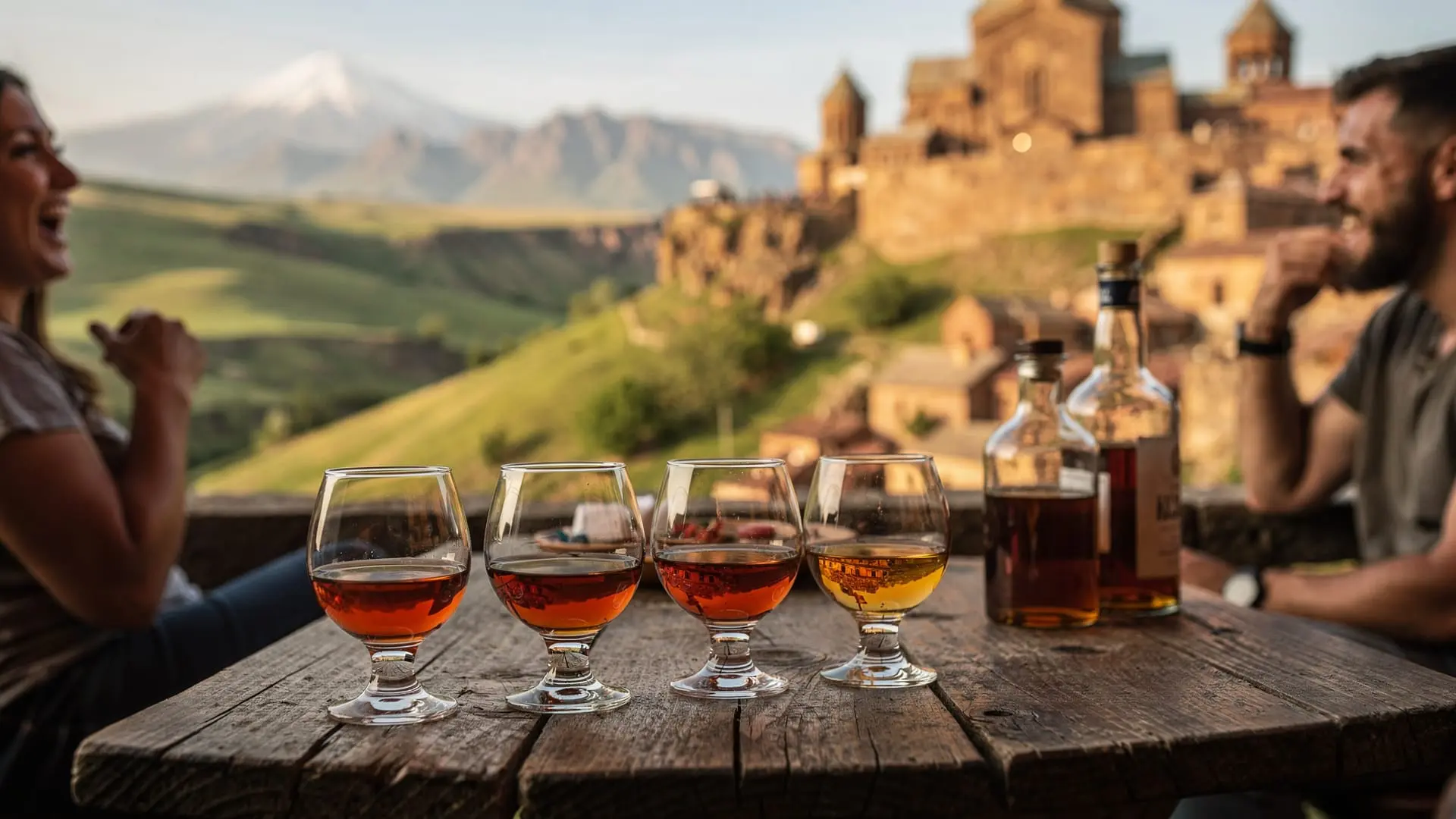
The tasting at the end includes four to six expressions from the range — typically the 3-star, 5-star, Akhtamar, and Vaspurakan as a minimum — with proper guidance rather than just a self-service pour. The guides explain the nose, palate, and finish of each in terms that are accessible without being condescending.
The factory also has a connection to a story that Armenian guides tell with particular pleasure: during the Yalta Conference in 1945, Churchill received a gift of Ararat brandy. He reportedly wrote to Stalin — who had arranged the gift — that he would prefer to receive twelve bottles per year for the rest of his life. The story is told by Armenians as evidence of something about the quality of their brandy and the quality of their sense of humour simultaneously.
Tasting at home: the brandy ladder in practice
If you’re building a small collection to bring home from Armenia, here is a practical buying guide based on what travels well and what makes a good gift.
For everyday drinking: two bottles of Ararat 5-star (Akhtamar). It’s the sweet spot of quality-to-price across the whole range, fits in a checked bag without alarming weight, and will make an impression on any diner who hasn’t encountered it before. It’s also the bottle worth bringing to a proper khorovats dinner or alongside a spread of dolma — Armenian brandy is built to sit next to rich, smoky food rather than to be sipped in isolation.
For a special gift: one bottle of Ararat Vaspurakan 10-year. It’s distinctive enough to be memorable, old enough to have real complexity, and still within a price range that doesn’t feel like a statement.
For yourself, to drink slowly over several months: the Nairi 20-year if your budget stretches. Pour it after a meal, in a small glass, without rushing it. It will reward patience.
The independent producers — Noy, Proshyan, Mane — are worth exploring if you’re in Yerevan for more than a few days and interested in brandy as a category rather than just as a souvenir. The specialist shop on Northern Avenue (ask any hotel concierge for the current address, it has moved twice) carries a wider selection than the factory shops.
Where to buy and what to avoid
The Yerevan Brandy Company factory shop on Admiral Isakov is the most reliable source for the full Ararat range, and the factory tours are excellent if you want context alongside your purchase. For independent producers and a broader selection, the specialist spirits shops on Northern Avenue and Abovyan Street carry more variety than the supermarket chains.
A note on the Vernissage market and tourist-area vendors: counterfeit branded brandy exists in Armenia, and the Vernissage is a known source of questionable product. Do not buy Ararat at the flea market. Buy it at a proper shop or at the factory. The price difference between legitimate product and the Vernissage vendors is small enough that there is no economic reason to risk the uncertainty. The same caveat applies to vendors in the touristy restaurant zone around Republic Square. The Vernissage guide explains what is and isn’t worth buying at the market — brandy is firmly in the “not worth buying” category, while some of the craft items are genuine.
Where to drink it in Yerevan
If you’d rather taste brandy in a bar setting than buy a bottle, Yerevan has good options. Malkhas Jazz Club pours a solid range of Ararat expressions alongside live jazz most evenings, and several of the specialty cafés covered in the Yerevan café culture guide double as evening bars with a serious brandy list once the coffee crowd thins out. For a proper night out that includes cocktails built around Armenian brandy rather than straight pours, the Yerevan nightlife guide covers the current bar scene. And if you want brandy alongside something sweet rather than savoury, a slice of gata is the traditional local pairing — the layered, slightly sweet pastry cuts through the brandy’s richness in a way that works better than it sounds.
FAQ
Is Armenian brandy the same as cognac? No, not legally — “Cognac” is a protected term for brandy from a specific region of France, so what Armenia makes is technically brandy, even though it’s been informally called “cognac” locally since the 19th century. The production method (double distillation in copper pot stills) is similar, but the grape varieties, altitude, and Caucasian oak ageing give it a distinct character.
Can I bring Armenian brandy home in checked luggage? Yes, within standard duty-free liquid allowances — check your destination country’s limits, but two 500ml bottles well-wrapped in checked luggage is standard practice for visitors leaving Yerevan. Buy from the factory shop or a proper retailer rather than the airport if you want the widest selection and best prices.