Yerevan Brandy Company: factory tour & tasting
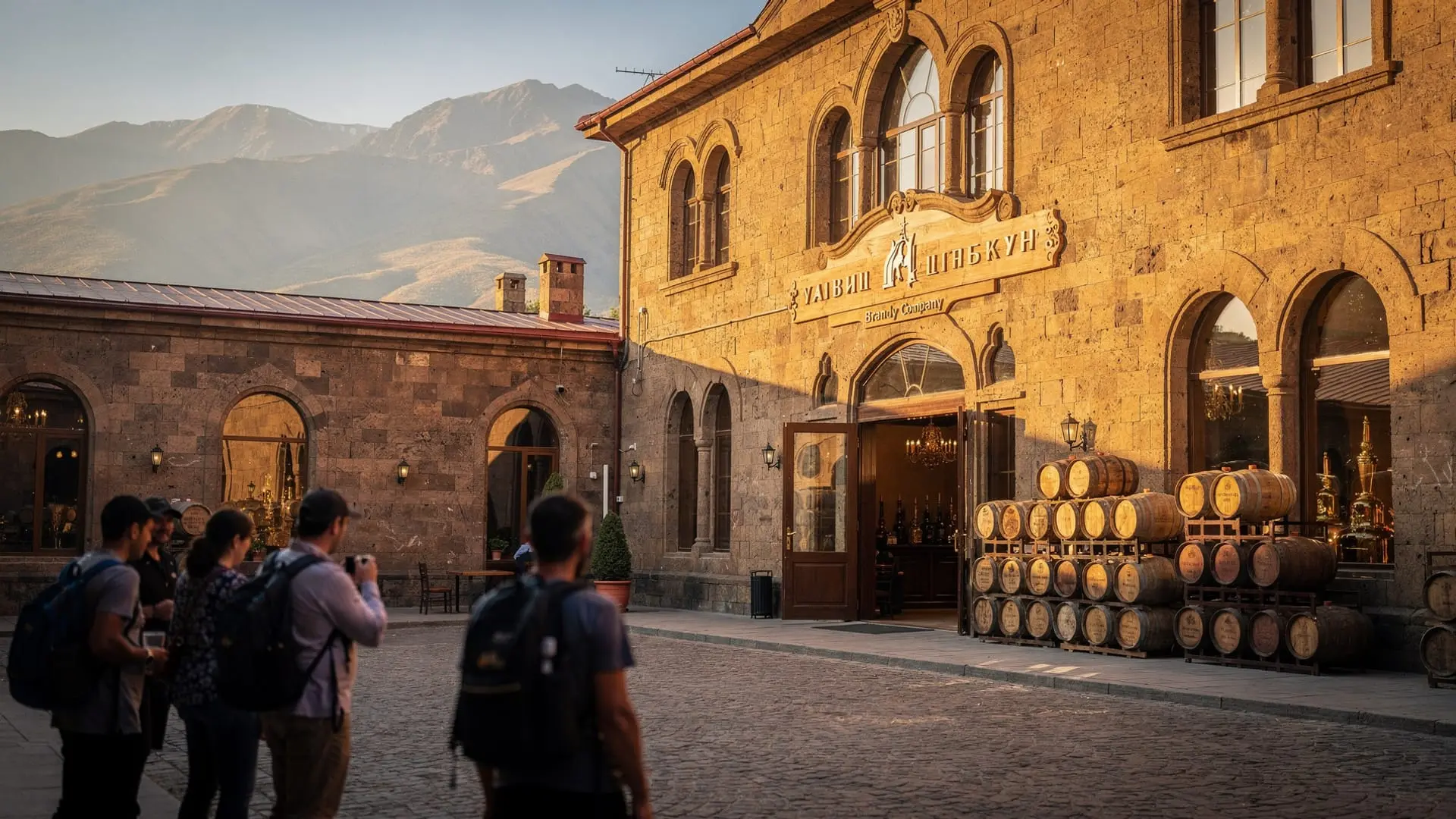
A living institution on the Hrazdan River
When the Yerevan Brandy Company opened in 1887, Yerevan was a modest regional town of around 25,000 people in the Russian-controlled Transcaucasus. The distillery was established by Nerses Tairyan on the banks of the Hrazdan River gorge, taking advantage of the pure mountain water and the cool, consistent temperatures of the cellars cut into the canyon walls. Within two decades it had become one of the most prestigious spirits operations in the Russian Empire.
| Where | 2 Admiral Isakov Avenue, Hrazdan gorge, Yerevan |
| Cost | Standard tour ~4,000–6,000 AMD; premium ~10,000–15,000 AMD |
| Time needed | 60–90 min standard; 2–2.5 hrs premium |
| Getting there | 20-min walk from Republic Square, or GG Taxi |
| Booking | Advance booking recommended, essential in peak season |
More than 135 years later, the distillery still occupies the same site. The Hrazdan River still runs below. The ageing cellars — some of them containing barrels that predate the Soviet Union — are still in active use. The company, now owned by Pernod Ricard and producing under the Ararat brand name, welcomes visitors for guided factory tours and formal tastings that make for one of the most distinctive experiences in Yerevan.
This guide covers the practical details: which tour to book, what you will see, what you will taste, how to get there, and how to buy without being scammed.
The history behind the visit
Understanding the context enriches the tour considerably. The Yerevan Brandy Company’s story arc — from Tsarist-era founding through Soviet nationalisation and prestige production to post-independence privatisation — mirrors the broader arc of Armenian history across the twentieth century.
1887: Nerses Tairyan founds the distillery. The site on the Hrazdan River provides ideal conditions: cool cellars, clean water, proximity to vineyards in the Ararat Valley.
1898: Tairyan’s business is sold to the Shustov Brothers, a major Russian spirits trading company that also owns cognac houses in France. The Shustovs invest heavily, expand the cellars, and begin exporting to European markets.
1920: Soviet nationalisation. The distillery continues operating as a state enterprise; investment actually increases during the Stalin era as the facility becomes a showcase for Soviet industrial achievement.
1945: At Yalta, Winston Churchill is served Armenian brandy by Stalin and reportedly declares it the finest brandy he has ever tasted. The story becomes central to the brand’s identity and is still told on every tour.
The word “cognac”: for much of the twentieth century, Armenian brandy was sold internationally as “cognac arménien.” After sustained pressure from French producers and the establishment of protected geographical indications under international trade law, this use of the word “cognac” was progressively restricted. Armenian brandy cannot legally be called cognac today. However, Armenians themselves — and the distillery’s own colloquial usage — still employ the word freely in everyday speech. The brand navigates this by using “cognac” in internal Armenian-market communication while exporting under the “Armenian brandy” designation.
1998: the company is privatised and eventually acquired by Pernod Ricard, the French spirits multinational (owner of Jameson, Absolut, and Chivas Regal, among others). This acquisition was controversial among some Armenians who saw it as foreign appropriation of a national asset; others saw it as the best guarantee of quality investment and international distribution.
Today: Ararat is Armenia’s most-exported spirits brand, available in approximately 65 countries.
The factory tours
The Yerevan Brandy Company offers several tour formats. Pre-booking is strongly recommended for all of them.
Standard factory tour
Duration: approximately 60 to 90 minutes.
The standard tour covers the main production areas: the distillation room (with its copper pot stills, the same technology used in Cognac for centuries), the cooperage (where barrels are made and repaired), the ageing cellars (the most atmospheric part of the visit, with barrel upon barrel stretching into the cool darkness below street level), the blending laboratory, and the bottling line.
The cellars contain barrels going back to the 1940s — some of the oldest continuously ageing brandy stocks in the world. The smell alone is worth the visit: concentrated dried apricot, vanilla, and the “angel’s share” (the portion that evaporates through the barrel staves, approximately 3 to 4% per year in the dry Yerevan climate).
The tour concludes with a seated tasting of three to four expressions from the Ararat range.
Cost: approximately 4,000 to 6,000 AMD (10 to 15 EUR) per person. Book via the distillery website or through GetYourGuide.
Premium tour with extended tasting
Duration: approximately 2 to 2.5 hours.
The premium format includes all elements of the standard tour plus an extended seated tasting — six to eight expressions covering the full age range from the 3-year standard through Akhtamar (10-year) and Nairi (20-year), and occasionally older prestige expressions. Accompanied by dried fruits, local cheeses, and dark Armenian chocolate.
This is the format to choose if you have a genuine interest in brandy rather than simply ticking the box. The progression from young to old illustrates the transformation wrought by two decades in oak with startling clarity.
Cost: approximately 10,000 to 15,000 AMD (24 to 37 EUR) per person.
Booking: the Armenian brandy tasting at the Yerevan Brandy Company on GetYourGuide is one booking option. The Brandy tasting experience at the Ararat factory covers a similar premium tasting format.
Private and corporate tours
Group visits, private tours, and corporate events can be arranged with advance notice. The distillery’s private dining room — deep in the cellar complex, surrounded by ageing barrels — is one of the most atmospherically compelling event spaces in Yerevan.
What to see inside
The highlights of the tour, beyond the structural overview above:
The oldest barrels: some barrels in the deepest cellar sections date to the 1940s and 1950s. The Maestro (master blender) periodically samples these ultra-aged stocks to decide whether they are ready to contribute to a prestige blend or should continue ageing. A barrel of 1946 brandy — to put it in context — has been ageing since the year after the Second World War ended.
The Churchill display: a section of the visitor route is dedicated to the Yalta story. Letters, photographs, and archival materials document the 1945 episode and Churchill’s subsequent enthusiasm for Armenian brandy. Whether or not you share his politics, the historical documentation is genuine and interesting.
The production scale: the distillery produces approximately 10 million litres of brandy per year — a significant volume, but still small by global spirits standards. Seeing the scale of the operation alongside the craft elements (hand-monitored barrel filling, manually operated copper stills) gives a sense of how industrial and artisan processes coexist in Armenian brandy production.
Getting there
Location: 2 Admiral Isakov Avenue, Yerevan.
On foot from Republic Square: approximately 20 to 25 minutes walking, mostly downhill via Moskovyan Street toward the Hrazdan gorge. The return walk is uphill; take a taxi back if needed.
By GG Taxi: approximately 600 to 900 AMD (1.50 to 2.20 EUR) from central Yerevan. Share the app with your driver to ensure the correct Hrazdan River address.
By walking tour: several Yerevan walking tours include the brandy company as a stop. The Shopping with Brandy tour combines a city tour with factory visits and market stops. The Walking city tour with brandy and five wines incorporates the brandy tasting within a broader city walk.
The shop: what to buy (and what to avoid)
The Yerevan Brandy Company’s on-site shop is the safest and most reliable place to purchase Ararat brandy in Armenia. All bottles are genuine (obviously — you are in the distillery itself), and the shop stocks the full range including older expressions and gift presentations not readily available elsewhere.
Recommended purchases:
- Akhtamar 10-year: the most universally appreciated gift. Available in 375ml, 500ml, and 700ml formats. Prices from approximately 12,000 AMD (29 EUR) for 500ml.
- Nairi 20-year: for serious spirit enthusiasts or as a prestige gift. Approximately 28,000 to 35,000 AMD (68 to 85 EUR) per 500ml.
- Gift sets: wooden presentation boxes containing 200ml bottles of multiple expressions (typically 3, 5, and 10-year) are ideal for carrying on a plane and for giving to people who want to compare the age progression. Prices from 10,000 to 18,000 AMD (24 to 44 EUR).
- Signed Maestro editions: occasional prestige releases signed by the master blender, available in very limited quantities.
A critical note on counterfeits: buying Ararat brandy from street vendors, market stalls, or the Vernissage flea market carries a significant risk of receiving counterfeit product. The most common scam involves genuine-looking bottles with authentic labels but inferior content. Stick to the distillery shop, SAS or Yerevan City supermarkets, or established wine and spirits retailers. If a price seems too low, it is.
Combining the Yerevan Brandy Company with other Yerevan sights
The distillery sits in the lower city near the Hrazdan gorge, within walking distance of several other significant Yerevan attractions.
The Cascade: the enormous stepped monument-cum-art gallery is a 15-minute walk uphill from the distillery. See the Cascade Complex guide (when published) for details.
Republic Square: the heart of the city, with the fountains and the History Museum, is about 20 minutes on foot.
Matenadaran manuscript library: 25 minutes from the distillery on foot; one of the world’s great repositories of medieval illuminated manuscripts, including significant wine-related agricultural texts. See /guides/matenadaran-manuscripts-guide/ for details.
Brandy-and-wine evening walk: Yerevan’s wine bar and brandy-tasting scene clusters around Abovyan Street, Tumanyan Street, and the neighbourhood around the Opera House. An evening that begins with a brandy tasting at Yerevan Brandy Company and continues through wine bars to dinner at Lavash, Sherep, or Tavern Yerevan makes for one of the most distinctly Armenian urban evenings possible.
The Armenian brandy guide covers the historical context, age expressions, and culture of Armenian brandy in greater depth for those who want to go beyond the tour experience. For the wine side of Armenia’s fermented culture, the Armenia wine country overview is the companion piece.
Frequently asked questions about the Yerevan Brandy Company tour
Do I need to book in advance?
Yes — particularly for the premium tasting and for visits during summer (June to August) and the September to October harvest season. Weekend tours fill weeks in advance. Book through the distillery website or GetYourGuide at least a week ahead.
Is the tour in English?
English-language tours run several times daily; schedules vary by season. The booking confirmation will specify the tour language. If the English slot is full, ask about private English-language tours, which can sometimes be arranged for a small supplement.
Is the Yerevan Brandy Company open on public holidays?
The distillery typically remains open for tours on major Armenian public holidays (including April 24, National Unity Day, and Armenian Christmas on January 6), but with reduced schedules. Check the distillery’s current published hours before visiting.
Can children visit the factory tour?
Children are permitted on the standard factory tour (the cellar and production areas are appropriate for all ages). The tasting portion is adults-only. If visiting with children, a non-tasting companion can accompany you through the production areas.
Is the brandy at the tour the same as what I buy in a shop?
Yes, assuming you are buying from the distillery shop or a legitimate retailer. The factory tour tastings draw directly from production stock. The only variation is that tasting-room pours are sometimes from open demonstration bottles that are a few months old; freshly sealed bottles purchased for home are identical in composition.
How does the Yerevan Brandy Company compare to smaller independent brandy producers?
The Yerevan Brandy Company (Ararat) is Armenia’s largest and most internationally recognised producer, with the infrastructure and history to support a genuinely polished visitor experience. Smaller independent brandy houses exist but rarely offer organised tours to the same standard, and consistency between bottles is less guaranteed. For a first visit focused on understanding Armenian brandy as a category, the Yerevan Brandy Company is the right choice; specialist enthusiasts can seek out smaller producers afterward with more targeted research, though few offer the same level of organised, English-language visitor infrastructure.
Can I combine the brandy tour with wine tasting on the same trip?
Yes, and many visitors do. The distillery tour pairs naturally with an evening at a Yerevan wine bar (In Vino on Tumanyan Street is the standard recommendation) or, for a fuller experience, a follow-up day trip to the Vayots Dzor wine route or Voskevaz winery. See the combined tasting itinerary below for a structured three-day version, and note that both wine destinations require a separate day and driver — don’t try to add either to the same day as the brandy tour itself.
The Maestro: Armenia’s master blender tradition
One of the most significant roles at the Yerevan Brandy Company is the Maestro — the master blender responsible for maintaining the house style across years and decades. This position is not merely technical; it is custodial. The Maestro’s task is to ensure that a bottle of Nairi purchased today is consistent with a bottle of Nairi purchased five years ago and will be consistent with one purchased five years from now, despite the inherent variability of grape harvests, distillation runs, and barrel ageing.
The tradition of the Maestro stretches back to the Soviet era, when the distillery’s production was considered a matter of national prestige and the blender occupied a role somewhat analogous to a chef de cave at a Champagne house. Each Maestro typically holds the position for decades, learning the character of specific barrel batches and developing the sensory memory needed to make consistent blending decisions across a warehouse containing hundreds of barrels of spirits at different ages.
The current and recent Maestros have been celebrated figures in Armenian cultural life, featured in newspapers and national media when new prestigious releases are issued. When the distillery was acquired by Pernod Ricard, one condition of the deal was that production methodology — including the Maestro system — would be maintained. The house style has remained consistent.
On the tour, the role of the Maestro is explained in the blending laboratory section. The tools of the trade — small pipettes, reference samples in sealed vials, the Maestro’s notebook of blending records going back decades — are typically on display.
Architecture and heritage: the distillery buildings
The Yerevan Brandy Company complex is not merely a production facility; it is one of Yerevan’s most interesting pieces of industrial heritage. The buildings date from different periods, with the oldest sections from the late nineteenth and early twentieth century, expanded significantly during the Soviet era, and updated most recently in the early 2000s.
The Hrazdan River gorge forms the natural northern boundary of the site, and the original cellar complex was literally carved into the gorge walls — a practical solution that provided the cool, stable temperatures needed for ageing, and that also creates one of the tour’s most atmospheric moments when you descend into the rock-cut chambers lined with barrels.
The Soviet-era additions — the large ageing warehouses, the main production building — are functional rather than beautiful, but they contain the barrels of aged spirit that make the tour worthwhile. The blend of Tsarist-era craft architecture and Soviet industrial scale is characteristic of Yerevan’s built environment more broadly.
The surrounding neighbourhood — the banks of the Hrazdan gorge below the Cascade — has become one of Yerevan’s most interesting urban areas in recent years, with several restaurants, bars, and cultural spaces colonising the gorge-side buildings. The post-tour walk back toward the city centre, following the gorge path upward, is a pleasant way to decompress and take in the topography of the Armenian capital.
Brandy and wine: planning a combined Armenia tasting itinerary
The ideal introduction to Armenian fermented culture combines the country’s two great traditions in a logical geographical sequence.
Day 1 (Yerevan): morning at the Yerevan Brandy Company (factory tour + tasting). Afternoon exploring Yerevan’s wine bars — In Vino on Tumanyan Street is the best single destination. Evening dinner at Lavash or Sherep restaurant with a bottle of Areni Noir.
Day 2 (Vayots Dzor): drive to Areni (2 hours). Morning: Areni-1 cave. Midday: Hin Areni winery tasting and lunch. Afternoon: Trinity Canyon Vineyards for a premium flight.
Day 3 (Vayots Dzor/return): morning at Noravank monastery. Return via the Ararat Valley with a stop at Khor Virap for Mount Ararat views.
The Armenian brandy guide covers the full context of Armenian brandy production and aged expressions. For the wine side of the same story, the Armenia wine country overview and the Vayots Dzor wine route guide provide everything you need.
The 2-day wine and brandy tour with tastings from Yeghegnadzor combines both traditions in a single structured itinerary if you prefer a guided experience.
Understanding brandy age statements and what they mean in the glass
Ararat’s age statements — 3-star, Akhtamar (10-year), Nairi (20-year), and the older prestige releases — refer to the youngest spirit in the blend, following the same convention used in Cognac. A 10-year statement means every component has aged at least a decade, though the blend may include older reserves that lend depth. Tasting through the range in order, as the premium tour is structured to do, makes the progression tangible in a way that reading about it cannot: the 3-star is bright, fruity, and simple; by Akhtamar the oak has integrated into dried fruit and vanilla notes; Nairi adds a leathery, spiced complexity that only two decades in barrel produces, and the oldest prestige releases move toward something closer to a fine old Armagnac in character — worth seeking out if the tasting room happens to be pouring one that day. This progression is the single most useful thing to understand before tasting, since it reframes the higher prices of older expressions as a genuine function of time and evaporation loss (the “angel’s share”) rather than marketing.
Buying brandy as gifts: practical shipping and customs notes
Brandy purchased at the distillery shop travels well in checked luggage if wrapped carefully — ask the shop staff for protective packaging, which they provide routinely for tourists. Standard airline liquid allowances apply only to carry-on; checked bags have no volume restriction on alcohol, though airlines do cap total alcohol percentage and quantity per passenger (typically up to 5 litres of spirits between 24% and 70% ABV without special permission — Ararat brandy at 40% ABV falls within this). Duty-free re-entry allowances vary by destination country; EU travellers typically have a generous allowance for spirits from outside the bloc, while other destinations may have stricter limits. The distillery shop staff are used to advising international visitors and can confirm current airline and customs guidance for common destinations on request.