April 24: commemorating the Armenian Genocide in Yerevan
| Where | Tsitsernakaberd memorial, western Yerevan |
| When | April 24, all day; main procession from mid-morning |
| Cost | Free — memorial, eternal flame and museum grounds are open to all |
| How to get there | Taxi or marchroutka; roads near the site close to traffic during the procession |
| What to bring | Flowers if you wish to lay them, modest dress, patience for crowds |
What April 24 is
April 24 is the day Armenia commemorates the Armenian Genocide — the systematic deportation and mass killing of Armenians carried out by the Ottoman government beginning in 1915, which killed an estimated 1 to 1.5 million people and destroyed the Armenian presence in most of Anatolia. April 24 marks the anniversary of the arrests of Armenian intellectuals and community leaders in Constantinople in 1915, often cited as the beginning of the organised campaign.
The genocide is a recognised historical fact, acknowledged by a growing number of governments and parliaments worldwide and by most historians of the 20th century. It is the central tragedy of Armenian history, the event that shaped the diaspora communities in France, the United States, Lebanon, Syria, and elsewhere, and it remains a living presence in Armenian cultural memory in a way that is neither distant nor purely historical.
For a visitor to Armenia, April 24 is a day when the country’s relationship with its own history becomes visible in the most direct way. I was in Yerevan in April 2021 and I went to Tsitsernakaberd — the memorial complex on the hill above the Hrazdan gorge — on the morning of the commemoration. This is an account of what I saw and what I was thinking.
Tsitsernakaberd before the crowds arrive
I arrived at the memorial at 7:30 a.m., which was early enough to be at the site before the main procession but late enough that the first individual visitors were already there. Tsitsernakaberd — the name means “swallow fortress” — is a hill in western Yerevan, above the gorge. The memorial complex, built in 1967, consists of two main elements: a circular basalt wall enclosing an eternal flame, and a 44-metre stele that splits as it rises, the two arms leaning apart. There is also the Genocide Museum, built into the hill below the memorial.
The approach to the memorial is along a long tree-lined avenue of cypress. The cypress is a traditional Armenian symbol of grief. Hundreds of trees, all tall and dark, line both sides of the path. In early morning April light, before the crowds, walking this avenue in silence produces a certain quality of attention that I have not found elsewhere.
At the circular memorial, a small number of people were already laying flowers beside the eternal flame. The flame itself — a gas burner in the centre of a twelve-segment basalt circle — burns continually, regardless of weather. The segments of the circle represent the twelve provinces of historic western Armenia, most of which are now in eastern Turkey. I stood there for a while and watched the people who were bringing flowers.
The march
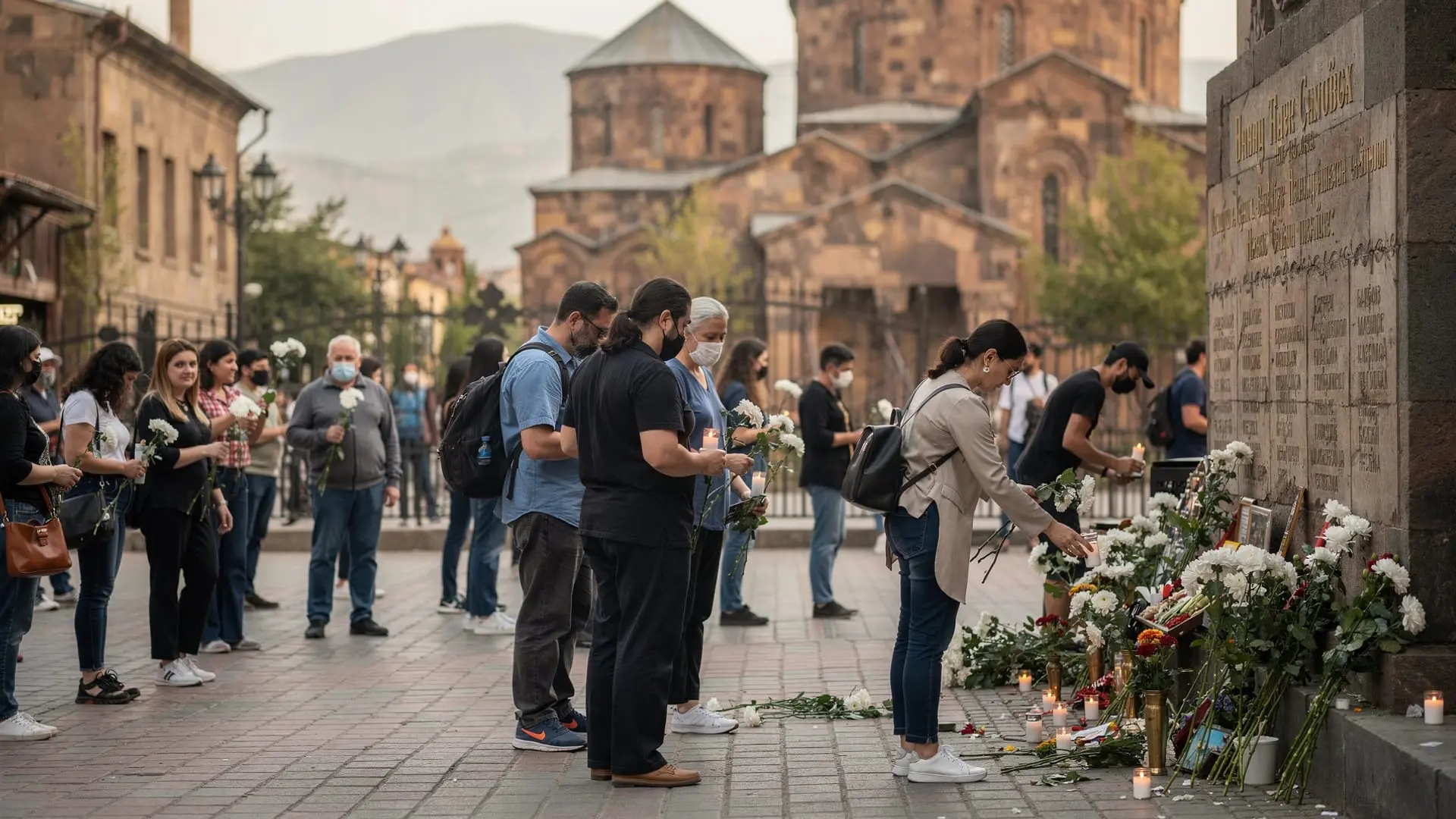
The main commemoration begins in the morning and continues throughout the day. In 2021, under COVID restrictions, the march was smaller than usual — but even reduced, it filled the avenue for an extended period. Armenians come individually and in family groups, by bus from every province, from the diaspora if the borders are open, from the local diaspora communities in Yerevan itself. They carry flowers — typically red carnations or wildflowers — to lay at the eternal flame.
What struck me most, standing at the side of the avenue to watch and then walking alongside for part of the approach, was the composition of the crowd: elderly people who had heard the stories from their own grandparents, children too young to have any historical consciousness but carrying flowers they’d been given, young people in their twenties and thirties who understood the event through both education and family memory. A woman in her eighties walked very slowly, supported by a woman in her fifties who might have been her daughter. They were not speaking to each other. They were simply walking.
A priest I stood near for a moment spoke to an elderly couple in Armenian. I don’t speak Armenian, so I don’t know what was said. The tone was quiet, unhurried.
The Catholicos’s homily
The official ceremony at the memorial includes a homily by the Catholicos of All Armenians — the head of the Armenian Apostolic Church, resident at Etchmiadzin. In 2021, Catholicos Karekin II was present. The address was in Armenian and I did not understand it, but I have since read a translation of the key elements: the call for international recognition, the affirmation of the survivors’ descendants, the theological framing of memory as an act of witness rather than vengeance.
There were prayers. There was music — the duduk, the Armenian instrument whose tone is associated with lamentation in Armenian musical tradition, its sound carrying across the hillside in the morning air.
The ceremony has a quality of gravity that I think can be hard for outsiders to stand in without feeling that they are intruding on something private. I was aware of being a non-Armenian in a space where most people present carried this day in their personal histories, not just their knowledge. I tried to behave accordingly: quiet, present, not photographing people close up, not performing observation.
The Genocide Museum
The museum is built into the hillside below the memorial and holds a permanent exhibition on the Armenian Genocide: historical documents, photographs, deportation routes, survivor testimonies, and records of international recognition. I visited in the afternoon, after the main crowds had processed through.
The exhibition is dense with primary sources — telegrams, consular reports, photographs from German and American observers present during the deportations. The evidence is extensive and well-documented. The museum does not editorialise; it presents documents and lets them speak.
The most affecting section, for me, was the room of photographs taken by German officers who were present as military advisors to the Ottoman army. These are not anti-German photographs — most of the German observers were horrified by what they witnessed — but they are records made by people who were there and who were not Armenian, which makes them a specific kind of evidence.
I spent about an hour and a half in the museum. The Tsitsernakaberd guide has practical information on visiting.
The flowers and what they mean
The specific ritual of April 24 is the bringing of flowers. Red carnations are the most common — not because anyone mandated this, but because it has evolved into convention over the decades since the memorial opened in 1967. Families bring bunches. Schoolchildren carry single stems. Some people bring wildflowers gathered from the hillsides around Yerevan, which seem more personal and less formal.
The flowers accumulate throughout the day around the eternal flame. By late afternoon, the inner circle of the memorial is deep in red and white. The scale becomes symbolic: it is not one family’s gesture but a collective act of witness, the flowers layering on flowers until the stone is barely visible.
I watched one family — a grandmother, her adult daughter, and two grandchildren aged perhaps eight and twelve — place their flowers in silence. The grandmother held the children’s hands after. The older child asked her something in Armenian. She answered in a few words. The child nodded.
I don’t know what was said. I didn’t ask. But the gesture — the question, the simple answer, the nod — was the specific shape of the event: one generation explaining to the next what they are doing here and why.
The diaspora dimension
What makes April 24 in Yerevan different from a purely national commemoration is the diaspora. In normal years, Armenians from France, the United States, Lebanon, Australia, and elsewhere travel specifically to Yerevan to be at Tsitsernakaberd on this day. The diaspora communities exist because the genocide scattered the Armenian population across the world; coming back to Yerevan on April 24 is, for many diaspora Armenians, a specific act of reconnection.
I spoke briefly with a man named Hagop who had flown from Lyon with his wife and two adult children. His family was originally from Harput in eastern Anatolia — one of the cities from which Armenian deportations were organised in 1915. “My great-grandmother survived,” he said. “She came to France as a refugee. We came back.” He said it simply, without drama. His wife was holding flowers.
The diaspora dimension of Armenian history is something that the country’s diaspora heritage guides address in practical terms: how to trace an ancestral village, how to use the memorial in a way that connects personal family history to the larger commemorative event. For many diaspora visitors, April 24 in Yerevan is the central purpose of a heritage trip.
On being a visitor
I want to be direct about the question that any non-Armenian visitor should ask themselves before going on April 24: is it appropriate for me to be here?
My conclusion was yes, with conditions. The commemoration is a public event and visitors are not turned away. The presence of non-Armenian witnesses — people who come as allies to the memory rather than observers of a curiosity — seems, from the Armenians I spoke with afterward, to be welcomed. “It matters that people come from outside and see this,” said a young man I spoke with briefly at the memorial. “It is important that people know.”
The conditions are: go quietly, don’t photograph people in grief close up, don’t treat it as a sightseeing event, and take the time to understand what the day means before arriving. The Tsitsernakaberd pilgrimage guide is a good starting point for understanding the context.
April 24 in Yerevan is a sombre day, a day of walking and flowers and silence, and it is also a day of remarkable civic solidarity — a whole country, and much of its diaspora, moving together toward a hilltop memorial. For a visitor willing to be present with appropriate humility, it is one of the more significant things available to witness in this part of the world.
Getting to Tsitsernakaberd on the day
On April 24 itself, several roads near the memorial close to vehicle traffic during the main procession, so plan to walk the last stretch regardless of how you arrive. A taxi or marchroutka can drop you near the base of the hill; from central Yerevan the ride is short, but expect it to take longer than usual because of road closures and crowds. If you are staying near Republic Square, it is a reasonable walk on a normal day but not one I’d recommend on April 24 itself given the crowds converging from every direction. Arriving by mid-morning, as I did, still lets you see both the quieter early hours and the fuller procession later.
If you can’t be there on April 24
The memorial and museum are open year-round, and visiting on any other day gives you a very different, much quieter experience — the avenue of cypress, the eternal flame, and the museum without the crowds. This is worth knowing if your Armenia trip doesn’t align with the date: the Tsitsernakaberd guide covers opening hours and what to expect on an ordinary day. Many visitors combine a quiet memorial visit with other Yerevan sights the same afternoon, since it sits within reasonable taxi distance of the Cascade complex.
Yerevan private cultural walking tourFrequently asked questions
Do I need to book anything to attend the April 24 commemoration? No. The memorial and the day’s events are open to the public with no ticket, registration, or fee required. Arriving early gives you a calmer experience before the crowds build through the morning.
Is it respectful for tourists to visit the museum on an ordinary day, not just April 24? Yes — the Genocide Museum and memorial are open year-round specifically so that visitors can learn the history at any time, and a quiet weekday visit is, if anything, easier to absorb than the crowded commemoration itself.
For deeper background on the history behind the day, the genocide memorial pilgrimage guide is the fuller companion piece to this account.