Why Armenia's only pagan temple survives at Garni
| Where | Garni village, Kotayk province, ~28km east of Yerevan |
| Built | 1st century AD, under King Tiridates I; reconstructed 1969–1975 |
| Time needed | 1–1.5 hours at the temple; add an hour for the gorge walk to the Symphony of Stones |
| Getting there | Day tour, taxi, or self-drive; often paired with Geghard |
| Best time | Morning, before 11am, for good gorge light and fewer crowds |
A temple out of place
Armenia adopted Christianity as its state religion in 301 AD, becoming the first country in the world to do so. In the sixteen centuries since, the country has built hundreds of churches, monasteries, and cathedrals — an architectural record of Christian devotion that defines the landscape from Lori to Syunik. What Armenia has not preserved, with one exception, is anything from the pre-Christian period. Temples, shrines, and cult sites were systematically destroyed as the new faith took hold.
The exception is Garni.
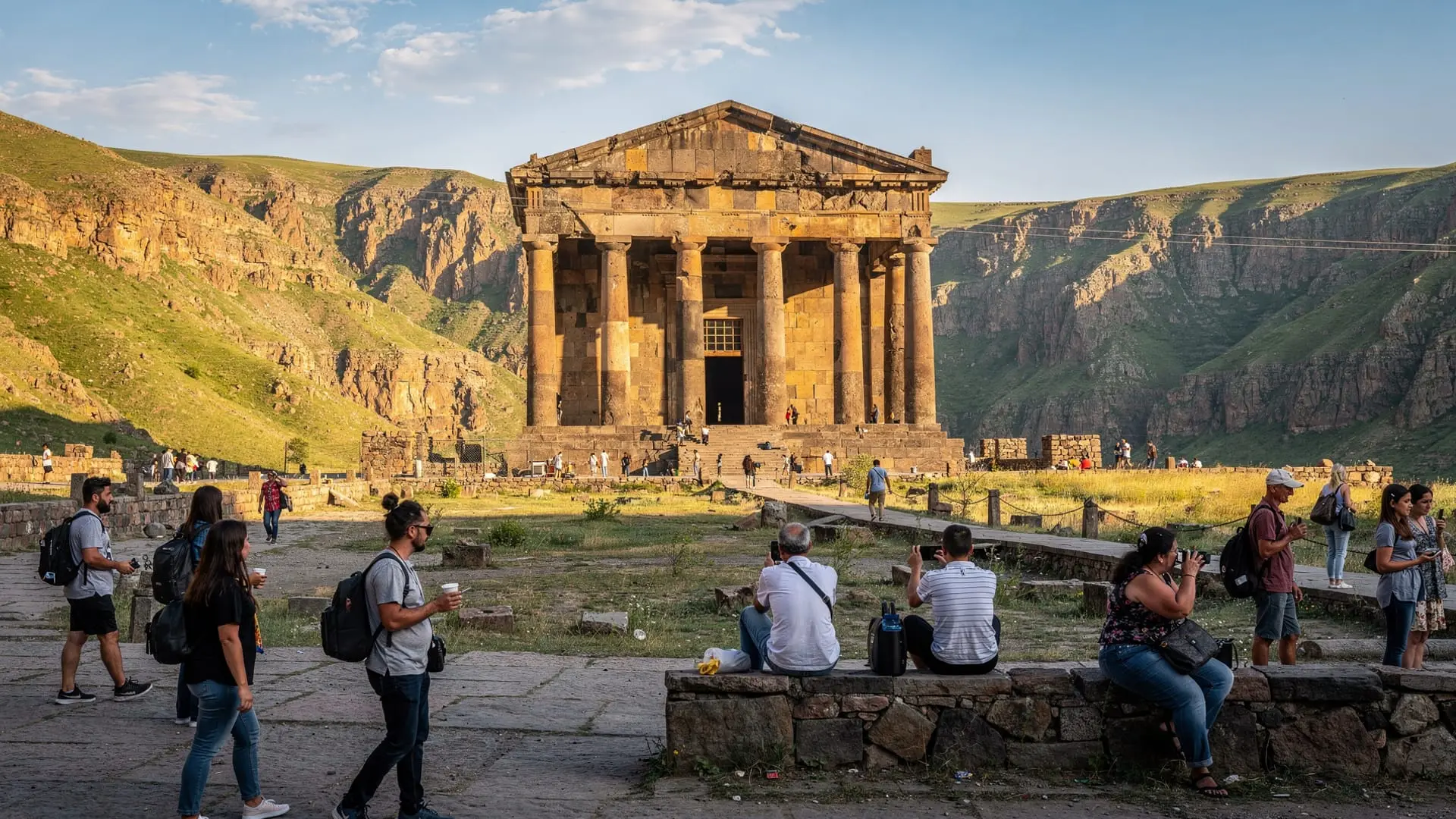
Standing on a basalt promontory above the Azat gorge in Kotayk province, about 28 kilometres east of Yerevan, the temple at Garni is the only Hellenistic-style building still standing in the entire South Caucasus. It is also, consequently, the most visually improbable thing in a country that has no shortage of improbable sights. A column-fronted, peristylar temple with an Ionic entablature, standing in a place where the building tradition is stone churches with conical domes — it looks, at first glance, like it was set down from somewhere else.
The question of why it’s still standing involves an earthquake, a royal identity, and a willingness to retrofit history.
Who built it and why
The temple’s origins lie in the first century AD, during the reign of King Tiridates I of Armenia. After a period of Parthian and Roman contestation over the Armenian throne, Tiridates was installed as king with Roman endorsement around 66 AD — he made a famous journey to Rome to receive his crown from the Emperor Nero, a diplomatic performance described by the Roman historian Suetonius. The temple at Garni is generally understood as a product of this Romano-Armenian moment: Tiridates, freshly returned from Rome and impressed by Roman architecture, commissioned a Hellenistic-style temple in his summer capital.
The inscriptions found at the site — in Greek, the prestige language of the educated Eastern Mediterranean at the time — name Tiridates as the builder and dedicate the structure to the sun god Mihr (equivalent to Mithra in Persian religious tradition, Sol Invictus in Roman). The site of Garni had been a royal residence and fortress for centuries before the temple; the promontory, flanked on three sides by the gorge, was naturally defensible and strategically visible.
The Hellenistic style was not unusual for a region that had absorbed waves of Greek cultural influence since Alexander the Great’s campaigns. Armenia had its own version of the Hellenistic synthesis — Greek architectural forms applied with local materials and inflected by Armenian and Parthian taste. Garni is the surviving example.
Christianity and the question of survival
When King Tiridates III — a later successor — converted to Christianity in 301 AD under the influence of Gregory the Illuminator, the new religion’s institutional arrival in Armenia brought rapid changes to the religious landscape. Pagan temples were torn down or converted. The priesthood of the old faith lost its position. Sacred sites were repurposed or abandoned.
Garni survived this process. The reasons given in historical sources are not entirely satisfying but have a logic. The Armenian historian Agathangelos, writing in the fifth century, says that Tiridates gave Garni to his sister Khosrovidukht as a summer retreat. A royal summer residence — a luxurious private property rather than an active cult site — may have been treated differently from working temples. There may also have been calculation involved: the site had been a royal residence for centuries, and simply erasing it would have meant erasing part of the royal family’s own heritage.
Whatever the reason, the temple at Garni was not destroyed in the fourth-century religious transition. It became a bath house, according to some accounts — a prosaic function that would have drained it of religious significance and made its preservation practically useful rather than ideologically awkward.
The earthquake and the fragments
In 1679, a major earthquake devastated much of Armenia. The temple at Garni collapsed. What was left was a field of stone — columns, capitals, sections of entablature, the platform of the podium — scattered across the promontory and gradually buried under soil and rubble over the following centuries.
The ruins were known to European travellers from the 17th century onward. Scholars identified the structure and sketched the remains. But the site remained a collapsed ruin, its stone increasingly appropriated for local construction, until the Soviet period.
The decision to reconstruct the temple was made in the 1960s, and the work was completed in 1975. The reconstruction was led by the architect Alexander Sahinian, who approached the project as a scholarly exercise in anastylosis — the method of reassembling original elements in their correct positions based on architectural analysis. The surviving original stones were used where possible; new basalt of matching quality was cut for elements that were missing or too damaged.
The result is a reconstruction rather than an ancient original, which matters to some visitors and doesn’t matter to others. The architecture is correct — the proportions, the column spacing, the entablature — even if the stone is partly new. Standing in front of it, what you’re seeing is what was there in the first century, not what survived intact into the twentieth.
The reconstruction debate
Before visiting, it’s worth knowing that what you’re seeing is a reconstruction, completed in 1975, not an intact ancient monument. This matters to some visitors and not to others, but it affects how you read the site.
The original temple collapsed in the 1679 earthquake. The stones remained on the site, scattered, for nearly three centuries. In 1969, the Soviet-Armenian government decided to reconstruct it. The lead architect, Alexander Sahinian, used anastylosis — reassembling original stones where possible, replacing missing elements with new basalt that was visually integrated but structurally distinct, identifiable on close inspection by a subtle colour difference.
Critics of the reconstruction argue that the result is a 20th-century interpretation of an ancient building rather than the ancient building itself — that the “original” aura that tourists respond to is partly illusory. Proponents argue that anastylosis, when done carefully, is a legitimate and valuable form of preservation; that the architectural information conveyed is accurate; and that a reconstructed temple is more useful for understanding the past than a field of scattered stones.
My own view is that the debate is worth knowing about before you visit, because it changes what you’re looking at. When you stand in front of the temple, you are seeing what a first-century Hellenistic temple in Armenia looked like. Whether the specific stone block in front of you is ancient or 1975, you are receiving accurate architectural information about the original. That seems worthwhile, even if the authenticity is partial.
The site today
Garni village sits above the gorge, and the temple occupies the fortress complex at the edge of the basalt promontory. The surrounding walls of the earlier fortress are partly visible — defensive curtain walls that predate the temple by centuries, built when Garni was a strategic stronghold in the wars between Armenian, Parthian, and Roman power.
Below the promontory, the Azat gorge drops steeply to the river. On the opposite wall of the gorge, the basalt columns of the Symphony of Stones are visible — a natural formation created by ancient lava flows cooling in vertical geometric columns. The resemblance to the temple’s own basalt construction is coincidental but striking. Walking down to the gorge floor and back up takes about an hour and is worth doing if you have time.
The site also contains a small 7th-century church — built after Christianity had long been established — and a functioning bath complex with good Roman-style mosaic floors, excavated and preserved under a modern cover structure. The mosaics show mythological figures and geometric patterns in the Mediterranean tradition, a reminder that Garni was never culturally isolated from the wider ancient world.
Roman Armenia and the Hellenistic synthesis
The temple at Garni belongs to a specific cultural moment: first-century Armenia under the Arsacid dynasty, navigating between Roman and Parthian power. The Arsacids were themselves a Parthian dynasty by origin, ruling an Armenia that was both culturally distinct and subject to intense pressure from both superpowers of the ancient Near East. The temple represents their solution to that pressure: adopt the prestige architectural language of Rome, express it in local materials, and make a statement of cultural equivalence.
Tiridates I’s journey to Rome in 66 AD was theatrical in a way that Suetonius and other Roman sources found remarkable. He brought a large retinue, performed obeisance to Nero in a ceremony staged for maximum spectacle, and received his crown back as a client king. He also saw Roman architecture. The forum of Augustus, the baths of Agrippa, the temples of Rome at their imperial peak: these were the visual references that informed the Garni commission.
What makes Garni culturally interesting rather than merely derivate is what the local architects did with these references. The proportions are Roman; the stone is Armenian basalt; the site is an Armenian fortress promontory above a volcanic gorge. The synthesis is not imitation. It is a first-century Armenian interpretation of a Mediterranean form, and the result is neither fully Roman nor fully Armenian but specifically the product of this particular political and cultural moment.
The bigger picture: what Garni tells us
The survival of Garni is partly luck and partly the specific dynamics of early Armenian Christianity. The Armenian church was building its own architectural tradition — the centralised church plan, the drum-and-cone dome — that would eventually produce the masterpieces of Geghard, Tatev, and Haghpat. Pagan temples were not part of that tradition and were not generally preserved.
But Garni also tells us something about the cosmopolitan nature of ancient Armenia. A kingdom at the junction of the Roman, Parthian, and later Sassanid Persian empires absorbed architectural, religious, and cultural influences from all sides. The Hellenistic temple was an Armenian choice — a deliberate statement about cultural prestige and international connection — not a foreign imposition. The king who built it had just returned from Rome. He knew what prestige architecture looked like.
The distance between that first-century act of cultural display and the 13th-century genius of the Geghard rock-cut monastery, nine kilometres up the same valley, is the span of Armenian architectural history. Both sites are accessible in a single day from Yerevan, and seeing them together makes the full arc visible in a way that neither site achieves alone.
If you’re visiting, aim for a morning start from Yerevan — the gorge light is best before noon and the site gets busier after 11 a.m. in summer. March, when I was there most recently, is quiet and the wildflowers on the promontory are beginning to appear. The Garni destination guide has the logistics in full.
Pairing Garni with the rest of the valley
Almost every visitor combines Garni with Geghard monastery, nine kilometres up the same valley, and the pairing is worth understanding rather than just booking: the two sites bracket the entire arc of Armenian religious architecture, pagan to Christian, in a single morning. Some day tours also add Khor Virap or a wine-tasting stop, stretching the outing into a full day — worth it if you have the time, unnecessary if Garni-Geghard alone is the goal. For visitors staying longer, the Yerevan best day trips ranked guide puts Garni-Geghard in context against the other half-day options from the capital.
Garni temple, Symphony of Stones and Geghard monastery day tripFrequently asked questions
Is the temple at Garni “real” if it was reconstructed in 1975? The stone is partly original, partly matching new basalt cut to complete the anastylosis, but the architectural information — proportions, column spacing, entablature — reflects genuine first-century design based on the surviving fragments. It’s a scholarly reconstruction rather than an invented replica, which is a meaningful distinction even if the site isn’t fully “ancient” in the sense a ruin would be.
How much time should I budget for Garni alone, without Geghard? About 1 to 1.5 hours covers the temple, the bath mosaics, and the fortress walls at a comfortable pace; add roughly an hour if you want to walk down into the gorge to see the Symphony of Stones up close.
Is there an entrance fee, and is it worth going with a guide? There is a modest entrance fee to the fortress complex, payable at the site — a small amount by any standard, and not something to plan around. A guide isn’t required to appreciate the setting, but the history here is dense enough (Tiridates, the earthquake, the anastylosis debate) that a guide or a good pre-read genuinely changes what you get out of the visit, more so than at many Armenian sites where the architecture speaks for itself.