Summer 2019 at Lake Sevan: notes from the shore
| Where | Gegharkunik province, ~65km / 1hr15 from Yerevan |
| Cost | Guesthouse doubles from ~10,000–12,000 AMD; ishkhan trout around 2,500 AMD |
| Time needed | Doable as a day trip; 1–2 nights to actually feel the place |
| Water temp | 12–15°C in June, warmer by late July–August |
| Best time | June or September for quiet; late July–August for swimming |
The drive up from Yerevan
I left Yerevan at 7 in the morning, before the city heat had settled in. June in Yerevan is already pushing 30°C by mid-morning, and the drive through the Kotayk hills — rising from the Ararat plain toward the Sevan Pass at 2,100 metres — is one of those transitions where you watch the thermometer in the car drop a degree every few minutes. By the time I crested the pass and saw the lake below, it was 18°C and there was a wind coming off the water.
The view from the pass is the one that appears on every list of Armenian landscape moments. Lake Sevan is 1,900 metres above sea level — high enough that the sky is a different blue than the one you left in Yerevan, and the lake reflects it precisely. From above, it looks like a piece of sky that fell and decided to stay. I had seen photographs, which meant I was prepared and still wasn’t prepared.
The lake is large. It covers about 940 square kilometres, making it one of the largest high-altitude freshwater lakes in the world. The shoreline is long enough that you could spend a week exploring it without doubling back. I had four days, which was enough to get a feel for its character without exhausting it.
Sevanavank in the morning
The first morning, I drove the short distance to Sevanavank. The monastery sits on what was once an island — it became a peninsula in the 1930s when Soviet engineers began lowering the lake’s water level for irrigation and hydropower, dropping it by about 20 metres. The environmental damage this caused is a story that deserves its own treatment; the result is that the monastery, once reachable only by boat, is now approached on foot up a hillside path.
The climb takes about ten minutes. It’s well-maintained, with stone steps for most of the ascent. When I arrived just after 8 a.m., there were perhaps four other visitors. By 10 a.m., when I came back down, there were coach tours and selfie poles and a vendor selling cold drinks at the foot of the path. Arrive early.
Sevanavank consists of two churches — St. Arakelots and St. Astvatsatsin — built in the 9th century on an older foundation. The stonework is the dark grey basalt of the region, weathered to near-black in places, and the setting against the blue of the lake below is exactly what it appears to be in photographs: one of the genuinely good views in Armenia. I sat on the stone terrace between the two churches for a long time. A monk in black robes crossed the terrace once, briefly, and disappeared into the smaller church. I heard singing for a few minutes, then silence.
The interior of St. Astvatsatsin has khachkars — the carved cross-stones that are unique to Armenian Christianity — set into the walls. Some are medieval. Others are more recent, donated by diaspora Armenian communities from various countries whose names appear in English and Armenian alongside the carvings. The combination of ancient and contemporary devotion in the same space is something I find quietly moving about Armenian religious sites.
Ishkhan and the question of what to eat
The issue with eating near Lake Sevan is the same as it is near any famous fishing lake: the speciality fish is everywhere, the quality varies enormously, and the establishments closest to the tourist approach are not necessarily the best places to eat it.
Sevan ishkhan is the lake’s endemic trout, one of four subspecies. In the wild, the fish can grow large — specimens of 15 kilograms have been recorded historically, though such sizes are now exceptionally rare. The ishkhan you’ll be served at a lakeside restaurant is typically much smaller, pan-sized, with orange flesh and a flavour that genuinely is distinctive from farmed trout.
I ate ishkhan three times in four days, at three different restaurants. The best was at a small, untitled place in Sevan town — not on the main strip — where the owner’s wife cooked it in a way I can only describe as “with respect”: simply, with butter and herbs and a few minutes of attention. The worst was at a restaurant with a large terrace and extensive signage, which served ishkhan that had clearly spent time in a freezer. The middle one was from a roadside grill where the fish came with lavash and a tomato salad and cost about 2,500 AMD.
The lesson I take from this is consistent across Armenia: ask your accommodation where they would eat, not where the tour buses stop.
The back shore and the quiet
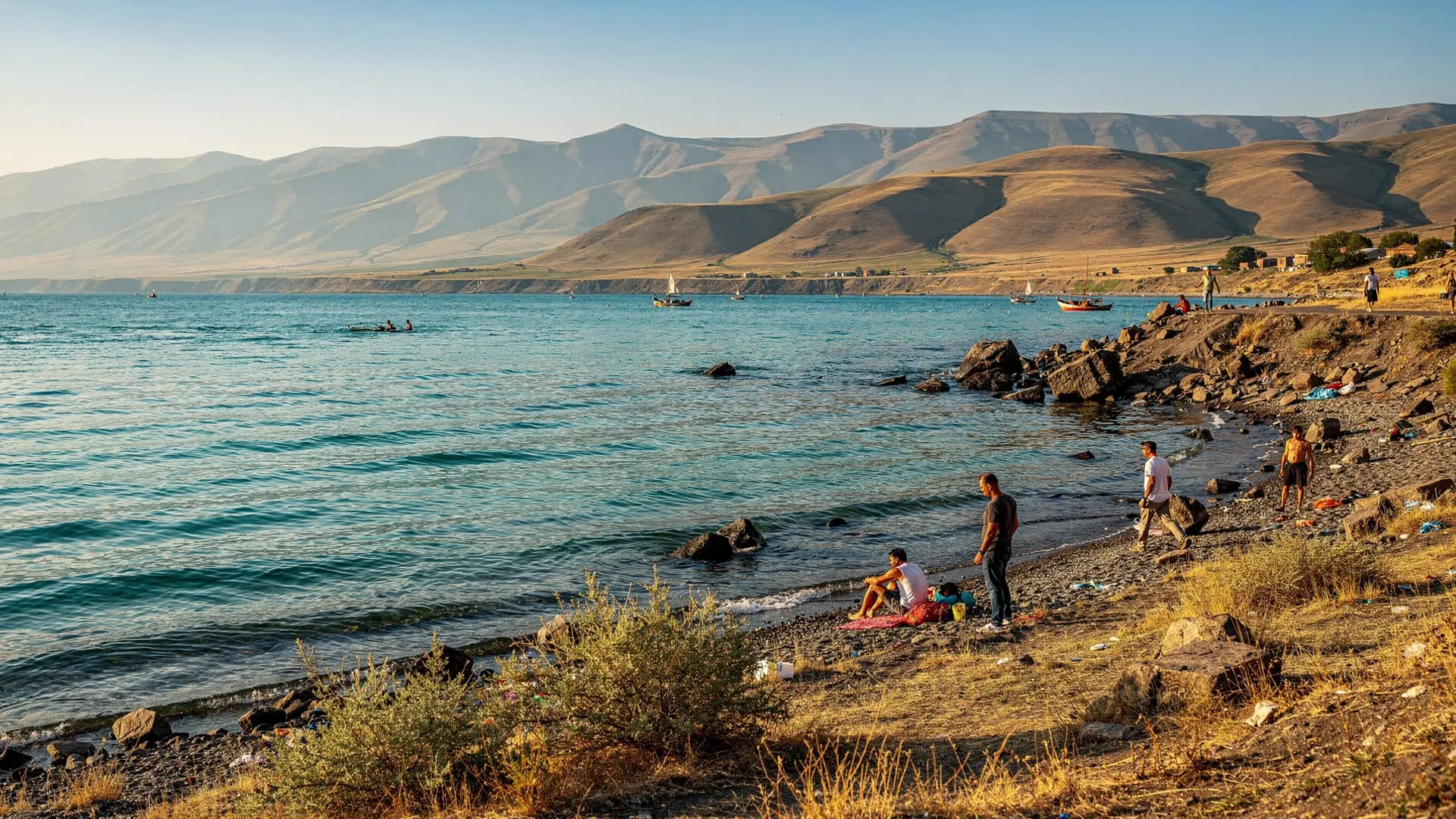
The main road around Lake Sevan follows the northern and western shores, which are more developed — beaches, restaurants, summer houses, occasional resort hotels. The southern and eastern shores are quieter, the road smaller, the settlements fewer. On my third day I drove the eastern shore and spent an afternoon at a beach that consisted of grey volcanic sand and almost no one else.
The Noratus khachkar cemetery is also on this quieter side of the lake. It contains more than 900 medieval cross-stones — the largest surviving collection in the world — arranged in rows across a hillside above the shore. The scale of it only becomes apparent when you’re inside: you’re surrounded in every direction by carved stone, each one different, the carvings ranging from simple incised crosses to complex interlaced patterns with figures of saints, animals, and geometric borders. The oldest stones date from the 9th century; the most recent are from the 17th.
There were two other visitors when I arrived, and we each found our own section of the field and wandered in silence. This is the correct way to experience Noratus. It rewards slow looking.
The temperature problem
I should be honest about what June means at Lake Sevan. The lake is cold. Not “refreshingly cool” cold — cold in the way that high-altitude glacial runoff is cold. Water temperature in June is typically 12-15°C. Some people swim; I watched them admiringly from the shore. The beach culture around Sevan is more about sitting in the sun and eating grilled fish than about sustained swimming, at least until late July when the lake warms a few degrees further.
The air temperature is comfortable and sometimes perfect — 20-24°C in June, usually with a breeze. The combination of cool air and warm sun on a beach chair is genuinely pleasant. I am simply noting that if you arrive expecting a swimming holiday, the water will require preparation.
The highest point of the summer swimming season is late July to mid-August. The lake is also at its most crowded then — the beaches around Sevan town fill with Yerevan families escaping the city heat. If you want the lake to yourself, come in June or September, accept the cooler water, and enjoy the relative solitude.
The Sevanavank route on foot
Most visitors drive to Sevanavank. The road brings you to the base of the hill in a matter of minutes from Sevan town. But there is a walking route from the main beach area — roughly 45 minutes across the peninsula — that puts you at the monastery from the water side, and this approach is better in the morning when the sun is behind you and the monastery is lit from the east.
I walked it on my third morning at 7:30 a.m. The path is informal and unsigned but easy to follow, cutting across the low scrub of the peninsula with the lake on both sides — you are on a peninsula, so you often have water visible to the left and to the right simultaneously, which is an unusual sensation. The monks’ quarters and the newer buildings that support the monastery as a working institution are visible as you approach from this side, less prominent than the ancient churches but part of what the place actually is.
At that hour, the water on the western side was perfectly still — a mirror for the morning sky — and the monastery was in its own early silence before the first coach pulled in at 9 a.m. Two elderly women were climbing the path ahead of me, taking it slowly, one supporting the other. By the time I reached the top, they were already seated on the terrace bench, looking out over the lake with an expression of specific contentment that you see in people who have done a thing many times and found it consistently worth doing.
Notes on staying
I stayed in a guesthouse in Sevan town rather than a beach resort, which was the right choice for my purposes. The guesthouse owner — a woman named Anahit who had spent twenty years in Moscow and moved back after 2014 — made breakfast that included fresh matsun (Armenian yoghurt), lavash, and a cheese I hadn’t encountered before, firm and slightly salty, that she said came from a farm in the hills above town. Breakfast was included in the room price of around 12,000 AMD per night.
There are fancier options: a couple of resort hotels on the northern shore have swimming pools, restaurants, and the full amenity stack. They are also several times the price. For budget travellers, there are hostels in Sevan town, and camping on the eastern shore is possible in summer.
The drive from Yerevan is 65 kilometres — about an hour and a quarter, depending on traffic. It’s a comfortable day trip if you go early and leave by 4 p.m. But to actually inhabit the lake, to watch the light change on the water in the evening and see Sevanavank at dawn with no one else there, you need to stay at least one night. Two nights is better. The lake rewards the time.
Combining Sevan with the rest of Gegharkunik and beyond
Most itineraries treat Sevan as a stop on the way to Dilijan, and the road between the two — over the pass and down into the greener Tavush hills — is a natural extension if you have more than a day. Closer to the lake itself, Sevanavank monastery deserves the fuller treatment this account gives it, and travellers with an extra half-day should not skip the Noratus khachkar cemetery, the largest surviving collection of cross-stones in the world. If your time is limited, the Lake Sevan and Dilijan day trip guide covers how to combine both without rushing either.
Half-day Lake Sevan and Sevanavank monastery tour from YerevanWhere to base yourself around the lake
Sevan town, on the northwestern shore, is the practical base — closest to the monastery, with the widest range of guesthouses and restaurants. The eastern and southern shores are quieter but have fewer services, better suited to a day visit or camping than a multi-night base unless you’re specifically seeking solitude. For beach-focused stays, the Lake Sevan best beaches guide breaks down which stretches of shore suit swimming versus quiet walking, and families should check the Lake Sevan with kids guide before committing to a specific beach.
Frequently asked questions
Is Lake Sevan worth visiting outside the summer swimming season? Yes — June and September give a quieter, still-pleasant lake with fewer crowds at Sevanavank and Noratus, even though swimming is only comfortable for the hardy. If swimming is the priority, late July through August is warmest, but also the most crowded.
Where is the best ishkhan trout, and how do I avoid a bad version? Ask your guesthouse or a local rather than eating at the first large terrace restaurant near the monastery car park — the busiest, most visible places are more likely to serve fish that’s been frozen. Smaller, unsigned restaurants in Sevan town itself were consistently better in my experience.