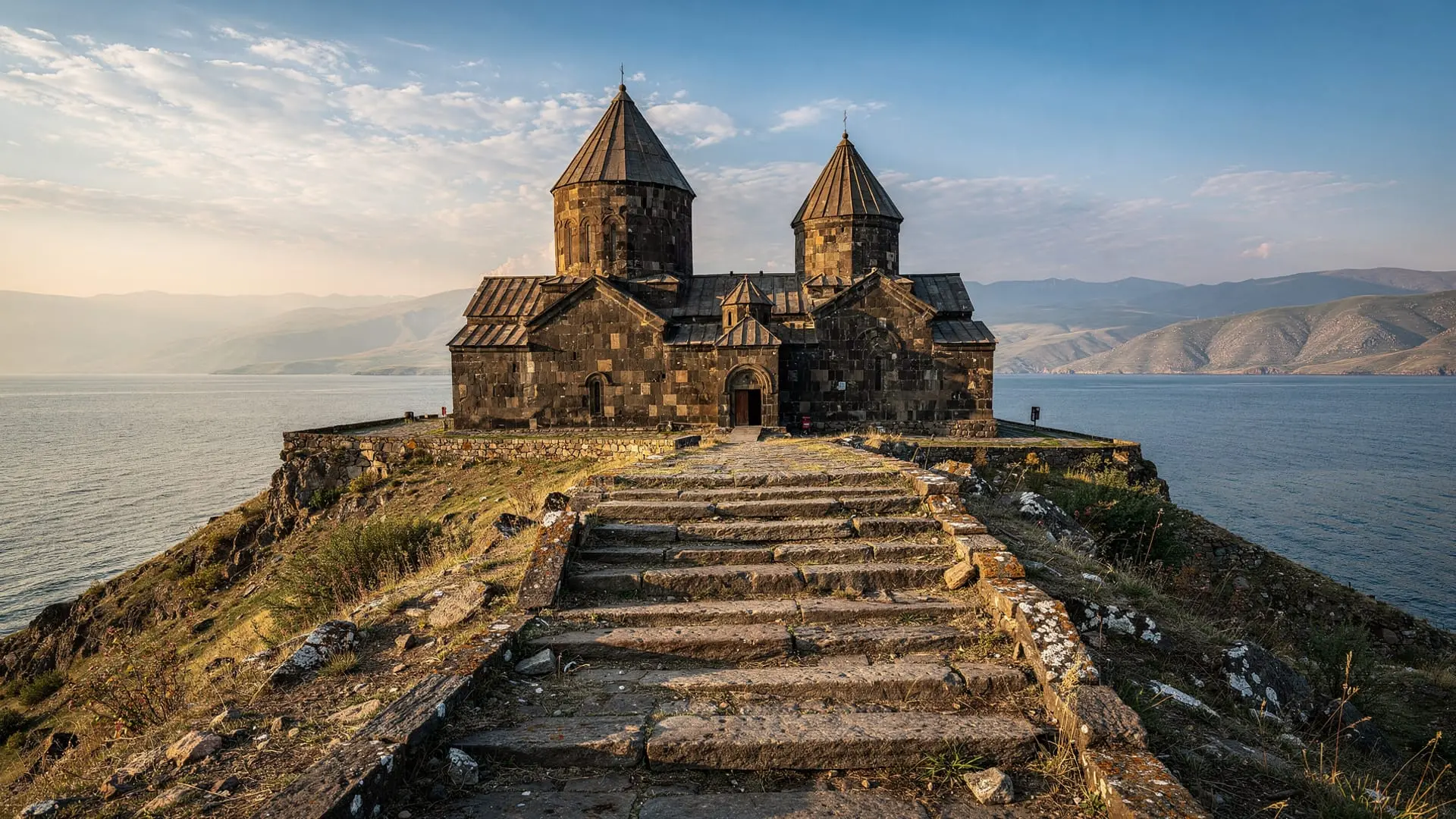
Twin churches above the blue
The image is one of the most replicated in Armenian tourism: two small 9th-century churches perched on a rocky peninsula above the impossible blue of Lake Sevan, viewed from the shore with the mountains of Gegharkunik as a backdrop. Sevanavank delivers precisely this — and, for those who climb the stone stairs to reach the churches, a lake panorama that extends to every compass point.
The monastery was founded in 874 AD by Princess Mariam, daughter of the Bagratid king Ashot I, on what was then a true island. The Soviet-era water level reduction connected it to the mainland — the stone causeway you walk today sits where shallow water once covered the path. Two churches survive: Surb Astvatsatsin (Holy Mother of God) and Surb Arakelots (Holy Apostles). Both retain their original 9th-century fabric with relatively modest later additions.
Sevanavank is an essential stop on any Lake Sevan visit. It takes 1.5–2 hours to do it justice, including the climb, the church interiors, and time for views.
| Season | Months | What to expect |
|---|---|---|
| Spring | May–Jun | Bluest water of the year, lighter crowds, green surrounding hills |
| Summer | Jul–Aug | Peak season, very crowded 11:00–14:00; go early morning or late afternoon |
| Autumn | Sep–Oct | Best overall — thinner crowds, warm low-angle light, exceptional lake colour |
| Winter | Nov–Apr | Quiet and cold; dramatic stone-and-water photography, bring waterproof boots |
Getting to Sevanavank from Yerevan
By car: 70 km east of Yerevan via M4 highway, following signs to Sevan town and then the monastery peninsula (well-signposted). Drive time: 1 hour 20 minutes. Parking at the base of the steps.
By marshrutka: Marshrutkas to Sevan town from Kilikia Station (700–800 AMD, 1h20). From Sevan town, the monastery is 5 km — take a local taxi (1,000–1,500 AMD) or walk 45 minutes along the shore road.
By guided tour: almost always part of a Lake Sevan day trip. See tours section below.
What to see at Sevanavank
The steps and the approach
About 200 steps lead from the shore road to the monastery terrace. At 1,900 metres of altitude, these feel steeper than they look — plan a slightly slower pace if you’re not acclimatised. The view opens gradually as you climb, revealing more of the lake with each flight of stairs.
Surb Astvatsatsin and Surb Arakelots
The two churches are typical examples of early Bagratid architecture: compact, cruciform plans, conical drums, and carved khachkar panels set into exterior walls. The interiors are functional rather than decorative — Armenian Apostolic churches are generally spare compared to Orthodox or Catholic counterparts. Candles can be purchased and lit near the altar.
Look carefully at the carved exteriors: the stone-cutters of the 9th century left intricate animal reliefs, vine scrolls, and geometric patterns that have survived over a millennium with remarkable clarity.
The panoramic terrace
The monastery terrace gives a 360-degree view of Lake Sevan — this is what most people come for. The lake’s surface changes colour through the day: deep indigo in morning, brilliant turquoise in afternoon sun, silver-grey at dusk. On the clearest days (typically September mornings), the Gegham and Vardenis mountain ranges are visible as a ring around the lake’s horizon.
The shore below
The flat area below the monastery steps has been developed with restaurants and a small beach. It gets crowded in summer. The restaurants here are tourist-oriented and more expensive than equivalents in Sevan town — acceptable for a quick fish lunch but not the best-value option.
Tours and tickets
Admission: free. The monastery charges no entrance fee.
For a half-day from Yerevan specifically focused on Sevanavank: half-day Lake Sevan tour from Yerevan .
The most popular full-day combination: Lake Sevan and Dilijan full-day tour — includes Sevanavank and then continues to Dilijan’s forests.
See the main Lake Sevan guide for full context.
Best time to visit Sevanavank
May–June: excellent. The lake is at its bluest in spring, tourist numbers are lower than peak summer, and the surrounding hills are green.
July–August: peak season. The monastery and its steps are very crowded between 11:00 and 14:00. If visiting in summer, go early morning or late afternoon for more space and better light.
September: best overall. The summer crowds thin, the light becomes warmer and lower-angle, and the lake colour in September is exceptional.
October: off-season quiet, stunning light, cold (bring layers).
November–April: few tourists. The monastery is accessible year-round. The stone and water in winter light offer the most dramatic photography — bring waterproof boots.
Practical tips
- Photography: the classic shot is from the shore below the steps, best in morning light. For aerial-style views, climb to the highest point of the monastery terrace.
- Dress code: cover shoulders and knees. A scarf for women. Not strictly enforced but respectful.
- Combine with: Noratus khachkar cemetery (20 km south) and Dilijan (50 km north) for a strong full-day circuit.
- Altitude awareness: 1,900 metres. The step climb is gentle but takes slightly more effort than at sea level.
Frequently asked questions about Sevanavank
How many steps lead up to Sevanavank?
Approximately 200 steps, varying slightly by route. The climb takes 5–10 minutes at a moderate pace.
Was Sevanavank once an island?
Yes. Before Soviet-era water level reduction starting in the 1940s, Sevanavank stood on a true island accessible only by boat. The lowered water level created the causeway now used as the approach road. The monastery’s name — Sevanavank, meaning “lake monastery” — reflects its original insular setting.
Can you enter the churches at Sevanavank?
Yes, both churches are open to visitors during daylight hours. Candles are available near the altar. Dress modestly (covered shoulders and knees). Services are held on religious feast days; during services, respectful observation is welcome.
Is Sevanavank better than Noravank or Tatev?
Different rather than better. Sevanavank is architecturally simpler than Noravank or Geghard, but its setting — lake on all sides, sky and mountains as backdrop — is unmatched. It’s also the most easily reached monastery from Yerevan (1h20) making it ideal for a shorter day trip.
Sevanavank in history
The monastery was founded in 874 AD by Princess Mariam, daughter of King Ashot I of the Bagratid dynasty. The founding followed a tradition of Armenian royal and noble patronage of monastic communities as acts of piety and as assertions of dynastic legitimacy.
The original community included a nunnery, and early written sources describe Sevanavank as having multiple buildings beyond the two surviving churches. The monastery was sacked by Arab raiders in the 10th century, partially rebuilt, and reduced again over subsequent centuries. By the time of the Russian imperial surveys in the 19th century, only the two churches and their foundations remained.
An interesting episode: in 1850, the Russian imperial authorities attempted to close the monastery and convert the buildings for secular use, provoking protests from local Armenian communities. The monastery continued to function, though with a reduced monastic community. It is today an active religious site administered by the Armenian Apostolic Diocese of Gegharkunik.
The peninsula and the island
From medieval accounts and early photographs (the earliest date to the 1880s), Sevanavank is clearly shown as an island monastery — visible from the shore but accessible only by boat. The 19th-century approach to the island, involving a small wooden boat rowed from the shore, was itself considered part of the pilgrimage experience.
The Soviet water level reduction that created the present causeway is documented in photographs from the 1950s–1970s: the water retreating, the sandy connection to the mainland emerging, the island gradually becoming a peninsula. The current stone causeway was formalised in the 1960s–1970s as traffic to the now-accessible monastery increased.
If the ongoing restoration programme returns Sevan to its pre-Soviet level (an optimistic scenario that requires decades), Sevanavank would again become an island — accessible, as it was for 1,000 years, only by boat.
Lake Sevan’s environmental context
Lake Sevan is one of the largest high-altitude freshwater lakes in the world, sitting at around 1,900 metres and covering roughly 5% of Armenia’s total land area. Soviet-era plans in the 1930s–40s intended to drain much of the lake for irrigation and hydropower, lowering the water level by nearly 20 metres before the policy was reversed in the 1960s once the ecological consequences became clear — including the near-loss of the lake’s status as an island setting for Sevanavank itself. Since the 2000s, Armenia has run a slow refilling programme, raising the water level gradually through controlled inflow management, though the lake remains well below its historical maximum. Understanding this history explains why Sevanavank sits on a peninsula rather than the island it was built on, and why some Armenian conservationists still talk about the monastery’s causeway as a scar from a 20th-century environmental mistake rather than a permanent feature of the landscape.
Photography at Sevanavank
The classic shot: from the shore 200–300 metres south of the monastery, with a telephoto lens compressing the monastery against the sky. Best in morning light (08:00–10:00) when the sun is northeast of the peninsula.
The golden-hour shot: from the top of the monastery terrace looking west, with the lake and sunset behind you reflected in the water. Best in September–October when the sun sets over the western mountains at 19:00–19:30.
The winter shot: monastery and grey lake under low winter cloud. Stark, minimal, powerful. Best on overcast January or February mornings.
Drone photography: check Armenian CAA regulations before flying. As of 2026, drones require registration and permits for flight near cultural heritage sites.
Practical notes on the approach road
The road from the M4 highway to Sevanavank (approximately 5 km) passes through Sevan town, which has the usual small-town services: ATMs (ACBA Bank), petrol stations, a supermarket. Stock up here if you need cash or snacks.
The parking area at the monastery base can be crowded in July–August. Arrive before 09:30 or after 15:30 for easier parking.
The steps from the parking area to the monastery are uneven and steep in places. Comfortable shoes with grip are advisable — sandals are fine for most people in dry conditions, but can be slippery on wet stone.
See the main Lake Sevan guide for full logistics on visiting the lake and surrounding attractions.
What to combine with Sevanavank
Noratus khachkar cemetery (20 km south)
The largest surviving khachkar (cross-stone) cemetery in the world is on the west shore of Lake Sevan, 20 km south of Sevanavank. Over 900 medieval stone crosses are installed in a field above the shore — the oldest dating to the 10th century. Walking among them is one of the most meditative heritage experiences in Armenia. The scale and quality of carving, and the sense of accumulated centuries of memorial practice, make this an essential addition to any Lake Sevan visit.
Most visitors to Sevanavank simply turn around and drive north back toward Yerevan after the monastery. Driving south along the western shore instead, stopping at Noratus, takes an additional 45 minutes but rewards substantially. Free. See /destinations/noratus-cemetery/.
Hayravank monastery (15 km south)
Slightly further south on the west shore, the 9th-century Hayravank monastery sits on a cliff projection above the lake. It is small, less visited than Sevanavank, and has a quality of isolated contemplation that the more trafficked north shore lacks. Free. A 30-minute detour.
Tsaghkadzor (40 km west)
The ski resort town of Tsaghkadzor is 40 km west of Lake Sevan — a 50-minute drive that makes a logical pairing in winter (December–March when the ski lifts run) or for the Kecharis monastery in any season. See /destinations/tsaghkadzor/.
Dilijan (50 km north)
The classic Sevan–Dilijan day trip from Yerevan: Sevanavank in the morning (arrive 09:30 before the day-trip groups), lunch at a lakeside trout restaurant, then the 50 km drive through the Sevan-Dilijan tunnel to the forest town of Dilijan for an afternoon walk. This is one of the most consistently rewarding single-day circuits from Yerevan. See /guides/lake-sevan-dilijan-day-trip/.
Buying at Sevanavank
The small vendor area at the base of the steps sells:
- Churchkhela: walnut-and-grape-must sausages, a traditional Caucasian sweet. Quality here is generally genuine. 500–1,000 AMD each.
- Dried apricots and walnuts: Armenian dried apricots (naturally dried, no sulphur) are among the best in the world. Sold loose. Taste before buying.
- Small khachkars: carved stone cross replicas of varying quality. The better pieces are identifiable by even carving lines and clean finishing. 3,000–15,000 AMD depending on size and quality.
- Sevanavank honey: local beekeepers sell varietal honeys, including the distinctive mountain thyme honey of the Gegharkunik plateau. Worth buying a small jar.
The major tourist souvenir shops in Yerevan offer the same product range at higher prices and lower quality. Buying directly at the monastery supports the local economy.