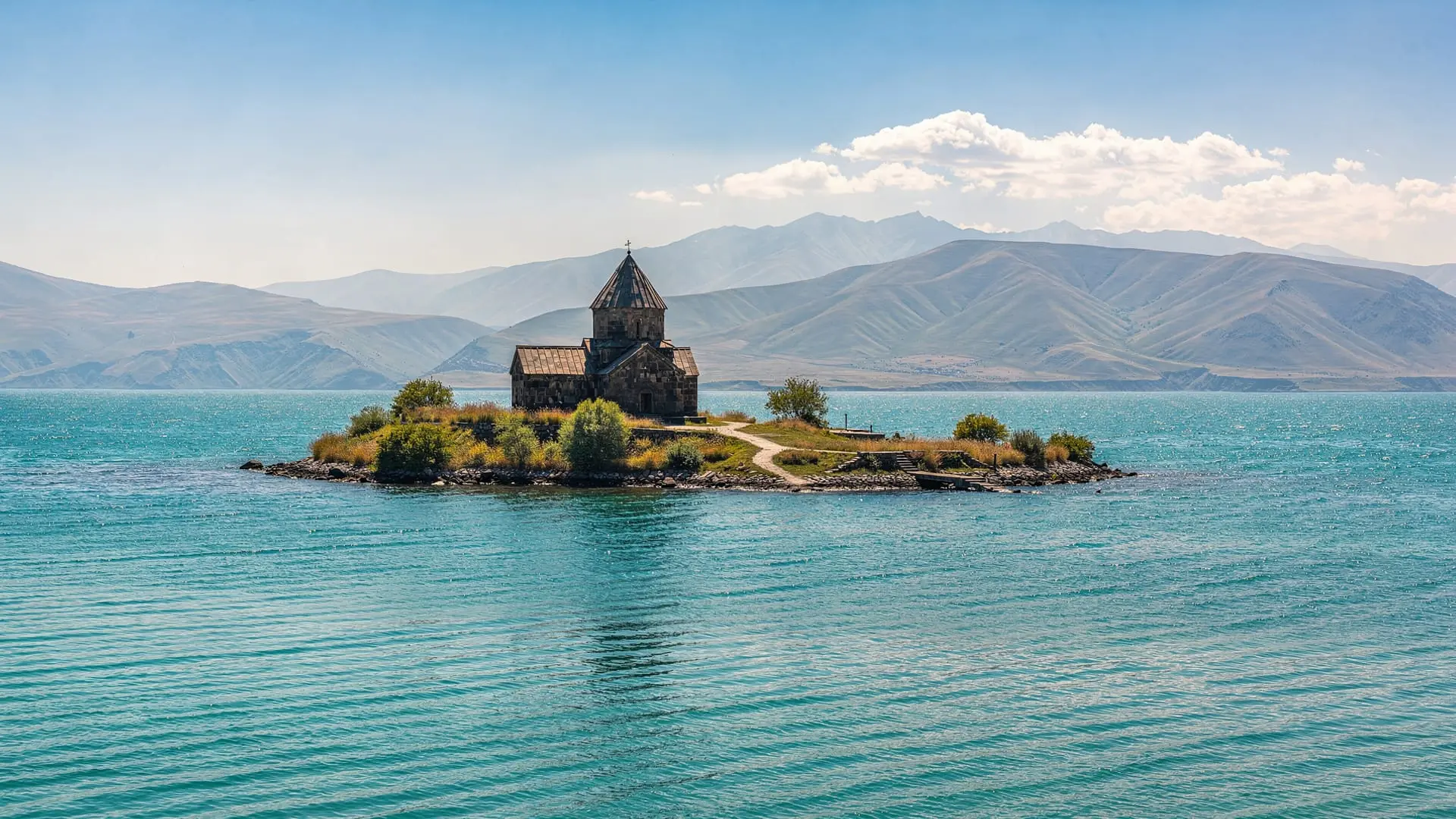
The blue eye of Armenia
Lake Sevan sits at 1,900 metres above sea level and covers 1,242 square kilometres — one of the world’s largest high-altitude lakes, and certainly the most significant body of water in Armenia. Armenians hold it with the same emotional significance that makes it difficult to find an unbiased local review: Sevan is home, summer, childhood.
From the highway that runs along the western shore, the first glimpse of the lake is arresting: deep cobalt blue against brown-green steppe mountains, with the water extending to a horizon that feels oceanic despite the altitude. The Sevanavank monastery peninsula juts into the lake from the northern shore — its two medieval churches visible for miles, an image that has become one of the defining postcards of Armenia.
The lake has an environmental history that demands brief mention. Between the 1940s and 1980s, Soviet engineers drained significant volume from Sevan to power hydroelectric stations and irrigate farmland. The water level dropped by about 20 metres. Since 1981, a reversal programme has been slowly refilling the lake by reducing outflow — by 2026, the level has recovered about 4 metres from its Soviet-era low. The Sevanavank peninsula, which was once an island accessible only by boat, became a promontory connected to the mainland as levels dropped.
| Where | Gegharkunik province, 65 km east of Yerevan |
| Cost | Free (Sevanavank, Noratus, Hayravank); beach loungers paid on-site |
| Time needed | Half day (morning stop) to a full day |
| Getting there | Car (1h15), marshrutka + local taxi, or guided tour |
| Best time | Jul–Aug for swimming; May, Sep–Oct for views and fewer crowds |
Getting to Lake Sevan from Yerevan
By car: 65 km east of Yerevan via the M4 highway. The drive takes 1 hour 15 minutes under normal conditions. The motorway is good until you reach the lake shore, where the road quality varies.
By marshrutka: Marshrutkas to Sevan town depart from Kilikia Station, Yerevan (fare around 600–800 AMD, 1h15). From Sevan town, local taxis reach the Sevanavank peninsula (5 km, 1,000–1,500 AMD) or the northern beaches. Return marshrutkas operate until approximately 18:00.
By guided tour: the Lake Sevan–Dilijan combination is one of the most popular day trips from Yerevan, and well-served by both group and private tours.
What to see and do at Lake Sevan
Sevanavank monastery
The monastery on the peninsula is the obligatory stop — two medieval churches (Surb Arakelots and Surb Astvatsatsin, 9th century) at the top of a staircase of 200-plus steps. The climb rewards you with sweeping 360-degree lake views. The monastery is an active religious site; dress modestly and behave accordingly. Admission free.
For full coverage, see our dedicated Sevanavank page.
Beaches and swimming
The north shore of Sevan has several pebble-and-sand beaches. The most popular (Sevan Beach, near Sevan town) is well-serviced with sun loungers, boat rentals, and restaurants but gets intensely crowded in July–August. Parking is paid in peak season.
For a quieter swim, drive further around the northern shore toward Tsovagyugh or Geghamasar — fewer facilities, more breathing room.
Water temperature: the lake reaches about 18–20°C in July–August — cool but swimmable. May and October are too cold for most people (8–12°C).
Water quality: periodically affected by algae blooms in late August due to agricultural runoff — a known issue. Check conditions locally before swimming in late summer.
Noratus khachkar cemetery
20 km south of Sevan town on the western shore, Noratus is home to the largest surviving khachkar (Armenian cross-stone) cemetery in the world — over 900 medieval stone crosses in a field above the lake. The oldest date to the 10th century; many carry inscriptions naming the deceased and their professions. It is one of the most haunting and remarkable open-air heritage sites in Armenia. Free; accessible any time. See /destinations/noratus-cemetery/.
Boat trips
In summer, short boat trips depart from Sevan town harbour. A 30–60 minute ride on the lake gives perspective on the Sevanavank peninsula and the scale of the water. Prices are negotiated directly with boatmen: around 5,000–10,000 AMD for a private boat trip.
Sevan trout (Ishkhan)
The Sevan trout, known as Ishkhan (“prince”), is a species found only in this lake and prized for its delicate flavour. It was almost driven to extinction by Soviet-era overfishing; populations have partially recovered with protection measures. It is now farmed extensively in the lake. Eating Ishkhan at Sevan is considered one of the essential food experiences in Armenia.
Most restaurants around the lake serve it — see below for recommendations. See our guide /guides/lake-sevan-trout-ishkhan/ for context.
Hayravank monastery
On the western shore, 15 km south of Sevan town, this small 9th-century monastery sits on a cliff above the lake. Far less visited than Sevanavank, and genuinely atmospheric in its isolation. Worth a 30-minute detour if driving south. See /destinations/hayravank/ for the dedicated guide.
Best beaches around the lake
The north shore concentrates the developed beach infrastructure, but quality and crowding vary considerably by stretch. Our Lake Sevan best beaches guide ranks the options in detail; the short version is that the busiest beach near Sevan town has the best facilities and the worst crowds, while beaches further north toward Tsovagyugh trade some convenience for significantly more space.
Camping and slower travel around Sevan
Beyond the day-trip crowd, a growing number of travellers use Sevan as a base for a slower two- or three-night stay rather than a single Yerevan day trip. The appeal is straightforward: cooler evenings than the capital, direct lake access without a return drive, and easy onward mornings toward either Dilijan and Tavush or south toward Noratus and the Gegharkunik villages. Informal camping is tolerated in many spots along the eastern and southern shores away from the main beaches, though facilities are minimal — bring your own water and expect no toilets outside the developed beach areas. For a more comfortable slower stay, the Tufenkian Sevan Writers’ House and Villa Kars both work well as multi-night bases, particularly for travellers who want to explore the quieter southern shore villages at a relaxed pace rather than fitting Sevan into a single rushed afternoon.
Where to stay near Lake Sevan
Tufenkian Sevan Writers’ House — the most distinctive hotel on the lake: a Soviet-era writers’ retreat (where Armenian intellectuals were sent for work residencies) repurposed into a boutique hotel by the Tufenkian group. Stone buildings, lake views from all rooms, a good restaurant, and a sense of genuine place that few lakeside hotels achieve. Prices: 40,000–65,000 AMD per room (~98–158 €).
Villa Kars — well-regarded lakeside hotel with comfortable rooms and a solid restaurant. Popular with families in summer.
Avan Marak Tsapatagh — a newer resort on the western shore, with better facilities than the town options but somewhat impersonal. Worth it for families with children who want a pool.
For budget stays, small family guesthouses around Sevan town offer rooms from 15,000–20,000 AMD. Facilities are basic but the hosts are typically welcoming.
Where to eat at Lake Sevan
The lake shore is lined with restaurants, most serving variations on the same menu: Ishkhan trout, crayfish, lavash, Armenian salads, and khorovats. Quality varies significantly.
Karma Hotel restaurant (Sevan town) — consistently well-reviewed for Ishkhan. The terrace overlooks the lake.
Sevan Star restaurant — popular with families, good portions, reliable quality. Grilled trout with butter and herbs is the main event.
Sevanavank area restaurants — the cluster of restaurants immediately below the monastery peninsula is touristy and overpriced. Walk 500 metres further along the shore for better value at local spots.
Smoked fish from roadside vendors: between Yerevan and Sevan, the roadside is lined with vendors selling smoked Sevan crayfish and trout. The quality is generally excellent and the prices fair. This is one of the more satisfying spontaneous roadside purchases in Armenia.
Tours and tickets
Admission: Lake Sevan is free. Sevanavank monastery is free. Noratus cemetery is free. Paid beach facilities (sun loungers, etc.) are negotiated on arrival.
For a private lake tour that includes Noratus cemetery and Hayravank monastery: private Lake Sevan tour with Noratus and Hayravank .
The popular Sevan–Dilijan full-day combination: Lake Sevan and Dilijan full-day tour from Yerevan .
For a private tour combining Sevan with Garni and Geghard: Garni, Geghard, and Lake Sevan private tour .
Our comprehensive guide: /guides/lake-sevan-complete-guide/.
From Yerevan: Garni - Geghard - Lake Sevan (Journey)Best time to visit Lake Sevan
July–August: the swimming season. Water temperature reaches 18–20°C. Beaches are packed, restaurants full, boats busy. If you want the social Sevan experience with Yerevan families relaxing, this is it. Book accommodation far ahead.
May–June: excellent for non-swimmers. Fewer crowds, green steppe hills, the Sevanavank views are exceptionally clear.
September: arguably the best overall. Warm enough for a brave swim, tourist numbers drop sharply after the first week. The light on the lake is exquisite in September afternoon.
October: off-season beauty. The lake at lower light, few tourists, the surrounding hills beginning to turn. Not for swimming.
November–April: cold and often grey. The lake doesn’t freeze but the shore is desolate. Fine for a quick stop combining with Dilijan, but not a standalone destination.
Practical tips
- Crowds: the north shore near Sevan town is the busiest in summer. Drive east or south for quieter spots.
- Food safety: check crayfish freshness in summer heat — buy from established restaurants, not roadside vendors with ice that’s been sitting in sun.
- Sunburn: at 1,900 metres the UV index is significantly higher than at sea level. Sunscreen matters.
- Altitude: if you’re coming from a low-altitude destination (most European cities), the 1,900-metre altitude means mild exertion feels harder. Drink water.
- Currency: most lakeside restaurants accept cash only. Bring AMD.
Frequently asked questions about Lake Sevan
Why is Lake Sevan so blue?
The intense cobalt-blue colour results from the lake’s high altitude, low nutrient levels (oligotrophic in most zones), and the quality of light at 1,900 metres. The colour is most vivid under clear skies in June and September.
Can you swim in Lake Sevan?
Yes, in July and August when water temperatures reach 18–20°C. The water is clear in most areas away from the town beach. Note: late August algae blooms occasionally make swimming unpleasant in some areas — check conditions locally.
What is Ishkhan trout?
Sevan trout (Salmo ischchan) is a species endemic to Lake Sevan. It was once so abundant that 19th-century travellers described the lake as “boiling with fish.” Soviet overfishing almost caused its extinction. Conservation efforts and aquaculture have stabilised populations. Eating freshly grilled Ishkhan at the lake is one of the signature food experiences in Armenia.
Is Lake Sevan worth a full day or just a morning stop?
A morning stop (3–4 hours: Sevanavank + a lake-view lunch + brief beach walk) is sufficient if you’re combining with Dilijan. A full day allows you to drive the southern shore to Noratus cemetery and Hayravank monastery, which are significantly less touristed and genuinely rewarding.
What is the elevation of Lake Sevan?
1,900 metres above sea level, making it one of the world’s largest high-altitude lakes. The high elevation contributes to cooler temperatures (8–10°C below Yerevan in summer) and the exceptionally intense blue colour of the water.
Can I combine Lake Sevan with Dilijan in one day?
Yes, and it’s one of the most popular day-trip combinations from Yerevan — Sevanavank in the morning, then north through the tunnel to Dilijan town or Lake Parz in the afternoon. See our Lake Sevan–Dilijan day trip guide for a realistic timing breakdown, as it is a genuinely full day rather than a relaxed one.
Is it better to visit Lake Sevan as a day trip or an overnight stay?
Both work, and the right choice depends on pace. A day trip from Yerevan efficiently covers Sevanavank, a meal, and either a swim or Noratus cemetery. An overnight stay — at the Tufenkian Sevan Writers’ House, Villa Kars, or a guesthouse near Sevan town — makes sense if you want to explore the quieter southern shore villages, catch sunrise or sunset light on the water, or simply avoid a same-day return drive after a long day of sightseeing.
Lake Sevan in depth: ecology, history, and the water crisis
Understanding what happened to Lake Sevan under Soviet management — and the ongoing recovery effort — adds depth to what would otherwise be a pretty lake with a monastery on top. It is one of the more instructive environmental stories in the post-Soviet Caucasus.
The Soviet drainage
Between the late 1940s and the 1980s, Soviet planners extracted billions of cubic metres from Lake Sevan to power hydroelectric stations at Sevan and Hrazdan and to irrigate the Ararat plain for cotton and wheat production. The lake level dropped by approximately 20 metres from its natural level. By the 1980s, the effects were catastrophic: the Sevanavank peninsula had emerged from the water as dry land (previously it was a true island); the shoreline had receded significantly; water quality deteriorated; and the endemic Sevan trout (Ishkhan) was facing extinction due to habitat loss and increased salinity.
Armenia’s literary and scientific establishment protested. The writer Paruyr Sevak wrote about Sevan’s decline. Academicians petitioned. In 1981, the drainage programme was officially curtailed and a restoration plan put in place: reduce outflow, allow natural inflow to rebuild the lake, and introduce fishery protections for the Ishkhan.
The recovery (1981–present)
The recovery has been slow. By 2026, the lake level has risen approximately 4 metres from its Soviet-era low — a meaningful improvement, but still well below the pre-Soviet natural level. The shoreline has moved back outward, the water quality has improved in most zones, and the Ishkhan population has stabilised through a combination of wild recovery and aquaculture programmes.
Full restoration to the pre-Soviet water level is not considered achievable in the near term — the infrastructure depending on the current level (hydroelectric stations, agriculture) cannot simply be switched off. The current policy is incremental: reduce outflow, protect the inflow catchment areas from deforestation, and manage fisheries sustainably.
The story is worth knowing for several reasons. It explains the Sevanavank peninsula — the monastery was built on an island; the “peninsula” you walk along is exposed lakebed. It contextualises the aquaculture you’ll see in the lake (the cage fish farms visible from the shore are part of the Ishkhan recovery programme). And it demonstrates the broader pattern of Soviet-era resource extraction that left complex legacies across the Caucasus.
The north shore vs. the south shore
Most tourists visit the north shore near Sevan town (Sevanavank, the main beaches, the lake-side restaurants). The south and east shores are quieter and, in some ways, more rewarding for those with time and a car.
South shore: the road running south from Sevan town passes through Noratus (the khachkar cemetery — one of the most haunting sites in Armenia), continues to Hayravank monastery on its clifftop perch, and eventually reaches the Gegham mountain range where the Dimats off-road area offers 4WD tracks above the lake. The south shore villages are genuinely local — no tourist infrastructure, Armenian signs only, authentic hospitality if you find a guesthouse.
East shore (Vardenis area): the Geghama mountain range forms the eastern backdrop to the lake in this area. The extinct volcano Azhdahak (3,597 m) rises above the ridge and can be reached by jeep and hike from the east shore. The village of Lichk on the southeast shore is known for its traditional fishing community.
Lake Sevan for families
The north shore near Sevan town has been specifically developed for family beach tourism — sun loungers, lifeguarded sections (in July–August), paddle boats, inflatable slides in the water, and a cluster of family restaurants. This is Yerevan’s closest seaside, and in July–August it operates accordingly: busy, noisy, full of children, and unmistakably Armenian in character (large family gatherings around long tables, abundant food, music from the restaurants).
For families wanting a quieter experience, the camping areas east of Sevan town offer more space. The national park area near the Artanish peninsula (east shore) has a particularly good ratio of space-to-tourists.
For more on visiting with children: Lake Sevan with kids guide.
Winter at Lake Sevan
The lake rarely freezes completely — it’s too large and deep. In very cold winters, ice forms along the shallow north shore near Sevan town but the main body remains open water. The winter colour of the lake — steely grey or dark blue under winter skies, often with snow on the surrounding mountains — is spectacular in a different register from the summer turquoise. Almost no tourists, no beach infrastructure operating, the restaurants closed. A raw and honest version of the lake.
Sevanavank in winter — grey stone monastery, white hills, empty staircase, the lake dark below — is one of the finest photographs available in winter Armenia.
Combining Sevan with Dilijan and the north
The most common extended itinerary pairs Lake Sevan with Dilijan as a single northern-arc day or overnight — Sevanavank and a lakeside lunch in the morning, then continuing north through the Sevan–Dilijan tunnel to the forested Tavush towns in the afternoon. Our Lake Sevan and Dilijan day trip guide covers the logistics of this combination in detail, including whether it’s better attempted as one long day or split across two.
For travellers heading further north still, the road continues toward Tsaghkadzor (via a different route than the main Dilijan road), making a Sevan–Tsaghkadzor combination a practical option for those based in Kotayk rather than travelling the Tavush direction.