Skiing Tsaghkadzor: the 2023 season report
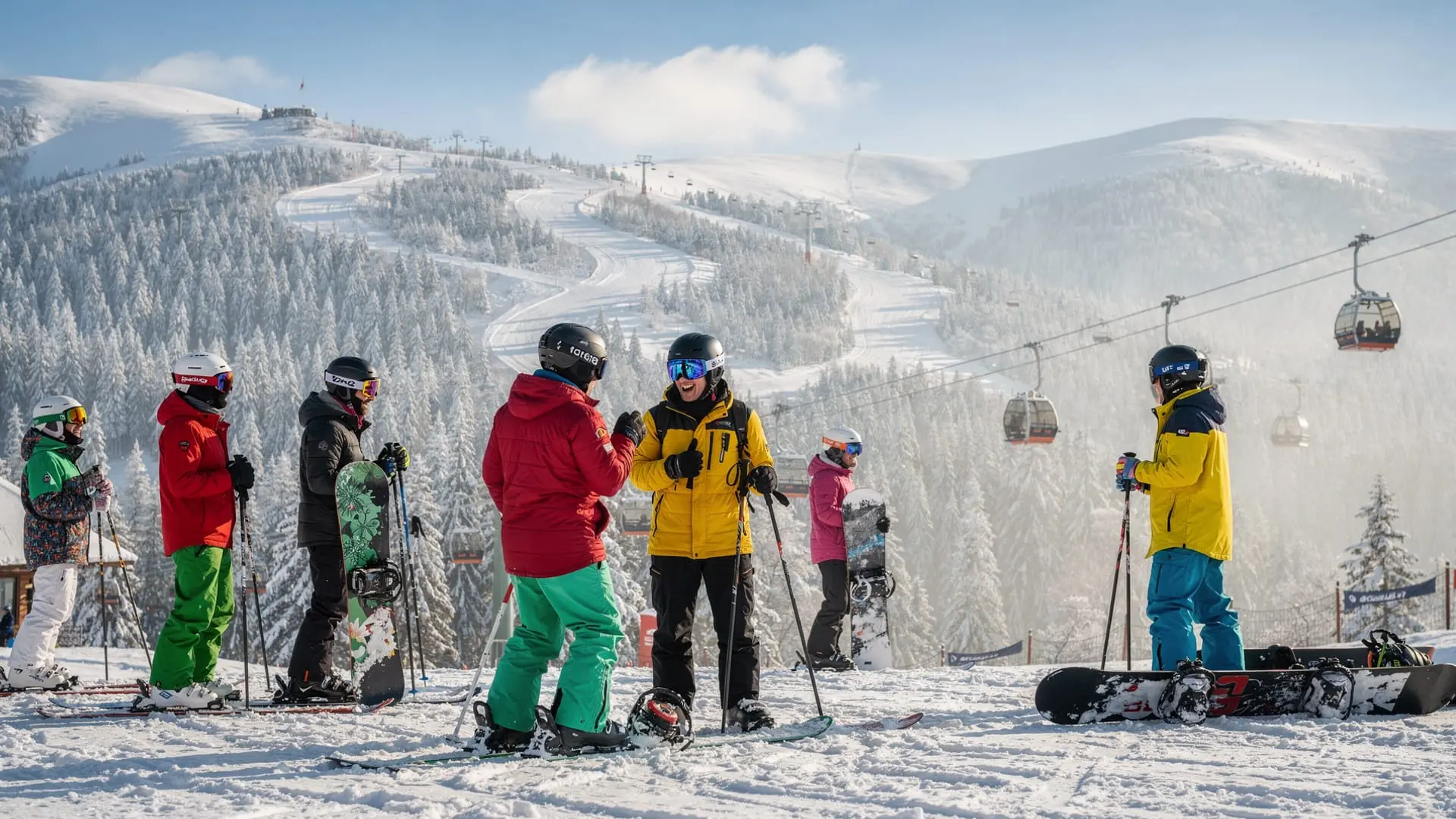
A February 2023 field report from Tsaghkadzor — Armenia’s main ski resort — covering snow conditions, lift status, day-pass prices, and an honest read on the infrastructure against European resorts.
| Where | Kotayk province, ~80km / 1h20 from Yerevan |
| Base elevation | 1,966m; top around 2,800m near Mt. Kaqavasar |
| Day pass | Around 12,000 AMD adult / 8,000 AMD child; half-day ~8,500 AMD |
| Rental | Skis, boots, poles around 5,000 AMD/day |
| Season | Roughly December–March, best snow typically Jan–Feb |
Snow at last
I had been watching the Tsaghkadzor webcam for two weeks before I finally committed to the drive. The first half of January 2023 had been inconsistent — a couple of decent falls, then warm nights that turned the lower runs to ice. By the second week of February the snowpack had settled and the reports from people I trusted in Yerevan were positive: two metres at the top, the upper lifts running. I left Yerevan at 6:30 a.m. on a Thursday to avoid the weekend crush.
The drive is about 80 kilometres from the city, roughly an hour and twenty minutes if you make good time on the M1 and turn north toward Kotayk. The resort sits at 1,966 metres at base level, which is modest by Alpine standards but sufficient for a ski area that serves a country where most people learn on these slopes. Coming up the switchbacks above the town, the road was sanded but not entirely clear — I was glad of the winter tyres.
Conditions on the mountain
When I arrived at the main lift area, the snow depth at base was being posted as 85 centimetres, with around 180 centimetres at the upper section near Mount Kaqavasar. Both figures felt roughly accurate. The groomed runs were genuinely good: firm at the edges where it had refrozen overnight, softer and more forgiving in the fall line where the morning sun had just begun to work. I would describe the conditions as solid intermediate skiing rather than anything to get excited about in powder terms, but solid intermediate skiing on a clear February morning in the Caucasus is quite enjoyable.
Three of the four main chairlifts were operating. The bottom lift — the oldest of the four, a double chair that dates from the Soviet period — was closed for what a staff member described as a mechanical inspection. This is the lift that serves the beginner run below the main base area, so its closure only really affected people bringing children who were learning. Everyone else went straight to the gondola or the upper chairs. I heard from other skiers that the lower lift had been closed for most of the season, which suggests the inspection had stretched out somewhat.
The piste map — which you can pick up at the ticket office or find laminated on posts throughout the resort — shows seven marked runs totalling around 30 kilometres, though I suspect the actual skiable distance is somewhat less if you subtract the access traverses. The red runs off the upper section are the best skiing on offer: sustained, not too narrow, with a genuine vertical drop of around 550 metres. There are a couple of blue runs suitable for beginners and improvers. There is nothing that would genuinely count as a black run, though some sections of the upper reds feel black-ish in icy conditions.
Lift passes and equipment rental
Day-pass prices in February 2023 were 12,000 AMD for adults (roughly 29 EUR at the exchange rates of the time), and 8,000 AMD for children under twelve. A half-day pass — starting after noon — was 8,500 AMD. These prices are significantly lower than comparable ski areas in Georgia or the French Alps, which is part of Tsaghkadzor’s appeal for budget-conscious visitors.
Equipment rental is available in several shops along the main access road and at two rental points near the base lifts. I rented skis, boots, and poles for 5,000 AMD per day, which I found serviceable if not particularly modern. The boots were Rossignol models that I estimated to be about six or seven years old; functional, properly sized when I asked for a half-size up from my usual. The ski shop staff were helpful and spoke reasonable English with skiers who struggled to communicate in Armenian or Russian.
For anyone with their own equipment, the boot room facilities are adequate but not large — arrive early if you want a locker near an electrical socket for boot warmers.
The infrastructure question
I want to be fair but honest here, because some of what you read about Tsaghkadzor online is either uncritically promotional or written by people who have never skied anywhere else. The lifts are functional but several are old. The grooming equipment is limited and the piste quality outside of the main gondola corridor is variable. The resort infrastructure — ticket offices, toilet facilities, ski patrol presence — is noticeably more basic than European resorts of comparable size.
None of this makes it a bad place to ski. It makes it a place that is worth calibrating expectations about. If you come expecting Courchevel you will be disappointed. If you come expecting a genuine mountain ski day in an interesting country at prices that feel almost absurdly reasonable, you will have a good time.
The mountain itself is the strong point. The views from the upper runs — across the valley toward Lake Sevan in the distance, with the monastery of Kecharis visible below the town — are beautiful in a way that no lift upgrade changes. On a clear February morning, those views are worth the drive on their own.
After skiing: the town and evening options
Tsaghkadzor the town is small and mostly oriented toward weekend visitors from Yerevan. The infrastructure has two distinct registers: the budget-to-mid-range guesthouses and small hotels lining the main access road, and at the base of the slopes, the larger Marriott property which operates at a noticeably different standard. The Marriott’s spa and indoor pool are available to non-guests for a day fee — I saw a number of people who appeared not to ski at all, using the resort purely for the wellness facilities, which is a legitimate way to spend a winter day in a place with few other distractions.
For food, the options are more limited than the ski area deserves. The main street has a handful of restaurants serving Armenian standards: khorovats from a proper coal grill, khash on Friday and Saturday mornings (the traditional dawn dish of slow-cooked trotters and garlic, eaten communally and requiring some commitment), dolma in various forms, the usual bread and salad setup. I had dinner at a simple place near Kecharis Monastery that served adequate grilled meat and genuinely good bread; a couple of the hotels have more polished dining rooms if that’s what you’re after. There are no fine-dining options and this is not a problem.
The Kecharis Monastery itself — a three-church complex from the 11th and 12th centuries sitting in the middle of the town — is worth a visit even in February. The churches are small and impeccably proportioned, and the monastery complex has a different kind of presence in snow: the dark stone against the white, the mountains visible behind. You can be in and out in half an hour and it adds real context to the otherwise resort-focused day.
Winter day trip from Yerevan combining Tsaghkadzor with Lake SevanThe après-ski scene, to use the word loosely, is a bar or two with recorded music and the hotel common rooms. It is not Verbier. This is both a limitation and, in a way, a relief — there is no pressure to perform enjoyment past a reasonable hour, and the quiet of the Kotayk mountains in the evening, with a reasonable meal and an Ararat brandy afterward, is genuinely pleasant. For a long weekend of skiing with evenings spent quietly eating and sleeping, it is exactly what you need.
Kecharis Monastery and the broader resort experience
One dimension of Tsaghkadzor that ski-focused visitors sometimes overlook is the interaction between the modern resort and the medieval monastery at its heart. Kecharis was founded in the 11th century and remained a significant ecclesiastical center through the medieval period; its three churches reflect the architectural evolution of Armenian religious architecture across two centuries. That it now sits in the middle of a ski resort, with gondola lift pylons visible from its courtyard, is an only-in-Armenia kind of juxtaposition.
I’m not sure whether to lament this or appreciate it. On balance, I appreciate it: the monastery gives the resort a depth it wouldn’t otherwise have, and the ski resort ensures that the monastery has visitors and economic vitality that a more remote site might lack. The two coexist with less friction than you might expect.
Getting there and practical notes
Tsaghkadzor is accessible from Yerevan by taxi, private car, or marshrutka. The marshrutka to Hrazdan departs from Kilikia bus station and takes about an hour; from Hrazdan, a local taxi to Tsaghkadzor takes another twenty minutes and costs around 1,500-2,000 AMD. If you’re in a group, a direct taxi from Yerevan costs roughly 6,000-8,000 AMD each way and takes about an hour fifteen minutes. In winter the road is generally maintained and sanded on the main approach, but the upper sections can be icy — I would recommend winter tyres or chains if you plan to drive yourself.
Accommodation during the 2023 winter season ranged from around 6,000-8,000 AMD per night for a basic guesthouse room (breakfast often included) to 25,000-35,000 AMD at the Marriott. The mid-range option I’d recommend: one of the family-run hotels on the main access road at around 10,000-15,000 AMD per night, which get you clean rooms, heating that works, and hosts who will tell you honestly whether the snow is good before you buy a lift pass.
| Tier | Price/night | What you get |
|---|---|---|
| Basic guesthouse | ~6,000–8,000 AMD | Simple room, often breakfast included |
| Family-run hotel (recommended) | ~10,000–15,000 AMD | Clean rooms, working heating, honest local advice |
| Marriott | ~25,000–35,000 AMD | Spa, indoor pool, day-fee access for non-guests |
For the fuller current-season pricing breakdown, see the Tsaghkadzor ski prices and passes guide, and if you’re deciding between Armenia’s two main mountain-winter bases, the Tsaghkadzor vs Jermuk winter comparison is worth reading first.
The Tsaghkadzor destination page has the full practical breakdown including current accommodation options and pricing. The Kotayk province guide covers the broader regional context, including the Bjni trek which connects to Tsaghkadzor for hikers in warmer months. If you’re combining a ski day with a visit to Lake Sevan — entirely feasible in clear winter weather, the lake is roughly 25 kilometres southeast — add about 30-40 kilometres to your day.
How the 2023 season compared
For context: the 2023 season was considered good but not exceptional by regular visitors. The late January and February snowfall filled in the gaps from an underwhelming early season, and the conditions I found in mid-February were described by the rental shop staff as “decent mid-season, not amazing.” Years with heavy early snowfall (2021, for instance, saw conditions open in early December and remain consistent through March) are remembered fondly; years where the high-altitude snowpack never fully develops are forgettable.
What this means practically: if you’re visiting specifically for skiing, do your reconnaissance. The resort’s own webcam, social media accounts, and the snow reports that Armenian skiing groups share on Facebook are all reasonably reliable. The worst outcome is arriving to find the lower lifts closed and the upper section icy — which happens. The best outcome is the scenario I described: firm groomers in the morning, good visibility, the Caucasus mountains around you, and a lift pass that cost you less than a good dinner in Yerevan.
The complete Tsaghkadzor ski resort guide covers lift maps, run grading, and season-by-season updates in more depth than a single field report can.