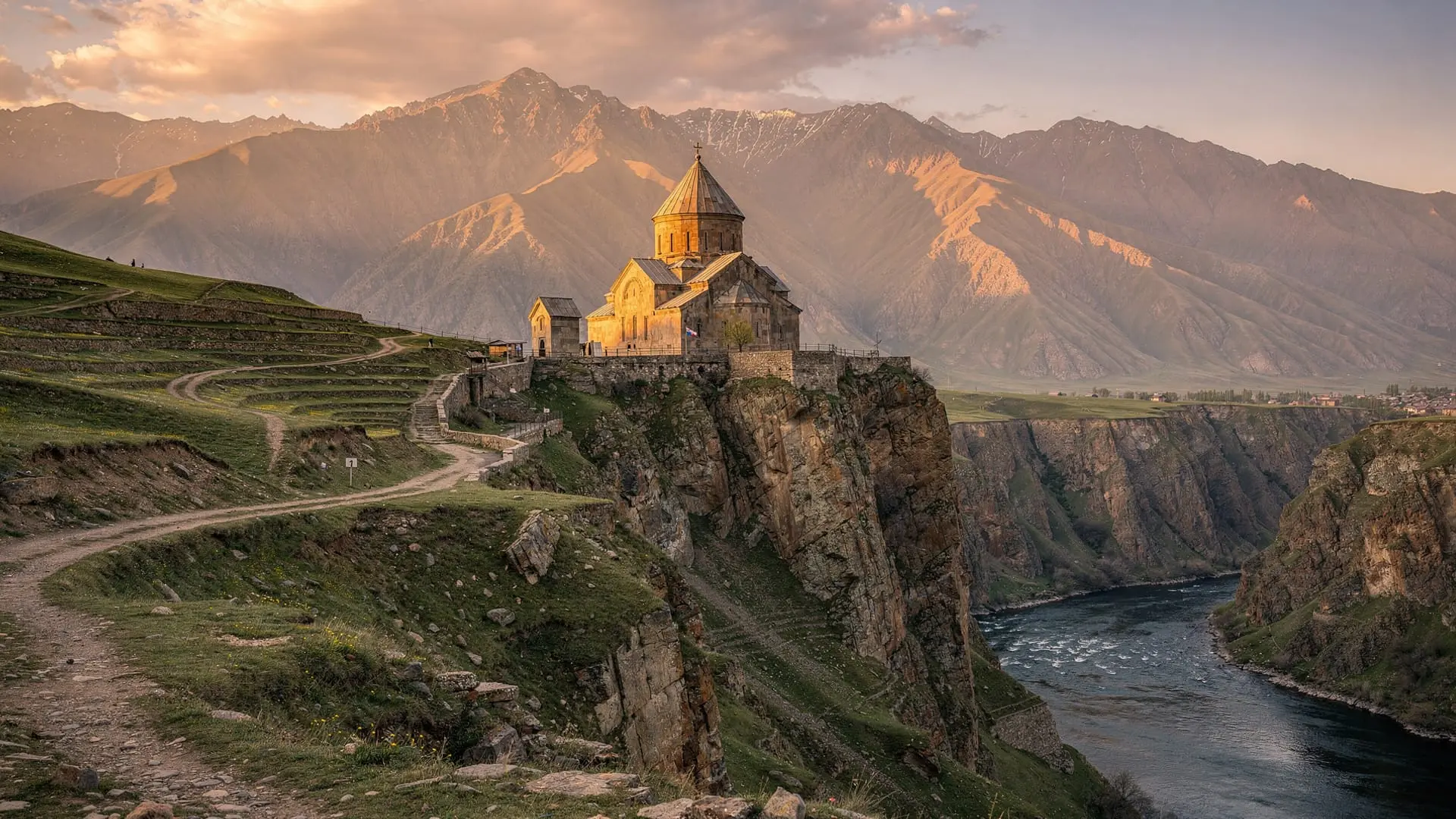
A forgotten fortress above the Hrazdan gorge
Bjni is one of those Kotayk province destinations that most visitors to Garni and Geghard walk straight past. The village sits on a ridge above the Hrazdan river gorge, about 40 km northeast of Yerevan, and it looks, at first glance, like an ordinary mountain settlement. But above the village, clinging to a volcanic basalt spur above the gorge, stand the scattered ruins of the 11th-century Bjni fortress — and beside the village road, an early 7th-century Armenian church that predates the fortress by four hundred years.
| Where | Kotayk province, Hrazdan gorge, 40 km northeast of Yerevan |
| Cost | Free entry to fortress and church |
| Time needed | Half day; full day if hiking to Tsaghkadzor |
| Getting there | Car (~50 min) or guided trek transfer; marshrutka impractical |
| Best time | Apr–Jun, Sep–Oct; avoid the trek Nov–Apr (ice) |
Bjni is also the official starting point for the Bjni–Tsaghkadzor trek, a 15-kilometre mountain traverse that has become one of the more popular day hikes in central Armenia. For that reason alone it draws a regular trickle of hikers who might otherwise have no reason to stop.
Getting to Bjni from Yerevan
By car: Bjni is about 40 km northeast of Yerevan via the M4 highway toward Hrazdan. Turn off at Bjni village, following signs toward Nor Bjni and then Bjni itself. The drive takes approximately 50 minutes.
By marshrutka: Shared taxis and minibuses to Bjni depart from the Kilikia (Gai) bus station in Yerevan. The village is small and service is infrequent — a taxi or private car is far more practical.
By guided tour: A small number of operators in Yerevan offer the Bjni–Tsaghkadzor trek as a guided day trip, handling transport to Bjni and return from Tsaghkadzor. This is the simplest option if you want to do the traverse without managing logistics yourself.
Getting back: If you complete the Bjni–Tsaghkadzor trek, you’ll need onward transport from Tsaghkadzor. Plan this in advance — arrange for a driver to meet you, or book a tour that includes the return transfer.
What to see
Bjni fortress (11th century)
The Bjni fortress was built in the 11th century under the Armenian Pahlavid dynasty and served as a regional stronghold controlling the Hrazdan gorge trade routes. It was later held by the Zakarids before falling into disuse after repeated Mongol incursions. Today the ruins are extensive but unexcavated — walls, towers, and cistern remnants scatter across the basalt spur with no formal museum or explanatory panels.
The approach to the fortress from the village is a 20–30 minute walk on a rough path. There is no admission fee and no formal opening. The views from the fortress ruins across the gorge and toward the Hrazdan valley are worth the climb even without the archaeology.
Note: the terrain around the fortress is rocky and uneven. Wear sturdy footwear. There are no safety barriers on the basalt cliffs.
The 7th-century church
Just below the fortress site, near the upper end of Bjni village, stands a small early medieval church — a straightforward single-nave basilica of the type built throughout Armenia in the 6th and 7th centuries. It predates Christianity’s full consolidation in Armenian rural areas and is one of the older intact ecclesiastical structures in the Kotayk region. The exterior stonework is plain but well-cut; the interior is typically bare.
The church is often unlocked during daylight hours. If locked, ask at a nearby house — a village resident usually holds the key.
The Bjni–Tsaghkadzor trek
This is the main reason serious hikers come to Bjni. The route follows mountain ridges from Bjni village northward through sub-alpine meadows and pine forests to Tsaghkadzor ski resort — approximately 15 km with about 700 metres of cumulative elevation gain. The walk takes 5–7 hours at a moderate pace.
The trail is well-worn but not formally marked throughout — download the GPX track from AllTrails or Wikiloc before setting out. The route passes viewpoints over the Hrazdan gorge, through high pastures where shepherds graze cattle in summer, and emerges at Tsaghkadzor near the ski base.
Best season: May–October. The route is technically walkable in late autumn but the upper sections become icy and navigationally tricky in November–April.
Difficulty: moderate. Suitable for hikers with basic trail experience and appropriate footwear.
How long to spend
Bjni village and the fortress ruins can be covered in 2–3 hours including the walk up and back. The church is a 15-minute stop. If you are doing the full Bjni–Tsaghkadzor trek, budget the entire day — typically 7–8 hours including travel from Yerevan and return from Tsaghkadzor.
For a half-day, the fortress visit alone (without the trek) is a perfectly satisfying outing, especially combined with a stop at Tsaghkadzor for lunch or Kecharis Monastery.
Combining with other sites
Tsaghkadzor (18 km north): The natural destination after Bjni, whether via the trek or by road. Tsaghkadzor has Armenia’s ski resort, the 11th-century Kecharis Monastery, and a chairlift to Mount Teghenis. Easily combined with Bjni for a full day.
Hrazdan town (15 km east): The regional centre of Kotayk, useful primarily as a fuel and lunch stop. Little of independent tourist interest.
Garni and Geghard (35 km south): The classic Garni temple and Geghard monastery day trip lies south of Bjni. Combining all four in one day is ambitious — better spread across two days if you have a car.
Bjni fortress-only visit vs the full trek
| Fortress + church only | Full Bjni–Tsaghkadzor trek | |
|---|---|---|
| Time | 2–3 hours | 7–8 hours including travel |
| Fitness needed | Basic | Moderate, sustained walking |
| Logistics | Simple round trip | Needs return transport arranged from Tsaghkadzor |
| Best for | History-focused day trip, families | Hikers wanting a real mountain day |
Most casual visitors are better served by the shorter fortress visit, especially if paired with Tsaghkadzor or Garni and Geghard by road; the full trek is worthwhile mainly for those who specifically want a multi-hour hike. For route detail beyond what fits here, see the Bjni–Tsaghkadzor traverse guide.
Tours and tickets
There is no admission fee for Bjni fortress or the 7th-century church. The Bjni–Tsaghkadzor trek costs nothing beyond transport.
To combine the Bjni area with Tsaghkadzor’s ski resort and Lake Sevan in one private day trip: this private Tsaghkadzor, Sevan, and Dilijan tour can be adapted to include a Bjni stop en route.
For those wanting a guided trek in the broader Kotayk highlands: this Kasakh gorge trekking day trip from Yerevan covers similar mountain terrain in the adjacent part of the range.
Practical tips
- Maps: download the Bjni–Tsaghkadzor GPX track from AllTrails or Wikiloc before setting out; mobile coverage is patchy in the upper sections of the route
- Water: carry at least 2 litres per person for the full trek; the upper pastures have no reliable water sources
- Weather: mountain weather in Kotayk changes quickly even in summer — bring a light waterproof layer
- Dogs: shepherd dogs on the upper pastures can be territorial; approach calmly and follow the shepherd’s guidance if present
- Return logistics: if trekking Bjni–Tsaghkadzor, arrange return transport from Tsaghkadzor in advance — marshrutkas back to Yerevan are available but infrequent in the afternoon
- Fortress safety: the basalt spur is exposed and the ruins are unguarded; exercise caution near cliff edges
- Currency: bring AMD cash — Bjni has no ATMs or card facilities; withdraw in Yerevan or Hrazdan beforehand
- Wider hiking context: if the trek appeals, the Armenia trekking gear checklist and Armenia hiking best season guide are useful before committing to the full traverse
Frequently asked questions about Bjni
Is Bjni worth visiting without doing the trek?
Yes, but it’s more of a niche interest than a mainstream sight. The fortress ruins and early church are genuine and uncrowded — refreshing after the busier sites at Garni and Geghard. If you enjoy medieval ruins without tourist infrastructure, Bjni delivers.
How difficult is the Bjni–Tsaghkadzor trek?
Moderate. The total distance is approximately 15 km with about 700 metres of elevation gain. There are no technical sections, but the path is not paved and some sections require navigation. Good fitness and proper hiking footwear are necessary.
Can I drive from Bjni to Tsaghkadzor?
Yes, via Hrazdan — the road distance is about 35 km and takes 40 minutes. The direct mountain path between the two is the trek; there is no paved road along the route.
Is there a café or restaurant in Bjni?
Bjni village has a small population and very limited services. There are no established restaurants; some villagers offer tea or basic food to visiting hikers, especially near the trailhead. Bring food and water from Yerevan or stop in Hrazdan on the way.
What age is suitable for the Bjni fortress walk?
The walk to the fortress from the village (20–30 minutes, rough path) is manageable for children aged 8 and above with reasonable fitness and good shoes. The basalt cliffs at the top require adult supervision. The Bjni–Tsaghkadzor trek is for adults and older teenagers with hiking experience.
Is Bjni a good alternative to Garni and Geghard if I want fewer crowds?
If your goal is medieval ruins without tour buses, yes — Bjni sees a fraction of the visitors that Garni and Geghard do. It doesn’t match their architectural polish or fame, but for travellers who’ve already done the well-known circuit and want something quieter, Bjni delivers genuine atmosphere.