Five things I bought at Yerevan's Vernissage flea market
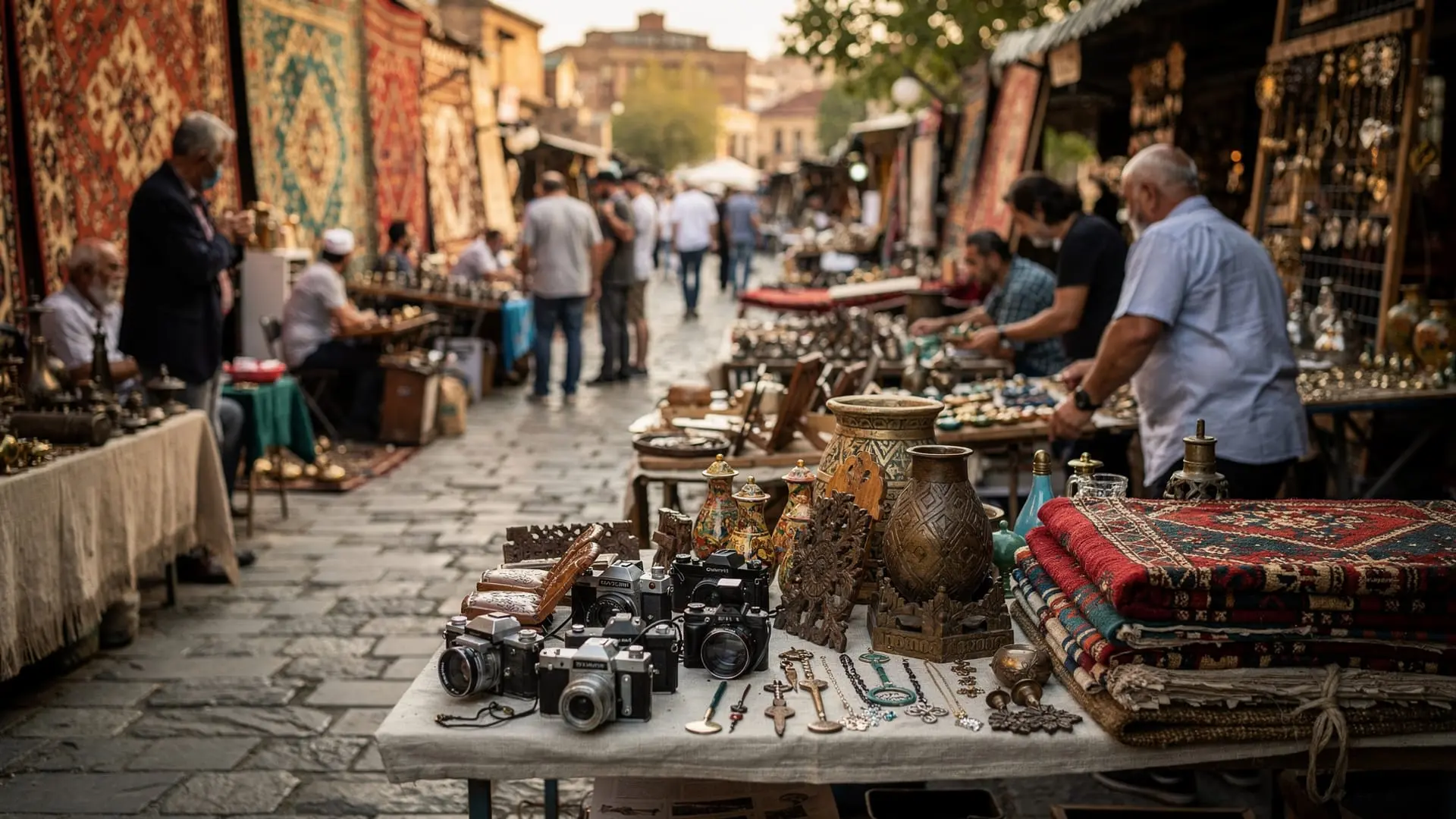
An honest account of five purchases at Yerevan’s Vernissage flea market — what’s genuine, what’s overstated, and the one category (cognac) worth avoiding entirely at the market itself.
| Where | Between Hanrapetutyan St and the National Gallery, Yerevan |
| Open | Saturday–Sunday year-round, some weekday presence |
| Best time | Before 11am, especially on Saturdays |
| Budget | 2 hours; small AMD denominations for negotiating |
| Avoid buying here | Cognac/brandy — fakes are common |
The market, first
Vernissage occupies a stretch of open ground between Hanrapetutyan Street and the National Gallery, and it operates in two distinct registers depending on the day. On weekdays, it’s quieter — fewer stalls, the hard-core dealers, people who’ve been coming here for thirty years with the same inventory and no particular interest in being charming about it. On weekends, it expands: more vendors, more tourists, more fake Ararat cognac, more teenagers selling handmade jewellery alongside the Soviet-era collectibles.
I went on a Saturday in September, which was the worst choice for crowd avoidance and the best choice for sheer volume of things to look at. The market has no map, no directory, no enforced arrangement. There are sections that specialise — metalwork here, textiles there, paintings along the back wall — but the categories blur and the best finds often appear unexpectedly, a single interesting object in the middle of a table of junk.
The walking approach I’ve developed: go twice around. First pass without buying, just mapping the territory and calibrating what you’re seeing. Second pass with intent. Vendors notice people who return, and that second approach sometimes opens a different conversation.
Before we get to the five objects: the most important Vernissage advice is to be skeptical about authenticity claims involving Soviet collectibles. “Original Soviet” is a phrase spoken with great confidence by vendors who are not always lying but are often overstating. The best policy is to buy things you like at the price you’d pay for them if they were definitely reproductions, then be pleasantly surprised if they’re not.
1. A Soviet-era enamel pin
I didn’t go to Vernissage looking for Soviet ephemera — that’s the category I find most susceptible to tourist inflation — but halfway through my first circuit I came across a vendor who had arranged roughly three hundred small enamel pins across a folding table in an approximation of order. Sport pins, factory pins, city anniversary pins, military pins, Young Pioneer pins, Olympic Games pins from 1980. They were priced between 500 and 2,000 AMD each.
I spent twenty minutes at this table. The vendor, a man in his sixties named Armen, told me in tolerable English that he’d been collecting these since the 1990s, when Soviet material was showing up at every market in the former USSR and no one quite knew what it was worth. He was particular about what he sold as genuine: he pointed to a pile of pins on a separate cloth and said “these are new,” with a gesture that made clear he found them distasteful.
I bought a 1974 Armenian SSR pin — a stylised representation of Mount Ararat in blue enamel on a cream background — for 1,500 AMD. Whether it’s original or a 1990s reproduction, I genuinely don’t know. I like it, and 1,500 AMD is about 3.50 EUR.
2. A hand-knotted Armenian rug runner
This is the purchase I am most careful about when describing, because the rug situation at Vernissage is complicated. The market has many textile sellers, and the rugs on display range from authentic hand-knotted pieces that took months to make, to factory-woven items that are perfectly serviceable but not what they’re presented as, to outright synthetic machine products with an Armenian motif ironed on.
I am not a rug expert. I went to Vernissage with a specific purpose: a small runner for a hallway, something with Armenian geometric patterns, hand-knotted if possible, not expensive. I spent about forty-five minutes looking at what was available and talking to three different vendors.
The one I bought was from a woman named Mariam who had four or five small runners spread on a plastic-covered table. She told me she made them herself, in her workshop in Vanadzor, using a traditional Kazakh-Armenian geometric pattern. The knot density felt consistent with hand work rather than machine work; the back showed individual knots rather than looped backing. She was asking 45,000 AMD. We settled at 35,000 AMD (about 85 EUR).
For serious rug purchases — real Armenian carpets with provenance — the Vernissage is not the right place. Megerian Carpet Factory and Yerevan Carpet both have showrooms in the city with authenticated traditional pieces at transparent prices. The Vernissage is for medium-confidence purchases in the range of 20,000-60,000 AMD where the story matters as much as the certificate.
3. An antique brass coffee pot
In the metalwork section, toward the back of the market, there are several vendors who specialise in old brass and copper objects. The inventory is eclectic: samovars, coffee service sets, engraved trays, old candleholders, decorative bowls with Armenian script, and a variety of objects whose original function is not immediately obvious.
I was looking at a stack of small serving trays when I noticed, half-buried under a heap of Soviet cutlery, a brass coffee pot of the long-handled Armenian variety — the kind used to make soorj (Armenian coffee) in sand or directly over heat. It was dented, darkened, and obviously old. The patina on the handle was the kind that takes decades to develop.
The vendor, an elderly man who spoke no English, named a price of 8,000 AMD when I picked it up. I thought this was already reasonable. I said “gner e?” — one of five Armenian phrases I had acquired — and he laughed and said 7,000 AMD. I paid 7,500 AMD as a split of the difference, which seemed to make him happy.
The pot needed cleaning, which took about an hour with brass polish. It now works perfectly and makes excellent coffee. It is the most useful thing I bought in Armenia.
4. A bottle of Areni Noir wine
This one requires a brief caveat about the cognac question, because it’s adjacent. Vernissage is famous — in the negative sense — for fake Ararat cognac. The brandy sold in unmarked bottles or reused branded bottles at the market is frequently adulterated or simply not what the label says. The CLAUDE.md note on tourist traps says it directly: buy Ararat brandy at the Yerevan Brandy Company or in supermarkets, not at Vernissage.
Wine is somewhat different. The domestic wine producers sell at the market, and a bottle of wine with a recognisable winery label and intact seal is what it says it is. I bought a bottle of Hin Areni Areni Noir — a single-vineyard wine from the Vayots Dzor region, one of the more respected names in Armenian natural wine — from a vendor who had a small selection of bottles and could discuss the vineyards.
The price was 4,500 AMD, which is reasonable for a bottle of this quality. The wine itself: dark red, tannic, with the specific dried-fruit character that Areni Noir develops in the high-altitude vineyards above Areni village. I drank it that evening in my hotel room with a plate of cheese bought from the GUM market, which was a satisfactory end to a day of market walking.
5. A hand-forged knife
The knife was not planned. I rounded a corner in the metalwork section and found a vendor who had a wooden board covered in knives — not the tourist-shop decorative knives with ornate handles, but plain working knives of the kind a shepherd or a cook would actually use. The blades were different lengths and finishes. The handles were wood, bone, or antler.
I picked up a medium-sized kitchen knife with a horn handle and tested the edge — a thing the vendor allowed me to do without comment, which suggested confidence in his product. The steel was properly hardened; the edge was sharp. He said, in Russian-inflected Armenian-English, “my son makes them.” The workshop, he indicated, was in the market somewhere. He was not wrong about the quality.
I paid 9,000 AMD. The knife has been in my kitchen for several years and holds an edge better than things I have bought in German department stores at ten times the price.
| Item | Price paid | Authenticity risk |
|---|---|---|
| Soviet enamel pin | 1,500 AMD | Moderate — reproductions common |
| Rug runner | 35,000 AMD | Moderate — ask about origin, check the back |
| Brass coffee pot | 7,500 AMD | Low — genuine wear is hard to fake |
| Areni Noir wine | 4,500 AMD | Low, if the seal and label are intact |
| Hand-forged knife | 9,000 AMD | Low — test the edge before buying |
For a broader shopping context beyond these five finds, the Vernissage flea market guide covers the layout and vendor sections in more detail.
On the cognac question
I said in the introduction that I was going to be honest about fakes, and the cognac situation at Vernissage is the most important specific warning I can give. The Armenian brandy tradition — made from the same Areni grape varieties, aged in oak in the same climate that produces the French Cognac’s flavour profile — is one of the genuinely great things Armenia has to offer. The Yerevan Brandy Company, founded in 1887, produces Ararat cognac of genuine quality at various age levels.
What you will find at Vernissage is people selling what is presented as Ararat cognac in unmarked bottles, or in reused branded bottles with new labels, at prices that are lower than the official retail price. Some of this is genuine product bought in bulk and decanted (sometimes plausible). More of it is adulterated spirit with colouring and flavouring, or outright falsified product. The vendor’s confidence is no guide to authenticity.
The solution is simple: buy Armenian brandy at the Yerevan Brandy Company (Tigran Mets Ave 2, Yerevan — the building is beautiful and the factory tour is worth doing), at Ararat-branded shops, or at the SAS or Yerevan City supermarkets. The price difference from Vernissage is modest, the authenticity is guaranteed, and you can drink it without wondering. The Yerevan Brandy Company tour guide and the Armenian brandy and cognac guide both cover this in full — read one before you buy anything brandy-shaped at a market stall.
The same principle applies, with less force, to Armenian wine. Wines with intact labels, sealed caps, and recognisable producer names are what they say they are. Wine in unlabelled bottles “from my brother’s vineyard” is a gamble, though sometimes a successful one.
The bigger picture
Vernissage is worth visiting even if you buy nothing. The density of stuff — a century’s worth of Armenian, Soviet, and pre-Soviet material culture arranged on folding tables under plastic tarpaulins — is interesting in itself. The paintings along the back wall range from competent traditional landscapes to genuinely accomplished work. The people-watching is excellent on a Saturday morning.
The practical limit: arrive before 11 a.m. if possible. By noon in September, the pedestrian density reaches the point where serious browsing becomes difficult. Budget two hours, bring Armenian dram in small denominations, and don’t carry a large backpack. Vendors are generally willing to negotiate, but the approach matters — curiosity and politeness work better than haggling theatre.
The market is open every Saturday and Sunday, year-round, with some weekday presence from permanent vendors. It’s a short walk from Republic Square and easily combined with the Cascade in the same morning, if you want to spend half a day in this part of the city. Afterward, the Yerevan cafe culture guide has recommendations for where to sit down with your finds and a coffee.