The rise of Yerevan's specialty coffee scene
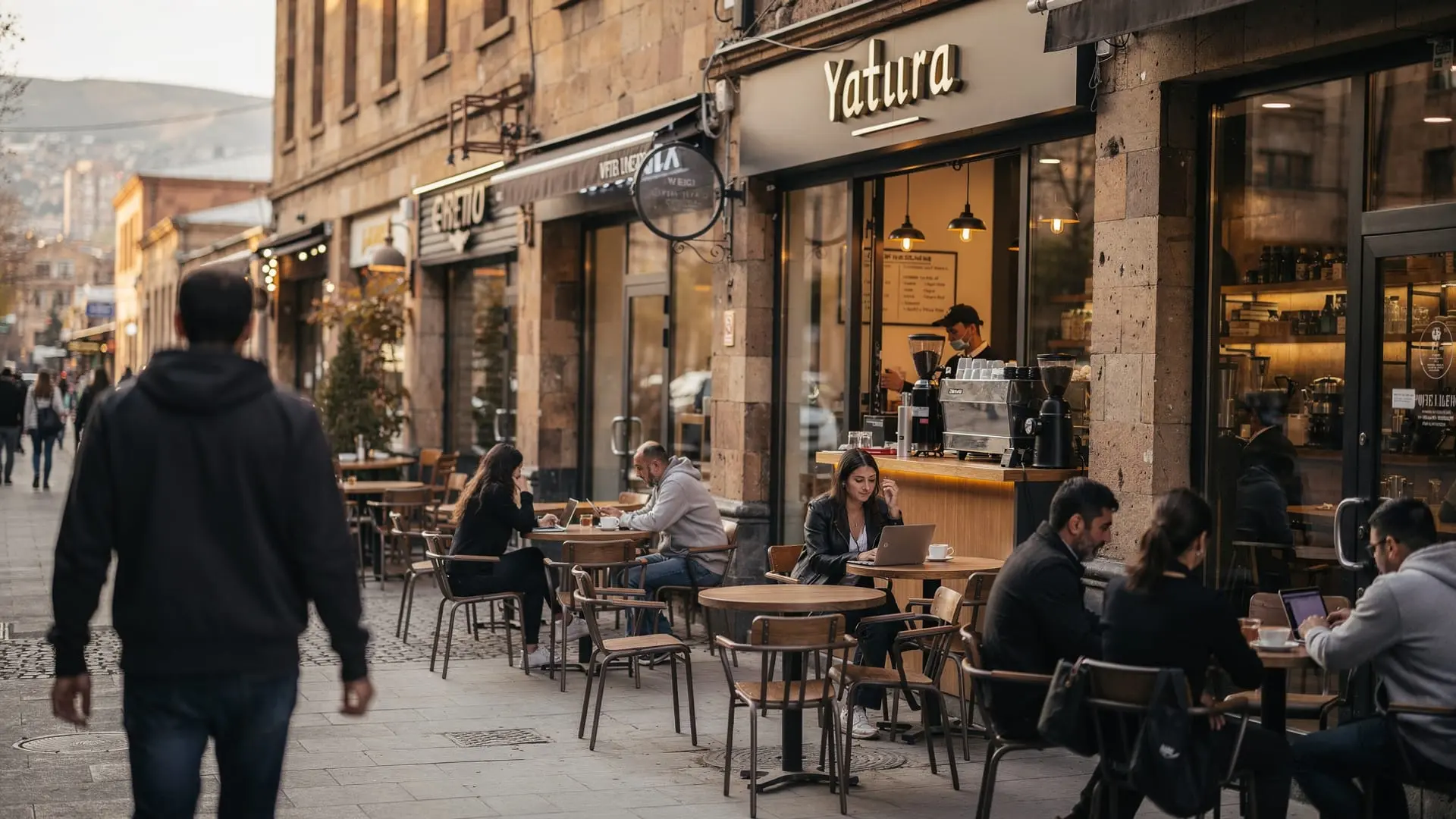
This is a personal account of a week spent visiting Yerevan’s specialty cafes in April 2024 — where the scene stands, which places are worth your time, and how it fits alongside the older soorj tradition. Prices and hours are approximate; cafes in Yerevan change fast.
| Where | Kentron district — Pushkin Street, Mashtots Avenue, Norq Marash |
| Typical price | around 800-1,200 AMD for a flat white or pour-over |
| Time needed | a morning for 2-3 cafes, a full day for a proper crawl |
| Best time | weekday mornings, before the mid-morning laptop crowd |
| Getting there | walkable from central Yerevan; GG Taxi for Norq Marash |
Something shifted
It’s a small thing to notice but it tells you something: in 2019 when I first came to Yerevan, ordering a filter coffee in most cafes produced a moment of mild confusion. By April 2024, the same order at half a dozen places I visited produced immediate, confident responses from baristas who could also tell me the origin of the beans, the roast profile, and how they had dialled in the grind that morning.
Yerevan has always had coffee culture. The tradition of soorj — Armenian coffee, brewed in a cezve and drunk thick and sweet from small cups — is ancient and deeply social. What’s new is the parallel emergence of a specialty scene: third-wave cafes with quality roasters, trained baristas, single-origin pour-overs, and the kind of serious attention to brewing that until recently was mostly confined to Tbilisi or Beirut in the immediate region.
This didn’t happen in a single moment. It reflects the gradual arrival of a professional diaspora, the influence of Armenian baristas who trained in Europe or Russia, a growing middle class in Yerevan that has both the spending power and the reference points for quality coffee, and the influx of Russian emigrants since 2022 who have brought a well-developed urban cafe culture with them.
Lumen Coffee Roasters
Lumen is probably the first name that comes up in any conversation about Yerevan specialty coffee, and having spent two mornings there in April, I understand why. The space on Pushkin Street is clean and carefully considered without being fussy: wooden benches, good natural light from tall windows, the roasting equipment visible through a glass partition in the back.
The coffee itself is what you’re here for. Lumen roasts their own beans, sources directly from producers in Ethiopia, Colombia, and Georgia (the country), and rotates single-origin offerings seasonally. The pour-over I had on my second visit — an Ethiopian natural processed Yirgacheffe — was genuinely excellent: the kind of coffee that makes you understand why some people take this seriously. The espresso is balanced and not over-roasted, which is more of an achievement than it sounds.
Lumen is also a good place to buy beans to take home. The retail section near the counter stocks a rotating selection of their roasts at reasonable prices.
Calumet
Calumet operates in a different register from Lumen — it’s a full cafe-restaurant in Norq Marash, with a broader menu including food, and it serves specialty coffee as part of a wider offer rather than as the sole focus. I went for a long lunch in mid-April and came away impressed by both the food (the mushroom toast was remarkable) and the cortado, which was precisely made.
The space is more elaborate than Lumen: good design, plants, a terrace that will be excellent once the weather settles into proper spring. It draws a mix of creative-class Yerevantsees and expats, and has the feeling of a place that’s been carefully put together by people who’ve spent time in cafes they admired elsewhere and made deliberate choices about what to bring back.
Achajour
Achajour is mentioned in the same breath as the others and deserves its reputation, though it’s a slightly different animal. The original Achajour began as a tea-focused cafe — the name comes from the Armenian word for mineral water, which gives you a sense of the wellness-adjacent positioning — but the coffee program has become a serious part of the offer.
What I noticed at Achajour was the quality of the oat milk options (significant, given that Yerevan’s dairy alternatives were limited until recently) and the careful sourcing of their tea and herbal infusions alongside the coffee. If you have a companion who doesn’t drink coffee, this is where to take them without anyone feeling like they’ve compromised.
Yerevan city tour with a local guide — great for discovering new neighbourhoodsBekon
Bekon came up repeatedly when I asked locals where they actually go rather than where they take visitors. It’s not on the main tourist circuit — it’s in a quiet street off Mashtots Avenue — and it feels deliberately unflashy: exposed concrete, minimal decor, very good coffee at prices that are honest rather than inflated.
The barista I talked to at Bekon had trained in Tbilisi and spoke about dialling in espresso with the kind of mild obsessiveness that characterises serious practitioners. The flat white I had was probably the best espresso-based drink of my April visit: the milk texture was genuinely good, not just warm froth, and the espresso underneath it was bright and clean.
If you want to experience the local coffee scene without tourist pricing, Bekon is the place.
The Coffeeshop Company question
Coffeeshop Company, the Austrian-originated chain that has operated in Yerevan for over a decade, gets mentioned in coffee conversations here in a way that reveals the generational shift. For older visitors and many locals, it remains a reliable option — the brand recognition, the wi-fi, the consistent if not extraordinary product. For anyone who’s been following the specialty scene, it’s a baseline rather than a destination.
It’s worth acknowledging that Coffeeshop Company played a role in normalising the idea that Yerevan cafes could have reliable espresso machines, trained staff, and a menu beyond Soviet-era black coffee. The scene that’s now overtaking it built on those foundations even as it moved past them.
What’s driving the growth
Several things converged to make this moment possible. The 2022 influx of Russians and Russian-speaking professionals created a surge in cafe-going that has been economically significant for the sector. Returning diaspora Armenians — from France, Lebanon, the US — brought coffee habits from cities where the third wave had already peaked. Instagram has done its work: pretty cafes with good coffee are a visible, shareable part of the Yerevan travel narrative.
But underneath the demographics, there’s also something more fundamental: the city has the talent now. A generation of Armenian baristas who trained properly, who care about the craft, who source well and brew carefully. That’s the change that lasts after the demographic trends shift.
Other spots worth knowing
Beyond the main five names, Yerevan’s specialty coffee landscape extends to a dozen or more smaller operations, some of which are doing interesting work at a slightly lower volume.
Mayaki, on a quiet side street near the Matenadaran, does good filter coffee and has the kind of unhurried atmosphere that the busier spots can’t always maintain. It’s the place I go when I want to work for two hours and not feel like I’m in someone’s way.
Coffee Crew near the Opera has been operating for several years now and maintains quality consistency that is harder to achieve than it sounds — the espresso on a Monday morning and the espresso on a Saturday afternoon taste the same. For visitors with limited time who want a reliable single stop, it’s a dependable choice.
The Collectors Club, which describes itself primarily as a vintage goods shop, has been running a small coffee programme from its back room that has attracted a loyal following among people who found it while looking for old Soviet cameras. The coffee is unexpectedly good. The timing, as always in these things, depends on the person behind the machine.
These smaller places are less likely to appear on Yerevan coffee roundups in travel media, which is partly why they’re worth knowing about. The formal specialty scene and the informal neighbourhood cafe sector overlap in interesting ways in Yerevan, and some of the most memorable coffee experiences I’ve had in the city have been in places that would never describe themselves as specialty.
The soorj tradition and the new scene
A word about the relationship between Armenian coffee — the traditional soorj, brewed in a small copper cezve over heat, thick and strong and drunk from cups that are never quite clean of the residue at the bottom — and the new specialty scene. Some travel writers treat these as competing traditions, as if the rise of Lumen or Calumet means the decline of the brass-cezve culture. This is wrong.
Soorj is a social institution, not a morning ritual. It is drunk after meals, between friends, as part of a visit that has its own time and shape. The grounds at the bottom of the cup are read by women who have learned to read them, which is a practice that is simultaneously a light entertainment and a genuine transmission of domestic knowledge. The cup is turned upside down, left to dry, and then the patterns of the dried grounds are interpreted. I have had my fortune read in a soorj cup in a Yerevan apartment and it was one of the more interesting conversations I’ve had about the future.
This tradition is not threatened by pour-over coffee. The specialty cafes serve a different moment of the day and a different kind of occasion. What the new scene has done is expand the coffee landscape rather than replace any part of it.
The Russian effect, acknowledged
It would be dishonest to write about Yerevan’s specialty coffee scene in 2024 without acknowledging the role of the Russian emigrant community. The influx of Russian professionals and creatives since 2022 — people who brought urban cafe habits developed in Moscow and St. Petersburg, where third-wave coffee arrived and developed a serious audience — has been a significant accelerant for the specialty scene.
Several of the better coffee shops in Yerevan are run by or staffed by Russian or Russian-Armenian emigrants. This is a complicated socio-political fact that Armenians have varying feelings about, and it’s not my place to arbitrate those feelings. What I can say is that the coffee is good, and that the cross-cultural transmission that has produced it is part of a larger and still-developing story about what Yerevan is becoming as a city.
Practical notes for coffee visitors
The best specialty cafes in Yerevan are mostly in or near the city centre — within walking distance of the Cascade complex and in the Mashtots Avenue and Pushkin Street corridors. A walking coffee crawl hitting Lumen, Calumet, and Bekon is entirely feasible in a morning and makes for an excellent introduction to a neighbourhood that rewards walking anyway.
Morning hours are generally better than afternoons for finding fully staffed, freshly dialled-in machines. Most of these places open at 9:00 or 9:30 a.m. Lumen in particular tends to be busiest mid-morning on weekdays, which is when the creative freelancer crowd arrives with laptops.
Prices at Yerevan specialty cafes are modest by Western European standards: a flat white or pour-over typically runs 800-1,200 AMD (roughly 2-3 EUR). The pricing reflects the general economy rather than any attempt to be accessible — it simply is accessible. This is one of several reasons that Yerevan is underrated as a city to spend time in.
The Yerevan café culture guide covers the traditional soorj tradition alongside the specialty scene in more detail. The Armenian coffee guide explains the cultural context of the traditional brew and where to experience it properly. Both are worth reading as counterpoints to the third-wave story — the old culture and the new are not in competition so much as parallel expressions of a city that has always, in various ways, known how to make coffee matter.
Buying beans and gear to take home
Several of these cafes double as a place to stock up before flying out. Lumen’s retail shelf is the most serious of the bunch — rotating single-origin bags roasted on site, priced fairly and clearly labelled with origin and roast date. Calumet sells a smaller selection alongside its food menu, useful if you’re already there for lunch. None of them will hard-sell you; ask and they’ll talk through what’s fresh that week. If you’re packing beans in checked luggage, ask for a valve bag rather than a plain pouch — it keeps the roast fresher over a long flight home.
Planning your own crawl
A single morning is enough to hit three or four places if you plan the geography sensibly. Start at Bekon off Mashtots Avenue for an honestly priced flat white away from the tourist flow, walk north toward Pushkin Street for Lumen’s pour-over, and finish near the Cascade where Achajour and a cluster of smaller cafes sit within a few minutes of each other. Norq Marash, where Calumet is based, sits slightly apart — worth a dedicated lunch trip rather than folding it into the same walk. If you want structure rather than winging it, a guided city tour that includes Kentron’s cafe streets is a reasonable way to see the neighbourhood context around the coffee.
Yerevan walking tour with a local guide — a good way to place the cafe scene inside the wider Kentron neighbourhoodMayaki, near the Matenadaran, is worth folding into a manuscript-museum morning rather than treating as a separate stop — the two are a five-minute walk apart and the pairing works naturally. The Collectors Club, meanwhile, sits close enough to the Vernissage flea market that a Saturday morning combining vintage-hunting and unexpectedly good coffee is one of the more rewarding low-key mornings you can spend in the city.