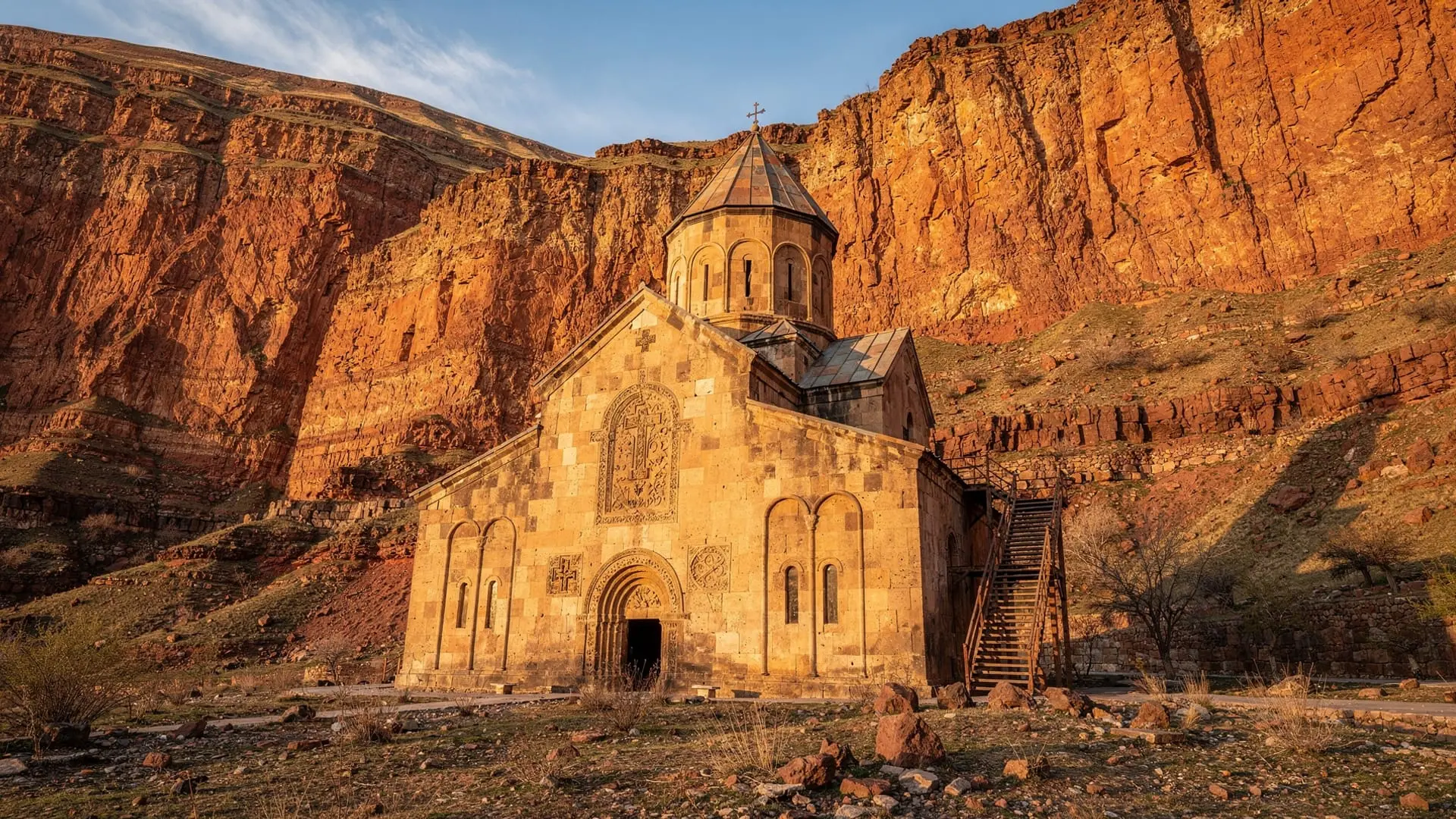
Red stone walls and a staircase like no other
The approach to Noravank is theatrical: the road leaves the main Vayots Dzor highway and plunges into a narrow canyon of blood-red and ochre limestone cliffs, closing in on either side until the monastery appears at the far end — pale stone against blazing red rock, with the canyon walls towering 200 metres above.
The monastery complex (13th–14th century) centres on the Church of Surb Astvatsatsin (1339), which has one of the most memorable architectural features in Armenia: a double-arched external staircase leading to an upper chapel whose door is barely a metre wide. The steps are steep and narrow and require climbing on all fours near the top — a deliberately challenging approach designed to enforce humility at the threshold of the sacred. It is one of the most photographed architectural details in the country.
Noravank is most efficiently visited in combination with Areni (20 km north) on a southern Armenia day trip from Yerevan.
| Season | Months | What to expect |
|---|---|---|
| Spring | Apr–May | Wildflowers soften the canyon edges, clear air, lighter crowds |
| Summer | Jun–Aug | Canyon traps heat, 35–38°C at midday; visit before 10:00 or after 16:30 |
| Autumn | Sep–Oct | The finest season — amber and gold afternoon light, comfortable temperatures |
| Winter | Nov–Mar | Quiet, atmospheric, occasional snow on the canyon rim; accessible year-round |
Getting to Noravank from Yerevan
By car: 130 km south from Yerevan, passing Areni and then turning onto the side road into Noravank canyon (well-signposted). Drive time: about 2 hours. The canyon road is 9 km long from the main highway; it is paved but narrow.
By taxi from Yerevan: 2 hours each way. A return trip costs 20,000–30,000 AMD if doing Noravank only; 30,000–45,000 AMD for a Khor Virap + Areni + Noravank circuit.
By marshrutka: No direct marshrutka service. Take a marshrutka to Yeghegnadzor from Kilikia Station, then a taxi (5,000–8,000 AMD return) the 25 km to Noravank.
By guided tour: almost always combined with Khor Virap and Areni in a full-day or half-day tour from Yerevan.
What to see at Noravank
Church of Surb Astvatsatsin (1339)
The main church is a two-storey structure: a lower-level mausoleum containing the tomb of the Orbel princes, and an upper chapel reached by the famous external staircase. The carved portal reliefs on the lower entrance door — Christ enthroned, flanked by angels with archangel Michael holding a shield — are among the finest examples of medieval Armenian stone carving. The quality of detail in the surrounding vine scroll and animal reliefs makes this church a reference point for Armenian ecclesiastical art.
The staircase: the double arched structure rises about 6 metres, each flight ascending in opposite directions. The final approach to the upper door is the genuinely steep section — fit visitors manage it easily; those with a fear of heights or poor balance may prefer to admire from below.
Church of Surb Grigor (1275)
The slightly older church in the complex, a standard-plan Armenian church with carved exterior panels. Note the relief of God the Father with Adam and Eve on the western facade — unusually for Armenian religious art, these are representational human figures rather than abstract symbols.
The canyon walls
Noravank canyon is one of the most geologically dramatic settings for any monument in the Caucasus. The limestone walls are a deep red-orange, streaked with mineral deposits in yellow and white. In afternoon light (14:00–17:00), the canyon glows. In September–October, the combination of red stone, golden light, and the monastery’s pale tuff walls makes this one of the most photographed spots in Armenia.
Tours and tickets
Admission: free. Noravank monastery charges no entrance fee.
For a tour that also includes the Areni wine cave: private day trip to Khor Virap, Areni-1 cave, and Noravank .
If you want to extend south to Tatev: Khor Virap, Areni, Noravank, and Tatev — a long (12–14 hour) but comprehensive circuit.
See the detailed guide at /guides/noravank-monastery-red-cliffs/.
Best time to visit Noravank
September–October: the finest season. Afternoon light in the red canyon at this time of year is exceptional — the walls glow amber and gold. Temperatures are comfortable (18–25°C).
April–May: excellent. The spring wildflowers soften the canyon edges, the air is clear, and crowds are lighter.
July–August: the canyon traps heat and temperatures reach 35–38°C at midday. Visit early morning (before 10:00) or late afternoon (after 16:30). The light quality in summer afternoon is also very strong.
November–March: quiet and atmospheric. The red cliffs contrast beautifully with any snow on the canyon rim. Accessible year-round. Very few tourists.
Practical tips
- Climbing the upper staircase: wear shoes with grip. The final steps are genuinely steep. Children above age 8 and reasonably fit adults manage fine.
- Photography: afternoon light (14:00–17:00) on the canyon walls is best. For the monastery itself, slightly diffused morning light works well.
- Opening hours: no formal hours. The complex is accessible during daylight. A custodian may be present on busier days.
- Combine with: Areni (20 km north) always. Khor Virap (85 km north) for a full southern day. See /guides/khor-virap-noravank-day-trip/.
Frequently asked questions about Noravank
Why is the staircase at Noravank so steep?
The steep external stair leading to the upper chapel of Surb Astvatsatsin was a deliberate architectural choice: the physical effort of climbing — particularly the final squeeze through a barely-human-sized doorway — was intended to create a threshold experience, a reminder that entering the sacred space demanded effort and humility. It is a highly unusual design in Armenian ecclesiastical architecture.
Can I visit Noravank independently without a guide?
Yes. The monastery is accessible without a guide. Explanatory panels are in Armenian and Russian. For deeper architectural and historical context, an English-speaking guide adds significant value. See our guide: /guides/noravank-monastery-red-cliffs/.
Is Noravank and Areni a full day from Yerevan?
Not quite — the two sites together take about 4–5 hours on the ground, plus 4 hours of driving round-trip from Yerevan. Most visitors add Khor Virap to complete a full day circuit. See /guides/khor-virap-noravank-day-trip/.
What a Noravank visit actually costs
Entry to the monastery itself is free, but budget for transport, which is the real cost of a Noravank trip. A round-trip taxi from Yerevan doing Noravank only runs 20,000–30,000 AMD; adding Khor Virap and Areni to the same trip pushes that to 30,000–45,000 AMD, which is usually better value per site given the shared driving distance. Guided small-group day tours from Yerevan covering Khor Virap, Areni, and Noravank together typically run in a similar range per person with transport and a guide included, and are worth it if you want the Momik carving history explained rather than self-navigated from a guidebook. The café and picnic area at the monastery parking lot sells drinks and light snacks at modest prices; a full lunch is better found in Areni or Yeghegnadzor on the way.
The architecture of Noravank: what to look for
Noravank was built primarily under the patronage of the Orbel (Orbelian) dynasty — the noble family who ruled Syunik and Vayots Dzor from the 12th to 14th centuries. The monastery’s stone carver, sculptor, and architect was Momik (died c. 1333), one of the most celebrated figures in medieval Armenian art. Momik’s carved reliefs at Noravank are the finest examples of his mature style.
Momik’s carved portals
The western portal of Surb Astvatsatsin is the masterwork. Above the door lintel, a relief depicts God the Father (an extraordinary choice — God the Father is rarely depicted in figural form in medieval Christian art) holding Christ’s head. The composition has a spatial complexity unusual for relief carving of this period: figures overlap, garments fall in convincing folds, and the surrounding vine scrolls and animal reliefs are executed with extraordinary precision.
On the tympanum above: Christ enthroned in a mandorla (almond-shaped aureole), flanked by angels. The formal composition is Byzantine but the carving style — the simplified but expressive faces, the dynamic vine tendrils — is distinctively Armenian of the 13th century.
The Proshyan lion
The courtyard walls bear several carved lion reliefs — the heraldic symbol of the Orbel (and later Proshyan) princes who patronised the monastery. The lions are shown frontally, with stylised manes and alert expressions that combine power and dignity. Compare these to the more schematic lion carvings at Geghard for a sense of how Armenian sculptural style varied by region and workshop.
The lower mausoleum chamber
The ground floor of Surb Astvatsatsin is a mausoleum — the burial chamber of the Orbelian princes. The carved khachkar panels on the interior walls are some of the finest at Noravank. The low-ceilinged space has an intimate, memorial quality very different from the open-air drama of the staircase and upper chapel above.
The canyon geology
The red colour of Noravank canyon comes from oxidised iron compounds in the limestone — the same mineral process that turns sandstone red. The canyon walls are primarily Cretaceous limestone from approximately 100 million years ago. Tectonic activity over millions of years pushed these layers to vertical and near-vertical orientations, which is why the canyon is so narrow and the walls so sheer.
In late afternoon, when the low sun strikes the western canyon wall from the south, the colour intensifies from orange-red to deep crimson. Photographers arriving for the 16:00–18:00 window in September and October find the best light of the year here.
The canyon road from the main highway follows the Amaghu River, which carved this slot through the limestone over millions of years. The river is small today but the canyon it created is disproportionately large — a testament to the abrasive power of water over geological time.
Combine Noravank with nearby sites
Areni (20 km north): the wine village and Areni-1 cave — essential combination. See /destinations/areni/.
Khor Virap (85 km north): the monastery at the foot of Ararat — makes a full southern day circuit. See /destinations/khor-virap/.
Jermuk (60 km southeast): the spa town and mineral water galleries — logical extension for a two-day Vayots Dzor circuit. See /destinations/jermuk/.
Yeghegnadzor (25 km north of Areni): the provincial capital is a useful lunch and service stop; it also has the Selim Caravanserai nearby (14th century, on the Silk Road).
For a two-day Vayots Dzor circuit including all of these: Armenia wine route 5-day itinerary provides the framework.
Practical notes on Noravank canyon
The road into the canyon
The 9 km road from the main M2 highway to the monastery runs along the Amaghu river valley, closing in between canyon walls that grow steadily taller and redder as you approach. The road is paved but narrow — passing oncoming vehicles on some bends requires care. In peak season (July–August), the road is one-way at peak hours (approximately 11:00–15:00) due to traffic volume: uphill in the morning, downhill in the afternoon. Check current restrictions locally.
A café and picnic area operate at the monastery parking lot in season. The parking lot can fill completely on summer weekends by 11:00 — arrive early.
Seasonal changes at Noravank
Spring (April–May): wildflowers grow from crevices in the red limestone, including small irises and Caucasian rock-jasmine. The canyon air is cool and the light soft. This is an underrated time to visit.
Summer (June–August): hot in the canyon, with midday temperatures sometimes exceeding 35°C in the enclosed space. The red walls are at their most saturated under high summer sun but the heat is uncomfortable without shade. Restaurants near the monastery serve cold water and local wine.
Autumn (September–October): finest overall. The afternoon light in September–October transforms the canyon walls from orange to deep crimson. Comfortable temperatures. Best photography of the year.
Winter (November–March): almost no tourists. The canyon can receive light snow on the rim; the floor rarely freezes. The red walls under grey winter sky have their own austere beauty. The monastery is accessible year-round.
Visiting with children
The upper staircase at Surb Astvatsatsin is steep. Children above about 8 years old who are comfortable on stairs manage fine. Younger children should stay with an adult. The canyon road walk between parking lot and monastery (about 5 minutes) is easy for all ages.
The canyon walls and the geological formations are immediately comprehensible to children — the red colour, the scale, the mystery of how a church ended up in such a place — making Noravank one of the more accessible historical sites in Armenia for families. See /guides/kid-friendly-monasteries-armenia/ for more family-friendly monastery advice.