Armenia's train network: routes & schedules
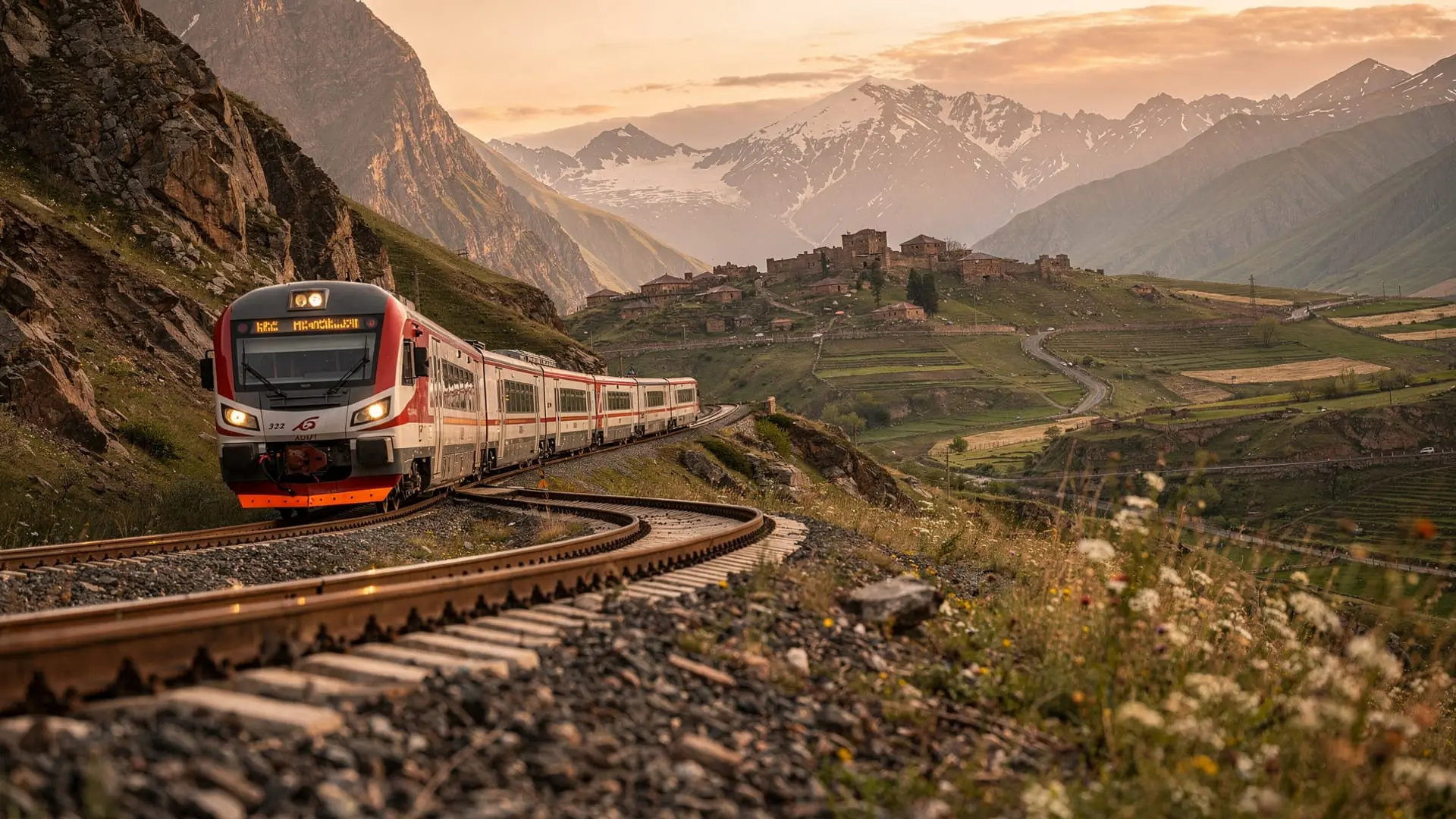
Armenia by rail: limited but underrated
Armenia’s railway network is not the Swiss Federal Railways. The country has roughly 700 km of operational track — a fraction of what existed in the Soviet era — and services are sparse. But for the routes that do operate, trains offer something that marshrutkas cannot: a seat you booked in advance, a predictable departure time, and in the case of the Yerevan–Tbilisi night train, the civilised option of sleeping your way between two capitals.
If you are planning to visit Gyumri, go by train. If you are crossing to Tbilisi by land, consider the night train before booking a shared marshrutka. These are the two strongest cases for Armenian rail travel.
| Useful routes | Yerevan–Gyumri (3h), Yerevan–Tbilisi night train (10h) |
| Operator | South Caucasus Railway (SCR) |
| Cost | around 2,000 AMD (Gyumri) to 18,000 AMD (Tbilisi kupe) |
| Booking | Station same-day (Gyumri); 1–2 weeks ahead in summer (Tbilisi) |
| Not covered | Dilijan, Tatev, Goris, Jermuk — marshrutka only |
The railway operator
Armenian trains are operated by South Caucasus Railway (SCR, subsidiary of Russian Railways / RZhD). The headquarters and main ticketing office are at Yerevan’s central station on Admiral Isakov Avenue.
Booking tickets:
- In person at Yerevan Central Station (Admiral Isakov Avenue), open daily.
- Online via the SCR website (southcaucasus-railway.am) — interface available in Russian and Armenian; English is limited but manageable with a browser translator.
- For the Tbilisi night train, book well in advance in summer (July–August seats sell out).
Tickets are issued in AMD for domestic routes and in both AMD and USD/EUR for the international Tbilisi train. Have your passport for ticket purchase.
Route 1: Yerevan to Gyumri (the recommended route)
Distance: 120 km
Journey time: approximately 3 hours
Frequency: 2–3 trains daily
Approximate fare: 1,500–2,500 AMD (second class)
Departure point: Yerevan Central Station
This is the most useful domestic train route in Armenia and is genuinely recommended over the marshrutka for visiting Gyumri. The train is slower than a car (2 hours by road), but it is comfortable, arrives at a central station in Gyumri close to the historic quarter, and does not require you to navigate marshrutka terminals at both ends.
Gyumri, Armenia’s second city and cultural capital, deserves a full day visit. The Gyumri day trip guide covers what to see and how to structure the day around train times.
Why prefer the train to the marshrutka on this route?
- Gyumri’s marshrutka station is outside the centre; the train station is walkable to the main sights.
- Departure is on a fixed schedule — you know exactly when you will leave.
- Carriages are more spacious than a minibus for a 3-hour journey.
- The scenery through the Ararat Valley and then up through the Shirak plateau is genuinely attractive.
Route 2: Yerevan to Tbilisi — the night train
Distance: approximately 500 km (rail route via Gyumri and north)
Journey time: approximately 10 hours
Frequency: alternate days (check current schedule — runs 3–4 times per week in summer, less in winter)
Departure: Yerevan approximately 21:30
Arrival Tbilisi: approximately 07:30
Approximate fare: 10,000–20,000 AMD depending on class (economy seat or sleeping berth)
Departure point: Yerevan Central Station
The Yerevan–Tbilisi night train is one of the great small adventures of Caucasus travel. You board in Yerevan in the evening, wake up as the train rolls into Tbilisi in the morning, and skip both the 6-hour road journey and a night’s accommodation. In sleeping berths (kupe class), the compartments hold four berths and are clean if not plush.
Practical notes:
- Bring food and water — the dining car is rudimentary at best.
- The border crossing at Bagratashen/Sadakhlo happens in the early hours; border guards board the train and stamp passports while you are barely awake.
- Book well in advance in summer — this train is popular with travellers who have discovered the Caucasus.
- The route via Gyumri adds interest: you pass through the Shirak plateau at night, crossing into Georgia through the Debed Valley.
The Yerevan to Tbilisi overland guide compares the night train against marshrutka and private transfer in detail, including costs for 2026.
Route 3: Yerevan to Lake Sevan — summer commuter
Distance: 65 km
Journey time: approximately 1h 30min
Frequency: summer only (approximately June–September), weekends primarily
Approximate fare: 500–700 AMD
Departure point: Yerevan Central Station
A summer-only commuter service runs from Yerevan towards Lake Sevan, popular with local families heading to the lake for weekend swimming. It is slower and less frequent than the marshrutka (which takes about 1h 15min and departs more frequently from Kilikia), but it has its charm as a leisurely lake excursion.
For independent travellers, the Lake Sevan complete guide recommends the marshrutka for most visitors due to frequency and flexibility.
Yerevan Central Station
Yerevan’s main railway station sits on Admiral Isakov Avenue, about 3 km south of Republic Square. It is a grand Soviet-era building worth seeing in its own right — the marble halls and high ceilings are impressive, though the services have quietened significantly since the 1980s.
Getting to the station: GG Taxi from the centre costs 1,500–2,000 AMD. The Zoravar Andranik metro station is a 15-minute walk away. For early-morning or late-evening departures, pre-booking the taxi the night before removes any risk of a delayed pickup on a schedule you cannot afford to miss.
Routes that no longer operate
Several former routes are currently suspended or only partially operational:
- Yerevan to Yeraskh (Ararat region) — suspended.
- The Iranian border line — not operational for passengers.
- Yerevan to Sevan via Abovyan — frequency has been reduced to summer weekends only.
The once-active routes to Kapan in Syunik and to the Lake Sevan northern shore are not currently operational for passengers. This means that for destinations like Goris, Tatev, Jermuk, and Dilijan, marshrutkas or private transport remain the only options.
Complete schedules: Yerevan departures 2026
Schedules on Armenian railways change seasonally and should be verified at the station or via southcaucasus-railway.am before travel. The following represents the established pattern as of spring 2026:
Yerevan to Gyumri
| Departure | Arrival | Type | Days |
|---|---|---|---|
| 07:00 | 10:00 | Economy | Daily |
| 09:30 | 12:30 | Economy | Daily |
| 15:00 | 18:00 | Economy | Daily |
| 18:30 | 21:30 | Economy | Mon–Sat |
Four departures per day is the standard weekday pattern; Sunday sees three. The 07:00 is the best choice for a day trip to Gyumri — it arrives early enough to see the main sights before afternoon. The return last train from Gyumri is typically around 19:00–20:00 (check current times), giving a comfortable day.
Fares: economy class approximately 1,500–2,500 AMD. There is no business class on the Gyumri route. Seats are assigned; tickets can be purchased at the station on the day of travel (Gyumri route rarely sells out outside holidays).
Yerevan to Tbilisi night train
| Departure | Arrival | Frequency | Class |
|---|---|---|---|
| ~21:30 | ~07:30 (+1d) | 3–4 times/week (check current days) | Kupe (4-berth), Platzkart (54-berth) |
The exact days vary by season: in summer (June–September), the train runs 4 times per week, typically Sunday, Tuesday, Thursday, and Saturday. In winter it may be reduced to 3 times per week. Always check the current schedule before planning.
Fares as of 2026: Platzkart (open carriage) approximately 7,000–10,000 AMD; Kupe (closed 4-berth compartment) approximately 12,000–18,000 AMD. Prices are set in AMD but may be quoted in USD at the ticket window for international service. Booking online through southcaucasus-railway.am gives the same prices as in-person.
Seat classes in detail:
Platzkart is an open carriage with 54 berths in bays of 6 (two lower, two upper on each side of the aisle, plus two perpendicular berths at the aisle end of each bay). It is cheap, social, and popular with local travellers and budget tourists. Privacy is minimal — bring earplugs and accept the communal nature of the arrangement. Lower berths are easier to access but serve as seats during the day if others are using the same bay.
Kupe (second-class sleeping, also called “coupé” in the French system inherited by Soviet railways) is a closed compartment with four berths — two upper, two lower. The door closes; the space is small but private. This is the recommended choice for most independent travellers on the night train. Bedding (a thin mattress pad, pillow, and blanket in a sealed packet) is provided. The lower berths are slightly more expensive than upper but more comfortable for sleeping.
SV (spalny vagon, first class) exists on some services — typically a 2-berth compartment. Not always available on the Yerevan–Tbilisi service; check at booking.
Yerevan to Yeraskh
This southern commuter route to the Ararat region (approximately 40 km south of Yerevan) is currently suspended as of 2026. It had been operational as recently as 2023; check at the station for any resumed service.
Yerevan to Lake Sevan (summer commuter)
Departures typically at 08:30 and 10:00 on Saturdays and Sundays from June through early September. Return services in the afternoon. Fare: 500–700 AMD. Journey time approximately 90 minutes. The train terminates near the lake shore, within walking distance of the Sevanavank peninsula.
The Yerevan to Tbilisi night train: a detailed experience guide
Boarding begins 30 minutes before departure at Yerevan Central Station. The platform is signposted in Russian and Armenian; look for your carriage number (printed on your ticket) and match it to the numbers on the carriage doors. Conductors (провoдник/pravornik) at each carriage door check tickets and passports before you board.
Finding your berth: In kupe class, berths are numbered 1–4 in each compartment. The ticket specifies your berth number; lower berths (1 and 2 in each compartment) cost slightly more than uppers (3 and 4). The compartment fits four adults with luggage stored under the lower berths or in the overhead rack above the upper berths.
The border crossing: Approximately 3–4 hours into the journey, the train slows for the Armenian side of the border (Bagratashen). Armenian border guards board and check documents. The train then crosses into Georgia (Sadakhlo) where Georgian guards do the same. This process takes 1–2 hours total and happens while most passengers are asleep. Keep your passport accessible — not in the bottom of your bag.
What to bring: Food is essential. The dining car exists on paper but is inconsistently stocked and priced for tourist convenience. Vendors at Yerevan Central Station platform sell lavash-wrapped khorovats (grilled meat sandwiches), cheese bread, fruit, and drinks until about 21:00. Stock up before boarding. Water is available from the samovar (hot water boiler) at the end of the carriage, which conductors maintain — bring your own cup or buy one at the station.
Arriving in Tbilisi: The train arrives at Tbilisi Central Station (Station Square, central Tbilisi) around 07:30. There are taxis and the Metro directly from the station. Luggage storage is available at the station if you need to drop bags before hotel check-in (usually 14:00 or 15:00). Download offline Tbilisi maps before boarding.
Tour from Yerevan to Tbilisi: Sanahin, Haghpat, AkhtalaTrain vs marshrutka: a clear-eyed comparison
The marshrutka (shared minibus) is the backbone of Armenian intercity transport and serves routes the train cannot. Here is a direct comparison for the routes where both options exist:
Yerevan to Gyumri:
- Train: 3 hours, 1,500–2,500 AMD, assigned seat, departs on schedule from central station, arrives at central Gyumri station
- Marshrutka: 2–2.5 hours, 1,500–2,000 AMD, no seat assignment, departs when full from Kilikia bus station (requires taxi or Metro to reach), arrives at Gyumri marshrutka stand (outside centre)
- Verdict: Train recommended. The 30–60 minute time difference is not worth the marshrutka’s logistical disadvantages, and the central Gyumri arrival is a significant practical advantage.
Yerevan to Tbilisi:
- Train: 10 hours overnight, 7,000–18,000 AMD (depending on class), comfortable sleep, morning arrival
- Marshrutka: 6 hours daytime, 7,000–9,000 AMD, no reservation, shared van, can depart any time but usually morning, arrives at Ortachala bus station (outside Tbilisi centre)
- Verdict: Night train recommended for comfort and overall time efficiency (you travel while sleeping). Marshrutka is the only option on days when the train does not run.
For routes without trains (Dilijan, Tatev, Goris, Jermuk, anywhere in Syunik): marshrutka is the only public transport option. The train cannot substitute.
Getting to Yerevan Central Station
Yerevan Central Station is on Admiral Isakov Avenue, approximately 3 km south of Republic Square — a 15–20 minute walk, or a GG Taxi ride of about 1,500–2,000 AMD from the city centre.
By Metro: Zoravar Andranik station (red line) is the closest, approximately 15 minutes’ walk from the train station. The Metro is cheap (100 AMD per journey) and reliable; given the time of most train departures, a GG Taxi is more practical.
The station building itself is a Soviet-era structure worth a few minutes’ appreciation — the high-ceilinged marble hall has a grandeur somewhat at odds with the current level of rail activity, but it is a genuine architectural statement from an era that believed in the railway as a symbol of modernity and progress.
Discover Gyumri by Train, the City of Art and Culture| Route | Train | Marshrutka | Private car |
|---|---|---|---|
| Yerevan → Gyumri | 3h, ~2,000 AMD, recommended | 2.5h, ~2,000 AMD | 2h, ~35–80 EUR/day rental |
| Yerevan → Tbilisi | 10h night train, ~15,000 AMD sleeping | 6h, 9,000 AMD | 6h, ~100–200 EUR private transfer |
| Yerevan → Lake Sevan | 1.5h (summer only) | 1h15, 1,500 AMD | 1h15 |
| Yerevan → Dilijan | No service | 1h45, 2,000 AMD | 1h45 |
| Yerevan → Tatev | No service | 5–6h (via Goris) | 4h |
Booking tips and what to bring
Buying tickets at Yerevan Central Station
The ticketing hall at Yerevan Central Station is open daily from early morning. Staff speak Russian and Armenian; English is limited but point-and-show communication with a printed destination name works. Bring your passport. Tickets for the Yerevan–Gyumri domestic route are inexpensive and rarely sell out — you can buy them the same day. For the Tbilisi night train in summer, book at least one to two weeks ahead.
The station also has a small information booth and a left-luggage office (useful if you have a later train and want to explore Yerevan without your bags). Cash is accepted at the ticket window; card payment availability varies by clerk and time of day, so carrying enough AMD to cover your fare is the safer approach.
What to bring on the train
Yerevan–Gyumri: A window seat on the right side (departing from Yerevan) gives the best views toward Mount Ararat in clear weather. Bring a snack and water; the onboard refreshment cart is basic. The journey is pleasant and does not require any special preparation.
Yerevan–Tbilisi night train:
- Bedding is usually provided in kupe class (a thin blanket and pillow).
- Bring food — vendors at Yerevan station sell fresh fruit, cheese bread, and drinks.
- Earplugs and a light sleep mask help in the open platzkart carriages.
- Keep your passport accessible — border guards board the train in the early morning for document checks.
- Download offline maps of Tbilisi before boarding; you will arrive early morning in an unfamiliar city.
- Charge devices before boarding; charging sockets exist in some compartments but are not always functional.
Photographing the journey
Both the Gyumri and Tbilisi routes offer scenery worth planning around if photography matters to your trip. On the Gyumri train, sit on the right side departing Yerevan for the best angle toward Mount Ararat as the train crosses the Ararat Valley in the first 30–40 minutes; the Shirak plateau section that follows is more austere but atmospheric, especially in the low light of an early departure. On the Tbilisi night train, the daylight portion — the first two to three hours out of Yerevan before darkness falls — passes through the Debed Valley’s dramatic gorge scenery near Alaverdi and Haghpat, visible from the window if you catch a summer departure with long daylight hours. Winter departures see this stretch pass in darkness.
Seasonal variation and disruptions
Armenian rail schedules shift with the seasons more than Western European travellers might expect. The Lake Sevan commuter service is genuinely summer-only, typically running June through early September and disappearing entirely outside that window — do not plan around it for a shoulder-season or winter trip. The Tbilisi night train’s frequency contracts from 4 times weekly in summer to as few as 3 in winter, and occasional service disruptions occur around major holidays (New Year, Armenian Christmas) when demand spikes but staffing can be reduced. The Gyumri route is the most reliable year-round, running close to its standard schedule regardless of season, though winter snow on the Shirak plateau occasionally causes short delays. Always confirm current schedules at the station or via southcaucasus-railway.am rather than relying solely on a fixed timetable, particularly for travel around Armenian public holidays — see the Armenian public holidays and festivals guide for the dates most likely to affect services.
History of Armenian railways
Armenia’s railway was built during the Soviet era as part of the Transcaucasian network, connecting Yerevan to Tbilisi, Baku, and further into the Soviet Union. At its peak, the network carried passengers across the entire South Caucasus region.
Since 1991, several factors have fragmented the network: the closure of the Armenian–Azerbaijani border removed the route to Baku, conflict disrupted the Abkhazia line connecting to Russia via Georgia, and the Meghri line to Iran remains non-operational for passengers. What remains is a useful core — and South Caucasus Railway has made modest investments in rolling stock in recent years.
The Yerevan–Gyumri route retains its viability partly because the road journey is not dramatically faster, and the train deposits you in a convenient central location. The Tbilisi night train survives because the alternative — a 6-hour marshrutka — is less comfortable.
Combining rail and other transport for the best itinerary
The most effective approach to Armenian transport combines modes:
- Train for Gyumri and Tbilisi.
- Marshrutka for Dilijan, Lake Sevan, Goris, and other intercity routes without a train.
- GG Taxi for Yerevan city trips and airport connections.
- Rental car or private tour for monasteries off the marshrutka network (Tatev, Haghpat, Geghard).
This combined approach is covered in the getting around Armenia by marshrutka guide, GG Taxi guide, and car rental guide.
Train travel with children or reduced mobility
The Yerevan–Gyumri train is genuinely the more comfortable option for families over the marshrutka, since seats are assigned and the carriage has room to move around during the 3-hour journey — a real advantage with young children who cannot sit still in a cramped minibus. See the Armenia family itinerary for how a Gyumri day trip fits into a longer family plan. On the Tbilisi night train, kupe class is the better choice for families or anyone with mobility concerns, since platzkart’s open, ladder-accessed upper berths are awkward for children or less mobile travellers. Neither Yerevan Central Station nor Gyumri station has extensive accessibility infrastructure — lifts and ramps are limited — so travellers with mobility equipment should contact SCR directly ahead of time to confirm boarding arrangements.
Combining the Gyumri train with nearby sights
A train day trip to Gyumri need not be limited to the city itself. The Black Fortress and Kumayri historic district are a short taxi ride from the station, and travellers with a full day can combine the train journey with an afternoon exploring the city’s 19th-century architecture — see the Gyumri architecture and cultural capital guide — before catching an evening return service. This turns what could be a half-day city visit into a fuller regional day, without needing a rental car for the Shirak plateau leg.
Gyumri cultural capital day tour from YerevanFrequently asked questions about Armenian trains
How do I buy a ticket for the Tbilisi night train?
Tickets are sold at Yerevan Central Station in person or online via southcaucasus-railway.am. For summer travel, book 2–4 weeks ahead. Bring your passport — it is required for international ticket purchase. Tickets can be bought in AMD or sometimes USD.
Is there a dining car on the Tbilisi night train?
Technically yes; in practice, the dining car on this route is minimally stocked. Bring your own food and drinks. There are vendors at Yerevan station before departure.
What class should I book on the Tbilisi night train?
Kupe (second-class sleeping compartment with 4 berths) is the most popular choice — enclosed, reasonably private, comfortable for an overnight. Platzkart (open carriage with 54 berths) is cheaper but noisier. First-class (single or double compartment) exists on some services but is not always available.
Is the Yerevan–Gyumri train scenic?
Yes, particularly the second half as you climb onto the Shirak plateau. The Ararat Valley section in good weather offers views toward Mount Ararat. Autumn and spring are the most beautiful times for this route.
Does the Gyumri train run on weekends?
There are usually 2–3 departures per day on weekdays and weekends. Check current schedules at the station or via the SCR website as timings change seasonally.
Can I travel by train from Yerevan to Dilijan or Tatev?
No — there are no passenger rail services to Dilijan, Tatev, or Syunik currently. Marshrutkas or private transport are required for these destinations.
Is the train station in Gyumri convenient for sightseeing?
Yes. Gyumri train station is in the city centre, within comfortable walking distance of the main cultural sights including the Black Fortress, Kumayri historic district, and main market. The Gyumri guide has a walking map.
Is it safe to sleep in an open platzkart carriage?
Generally yes. Platzkart carriages are shared, social spaces used by a mix of locals and travellers, and theft is uncommon. As with any overnight shared transport, keep valuables and your passport close rather than in an overhead rack, and avoid leaving your berth unattended with visible electronics on display.
Can I bring a bicycle or large luggage on Armenian trains?
Large luggage is generally fine on both the Gyumri and Tbilisi routes, stored under lower berths or in overhead racks on the night train. Bicycles are not formally accommodated as checked items; if travelling with one, ask at the ticket window in advance, as space depends on how full the specific service is.