Akhtala: medieval frescoes & fortress
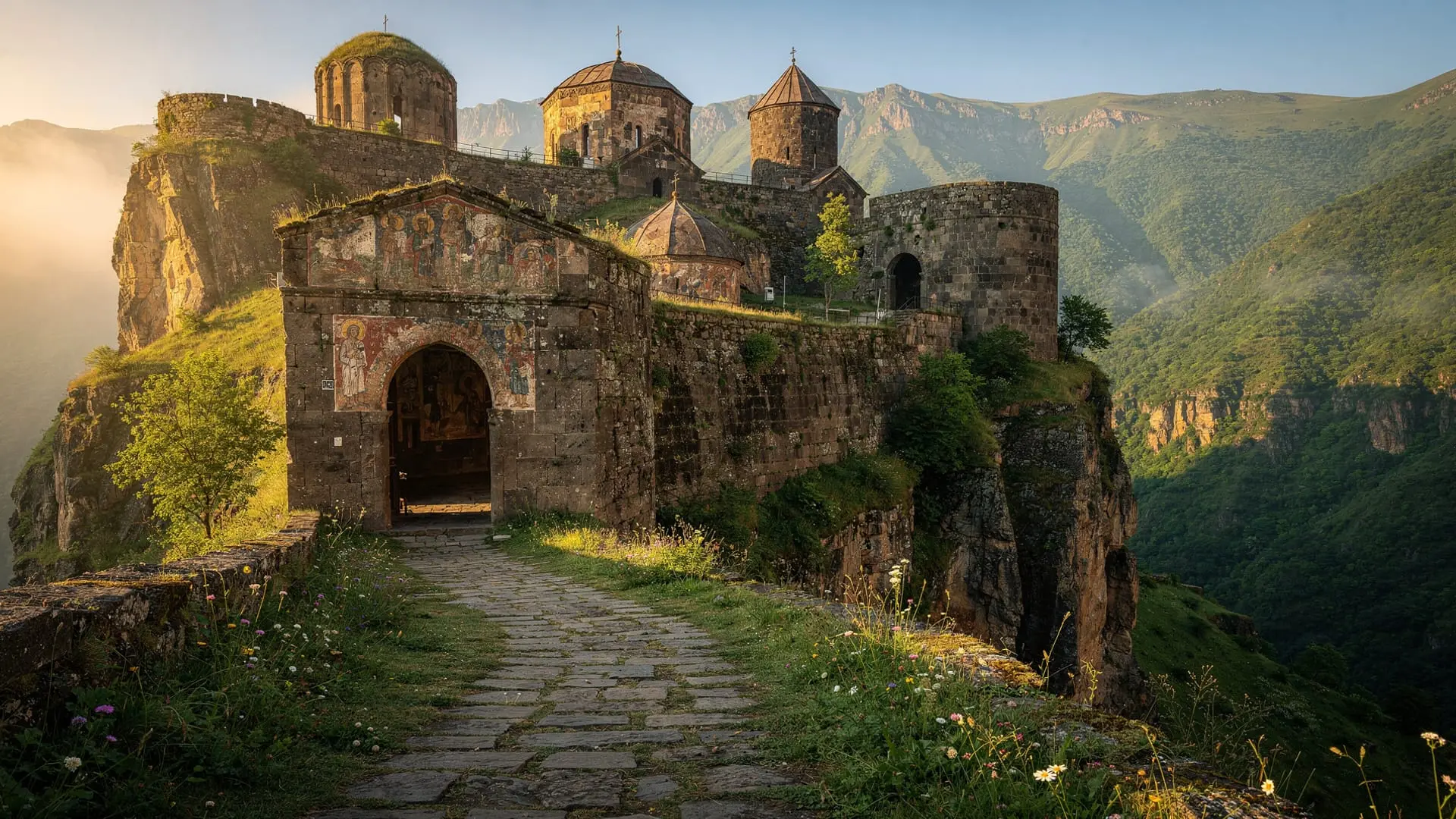
Armenia’s most significant painted church
Akhtala monastery stands within a fortress complex on a rocky promontory above the Debed river gorge in Lori province, 188 km north of Yerevan. What distinguishes it from the many other medieval monasteries in the region is not the architecture (respectable, but not exceptional) nor the setting (dramatic, but not unique in Lori) — it is the frescoes. The interior of the main church is covered with 13th-century wall paintings in the Byzantine tradition, representing the largest and best-preserved fresco programme in Armenia.
These are not the faded ochre outlines of most Armenian medieval churches. At Akhtala, the blues are still ultramarine, the reds are still vivid, and the gold backgrounds have retained their luminosity in sections. They are the closest equivalent in Armenia to the famous church paintings of Cappadocia or the frescoes of Decani in Serbia — though they receive a fraction of the attention.
Why this monastery matters
Akhtala was built in the late 12th to early 13th century under the patronage of the Zakarian princes — specifically the brothers Zakare and Ivane Zakarian, who administered northern Armenia as vassals of the Georgian crown. The Zakarids were a dynasty of Armenian-Georgian noble origin, and the Akhtala frescoes reflect this dual cultural allegiance: the iconographic programme follows Byzantine Orthodox conventions, while the architecture is Armenian. The patrons were Georgian Orthodox in their personal faith (unlike most of their Armenian subjects) — which accounts for the unusual choice of fresco cycles in a land where Armenian Apostolic churches are typically austere.
This theological complexity makes Akhtala unique. The monastery was not always under Armenian Apostolic jurisdiction; it was built as a Georgian Orthodox institution and only came under the Armenian church’s administration later. Today it belongs to the Armenian Apostolic Church, an Oriental Orthodox denomination.
The fortress that encloses the monastery is substantial — thick walls, towers, and a gatehouse that controlled access to the gorge road. It served as a strategic point on the route between Tbilisi and central Armenia throughout the medieval and early modern periods.
History
- 10th–11th century: Fortress structures already exist on the promontory when the Armenians and Georgians contested control of Lori.
- 1198–1220s: The Zakarian princes commission the main church (Cathedral of the Mother of God) and the fresco programme under the rule of Ivane I and his wife, the Georgian Queen Tamara’s administration.
- Early 13th century: The fresco programme is completed — one of the most ambitious painting campaigns in the medieval Caucasus.
- 13th–14th centuries: Mongol raids damage the fortress; the monastic community is disrupted.
- 17th–19th centuries: Periodic occupation and abandonment; frescoes suffer from neglect, water infiltration, and deliberate damage.
- 20th century: Soviet-era archaeological documentation; partial conservation of the frescoes.
- Post-independence: Ongoing conservation with international assistance (partial).
What to see at the site
Cathedral of the Mother of God (Surb Astvatsatsin, early 13th century): The main church and the reason to visit Akhtala. Enter through the west portal and pause to let your eyes adjust to the dim interior. As they do, the frescoes emerge from the walls: the apse vault holds a monumental Deesis (Christ enthroned between the Virgin and John the Baptist); the nave walls carry scenes from the life of Christ and a Communion of the Apostles; the western lunette above the entrance has a Last Judgement cycle. The iconographic programme is systematic and comprehensive — a theological narrative that reads from east (heavenly realm) to west (judgement and the human condition).
The colour palette — deep blue, crimson, and warm ochre against gold — is in better condition toward the top of the walls and in the apse, where moisture damage has been less severe. The lower registers show more loss.
The fortress walls: Walk the perimeter of the fortress enclosure for views of the Debed gorge and, on clear days, a sight line toward Haghpat and Sanahin on their respective ridges. The gatehouse and surviving tower sections give a sense of the fortress’s original defensive capacity.
Church of St Gregory (smaller chapel): A secondary chapel within the compound, plainer in decoration. Less frequently open to visitors.
How to get there
By car: From Yerevan, take the M3 north through Vanadzor to Alaverdi (185 km, approximately 3h 15min). Akhtala is 18 km west of Alaverdi on the M6. Total: 203 km, approximately 3h 30min. Alternatively, it is 20 km from Haghpat and can be combined in the same day.
By tour: Akhtala is commonly included in Lori monastery circuits with Haghpat and Sanahin.
Armenia: Odzun, Akhtala, and UNESCO heritage sites tour Yerevan: Haghpat, Zarni-Parni, Akhtala, and Aramyans tourCross-border option: Akhtala is about 80 km from the Georgian border — accessible as a first stop entering Armenia from Georgia or a last stop before departure.
Photography and best light
The exterior of the fortress and the gorge views are best in morning and afternoon light. The interior frescoes present the classic challenge of all medieval painted churches: the best illumination for human vision is also the worst for photography, as window light creates impossible contrast against dark walls.
For fresco photography:
- Use a wide-angle lens (16–24mm) to capture the full apse composition
- Expose for the highlights (the gold backgrounds) and accept shadow in the lower zones
- A colour-accurate LED panel — held at a low angle to reveal texture — gives the best results for detail shots
- No flash; it bleaches the pigment and disturbs any monks or visitors present
Overcast days are paradoxically better than sunny days for interior fresco photography — diffused light through the windows reduces contrast.
Combining with other sites
Akhtala anchors a Lori circuit:
- Haghpat monastery (20 km east): UNESCO medieval monastery — see Haghpat and Sanahin: UNESCO monasteries of Lori
- Sanahin monastery (25 km east): second UNESCO monastery — same guide
- Odzun basilica (45 km north): 7th-century church in a stunning hilltop setting
- Alaverdi (18 km east): access town for the Lori monastery cluster, with the Sanahin gorge and an interesting Soviet mining legacy
For cross-border travellers: Yerevan to Tbilisi overland guide.
Practical visit info
Entry fee: Free. Donation box inside the main church.
Opening hours: Dawn to dusk. The main church is usually open during daylight hours; occasionally locked on weekdays. If locked, ask at the adjacent structure where a monk or caretaker is often present.
Photography inside the church: Permitted without flash. Tripods are not restricted but may be impractical in the narrow interior.
Dress code: Standard modesty requirements. Women cover heads.
Conservation note: The frescoes are in ongoing need of conservation. Moisture is the primary threat. Do not touch the wall paintings.
Facilities: None at the monastery. Alaverdi (18 km east) has shops, cafes, and ATMs. The Tufenkian Avan Dzoraget Hotel, 15 km from Alaverdi, is the best accommodation in the region.
Best season: May–October. The gorge is accessible year-round but the mountain roads around Alaverdi can be icy in January–February. Autumn is particularly beautiful for the combined monastery-gorge-foliage composition.
The iconographic programme in detail
Reading the Akhtala frescoes requires understanding the basic structure of a Byzantine icon programme. In Byzantine and Oriental Orthodox churches that used wall painting, the theological narrative followed a fixed spatial logic:
The apse: The holiest space, at the east end where the altar stands. The apse vault typically shows Christ Pantocrator (Christ as ruler of all) or, as at Akhtala, a Deesis — Christ enthroned, with the Virgin and John the Baptist flanking him in intercession. The Deesis is a prayer image: the Virgin and the Baptist plead on behalf of humanity before the divine judge.
The nave walls: The north wall conventionally shows scenes from the life of Christ and feasts of the church. The south wall typically carries images of saints, martyrs, and the narrative of Mary. At Akhtala, both cycles are present, though the south wall is more damaged.
The narthex (west end): The Last Judgement cycle belongs here — the west is where you leave the world to enter the church, and the Last Judgement image is the theological gateway. At Akhtala, the western lunette fragments show ranks of figures that are identifiable despite the damage.
The ceiling: The drum carries images of angels and prophets. The pendentives (the triangular spaces between the dome and the square base) typically show the four evangelists.
What makes Akhtala’s programme remarkable is not the iconographic choices — they are conventional — but the quality of execution and the survival rate. The blues retain their azurite depth; the red ochres are vivid. The faces of the Virgin in the apse Deesis are painted with a delicacy that shows a trained master, not a workshop assistant.
The Debed gorge and the Lori landscape
Akhtala sits above the Debed gorge — the same river canyon that contains Haghpat and Sanahin further east. The Debed flows into Georgia and joins the Kura river; its valley was one of the main trade and communication routes between Armenia and the Caucasus for millennia.
The landscape here is different from the volcanic plains of Ararat or the alpine meadows of Aragats. This is a heavily forested canyon country — lush in summer, golden in autumn, dramatic in winter. The fortress at Akhtala commands a 360-degree view of the gorge and the surrounding ridges: any approaching army would have been visible for kilometres.
The Debed valley also has a significant Soviet industrial legacy. Alaverdi, 18 km east, was a major copper smelting centre; the chimney of the old smelter is still visible, and the town has a distinctive mix of medieval churches and Soviet factories that tells the full history of the region’s exploitation. The getting around Armenia by marshrutka guide covers transport from Yerevan to Alaverdi for those travelling without a car. This contrast — beautiful monastery, industrial ruin — is part of what makes northern Armenia interesting to the attentive traveller.
Armenian Apostolic versus Georgian Orthodox at Akhtala
The religious history of Akhtala is more complicated than most Armenian monasteries because it was built as a Georgian Orthodox institution by patrons who were Armenian nobles serving a Georgian crown. This dual identity — Armenian ethnicity, Georgian religious allegiance in the patrons — is the key to understanding why the frescoes look Byzantine rather than Armenian.
The Armenian Apostolic Church is an Oriental Orthodox denomination, theologically separate from the Eastern Orthodox churches of Georgia, Greece, and Russia since the Council of Chalcedon in 451 AD. The theological difference involves Christology — how the divine and human natures of Christ are understood. Armenian Apostolic theology holds that Christ has one united nature (miaphysitism); Georgian Orthodox theology follows the Chalcedonian definition of two natures. These churches are not in communion.
The Zakarian princes who built Akhtala served the Georgian Queen Tamar and adopted the Georgian Orthodox faith as a matter of political alignment. Their commitment to the Armenian Apostolic Church, which governed most of their Armenian subjects, was therefore in tension with their personal religious practice. The fresco programme at Akhtala is a product of this tension — the architecture is Armenian, the iconography is Byzantine Orthodox, and the patron was an Armenian noble serving a Georgian queen.
After the Zakarian period, Akhtala came under different administrations. Today it is administered by the Armenian Apostolic Church, which treats it as an Armenian heritage site regardless of its Georgian Orthodox construction. The complexity is real; the practical visitor experience is simply one of an outstanding frescoed church.
The Lori monastery circuit
Akhtala, Haghpat, and Sanahin form the core of what is sometimes called the Lori monastery circuit — a self-contained day (or better, overnight) itinerary covering the region’s UNESCO-listed and near-UNESCO-quality medieval sites. The logical route from Yerevan:
- Drive north 185 km to Akhtala (3h 15min from Yerevan) — arrive late morning, spend 1.5 hours
- Drive 20 km east to Haghpat (25 min) — spend 1.5 hours at the monastery
- Drive 10 km east to Sanahin (15 min) — spend 1.5 hours
- Either return to Yerevan (3h 30min) or stay overnight at the Tufenkian Avan Dzoraget Hotel
This is a very full day if done as a return trip. The overnight option allows more leisurely visits and time to explore the Debed gorge itself, which is beautiful for walking in good weather.
Conservation challenges and international support
The frescoes at Akhtala have been the subject of conservation concern for several decades. The principal threats are moisture infiltration (the roof has been partially repaired but problems persist), salt crystallisation in the stone that causes paint layer delamination, and biological growth from the damp environment.
Several international conservation missions have worked at Akhtala, including projects supported by the World Monuments Fund and various European cultural heritage programmes. The challenge is structural as well as conservatorial — the building itself needs sustained maintenance investment that the small resident community and the Armenian church administration cannot easily provide.
Visitors should not touch the painted surfaces for any reason. The oils from a single handprint can initiate a biological process that damages the paint layer over years.
Visiting without a car
Akhtala is reachable by marshrutka, though it takes patience. Take a Yerevan–Alaverdi marshrutka from Yerevan’s Northern Bus Station (roughly 3–4 hours, around 2,500–3,000 AMD) and change onto a local Alaverdi–Akhtala minibus or shared taxi for the final 18 km (typically 500–1,000 AMD, infrequent — expect to wait). Because return connections from Akhtala village are unreliable, most independent travellers without a car instead book a half-day taxi from Alaverdi (negotiate around 5,000–8,000 AMD return with waiting time) or join a Lori circuit tour from Yerevan, which removes the guesswork entirely. The getting around Armenia by marshrutka guide and the private tour vs marshrutka comparison both cover the trade-offs in more depth — for a single-day Lori push from Yerevan, a private driver or tour is markedly less stressful than stacking two marshrutka legs each way.
Where to eat and stay near Akhtala
There is no restaurant at the monastery itself, so plan around Alaverdi, 18 km east, which has a handful of simple cafes and guesthouses serving Armenian home cooking — khorovats, dolma, and fresh bread are the safe, reliable order. For an overnight in the region rather than a rushed return drive, the Tufenkian Avan Dzoraget Hotel (15 km from Alaverdi, on the Debed river) is the most comfortable base and puts Haghpat, Sanahin, and Odzun all within a short morning drive. Budget travellers can find basic guesthouse rooms in Alaverdi itself for a fraction of the cost. Carry AMD cash for Alaverdi’s small cafes and taxis — see the Armenia currency and AMD guide for withdrawal tips, since card acceptance this far from Yerevan is patchy.
A two-day Lori itinerary that does the frescoes justice
Because Akhtala rewards unhurried looking and the drive north eats most of a day either way, splitting the Lori monastery circuit over two days is the better plan if your schedule allows it:
- Day 1: Leave Yerevan early, drive 3h15 to Akhtala, arriving late morning. Spend 1.5–2 hours at the church and fortress before the midday light gets flat. Continue 18 km to Alaverdi for lunch, then check in at Tufenkian Avan Dzoraget or an Alaverdi guesthouse. Afternoon free for a gentle walk along the Debed gorge.
- Day 2: Morning at Haghpat and Sanahin (20–25 km east, 1.5 hours each), then either the Odzun basilica on the way back or a direct return to Yerevan, arriving by early evening.
This pace turns a punishing single-day 400 km round trip into something closer to a proper regional visit, with morning light for photography on both days instead of the harsh midday sun that a rushed itinerary usually forces on you.
Yerevan: full-day Sanahin, Haghpat, and northern Armenia tourFrequently asked questions about Akhtala
Why are the frescoes Byzantine-style in an Armenian monastery?
The Zakarian patrons who built Akhtala were Armenian nobles who administered territory on behalf of the Georgian crown. Ivane I Zakarian, the principal patron, was Georgian Orthodox rather than Armenian Apostolic in his personal faith. The fresco programme follows Byzantine Orthodox iconographic conventions — the same tradition that governed Georgian and Byzantine church painting of the period. The Armenian Apostolic tradition generally preferred sculptural decoration to fresco; Akhtala is the exception that proves the rule.
How do Akhtala’s frescoes compare to Tatev’s or other Armenian painted churches?
Akhtala’s are the best-preserved and most extensive fresco cycle in Armenia. Most other Armenian medieval churches have lost their original paintings entirely or retain only fragments. The closest comparisons in quality are Georgian churches (Betania, Ateni Sioni) and the Byzantine monasteries of Macedonia. Within Armenia, Akhtala is in a category of its own for painted programmes.
Is Akhtala safe to visit independently?
Yes. The site is quiet and peaceful. The fortress area is unfenced in places and the gorge edge requires care, but there are no particular safety concerns for independent visitors.
How long should I spend at Akhtala?
Allow 1.5 hours minimum: 45 minutes in the main church studying the frescoes, 30 minutes walking the fortress walls, and 15 minutes for the smaller chapel. Photography enthusiasts will want 2.5–3 hours to document the fresco programme systematically.
What is the best time of year to visit Akhtala?
May–June and September–October offer the best combination of weather, light, and visitor numbers. The gorge is green in May–June and golden-red in October. Summer (July–August) is warm and good for visiting but can be hazy. Winter (November–March) is cold — the gorge can receive significant snowfall — but the fortress in winter light is beautiful, and you will almost certainly be the only visitor. The frescoes are visible year-round; the challenge is always light quality inside, not weather.
Can I combine Akhtala with a Georgia border crossing?
Yes. Akhtala is approximately 80 km from the Bagratashen-Sadakhlo border crossing into Georgia. Many travellers on the Yerevan-to-Tbilisi route stop here — it adds only a 20 km detour from the main road. See the Bagratashen border crossing guide for logistics and Yerevan to Tbilisi overland guide for the full route.
Does Akhtala require a guide to appreciate fully?
Not technically, but the experience is considerably enriched by someone who can read the fresco programme and explain the iconographic conventions. Without context, the paintings are beautiful but opaque — with context, they become legible as theological statements. If you are coming specifically for the frescoes, hiring a guide with art history background is strongly recommended. Ask at your Yerevan hotel or the tourist information office for recommendations.
Is Akhtala monastery still active as a religious site?
The Armenian Apostolic Church administers the site and occasional liturgies are held in the church, though the fresco programme makes it a more unusual religious space than most Armenian churches (which do not use the Byzantine iconographic tradition). A small community of monks may be present. The site is not primarily a working monastery but a heritage site in religious custody.
Can I get to Akhtala without a car?
Yes, but it takes effort: a Yerevan–Alaverdi marshrutka (around 3–4 hours) followed by a local minibus, shared taxi, or negotiated taxi for the last 18 km to Akhtala. Return connections from the village are irregular, so most independent travellers either base themselves in Alaverdi and hire a taxi for a few hours, or join a Lori-circuit day tour from Yerevan that includes Akhtala, Haghpat, and Sanahin.
Where should I stay if I want to see the whole Lori monastery circuit properly?
Alaverdi has basic budget guesthouses within a short drive of Akhtala, Haghpat, and Sanahin. For more comfort, the Tufenkian Avan Dzoraget Hotel on the Debed river, about 15 km from Alaverdi, is the best-regarded option in the region and makes an unhurried two-day circuit realistic rather than a single exhausting day trip from Yerevan.