Bagratashen border crossing Armenia↔Georgia: practical guide
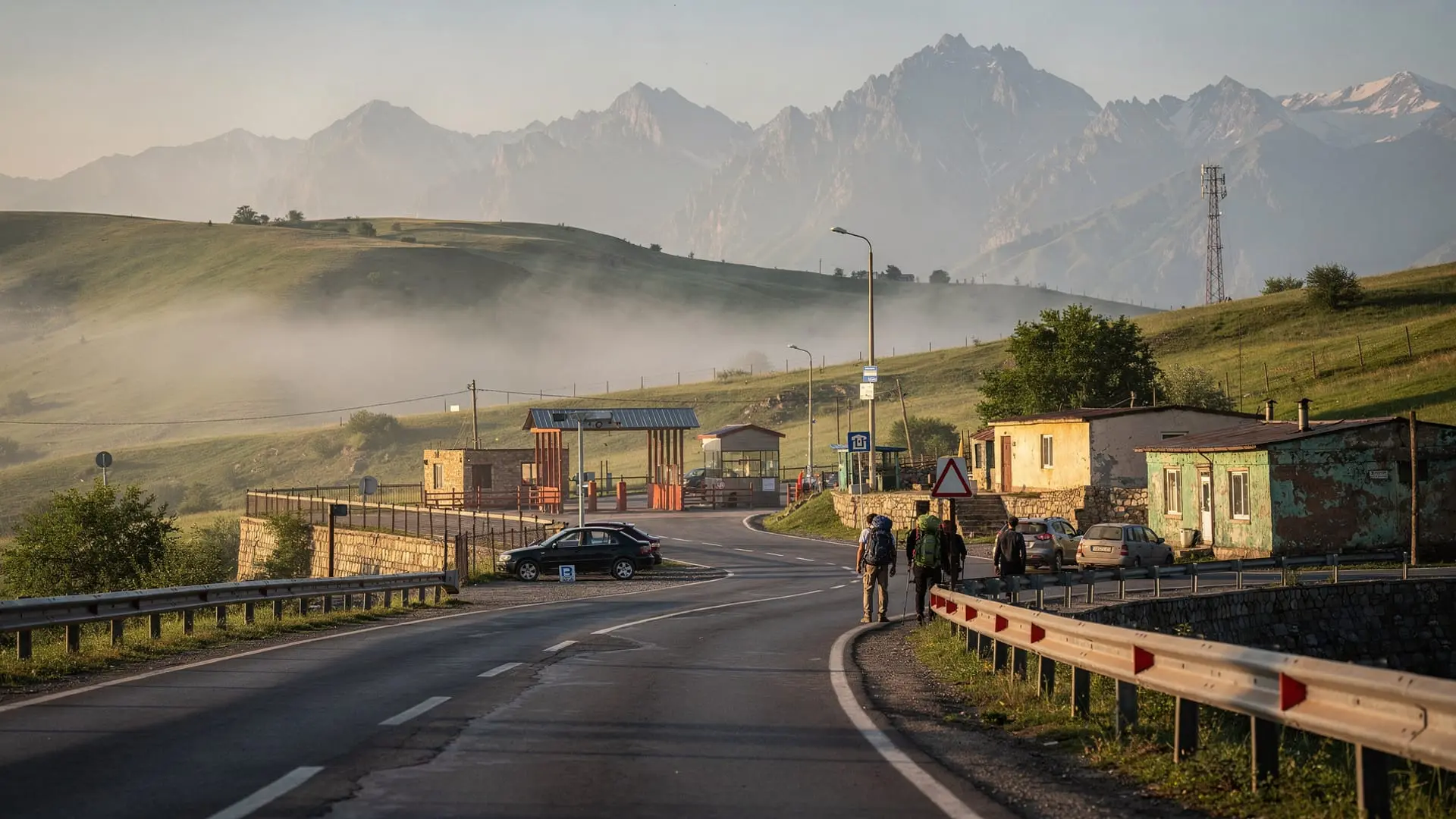
| Open | 24/7, no appointment needed |
| Typical wait (weekday AM) | 20–40 minutes |
| Typical wait (peak summer weekend) | 1.5–3 hours |
| Visa | Free for most nationalities, 180 days/year |
| Nearby | Haghpat & Sanahin monasteries, 15–20km |
The Bagratashen–Sadakhlo border crossing between Armenia and Georgia is the main land border between the two countries, handling the bulk of passenger traffic on the Yerevan–Tbilisi overland route. It’s an efficient, 24/7 crossing used by thousands of people daily — straightforward in normal conditions but capable of long queues in peak summer.
This guide gives you every practical detail: what to bring, what to expect at each step, how long it actually takes, and when to cross to avoid the worst delays. Whether you’re in a marshrutka, a private car, or crossing on foot (uncommon but possible), the procedure is the same.
Where the crossing is
The Bagratashen post is on the Armenian side, in a village of the same name in the Lori province (Tavush Marz border area), approximately 200 km north of Yerevan. The Armenian post and the Georgian post (called Sadakhlo) are approximately 500 metres apart, separated by a no-man’s land bridge over the Debed river.
The crossing sits in the Debed canyon — a dramatic gorge carved by the river through dark volcanic rock, with the UNESCO monasteries of Haghpat and Sanahin visible on the ridges above. If you’re driving, this is worth noting: the monasteries are 15–20 km from the border and make an excellent stop before or after crossing.
Hours and access
- Open: 24 hours a day, 7 days a week, including public holidays.
- No advance booking or appointment needed for pedestrians or private cars.
- Buses and marshrutkas cross as they arrive.
Who can cross without a visa
Citizens of the following countries (and many more) require no visa for both Armenia and Georgia:
- All EU member states
- USA, Canada, United Kingdom, Australia, New Zealand
- Switzerland, Norway, Iceland
- Japan, South Korea, Singapore
- Israel, UAE, Kuwait, Qatar, Oman, Bahrain
The standard visa-free allowance is 180 days per year (each country counted separately) for the nationalities listed above. Entry is on a passport — standard 6-month validity recommended.
If you are not on the visa-free list: Armenia offers e-visa for eligible nationalities via evisa.mfa.am. Georgia offers e-visa as well. Check current requirements before departure.
Step-by-step crossing procedure
1. Armenian exit
Your vehicle or marshrutka stops at the Armenian border post. You and all passengers hand over passports to the border officer (or exit the vehicle for pedestrian control at the booth). A stamp is placed in your passport. The process typically takes 5–15 minutes for private cars with no queue.
What they check: Valid passport, no issues with your Armenian residency period. Armenian exit is usually fast.
2. Drive across no-man’s land
A short drive (500 m, the bridge over the Debed river) brings you to the Georgian border post. On foot, the same stretch is walkable.
3. Georgian entry
This is where the queue forms in peak season. Georgian officers check passports at vehicle-by-vehicle booths or pedestrian lanes. For most EU/US/UK/Australian citizens: passport check, question about purpose of visit and length of stay, and you’re through.
What they may ask: How long are you staying? Where are you going? Do you have a return ticket or onward travel? Standard questions — answer honestly and briefly.
Luggage may be scanned or inspected by custom officers.
Currency: No limit for personal amounts of foreign currency declaration. Amounts over 30 000 USD or equivalent must be declared.
4. Continue into Georgia
Once through Georgian passport control, you’re in Georgia. The nearest town is Sadakhlo, with petrol stations and basic facilities. Tbilisi is approximately 3 hours’ drive via the Georgian Military Highway or the newer motorway.
Book a Tbilisi transfer with Haghpat & Sanahin stops
Wait times by day and season
| Period | Typical wait (total) |
|---|---|
| Weekday morning (before 10am) | 20–40 minutes |
| Weekday afternoon | 30–60 minutes |
| Weekend morning | 45–75 minutes |
| Weekend afternoon (peak summer) | 1.5–3 hours |
| July–August any time | 1–2.5 hours |
| November–March any day | 20–45 minutes |
The single best tip: Cross on a weekday morning before 10am. This single choice can save 60–90 minutes of queuing compared to a Saturday afternoon in August.
The crossing is also faster in November through March, when tourist volumes are low.
Crossing by different transport modes
Private car or rental
Stop at the Armenian post, exit to passport control, return to car, drive to Georgian post, exit again for Georgian passport control. Straightforward.
Note on rental cars: If crossing with a rental car, check your rental agreement. Some Armenian rental companies prohibit cross-border use or require advance notification and an additional insurance fee. Verify before departure.
Marshrutka (shared minibus)
All passengers exit the vehicle at both border posts and rejoin after clearing control. Your driver holds your luggage in the vehicle; keep your passport and valuables with you. The driver will wait.
On foot
Technically possible but uncommon — the crossing was designed for vehicles. Pedestrian lanes exist at both posts. If crossing on foot, you’ll need to arrange onward transport in Georgia (taxis wait on the Georgian side).
The overnight train
The Yerevan–Tbilisi overnight train crosses the border at a different point — at Ayrum (Armenia) / Sadakhlo (Georgia), a few kilometres from the road crossing. On the train, border officials come to your compartment around 1:30–2:30am. You hand over your passport, they stamp it, and return it while you remain in your bunk. This is the most painless crossing method.
See the overnight train guide for the full experience.
What to do near Bagratashen while waiting
If you arrive early and the border is moving slowly — or if you want to make the most of the northern Armenia approach — two UNESCO monasteries are within 20 km of the crossing:
- Haghpat monastery: 15 km south of Bagratashen on the Armenian side. One of the finest medieval monasteries in Armenia, barely crowded, in a dramatic ridge-top setting above the Debed canyon.
- Sanahin monastery: 5 km from Haghpat, architecturally equally fine, with a famous medieval school and khachkar collection.
Both are covered in the Haghpat & Sanahin UNESCO guide.
For travellers going the other way (Georgia to Armenia)
The same crossing works in both directions and the procedure is symmetrical:
- Georgian exit: usually fast (5–10 min)
- Armenian entry: passport check, same visa-free arrangements apply. Armenian officers may ask about purpose and length of stay.
At the time of writing, citizens of countries whose passports show a Georgian occupation-zone stamp (Abkhazia or South Ossetia) may face difficulties entering Armenia — this is a sensitive diplomatic issue. If relevant to you, seek current guidance from your embassy.
What to see near the crossing on the Armenian side
The Bagratashen area sits in one of the most historically rich parts of Armenia. Even if your primary purpose is transiting to Georgia, the monasteries within 20 km of the crossing are world-class and poorly known outside specialist circles.
Alaverdi town is the nearest urban centre on the Armenian side — a Soviet-era mining town in the Debed canyon, 20 km from the border. The town itself is industrial, but it is the jumping-off point for Haghpat and Sanahin monasteries.
Haghpat monastery (UNESCO, 10th–13th c.): On the ridge above Alaverdi, 15 km from the border. One of the finest medieval Armenian monasteries, rarely crowded. See the Haghpat & Sanahin guide.
Sanahin monastery (UNESCO, 10th c.): In the town of Sanahin across the gorge from Alaverdi. Armenia’s great medieval intellectual centre.
Akhtala monastery (13th c., frescoes): 35 km from the border, closer to the main highway than Haghpat and Sanahin. The interior Byzantine-style frescoes are the finest in Armenia.
For travellers driving from Tbilisi to Yerevan with an early morning crossing, a stop at Akhtala, then Haghpat, then Sanahin, then continuing to Yerevan covers three UNESCO or near-UNESCO sites and converts 30 minutes of “wasted” driving into a rich cultural day.
What Georgia looks like just across the border
Immediately on the Georgian side of the crossing (Sadakhlo area), the landscape changes character — the Debed canyon opens into the broader Kura tributary valley and the Georgian plains become visible. The first Georgian town of any size is Marneuli (30 km from the border), a predominantly ethnic Azerbaijani town with good petrol stations and basic facilities.
Tbilisi is approximately 3 hours from the border via the main highway through the Kura valley. The road passes Rustavi (an industrial city), then the outer suburbs of Tbilisi, entering the city from the southeast.
For everything Georgia-specific — Tbilisi orientation, border town logistics, Georgian SIM cards, first-night accommodation — visit georgia-spirit.com.
Vehicle insurance and rental cars at the border
If you are crossing with a rented car, the key issue is whether your rental contract permits cross-border use.
Armenian rental cars into Georgia: Most Armenian rental companies permit crossing into Georgia if you give advance notice (24–48 hours) and pay an additional cross-border fee (typically $20–50 USD). Some companies prohibit it entirely. Always check your rental agreement before planning a cross-border route.
Georgian rental cars into Armenia: Same applies — verify with the Georgian company before departure. Some Tbilisi rental companies are more permissive about Armenia crossings than others.
Insurance: Your rental insurance typically remains valid in both countries if cross-border use is permitted. However, verify that your coverage extends to Armenia if renting in Georgia (and vice versa). If you are renting from a third-party insurer, check your policy explicitly.
If your rental contract prohibits the crossing: You have several options:
- Return the car in Yerevan, cross by marshrutka or train, and rent a new car in Tbilisi
- Use a private transfer service for the border crossing and then rent locally
- Use guided tours that provide their own vehicles
International driving permits: While not strictly required for EU, US, or Australian licence holders at the Bagratashen crossing (Armenian and Georgian border officers generally accept standard licences from these countries), an international driving permit is recommended as backup, particularly for rental car procedures on the other side.
The border at different times of year
Summer (June–August): Peak crossing season. July and August bring the longest queues — the Bagratashen crossing handles not just tourists but also seasonal workers, traders, and migrants. Weekend afternoons in August can see queues of 1.5–2 hours or more. If possible, cross on a Tuesday or Wednesday morning.
Shoulder season (April–May, September–October): Much more comfortable. Wait times rarely exceed 45 minutes. These seasons are also the best times to be on both sides of the border — spring wildflowers in Armenia’s Lori province, autumn foliage in Georgia’s Kakheti.
Winter (November–March): The fastest crossing time of the year — 20–30 minutes is normal. The cold, however, means that standing outside the vehicle during the border procedure is uncomfortable. The mountain road sections between the border and Tbilisi/Yerevan can be icy — check weather before crossing late at night.
Frequently asked questions about the Bagratashen crossing
Can I cross at night?
Yes — the crossing is open 24/7. The overnight train crosses in the small hours (around 2am). Night crossings by road are possible and often faster than daytime in terms of queue length.
Do I need travel insurance for the crossing?
Neither Armenia nor Georgia requires proof of travel insurance at the border. However, travel insurance covering both countries is strongly recommended for any international trip.
Is there an ATM or currency exchange at the border?
Basic exchange offices operate on both sides. Rates are poor — exchange EUR or USD to AMD at a Yerevan bank, and to GEL at a Tbilisi bank. There is no ATM directly at the crossing; the nearest are in Alaverdi (Armenia) and Sadakhlo town (Georgia).
Can EU citizens enter without a passport (just an ID card)?
No — both Armenia and Georgia require a passport for entry. An EU national identity card is not sufficient.
Can I stop for a coffee or meal right at the border?
Basic cafes and small shops operate near both border posts, but they’re functional rather than destinations in themselves. A far better plan is to push on 15–20 km to Alaverdi on the Armenian side, or to Sadakhlo/Marneuli on the Georgian side, where the food options are more substantial. If you’re crossing from Armenia into Georgia, eating before the border in Alaverdi or after arriving in Marneuli both work better than the immediate crossing zone, and it turns otherwise dead transit time into a proper meal stop.
Are there other crossings between Armenia and Georgia?
Yes: the Bavra–Ninotsminda crossing (northwest, connects Shirak province with the Javakheti highlands of Georgia) and the Gogavan–Guguti crossing (also northwest). Both are smaller, less busy, and less served by public transport. Bagratashen is by far the most practical for Yerevan–Tbilisi travellers.
Choosing Bagratashen vs the other crossings
For most travellers going between Yerevan and Tbilisi, Bagratashen is simply the right choice — it has the most traffic, the best road infrastructure on both sides, and the most transport options (marshrutka, private transfer, guided tour, and the overnight train’s road-adjacent route). The Bavra–Ninotsminda crossing makes sense only if your route already runs through Gyumri and Shirak province, connecting more naturally to Georgia’s Javakheti region than to Tbilisi directly — useful for a Gyumri-to-Georgia overland trip that skips the capital loop entirely. Gogavan–Guguti is a minor crossing with limited facilities and is not realistically an option without your own vehicle and local knowledge. Unless your itinerary specifically routes through Shirak, default to Bagratashen.
A realistic timing plan for a same-day crossing
If you’re crossing and continuing to Tbilisi the same day rather than stopping at the Debed canyon monasteries, build in more buffer than the raw wait-time numbers suggest. A private car or shared marshrutka trip from Yerevan to Tbilisi via Bagratashen typically runs 5–6 hours door to door on a normal weekday: about 2 hours Yerevan to the border, 30–60 minutes at the crossing, and 3 hours from the border to Tbilisi. On a summer weekend, add at least an hour for border delays and plan for a 7-hour journey. If your onward plans in Tbilisi are time-sensitive (an evening flight, a booked tour), leave Yerevan by mid-morning at the latest and treat the border wait as the least predictable variable in the whole day.