Haghpat & Sanahin: UNESCO monasteries of Lori
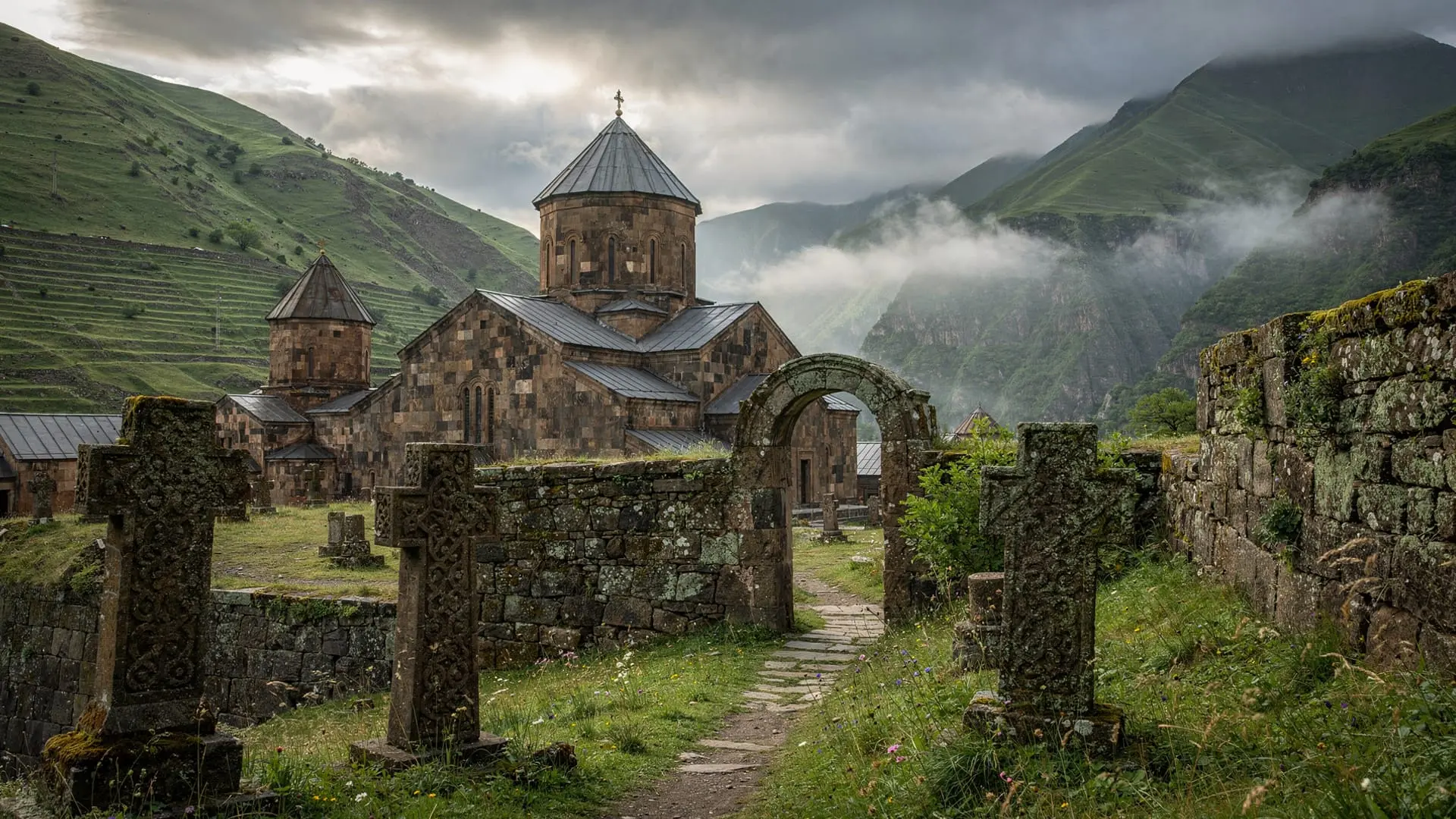
Armenia’s northern jewels and the twin monastic rivals
In the deep valleys of Lori province, two monasteries face each other across the Debed river gorge. Haghpat and Sanahin were founded within decades of each other in the 10th century, flourished simultaneously under the same Bagratid and Zakarian dynasties, and competed as centres of learning and ecclesiastical power for three centuries. Both were inscribed as UNESCO World Heritage Sites in 1996 (with later expansion in 2000). Yet despite their proximity — just 10 km separate them — they attract far fewer visitors than Geghard or Tatev, a gap that has nothing to do with merit and everything to do with distance from Yerevan.
| Where | Lori province, near Alaverdi, ~200 km / 3h30 from Yerevan |
| Cost | Free entry; donation boxes at each church |
| Time needed | 1.5 hours per monastery, 3+ hours for both |
| Getting there | Car, tour, occasional train to Alaverdi |
| Best time | October for autumn colour; consider an overnight in the gorge |
Visiting them together in a day is possible and rewarding. But those who stay overnight in the Debed canyon area discover something richer: a landscape of forests, gorges, and medieval stonework that the day-trip circuit never quite delivers.
Why these monasteries matter
Haghpat and Sanahin represent the apex of Bagratid Armenian culture. The Bagratid dynasty ruled much of Armenia from the 9th to 11th centuries and created the conditions for a cultural flourishing that produced major architectural innovation, manuscript production, and theological scholarship. When the Bagratid kingdom fell to the Seljuks in 1064, the monasteries of Lori continued to function under Georgian and later Zakarian patronage.
Sanahin’s academy in particular was one of the most celebrated in the medieval Caucasus. The physician Amirdovlat Amasiatsi, one of the most important medical scholars of 15th-century Armenia, had roots in this tradition. Haghpat was the principal ecclesiastical centre of the Diocese of Siunik-Utik and accumulated a library of manuscripts that was dispersed over centuries of conflict.
Both monasteries belong to the Armenian Apostolic Church, an Oriental Orthodox denomination — not Catholic and not Eastern Orthodox. The Georgian royal family of the Bagrationi dynasty patronised them alongside Armenian nobility, a reminder of how intertwined these two Caucasian Christian cultures were in the medieval period.
History
Sanahin:
- 966 AD: Founded by Queen Khosrovanuysh, wife of the Bagratid king Ashot III “the Merciful.”
- 10th–13th centuries: Gradual expansion. The academy and library grow to major significance.
- 1063: Construction of the Academy building — a two-storey structure unique in Armenian monastic architecture.
- 12th–13th centuries: Zakarian patronage; further building campaigns.
Haghpat:
- 976–991 AD: Founded also under Queen Khosrovanuysh and King Smbat I.
- 1065–1090: Major building phase produces the Cathedral of the Holy Cross (Surb Nshan), the principal church.
- 1181: The gavit (narthex-hall) of Surb Nshan completed.
- 13th century: Additional churches, bell tower, and library building added under Zakarian patronage.
- 14th century: Decline following Mongol incursions.
What to see at Haghpat
Cathedral of the Holy Cross (Surb Nshan, 1000–1005): The main church and the most important building in the complex. Built in the transitional style between early Armenian and mature Bagratid architecture. The carved tympanum above the main entrance and the cruciform interior plan with raised dome are the defining features. The gavit attached to the west (1181) is among the finest narthex halls in Armenia.
Church of St Gregory the Illuminator (Surb Grigor, 1005): A smaller church north of the main cathedral, contemporary with it.
Church of the Holy Sign and bell tower: The free-standing bell tower (1245) is photogenic and unusually tall for the period. Its three-storey structure with decorative niches is characteristic of Zakarian patronage.
Hamazasp gavit and manuscript library: The 13th-century library building preserves niches for manuscript storage. Some of Haghpat’s manuscripts are now in the Matenadaran repository in Yerevan.
Khachkar wall: The south exterior wall of the complex hosts a display of khachkars of various periods — a convenient summary of 400 years of cross-stone development.
What to see at Sanahin
Cathedral of All Saviors (Amenaprkitch, 10th century): The oldest and largest church at Sanahin, with an unusual interior that combines a basilica plan with a domed cruciform superstructure. The carved decoration is restrained — Sanahin’s appeal is more scholarly than decorative.
Church of the Mother of God (Surb Astvatsatsin, 10th century): A smaller chapel to the south, connected to the main church by a common gavit.
United gavit (1181): The large communal vestibule connecting the two churches was added by Mkhitar Gosh (the same jurist-writer associated with Goshavank) under Zakarian patronage. Its carved interior, particularly the ceiling stalactite ornament, rewards careful study.
Academy building (1063): A rare surviving example of an Armenian monastic academy. The two-storey structure with its wide arched openings on the upper floor was designed for study — benches were carved into the lower walls. Unique in Armenian ecclesiastical architecture.
** Zoravar bridge**: A medieval bridge spans the Debed tributary below Sanahin — worth a 10-minute detour for the view back up to the monastery.
How to get there
By car from Yerevan: Take the M3 north toward Vanadzor, then continue to Alaverdi (200 km, approximately 3h 30min). Haghpat village is 10 km east of Alaverdi; Sanahin village is 5 km south of Alaverdi. Road conditions on the M3 are good; the gorge roads to the villages are surfaced but narrow.
By tour from Yerevan: Several operators run the Haghpat-Sanahin circuit as a day tour, sometimes combined with Akhtala monastery.
Private tour to Haghpat and Sanahin monasteries from Yerevan Yerevan: Haghpat, Zarni-Parni, Akhtala and Aramyans tourBy train to Alaverdi: A train from Yerevan to Alaverdi runs on certain days (verify the current timetable — services have been irregular). The station is at the bottom of the gorge; taxis or shared vehicles reach the village and monastery.
From Tbilisi (cross-border): Haghpat and Sanahin are approximately 80 km from the Georgian border, making them a popular first or last stop on Armenia-Georgia combination trips. Several Tbilisi-based operators offer day trips to northern Armenia including the monasteries.
Photography and best light
Haghpat faces roughly south-southwest, catching afternoon light on its main facades from about 13:00. The bell tower photographs well in any light. Sanahin’s Cathedral of All Saviors faces east, so morning light (before 11:00) is best for the main entrance.
Both monasteries are surrounded by forested hillsides that turn golden in October — arguably the finest month to visit Lori, when autumn colour, low-angle light, and small crowds combine. Spring (May) brings lush green and wildflowers.
Combining with other sites
Haghpat and Sanahin anchor the Lori monastery circuit, which can also include:
- Akhtala monastery (20 km west of Haghpat): outstanding 13th-century Byzantine-style frescoes — see Akhtala: medieval frescoes and fortress
- Odzun basilica (30 km north of Akhtala): 7th-century church in a stunning hilltop setting
- Dsegh village (25 km north of Stepanavan): birthplace of the poet Hovhannes Tumanyan, with wild tea foraging tours
- Vanadzor (60 km south of Haghpat): Armenia’s third city, reasonable as a base for exploring Lori
For cross-border travellers, the Yerevan-to-Tbilisi route naturally passes through Alaverdi and can incorporate a half-day stop at both monasteries. See Yerevan to Tbilisi overland guide.
Practical visit info
Entry fee: Both monasteries are free. Donation boxes at the entrance of each main church.
Opening hours: Dawn to dusk daily. Both sites are accessible at any daylight hour.
Dress code: Shoulders and knees covered; women must cover heads. Spare headscarves may be available at the gates.
Accommodation in the area: Alaverdi has a few guesthouses and the Tufenkian Avan Dzoraget Hotel, about 15 km north, is an excellent property in the gorge with comfortable rooms and a good restaurant (approximately AMD 50,000–70,000 per night, EUR 120–170). Staying here overnight transforms the trip: you can visit both monasteries in easy morning sessions with time to explore the gorge.
Facilities: Small cafes and souvenir stalls operate at Haghpat; minimal facilities at Sanahin. Bring water and snacks. The nearest proper supermarkets are in Alaverdi.
Distance between the two: 10 km by road. Allow 20 minutes driving. Walking between them is possible on footpaths through the gorge (about 2h one way) — a pleasant option for hikers.
Best season: May–June and September–October. July–August is warm but manageable; the gorge provides shade. November–March is off-season with very few visitors; roads are accessible but can be icy in January–February.
The Debed canyon and Lori’s landscape
The Debed river carves a deep canyon through Lori province before crossing into Georgia. The canyon walls are dense forest — beech, hornbeam, and oak — and the valley floor carries the main railway line that once connected Yerevan to Tbilisi via Alaverdi. Both Haghpat and Sanahin are perched on ridge spurs above the Debed, looking across at each other from opposite sides of tributary gorges.
The landscape of Lori is fundamentally different from the volcanic plains of Ararat or the alpine meadows of Aragatsotn. It is green, forested, and cool, receiving more rainfall than most of Armenia. The combination of canyon topography, dense forest, and medieval stone architecture produces a visual richness that makes the region distinctive — and explains why the Tufenkian Avan Dzoraget Hotel, built in the gorge specifically to leverage this setting, has become one of the most appreciated rural lodgings in the Caucasus.
Autumn (September–October) is the finest season for the Lori monasteries. The beech forest turns golden-orange, the light drops in angle, and the canyon fills with colour. If you are choosing between seasons for a Haghpat-Sanahin visit, October is the answer without qualification.
The Bagratid architectural legacy
The architectural style of Haghpat and Sanahin is different from the Zakarian-period monasteries of Tavush or the Siunik-school buildings of Vayots Dzor. Both belong to the Bagratid period (9th–11th centuries), characterised by a preference for the cross-dome plan, relatively restrained exterior ornament (compared to the later Zakarian elaboration), and an emphasis on interior spatial quality over external display.
Key architectural features to observe at both sites:
The gavit (narthex-hall): Both Haghpat and Sanahin have large gavit structures that function as assembly halls, burial places, and reception spaces. The Haghpat gavit (1181) is among the finest in Armenia; the Sanahin united gavit (1181, attributed to the era of Mkhitar Gosh’s influence) connects the two main churches.
The dome and drum: The domes at both monasteries are raised on drums with carved blind arcading — the characteristic Bagratid device for elevating the interior space and creating a graduated transition between the dome and the supporting walls.
The library buildings: Both monasteries have surviving structures identified as libraries — unusual, since most medieval monastic libraries have not survived. At Sanahin, the Academy building (1063) is particularly remarkable, a two-storey structure designed specifically for teaching and study.
Alaverdi: the copper town
Any visit to Haghpat and Sanahin passes through or near Alaverdi, and the town deserves a moment’s attention. Alaverdi is built around copper mining and smelting operations that date to ancient times but were industrialised massively in the Soviet period. The AGMC copper smelter dominated the economy for decades; its legacy includes significant environmental contamination in the gorge.
The town is now in partial economic transition, with tourism beginning to replace the declining mining sector. It is not a pretty place, but it is honest — the juxtaposition of medieval monastery and Soviet smokestack is one of the most Armenian combinations possible, and Alaverdi exemplifies it without apology.
The Tufenkian Avan Dzoraget Hotel, 15 km north of Alaverdi on the Debed river, is worth knowing about: it is built as a traditional Armenian stone building in the gorge, with excellent rooms, a good restaurant, and an intimate scale. Staying here overnight for a Lori monastery visit transforms the experience from a long day trip into a genuine immersion.
Reaching Haghpat and Sanahin from Georgia
For travellers coming from Georgia, Haghpat and Sanahin are the logical first Armenian stops. The Bagratashen-Sadakhlo border crossing is approximately 80 km from the monasteries. The route passes through Alaverdi; a half-day stop at the monasteries before continuing south to Yerevan works well logistically.
Several Tbilisi-based operators offer day trips to northern Armenia specifically to see the monasteries. The full drive from Tbilisi to Haghpat is about 150 km (2h 30min). See Yerevan to Tbilisi overland guide.
The medieval manuscript tradition in Lori
Both Haghpat and Sanahin maintained active scriptoria — workshops for the copying and illumination of manuscripts. Several of the most important Armenian manuscripts now held at the Matenadaran in Yerevan were produced at or associated with these monasteries. The Matenadaran holds over 23,000 manuscripts representing the largest collection of Armenian manuscripts in the world, and a significant proportion originated in the Lori monastery complex.
Armenian manuscript illumination of the Bagratid and Zakarian periods (9th–13th centuries) developed a distinctive style that synthesises Byzantine iconographic conventions with Persian decorative ornament and indigenous Armenian geometric patterning. The carpet pages (abstract ornamental opening pages), the canon tables (columnar frameworks listing parallel gospel passages), and the evangelistic portraits in these manuscripts are among the finest examples of medieval book art in the world.
If the Matenadaran visit has been on your agenda for a Yerevan day, connecting it mentally to Haghpat and Sanahin enriches both experiences. The books in Yerevan came from places like this. See the Matenadaran manuscripts visitor guide.
The Armenian Apostolic Church in Lori
The Diocese of Gugark (covering much of Lori province) has administered Armenian Apostolic Church affairs in this region since the early medieval period. The Armenian Apostolic Church is an Oriental Orthodox denomination — not Catholic and not Eastern Orthodox. It separated from the Chalcedonian churches in 451 AD and has maintained its own theological, liturgical, and architectural tradition since then.
At both Haghpat and Sanahin, the liturgy is in Classical Armenian (Grabar) — a language that has not been spoken colloquially for centuries but has been preserved in ecclesiastical use, much as Latin was preserved in the Roman Catholic tradition. Hearing the Armenian liturgy in these stone buildings — the echo quality of the 10th-century masonry, the resonance of the classical language — is among the most affecting experiences Armenia offers.
Practical planning for the Lori monastery circuit
A well-organised visit to Haghpat and Sanahin requires genuine planning. The distances and driving times are not trivial:
Day-trip schedule from Yerevan (tight):
- Depart Yerevan 07:00
- Arrive Akhtala 10:15 (185 km, 3h 15min)
- Spend 1h 30min at Akhtala frescoes
- Drive to Haghpat (20 km, 25 min): arrive 12:10
- Spend 1h 30min at Haghpat
- Drive to Sanahin (10 km, 15 min): arrive 13:55
- Spend 1h 30min at Sanahin
- Depart Sanahin 15:25
- Arrive Yerevan 18:55 (200 km, 3h 30min)
Total: about 12 hours. Feasible but relentless. Adding a lunch stop extends to 13 hours.
Two-day Lori overnight (recommended):
- Day 1: Yerevan to Haghpat (200 km), visit Haghpat and Sanahin, overnight at Tufenkian Avan Dzoraget
- Day 2: Morning at Akhtala (20 km west), continue to Odzun basilica if desired, return to Yerevan
This gives each monastery the time it deserves and includes the Debed gorge in the experience.
Budget note: The Tufenkian Avan Dzoraget Hotel is the benchmark property for the area but not budget-friendly (AMD 50,000–70,000 per night, EUR 122–170). Guesthouses in Alaverdi and the surrounding villages offer rooms for AMD 10,000–20,000 per night (EUR 24–49) with varying quality. The Lori region does not have a strong guesthouse scene yet, but it is developing.
Haghpat and Sanahin compared
Since most visitors ask how the two sites actually differ, a direct comparison helps decide where to spend more time:
| Haghpat | Sanahin | |
|---|---|---|
| Standout feature | Bell tower (1245), Surb Nshan gavit | Academy building (1063), united gavit |
| Character | More varied architecturally, taller bell tower | More scholarly, restrained decoration |
| Best for | First-time visitors, photography | Those interested in medieval education history |
| Crowd levels | Slightly busier of the two | Marginally quieter |
Dsegh and the wider Lori circuit
If your Lori trip has more than a single day, Dsegh — birthplace of the poet Hovhannes Tumanyan, about 25 km north of Stepanavan — is a worthwhile literary detour that also offers wild tea foraging in the surrounding hills, a distinctly Lori activity that few visitors on the standard Haghpat-Sanahin day trip ever discover. Combining Dsegh with an overnight at the Tufenkian Avan Dzoraget Hotel turns a rushed monastery day into a genuine two- or three-day exploration of the province’s forests, gorges, and small towns.
Why the twin-monastery rivalry still shapes the visit
Haghpat and Sanahin were not simply neighbours in the medieval period — they competed directly for patronage, students, and ecclesiastical prestige, and that rivalry is part of what makes visiting both in sequence so rewarding today. Sanahin’s name is traditionally explained as meaning “this one is older than that one” (Ays anun Sanahin), a piece of local etymology that captures the competitive spirit between the two foundations even if scholars debate its literal accuracy. Standing at one monastery and looking across the gorge toward the other, as is possible from several vantage points near both sites, makes this rivalry tangible in a way that reading about it in a museum label cannot. The two communities drew on the same architectural vocabulary and the same Bagratid and Zakarian patronage networks, yet developed distinct personalities — Haghpat more visually assertive with its tall bell tower, Sanahin more inward-looking with its academy. Seeing both in the same visit, rather than choosing one, is genuinely the best way to understand what each represents.
Frequently asked questions about Haghpat and Sanahin
Which monastery should I prioritise if I only have time for one?
Haghpat is architecturally more varied, with its bell tower and the beautifully preserved gavit of Surb Nshan. Sanahin’s Academy building is unique and its academic history more celebrated. Most first-time visitors find Haghpat slightly more memorable visually; Sanahin rewards those with a deeper interest in medieval scholarship. If pressed, visit Haghpat first and treat Sanahin as the in-depth follow-up.
How does Lori compare to the more accessible monastery sites near Yerevan?
Lori’s monasteries are less visited than Geghard or Khor Virap, which is part of their appeal. The setting — deep gorge, dense forest, fewer tourist stalls — feels more genuinely remote. The architecture is more restrained and scholarly than the dramatic cave churches of Geghard. For travellers seeking depth over spectacle, Lori often becomes a favourite.
Is there a connection between Haghpat, Sanahin, and Mkhitar Gosh?
Mkhitar Gosh (c. 1130–1213), the jurist and fable-writer best known as the founder of Goshavank monastery in Tavush, also contributed to Sanahin’s united gavit. His legal code (Datastanagirk) is one of the most important documents in medieval Armenian jurisprudence. Gosh lived and worked within the same Zakarian patronage network that funded both Lori monasteries and the Tavush sites.
Can I combine Haghpat and Sanahin with the Georgia border crossing?
Yes. If you are travelling the Yerevan–Tbilisi route, the monasteries lie roughly 80 km from the Bagratashen-Sadakhlo border. A sensible northern Armenia circuit involves Haghpat and Sanahin on the route north, crossing into Georgia the same day or the next morning. See the Bagratashen border crossing guide for logistics.
Are English-speaking guides available at the monasteries?
No on-site guide service operates at either monastery. Arranging a private guide in Yerevan for the day is recommended if detailed historical commentary is important to you. Several reputable agencies offer knowledgeable English-speaking guides for Lori circuits.
Why are Haghpat and Sanahin listed together as a single UNESCO site?
UNESCO inscribed them jointly in 1996 because they represent complementary expressions of the same Bagratid architectural and cultural moment, developed in close geographic proximity under overlapping royal and noble patronage. Assessing them together, rather than as separate monuments, better reflects how they actually functioned historically — as rival but interconnected centres within a single regional monastic network.
Is it worth staying overnight near Haghpat and Sanahin rather than day-tripping?
Yes, if your schedule allows it. A day trip from Yerevan is genuinely long (10–12 hours round trip) and leaves little room to linger. Staying at the Tufenkian Avan Dzoraget Hotel or an Alaverdi guesthouse lets you visit both monasteries in relaxed morning sessions and adds time for Akhtala’s frescoes or Dsegh the following day, without the pressure of a return drive to Yerevan the same evening.
How physically demanding is walking between Haghpat and Sanahin?
The footpath through the gorge connecting the two is about 2 hours one way and involves real elevation change, making it a moderate hike rather than a casual stroll — suitable for reasonably fit walkers with proper shoes. Most visitors instead drive the 10 km road between them, which takes about 20 minutes.