The Vayots Dzor wine route: complete tasting guide
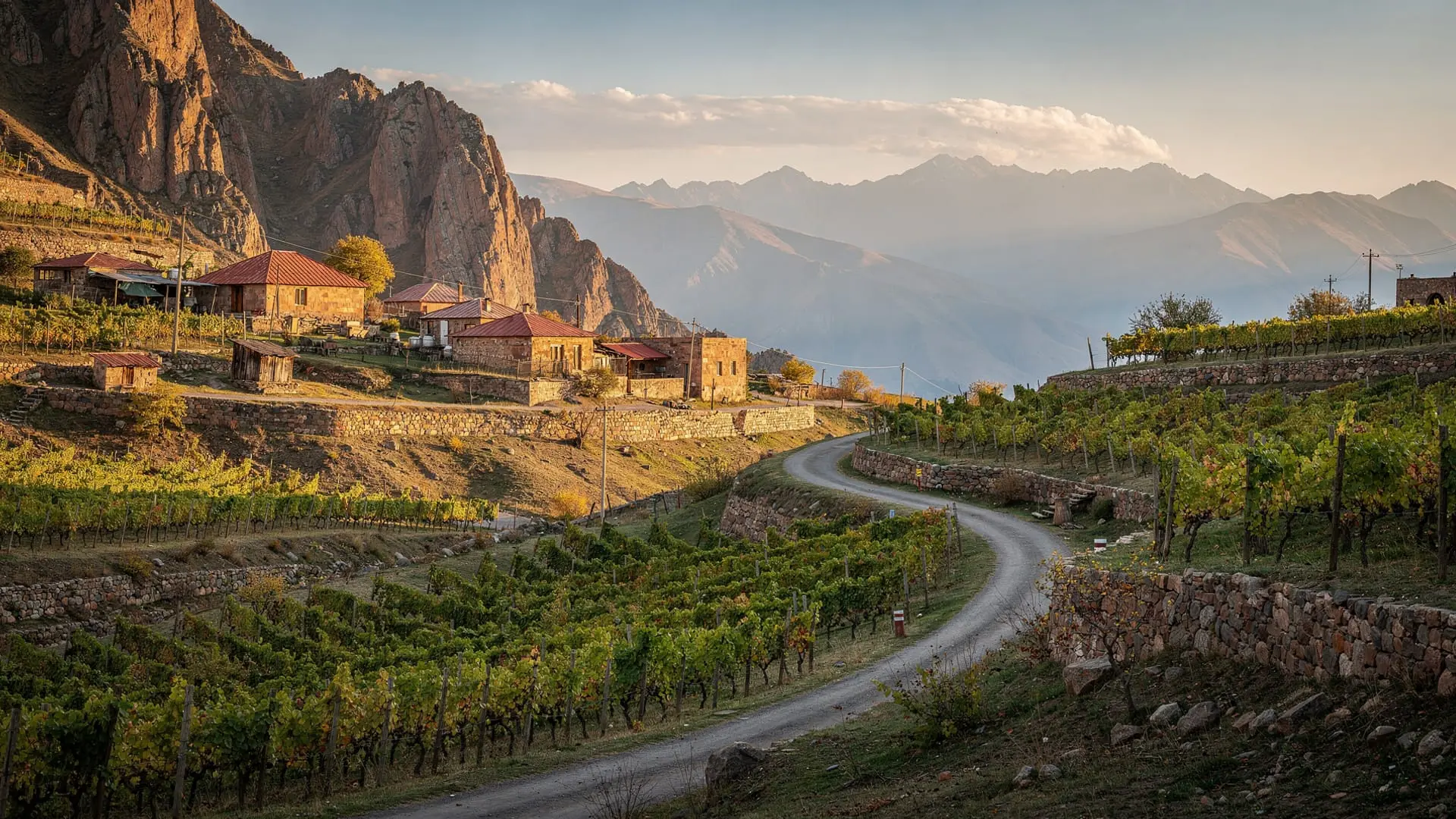
Armenia’s wine country laid out before you
The road from Yerevan to Areni descends through the rocky Ararat Valley and then climbs again into Vayots Dzor — literally “Gorge of Woes” — where limestone cliffs drop to the Arpa River and terraced vineyards climb the slopes above. It is one of Armenia’s most dramatic landscapes, and the context makes the wine taste better: these vines have been growing here for over 6,100 years, a fact confirmed when archaeologists uncovered the Areni-1 cave winery in 2007, dated to approximately 4100 BCE.
Today, Vayots Dzor is home to Armenia’s most celebrated boutique wineries. This guide takes you through the route, winery by winery, with opening hours, tasting fees, what to order, and how to sequence a day (or two) to see the most without rushing.
| Where | Vayots Dzor province, around Areni village (2 hrs south of Yerevan) |
| Cost | Around 3,000–8,000 AMD (7–20 EUR) per tasting; full day 20,000–35,000 AMD |
| Time needed | A full day for the Areni cluster; two days to add Zorah, Tariri and an overnight |
| Getting there | Rental car, private driver, or a guided day tour — no public transport between estates |
| Best time | Late September–early October (harvest and the Areni Wine Festival) or May–June |
How to use this guide
The wineries described below are arranged geographically, starting near Areni village and moving outward. Most visitors base themselves in Areni or Yeghegnadzor and make a loop. A car is strongly recommended — distances between estates are short (5 to 30 km) but there is no public transport linking them. The Vayots Dzor wine route day tour (approximately 12 hours, USD 110 per person) is the best option for those without a vehicle: it departs from Yerevan, visits multiple estates, and returns the same day. For a two-day itinerary with an overnight stay, the Areni wine tour with overnight stay covers more ground.
The route: Areni cluster
Hin Areni
The oldest established winery open to tourists in Areni village, Hin Areni operates from a building a short walk from the centre of the village. Founded in 2003, the estate has grown considerably and now produces a full range including sparkling, rosé, and still Areni Noir at multiple quality levels. The tasting room is welcoming and informal; the standard tasting (five wines, approximately 4,000 AMD or 10 EUR) is good value. The reserve Areni Noir is the flagship and one of the best expressions of the variety at a mid-range price point.
Opening hours: daily 10:00 to 18:00 (last tasting 17:00). Reservations recommended for groups of six or more. For complete visiting information see the Hin Areni winery guide.
Trinity Canyon Vineyards
About 4 km north of Areni on the road toward Yeghegnadzor, Trinity Canyon Vineyards occupies a hillside position with views over the Arpa gorge. The estate was founded in 2012 by three Armenian-American brothers and has earned an excellent reputation for its Areni Noir and Voskeat, both of which have won medals at international competitions. The tasting experience here is more polished than at most local producers — the room is well-designed, the staff are multilingual, and the wines are presented in flights of three or six.
Standard tasting: approximately 5,000 AMD (12 EUR). Premium tasting with reserve wines: 8,000 AMD (20 EUR). Open daily 10:00 to 19:00 April through October; by appointment November through March. Full details in the Trinity Canyon Vineyards guide.
Van Ardi (Sasunik estate)
Near the village of Sasunik (off the Areni–Yeghegnadzor road), Van Ardi is one of the newer boutique estates to emerge from Vayots Dzor and has quickly gained a following for its elegant, restrained style. The winery produces both indigenous varieties — Areni Noir, Voskeat, Karmrahyut, Kakhet — and small amounts of internationally influenced blends. The estate was designed with hospitality in mind: there is a terrace, a cellar tour option, and a small food menu to accompany tastings.
Standard tasting (four wines): 4,500 AMD (11 EUR). Open daily May through October; weekends only in winter. The Van Ardi winery tour and dining experience includes a guided tasting and a vineyard meal.
Maran winery
Located in the upper reaches of Areni village, Maran is a family-run producer operating on a small scale. The tasting experience is deliberately simple — a table outside the production building, a few wines poured directly by the winemaker — but the intimacy is part of its appeal. Maran’s Areni Noir is consistently well-reviewed, and the price-to-quality ratio is exceptional. Tastings start at 2,000 AMD (around 5 EUR). Call ahead to confirm availability, as opening hours are irregular.
Extending east: Yeghegnadzor and beyond
Tariri winery
Tariri sits approximately 10 km east of Areni near the village of Aghavnavank. The winery was founded in 2014 by a young Armenian winemaker with experience in France, and the house style reflects that training: clean, precise, with good fruit definition and well-managed tannins. Tariri focuses primarily on Areni Noir and produces both an entry-level and a reserve bottling. Tastings cost approximately 4,000 AMD (10 EUR) for four wines. Appointment strongly recommended.
Tushpa winery
Further east toward Jermuk, Tushpa is one of the more experimental producers in the region. The winemaker has been working with skin-contact Kakhet and extended-maceration Areni Noir, producing wines that attract attention from natural-wine enthusiasts. Not for everyone, but worth a detour if you have time and curiosity. Call ahead to confirm visits.
Going high: Zorah and Yacoubian-Hobbs
Both Zorah and Yacoubian-Hobbs grow their vines at significantly higher elevations than the Areni cluster — above 1,700 metres — giving wines with a distinctive mineral quality and naturally high acidity that differs from the richer, more immediately approachable style of valley-floor producers. Both are appointment-only and somewhat removed from the main route, but they represent the apex of Armenian winemaking ambition.
For full visiting details, opening hours, and what to expect from each estate, see the dedicated Zorah and Yacoubian-Hobbs guide.
Suggested one-day wine route itinerary
08:30 Depart Yerevan (driving time approximately 2 hours).
10:30 Arrive Areni-1 cave for a guided tour (allow 45 minutes; 1,000 AMD entry). This archaeological site provides essential context for everything you will taste later. See the Areni-1 cave guide for details.
11:30 Walk to Hin Areni winery for a standard tasting of five wines.
13:00 Lunch at the Hin Areni restaurant or at one of Areni village’s informal restaurants. Order grilled trout from the local river, fresh lavash, and a glass of house Areni Noir.
14:30 Drive to Trinity Canyon Vineyards for a premium tasting flight. The views from the terrace are excellent.
16:30 Drive to Van Ardi (Sasunik) for an afternoon tasting, or substitute Maran if you prefer something more rustic.
18:00 Begin return drive to Yerevan, or check in to accommodation in Areni or Yeghegnadzor for an overnight stay.
Suggested two-day wine route itinerary
Day one: Follow the one-day itinerary above through Trinity Canyon. In the late afternoon, drive out to Zorah’s vineyard area near Rind village (approximately 30 km from Areni) for a pre-arranged visit.
Day two: Morning at Tariri and Van Ardi. Afternoon at Noravank monastery (12 km from Areni) — one of Armenia’s most spectacular medieval sites, set in red-cliffed gorges. Return via Khor Virap monastery for sunset views of Mount Ararat. See Noravank monastery and Khor Virap destination pages.
The grape varieties you will encounter
Every winery on the Vayots Dzor route will offer you at least one wine made from Areni Noir, the indigenous red variety that is the soul of Armenian winemaking. Expect pomegranate, dried cranberry, and dried rose, with acidity that keeps the wine fresh through a full meal.
Voskeat (white) will appear at most estates: full-bodied and textural, with quince, beeswax, and dried apricot. Order it alongside grilled vegetables or fresh cheese.
Karmrahyut offers inky colour and dark fruit — blackberry, black plum — with a firmer tannic structure than Areni Noir. It is often used in blends to add depth.
Khndoghni (Sireni) is lighter and more aromatic, with cherry and floral notes. A few estates produce it as a standalone wine.
Kakhet appears in skin-contact or “orange wine” format at experimental producers — Tushpa in particular. The style is polarising but worth trying once.
See the Armenian wine grapes guide for a full botanical and flavour profile of each variety.
Prices and what to budget
Wine tourism in Vayots Dzor is good value by European standards. Budget the following per person for a full day on the route:
- Entry to Areni-1 cave: 1,000 AMD (2.40 EUR)
- Standard wine tasting at each winery: 3,000 to 5,000 AMD (7 to 12 EUR) per stop
- Lunch in Areni village: 4,000 to 8,000 AMD (10 to 20 EUR)
- Premium tasting at Trinity Canyon or Zorah: 8,000 AMD and above (20 EUR+)
- Accommodation in Areni village guesthouse (if staying overnight): 10,000 to 20,000 AMD (25 to 50 EUR)
Total for a self-guided full day (transport by rental car + three tastings + lunch): approximately 20,000 to 35,000 AMD per person (50 to 85 EUR), excluding transport from Yerevan.
When to visit
September and October are ideal. The harvest creates an energy throughout the valley, freshly pressed juice is sometimes available for tasting, and the first week of October brings the Areni Wine Festival — Armenia’s largest wine event, held in the village with dozens of producers pouring alongside food stalls and folk music. See the Armenian wine festivals guide for festival dates and logistics.
May and June are the second-best window: warm without being extreme, vines flowering, and crowds lower than during harvest.
July and August are manageable at Vayots Dzor’s elevation (the heat is less intense than in Yerevan or the Ararat Valley), but tourist numbers are at their peak.
November through March: many smaller wineries close or operate by appointment only. Always call ahead.
What else to see in Vayots Dzor
The wine route sits within a province that rewards broader exploration.
Noravank monastery (12 km from Areni) is one of Armenia’s most visited sites — a 13th-century complex built into a narrow canyon of red limestone cliffs. Allow 90 minutes for the visit.
The Areni-1 cave is the archaeological anchor of the region and should be the first stop on any wine-focused day. Details at /guides/areni-1-cave-oldest-winery/.
Jermuk (65 km from Areni) is a Soviet-era spa town with a famous waterfall, mineral water galleries, and thermal baths. A natural add-on for a two-day itinerary.
Selim Caravanserai (between Yeghegnadzor and Jermuk, on the old Silk Road pass) is one of Armenia’s best-preserved medieval caravanserais, at 2,410 metres elevation with mountain views.
For all transport logistics and what to do in the broader province, see the Vayots Dzor destination page.
Frequently asked questions about the Vayots Dzor wine route
Do I need to book winery visits in advance?
For Zorah and Yacoubian-Hobbs, yes — they are strictly appointment-only. For Hin Areni, Trinity Canyon, and Van Ardi, walk-ins are generally welcomed during published opening hours. Booking ahead is advisable in October during the festival period, as groups can fill tasting slots quickly.
Can I buy wine to take home from the wineries?
Yes, every winery on the route has wines available for purchase in their shop. Prices are generally lower than in Yerevan shops (no retail markup). Note that international travellers need to check their airline’s liquid allowance for checked bags if carrying bottles home; most wineries can recommend specialist packaging.
Is food available at the wineries?
Most of the larger estates (Hin Areni, Trinity Canyon, Van Ardi) have some form of food offering, ranging from a light snack board to a full restaurant menu. Smaller producers like Maran do not typically serve food. The village of Areni itself has several restaurants.
What is the alcohol content of Areni Noir?
Typical commercial Areni Noir wines range from 12% to 14% ABV. High-altitude, low-yield examples from Zorah and Yacoubian-Hobbs tend toward the lower end of that range; valley-floor versions can reach 14% or above in hot years.
Is there public transport to the wineries?
There is no public transport running between individual wineries. Marshrutkas connect Yerevan to Areni village, but moving between estates requires a car, a local taxi from the village, or an organised tour. The guided wine route day tour is the most practical option for those without a vehicle.
How does Vayots Dzor compare to Aragatsotn for a wine day?
Both are worthwhile, and they show different sides of Armenian wine. Vayots Dzor has more wineries clustered close together and the Areni-1 cave for historical context, making it the better single wine-focused day. Voskevaz in Aragatsotn is closer to Yerevan (under an hour) and pairs naturally with Amberd fortress if you want to combine wine with a highland day trip rather than dedicate a full day to tasting alone.
Can I visit the wine route as part of a longer Armenia itinerary?
Yes — most travellers combine it with Noravank monastery, Khor Virap, and sometimes Tatev, since all sit along the same southward road from Yerevan. The Armenia wine route 5-day itinerary builds a full trip around this corridor if wine is your main focus.
Understanding Vayots Dzor’s geology and its effect on wine
The physical geography of Vayots Dzor is unusual even by the standards of a region that includes the volcanic plains of Aragats and the basalt gorges of Lori. The province’s name — “Gorge of Woes” — describes its principal topographic feature: a series of steep-walled canyons cut by the Arpa River and its tributaries through a landscape of volcanic basalt, ancient limestone, and alluvial deposits left by multiple glaciations.
For viticulture, this complex geology is an asset rather than a challenge. Different soil types within a few kilometres of each other produce measurably different wines from the same variety. Areni Noir grown on pure basalt shows an iron-mineral, slightly smoky quality absent in valley-floor versions on alluvial soils. The same grape on limestone terraces above Yeghegnadzor produces wines with more floral delicacy and lighter body. The variation within Vayots Dzor is, in a sense, its terroir — not a single unified character but a mosaic of micro-expressions from an unusually diverse geological canvas.
Modern winemakers are beginning to exploit this diversity deliberately. Trinity Canyon farms across multiple soil types and blends them to capture the complexity of the mosaic; Zorah goes in the opposite direction, focusing on a single high-altitude basalt parcel to maximum purity. The fascination of the wine route comes partly from this range of philosophical approaches to the same landscape.
The winemakers behind the route: profiles
Gago Gevorkyan (Trinity Canyon Vineyards)
Gago Gevorkyan is one of the winemaking personalities who has most shaped the modern Vayots Dzor wine scene. With training in Bordeaux and deep family connections to the region, he returned to Armenia to work with the founding brothers of Trinity Canyon and has been instrumental in building its reputation. His approach combines French technical precision with genuine reverence for Armenian indigenous varieties; the reserve Areni Noir under his direction is regularly one of the best wines produced in the country.
Vahe Keushguerian (Zorah)
Keushguerian grew up in Uruguay, studied winemaking in California and Burgundy, and arrived in Armenia in 2007 — the same year as the Areni-1 cave excavations that confirmed the country’s 6,100-year winemaking history. His commitment to biodynamic viticulture and clay amphora ageing has made Zorah a reference point for natural wine enthusiasts interested in Armenia, and his Karasi Areni Noir is the most internationally distributed Armenian wine.
The family producers
Behind the celebrated names are dozens of family producers who make wine from their own plots and sell primarily at the festival or directly to local restaurants. These producers — operating with minimal equipment, often bottling under simple labels or not at all — are the living link to the agricultural tradition represented by the Areni-1 cave. Meeting them at the festival or on a self-guided tour of the village is one of the most rewarding experiences Vayots Dzor offers.
Sustainable and natural winemaking in Vayots Dzor
A small but growing cluster of producers in the region is working with natural and minimal-intervention winemaking principles. Beyond Zorah’s biodynamic approach, several estates are reducing or eliminating sulfur additions, working with indigenous yeasts, and experimenting with extended maceration of both red and white varieties.
This movement connects explicitly to the archaeological tradition: the Areni-1 cave winery would have produced wine without any additives whatsoever, relying entirely on ambient yeasts and clay vessels for fermentation and storage. Contemporary natural wine is, in this sense, a return to origins rather than an innovation.
Van Ardi and Tushpa are the two estates most consistently producing interesting natural-leaning wines in Vayots Dzor. Both welcome visitors with advance notice and are worth including on a wine route day for the contrast they offer with the more conventionally produced wines of the larger estates.
Accommodation and logistics for a multi-day stay
Staying overnight in Areni or Yeghegnadzor transforms the wine route experience from a day trip into an immersion. Several accommodation options:
Areni village guesthouses: small, family-run, typically 10,000 to 18,000 AMD (24 to 44 EUR) per night for a double room including breakfast. Simple but characterful; meals are often home-cooked. Book ahead in harvest season.
Yeghegnadzor hotels: the provincial capital has several mid-range hotels at 20,000 to 35,000 AMD (49 to 85 EUR) per night. More comfort and more reliable English-language service. Twenty km from Areni by car.
Rural B&Bs on the wine route: a handful of producers have added guest rooms or self-catering cottages to their estates. Van Ardi and one or two smaller producers offer this option; enquire directly. These provide the most intimate wine-country experience — waking up among the vines, breakfast with the winemaker’s family.
The Vayots Dzor destination page at /destinations/vayots-dzor/ has the most current accommodation listings for the province.
Vayots Dzor vs Aragatsotn: Armenia’s other wine region
Vayots Dzor is not Armenia’s only serious wine country. Northwest of Yerevan, the Voskevaz winery and its Aragatsotn neighbours grow at similar altitude on volcanic soils below Mount Aragats, producing a leaner, more mineral style — particularly noticeable in Voskeat, the indigenous white variety both regions share. If your schedule allows only one wine day, Vayots Dzor has the greater density of estates and the Areni-1 cave for archaeological context; if you are short on time and based in Yerevan, Aragatsotn is under an hour away and can be combined with the Amberd fortress and Aragats monasteries. Tasting both back to back — Vayots Dzor one day, Aragatsotn the next — is one of the more instructive things a visiting wine drinker can do in Armenia, since the same grape varieties express themselves so differently across the two terroirs.
Choosing between a self-drive day and a guided tour
Self-driving gives you control over pace and which estates you linger at, but it also means someone in your group is not tasting freely — Armenia’s drink-driving limits are strict and enforced. A rental car makes sense for groups of three or more where driving duties can rotate, or for anyone planning to continue on to Jermuk or the south afterward. For couples or solo travellers, the guided day tour removes that trade-off entirely: everyone tastes, someone else handles the winding gorge roads, and the itinerary is pre-negotiated with the wineries so you are not turned away at a closed gate.
Book the Vayots Dzor wine route day tour from YerevanPrivate tours booked directly with a driver (rather than a fixed-itinerary group tour) split the difference: you keep some flexibility over which wineries to prioritise while still being able to drink at every stop. This is worth the modest premium if your group has strong opinions about which estates matter most — natural-wine drinkers who want more time at Van Ardi and Tushpa, for instance, versus those who want the polish of Trinity Canyon.
What to eat alongside the wine
Vayots Dzor’s food culture is built around what pairs naturally with Areni Noir and Voskeat rather than fine-dining ambition, and that is exactly its appeal. Grilled river trout, fresh lavash torn straight from the tonir, soft local cheese with walnuts and honey, and the region’s own dried fruit (apricots, plums, mulberries) turn up on almost every winery’s food menu and at the informal restaurants in Areni village. During the October harvest, look for jash — a simple grape-must-based dessert paste — and freshly pressed grape juice sold alongside the wine at village stalls. None of this requires seeking out a specific restaurant; ordering whatever the winery’s kitchen or the nearest village table is serving that day is usually the better meal than anything more ambitious you could plan in advance.