Hin Areni winery: tour, tasting & tips
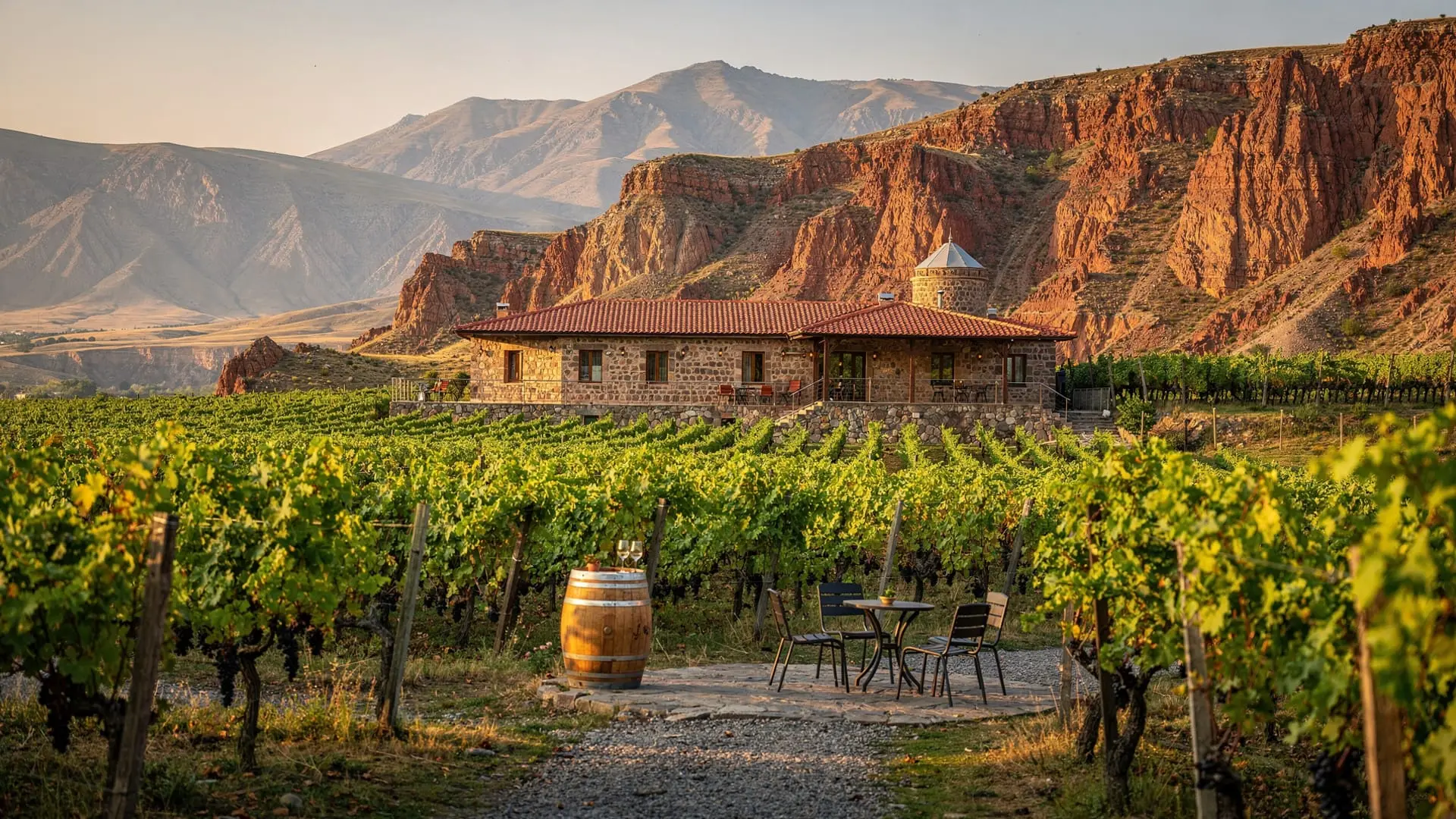
The winery that anchors Areni village
Walk into the centre of Areni village and it is difficult to miss Hin Areni. The winery’s stone-and-concrete building sits close to the main road through the village, a short walk from the bridge over the Arpa River gorge, and its tasting room sign is visible from the highway. For many visitors, Hin Areni is the first winery they encounter in Vayots Dzor — and for good reason: it is the most accessible, consistently open, and thoroughly welcoming operation in the area.
| Where | Areni village centre, Vayots Dzor, ~2h south of Yerevan |
| Cost | Tastings from around 4,000 AMD; reserve tour ~8,000 AMD |
| Time needed | 1.5–2 hours for tasting; add lunch for a half-day |
| Getting there | Car (M2 highway), organised tour, or marshrutka + taxi |
| Best time | Late Sept–early Oct for harvest; open daily April–October |
The name “Hin Areni” means “ancient Areni” in Armenian, a deliberate nod to the village’s deep winemaking roots and to the Areni-1 cave — the world’s oldest known winery, dated to approximately 4100 BCE — which sits just a few hundred metres outside the village. The winery was established in 2003, making it one of the earliest commercially oriented boutique wineries to emerge in post-independence Armenia, and it has grown steadily in scope and quality since then.
This guide covers the practical details of visiting, the wines to focus on, the food offering, and how to fit Hin Areni into a broader Vayots Dzor itinerary.
The wines
Hin Areni’s portfolio is larger than most visitors expect. The range spans sparkling, white, rosé, and multiple tiers of red, all made from indigenous Armenian varieties grown in Vayots Dzor.
Areni Noir is the undisputed flagship. The winery produces at least two quality levels: an approachable entry-level bottling aged briefly in steel, and a reserve version that spends twelve to eighteen months in French oak before bottling. The reserve is the wine to seek out — it shows the full character of Areni Noir at its best: pomegranate, dried cherry, dried rose, and a mineral, chalky finish. Acidity is high and food-friendly.
Voskeat (white): Hin Areni’s Voskeat is one of the most accessible introductions to this indigenous variety. Full-bodied and textural, with quince, dried apricot, and the characteristic bitter almond finish. Try it with grilled trout from the Arpa River, available at the winery’s restaurant.
Karmrahyut appears either as a single variety or blended with Areni Noir to add structure and dark fruit depth. When available as a single varietal, it offers blackberry, black plum, and a dense, structured palate.
The sparkling wine (generally Areni Noir vinified as a blanc de noirs or a rosé sparkling) is produced by the traditional method and is a good aperitif before beginning the tasting proper.
A Kakhet-based skin-contact white appears in limited quantities in some years — ask the tasting room staff whether it is available.
The tasting experience
The tasting room is set in a converted ground floor of the main winery building. The decor is simple — stone walls, wooden furniture, a bar running along one side with bottles displayed behind it — but the atmosphere is comfortable and unhurried. Staff are generally friendly and knowledgeable, and English-speaking guides are available for the standard tasting experience.
Standard tasting: five wines, approximately 4,000 AMD (about 10 EUR) per person. This is the most popular option and represents excellent value.
Reserve tasting: five or six wines focusing on the premium tier, including the reserve Areni Noir. Approximately 6,000 AMD (about 15 EUR).
Cellar tour + tasting: a guided walk through the production facility, explaining the winemaking process from grape reception through fermentation, ageing, and bottling, followed by a five-wine tasting. Cost approximately 8,000 AMD (about 20 EUR). Requires advance booking and is not always available for walk-in visitors.
All wines in the tasting are accompanied by locally produced dried fruits, nuts, and fresh bread — a thoughtful touch that helps pace the session.
The restaurant
Hin Areni operates a restaurant in an adjacent building that makes it a natural stop for lunch during a wine-route day. The menu focuses on traditional Armenian dishes prepared with local ingredients:
- Grilled trout from the Arpa River (4,500 to 6,000 AMD, 11 to 15 EUR)
- Lamb khorovats (barbecue) with lavash and fresh herbs (6,000 to 8,000 AMD, 15 to 20 EUR)
- Tolma (stuffed vine leaves) in both summer and winter versions
- Cheese and cold cuts platter with local honey and walnuts
The wine list at the restaurant goes beyond the tasting flights to include older vintages of the reserve Areni Noir, sometimes back to five or six years. Carafe pricing for house wine is reasonable at around 2,500 AMD for 500ml.
Reservations for the restaurant are recommended at weekends and during festival season (September to October). Walk-ins are usually accommodated Monday through Friday.
Getting there
Hin Areni is located in the centre of Areni village on the main road (M2 highway Yerevan–Goris). The winery is clearly signposted.
By car from Yerevan: approximately 2 hours via the M2 highway heading south. Follow signs to Yeghegnadzor and then Areni; the winery is on the main street through the village.
By organised tour: several day tours from Yerevan include Hin Areni as a stop. The Group tour including Hin Areni wine factory and Tatev combines the winery with the Wings of Tatev cable car and Khndzoresk cave village — an efficient way to see the highlights of southern Armenia in a single long day.
By marshrutka: marshrutkas from Yerevan’s Kilikia station run to Yeghegnadzor; from there, a local taxi to Areni costs approximately 3,000 AMD (7 EUR) each way.
Opening hours and contact
Open daily 10:00 to 18:00 (last tasting 17:00) from April through October. Reduced hours in winter; call ahead between November and March.
Groups of eight or more should book via email or phone at least two days in advance. Individual visitors and small groups can generally walk in.
Wine can be purchased to take home from the winery shop; prices are slightly lower than in Yerevan retail. Shipping within Armenia is possible; international shipping is not currently offered directly — buy and carry is the practical option.
Fitting Hin Areni into your Vayots Dzor day
Hin Areni pairs naturally with a stop at the Areni-1 cave (ten minutes on foot from the winery) and with a visit to Trinity Canyon Vineyards (4 km north on the road toward Yeghegnadzor). A logical one-day sequence:
- 10:30 Areni-1 cave tour (45 minutes; 1,000 AMD entry). Full visiting details at /guides/areni-1-cave-oldest-winery/.
- 11:30 Hin Areni winery: standard tasting (90 minutes)
- 13:00 Lunch at Hin Areni restaurant
- 14:30 Trinity Canyon Vineyards (see Trinity Canyon guide)
- 16:30 Optional stop: Noravank monastery (12 km from Areni; see /destinations/noravank-monastery/)
- 18:00 Drive back toward Yerevan
For a more comprehensive multi-winery day, add Maran winery (also in Areni village) or extend to Van Ardi near Sasunik. The full route is mapped in the Vayots Dzor wine route guide.
What to buy
The reserve Areni Noir is the most consistent gift option — it travels well and communicates Armenia’s wine identity clearly. Prices at the winery shop: entry-level Areni Noir from 3,500 AMD (8.50 EUR), reserve from 7,000 to 9,000 AMD (17 to 22 EUR), Voskeat from 5,000 AMD (12 EUR).
The winery also sells small-batch preserves (pomegranate molasses, dried fig compote) and local honey that make practical souvenirs alongside the wine.
The broader Areni wine village experience
Areni village itself is worth wandering beyond the winery gates. The village square has a few informal cafes selling tea and local pastries. The path down to the Arpa River gorge is accessible on foot (15 minutes), offering views of the volcanic basalt cliffs and the terraced vineyards that have been worked continuously — with a few interruptions — for over six thousand years. For the full story of those six thousand years, the Armenia wine country overview and the Areni-1 cave guide provide essential context.
Comparing Hin Areni’s tasting tiers
For visitors deciding which tasting option to book, a side-by-side helps:
| Tasting | Wines | Price | Best for |
|---|---|---|---|
| Standard | 5 wines | ~4,000 AMD | First-time visitors, quick stop |
| Reserve | 5–6 wines incl. reserve Areni Noir | ~6,000 AMD | Wine enthusiasts wanting the premium tier |
| Cellar tour + tasting | Facility walk + 5 wines | ~8,000 AMD | Anyone curious about the winemaking process |
Most first-time visitors do well with the standard tasting and can always order a glass of the reserve Areni Noir separately at the restaurant afterward if their interest is piqued — a more flexible and often cheaper way to sample the top tier than committing to the reserve tasting upfront.
Hin Areni and the Areni Wine Festival
If your trip coincides with late September or early October, timing a visit around the Areni Wine Festival adds a layer most visitors miss. The festival, held in Areni village itself, draws producers from across Vayots Dzor for tastings, folk music, and food stalls in the village square — Hin Areni, as the anchor winery of the village, is typically at the centre of the activity. Expect significantly larger crowds than a normal visit, so if a quiet, unhurried tasting is the priority, visit a week or two before or after the festival dates rather than during it. Either way, harvest season is the most visually interesting time to see the winery, with fresh fruit arriving at the reception table and the fermentation vessels active.
A practical note on driving after tasting
Given Hin Areni’s roadside position on the M2 highway, it’s worth planning who drives before you arrive rather than deciding at the tasting room. Non-drinking passengers can do the reserve tasting while the driver sticks to a smaller pour or the grape juice alternative offered for children and non-drinkers. Several of the organised day tours from Yerevan solve this problem entirely by including transport, which is one of their strongest practical arguments for groups where everyone wants to taste properly.
Armenia’s drink-driving limits are strict, and enforcement on the M2 highway has increased in recent years — treat any tasting seriously rather than assuming a casual sip-and-spit approach is optional. If you’re driving onward to Noravank or Trinity Canyon the same afternoon, spacing tastings across the day with food and water in between is the sensible approach rather than trying to taste at full pace everywhere.
Frequently asked questions about Hin Areni
Is Hin Areni open in winter?
The winery operates in winter but on reduced hours and staff. Walk-in tastings are possible but not guaranteed; calling ahead is strongly recommended between November and March. The restaurant may also be closed on weekdays in the low season.
Can children visit the winery?
Yes. The tasting room and restaurant are family-friendly. Grape juice and Armenian lemonades are available for non-drinkers. The cellar tour is interesting for older children and teenagers.
Is there accommodation near Hin Areni?
Areni village has several guesthouses within walking distance of the winery. Prices range from 10,000 to 20,000 AMD (25 to 50 EUR) per night for a double room including breakfast. The winery itself does not offer accommodation. Yeghegnadzor (20 km) has a wider choice of hotels.
Does Hin Areni do private events or weddings?
The winery has hosted private events in its restaurant space. Contact them directly for event enquiries. The restaurant terrace (weather permitting in spring and autumn) is particularly appealing for small groups.
How does Hin Areni compare to Trinity Canyon Vineyards?
Hin Areni is the more accessible, walk-in-friendly option with a broader range and a full restaurant. Trinity Canyon has a slightly more polished tasting room experience and focuses more specifically on its premium range. Both are excellent; visiting both in a single day is easy and complementary. The style differences — Hin Areni is slightly richer and more immediately approachable; Trinity Canyon tends toward more structure and longer finish — are interesting to compare side by side.
Understanding Hin Areni’s place in Armenian wine history
Hin Areni was among the first commercial wineries to emerge in the Vayots Dzor region after Armenian independence in 1991. The Soviet-era approach to winemaking in Armenia had been almost entirely industrial: grapes were harvested at high yields, processed into bulk concentrate, and shipped north. Individual winemaking identity was suppressed; regional terroir was irrelevant.
The founders of Hin Areni chose a deliberately different path. By anchoring the brand to the village of Areni specifically — and by naming the winery “ancient Areni” — they signalled that their project was about recovering something that had existed before the Soviet interruption. The connection to the Areni-1 cave, which archaeologists began excavating in 2007 and dated to approximately 4100 BCE, gave that intention archaeological weight.
Today, Hin Areni functions not just as a commercial winery but as an ambassador for the Areni Noir grape variety specifically. Its entry-level bottling is available in virtually every significant wine shop and restaurant in Yerevan; it is often the first Armenian wine that visitors encounter. This gives the winery an unusual responsibility — and, generally speaking, it discharges it well.
The Areni Noir grape and Hin Areni’s approach to it
Hin Areni works with Areni Noir at multiple elevations and from several different plots around the village. The entry-level wine draws from younger vines and valley-floor plots; the reserve draws from older vines on steeper terraces. The difference in the glass is real and interesting.
The entry-level Areni Noir — fresh, light, pomegranate-forward, with soft tannins — is the wine that converts sceptics. First-time drinkers of Armenian wine often expect something heavy and rustic; Hin Areni’s everyday Areni Noir is a revelation in its delicacy and freshness. It bears comparison to a good Beaujolais cru or a simple Pinot Noir from a warm year: something to drink young, with food, without overthinking.
The reserve is a different proposition. Eighteen months in French oak gives the wine structure it carries comfortably — the tannins are silky rather than aggressive, the oak integrates fully, and the original pomegranate-and-dried-cherry fruit is augmented by notes of dried herbs, tobacco leaf, and a faint volcanic mineral. At 7,000 to 9,000 AMD (17 to 22 EUR), it is one of the best-value wines in the Armenian market.
The Voskeat at Hin Areni: an indigenous gem
While Areni Noir is the calling card, the Hin Areni Voskeat deserves equal attention. The variety was nearly extinct at the time of Armenian independence; it is still grown in relatively small quantities across Vayots Dzor and Aragatsotn. Hin Areni has been producing a varietal Voskeat for most of its history and has done more than most producers to demonstrate the grape’s commercial viability.
The wine shows Voskeat’s signature profile beautifully: a golden-yellow colour, aromas of quince, beeswax, and dried apricot, a textural mid-palate, and the characteristic bitter almond finish that sets the variety apart from any other white grape in the Armenian portfolio. Served slightly chilled alongside grilled trout or fresh cheese, it is a genuinely distinctive wine — not merely a local curiosity but a grape variety that warrants international recognition.
Best pairings for Hin Areni wines at the restaurant
The winery restaurant’s menu is designed around the wines. Some specific pairing notes:
Areni Noir reserve with slow-roasted lamb: the wine’s acid and tannin cut through the fat beautifully; the dried-herb notes in the wine echo the herbs in the cooking.
Voskeat with grilled trout: a classic pairing from the local food tradition; the river produces the fish, the terraces produce the wine, and together they are greater than the sum of their parts.
Entry-level Areni Noir with tolma: the fresh acidity of the young wine is a perfect foil for the vinegary sharpness of the vine-leaf wrapping; neither overwhelms the other.
Sparkling Areni Noir with mezzeh (cold starters): a house speciality that shows the grape’s versatility.
The restaurant also serves the village’s most serious pomegranate molasses — a condiment integral to Armenian cooking — alongside grilled meats. The combination of the molasses, the lamb, and the reserve Areni Noir is the restaurant’s unofficial signature experience.
The Areni wine village: walking beyond the winery gates
Hin Areni’s central position in the village makes it an ideal base from which to explore Areni on foot. The village is small — perhaps 3,000 permanent residents — but it rewards unhurried exploration.
From the winery, a path leads down to the Arpa River gorge — about 15 minutes on foot — where the basalt canyon walls drop sharply to the fast-running river below. The terraced vineyards above the path are actively farmed; in autumn the clusters of Areni Noir hang in the sun at eye level. This is one of the few places in the wine world where you can stand at water level, look up at the vineyards, and then look at the cave mouth above the opposite bank where wine was first made 6,100 years ago.
The cave — Areni-1 — is a ten-minute walk from Hin Areni’s front door. Details of visiting are in the Areni-1 cave guide, but the practical point here is that the cave and the winery can be combined in a single morning without any transport.
The village square has several informal cafes where local men play backgammon over tea. These are not tourist operations; they serve tea, coffee, and sometimes freshly pressed pomegranate juice. Sitting for 20 minutes and watching village life is an underrated part of any Areni visit.
The Areni Noir harvest: how the season works
Understanding the harvest helps time a visit for maximum interest. Areni Noir typically ripens later than most commercial varieties because of its cool high-altitude position; the harvest in Vayots Dzor runs roughly as follows:
Late August to mid-September: white varieties (Voskeat, Kakhet, Khndoghni) are harvested first, typically at first light to preserve acidity. Hin Areni runs a small white wine operation alongside its reds.
Mid-September to mid-October: Areni Noir comes in from the lower-elevation plots first, then progressively from the steeper high-altitude terraces. The peak harvest weeks are typically the last week of September and the first two weeks of October — coinciding with the Areni Wine Festival.
The pressing and fermentation: after sorting on the reception table, grapes go into fermentation vessels — stainless steel at Hin Areni for the entry-level wines, with some oak or clay for the reserve parcels. Fermentation lasts ten to fourteen days for reds; the cap (floating grape skins) is punched down by hand twice daily to extract colour and tannin.
Visitors who arrive during the harvest may be invited to observe the reception and sorting at Hin Areni; ask the tasting room staff whether this is possible on the day of your visit.
Is Hin Areni suitable for a first-time visitor to Armenian wine who knows nothing about it?
Yes — arguably it’s the best possible introduction. The standard tasting is structured to be approachable, staff are used to explaining indigenous varieties like Areni Noir and Voskeat to visitors with no prior context, and the entry-level Areni Noir in particular is designed to convert sceptics without overwhelming them. Pairing the tasting with the Areni-1 cave guide next door adds historical context that makes the wine itself more meaningful.
Should I visit Hin Areni or start with the Vayots Dzor wine route guide first?
If you only have time for one winery, Hin Areni is a strong single stop given its accessibility, restaurant, and proximity to the Areni-1 cave. If you want the fuller picture of the region’s wine scene, the Vayots Dzor wine route guide maps out how to combine Hin Areni with Trinity Canyon, Maran, and other producers into a coherent day.