Armenia packing list: by season
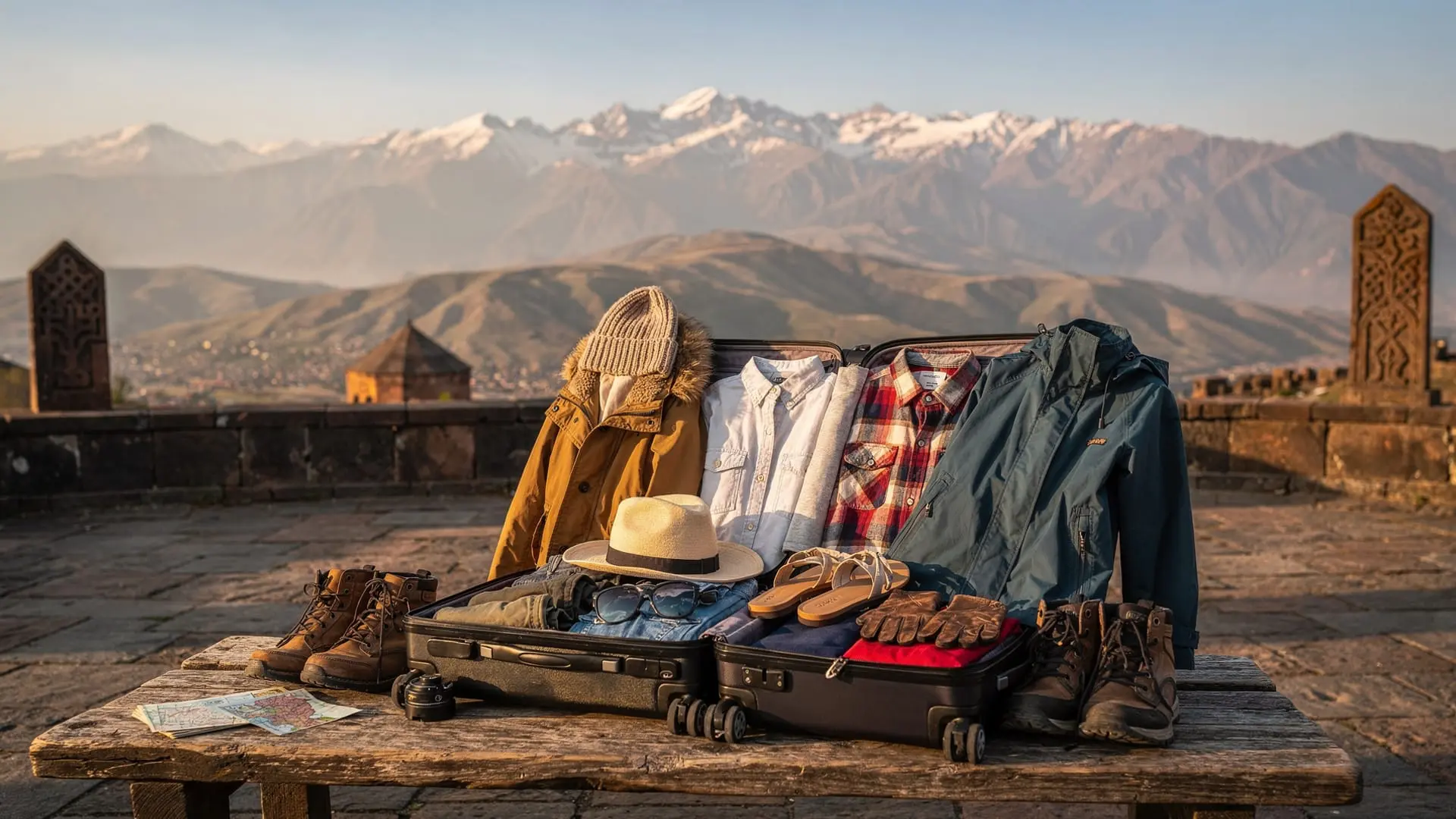
Packing for Armenia: the core principle
Armenia’s dramatic elevation range — from the hot Ararat Valley at 800 m to Aragats summit at 4,090 m — means you can experience extreme temperature variation within a single day trip. A morning at Khor Virap monastery in July might hit 35°C; an afternoon at Aragats lake can drop to 10°C. Layering is not just recommended, it is the only rational approach.
The second key principle: modest dress is required at all Armenian Apostolic churches and monasteries, which make up a significant portion of the typical Armenia itinerary. This means covered shoulders and knees for both men and women. Headscarves for women are appreciated but not always obligatory — the monastery will often provide a cloth at the entrance. This requirement exists year-round.
| Core rule | Layer for altitude swings; pack one modest layer year-round |
| Yerevan summer | Up to 35°C; mountains 10–20°C cooler |
| Yerevan winter | Down to -10°C; Tsaghkadzor -15 to -20°C |
| Bag size | 35–40L for a week spring/summer; 50L for 10–14 day mixed trips |
| Buy locally if needed | Sunscreen, adapters, scarves, hiking socks — all in Yerevan |
Seasonal packing at a glance
| Season | Key items | Watch out for |
|---|---|---|
| Summer (Jun–Aug) | Light cotton/linen, sun hat, SPF 50+ | 35°C in Yerevan; mountains still need a layer |
| Spring (Apr–May) | Waterproof shell, mid-layer fleece | Sudden rain; snow lingers on Aragats into May |
| Autumn (Sep–Oct) | Fleece layers, waterproof jacket | Evenings drop fast by October |
| Winter (Nov–Mar) | Down jacket, thermal base layers, waterproof boots | Icy streets; Tsaghkadzor sub-zero |
Summer packing list (June–August)
Summer in Yerevan is hot and dry. July and August regularly reach 35°C in the city. The mountains and lakes are cooler.
Clothing
- 3–5 lightweight t-shirts or linen/cotton shirts: the staple of summer in the Ararat Valley
- 1–2 lightweight long-sleeved shirts or cotton button-downs: essential for monastery visits and sun protection during long outdoor days
- 1–2 lightweight trousers or long skirts: for monastery visits and cooler evenings
- 1–2 pairs of shorts: for cities, beaches at Lake Sevan, and casual sightseeing days
- A lightweight scarf or pashmina: multi-purpose — modesty cover at monasteries, sun protection on open-air sites, cool evenings in Dilijan
- A light jacket or cardigan: Yerevan evenings can cool to 20–22°C; Dilijan and mountain areas are noticeably cooler even in summer
Footwear
- Sturdy walking shoes or light hiking shoes: Yerevan is a cobblestone city and monastery courtyards are uneven. Flat-soled trainers or leather walkers are ideal. Save sandals for Lake Sevan.
- Sandals or flip-flops: for beach days at Lake Sevan and casual city evenings
- Socks: more than you think you need — dusty paths at monasteries fill shoes quickly
Sun and heat protection
- Sunscreen SPF 50+: Armenia’s high plateau UV is intense in summer. Reapply throughout the day, especially at altitude.
- Sunglasses with UV protection: essential at Aragats and high-altitude sites
- A wide-brimmed hat or cap: the single most important summer item. Geghard, Khor Virap, and Noravank have almost no shade.
- Insect repellent: less critical than tropical destinations but useful for evenings near Lake Sevan and in forested areas of Dilijan and Tavush
Health and personal
- Reusable water bottle: Yerevan has excellent tap water and water fountains. Staying hydrated in summer heat is critical. Reduce plastic waste.
- Ibuprofen/paracetamol: For heat headaches, common at altitude on Aragats.
- Blister plasters: Cobblestones eat footwear. Even experienced walkers get caught out.
Spring packing list (April–May)
Spring is the best season and offers the most pleasant packing challenge: warm days, cool evenings, occasional rain.
Clothing
- 3–4 mid-weight tops and t-shirts
- 1–2 light to mid-weight long-sleeved shirts (for monasteries and layering)
- 1–2 pairs of hiking trousers or versatile travel trousers: perfect for monastery hiking and hill walks
- 1 waterproof or wind-resistant jacket: April rain can arrive without warning; a packable waterproof shell that fits in your day bag is ideal
- A mid-layer fleece or light down vest: evenings in April are cool (8–12°C in Yerevan); at Lake Sevan or Dilijan, drop to 5–8°C
- Modest layer for monasteries (as always)
Footwear
- Light hiking shoes or walking boots: Spring trails can be muddy after rain. Ankle support is useful on uneven monastery approaches.
- Waterproof or water-resistant boots if hiking: Aragats and mountain trails retain snow into May
Additional spring items
- Small day-hiking backpack (20–25L): for water, sunscreen, lunch, and a jacket layer
- Trekking poles: optional but appreciated for Aragats or gorge trails with loose shale
Autumn packing list (September–October)
Autumn mirrors spring in spirit — comfortable, photogenic, with increasing chill toward October.
Clothing
- 3–4 light to mid-weight tops
- 1–2 light to mid-weight fleece or merino wool layers
- 1–2 pairs of longer trousers: evenings get chilly fast in October
- A waterproof jacket: autumn rain is more frequent than spring in some areas
- Warm layer for evenings: by mid-October in Dilijan or Lori, evenings dip to 5–8°C
- Modest dress for monasteries (as always)
October is wine harvest time in Areni and Vayots Dzor. For Areni Wine Festival visits, comfortable casual wear and walking shoes for vineyard terrain are practical.
Footwear
- Sturdy walking shoes or light boots: grape-harvest terrain and monastery paths
- Warm socks: October morning starts are cool
Winter packing list (November–March)
Winter packing for Armenia means genuine cold in the mountains and variable conditions in Yerevan.
Clothing
- A quality down jacket: this is the single most important winter item. Yerevan can hit -10°C in extreme cold snaps; Tsaghkadzor ski resort regularly sits at -15 to -20°C.
- Thermal base layers (top and bottom): for any outdoor activity, skiing, or long monastery visits in cold churches
- 2–3 warm mid-layer sweaters or fleeces
- Warm scarf, hat, and gloves: essential, not optional
- Waterproof trousers or ski pants: for Tsaghkadzor skiing or mountain hiking
- At least one smart-casual outfit for Yerevan evenings: restaurants and bars are heated and social
Footwear
- Waterproof boots with insulation: essential for Yerevan’s occasional icy streets and any mountain excursion
- Ice-grip attachments (Yaktrax or similar): if you plan to hike in winter, particularly in Lori (Haghpat/Sanahin) or around Aragats, these snap-on crampons prevent slips on ice
- Ski boot rental is available at Tsaghkadzor: bringing your own is only worthwhile for frequent skiers
Ski-specific additions
- Goggles: essential on the slopes, even on overcast days
- Ski helmet: rental available at Tsaghkadzor but bringing your own is more hygienic
- UV-protective lip balm: high altitude winter sun causes serious lip burning
For the full winter travel guide, see Armenia in winter: snowy monasteries and Tsaghkadzor.
Year-round essentials
Regardless of when you travel, these items belong in every Armenia packing list:
Documents and money
- Passport (valid for your stay duration)
- Travel insurance documentation
- Some cash in AMD (withdraw from Inecobank or Ameriabank ATMs on arrival)
- Cards (Mastercard/Visa for Yerevan; cash for everywhere else)
Tech and connectivity
- Phone with GG Taxi app installed: the single most useful Armenia app
- Offline map (Maps.me or Google Maps offline area downloaded for Armenia)
- Power adapter: Armenia uses type C and F European sockets, 220V/50Hz. UK and US travellers need an adapter. See our electrical plugs guide.
- Power bank: essential for day trips where you may not be near a power source for 8–10 hours
Health kit
- Personal prescription medications (pharmacies in Yerevan are good; rural areas have limited stock)
- Antihistamines: pollen counts in spring can be high
- Lip balm SPF: any season, the plateau air is dry
- Antibacterial hand gel: useful at crowded monastery sites
Photography
- Extra memory cards and battery for your camera
- A small tripod if you plan interior monastery shots (low light, no flash policy at most sites)
Packing for monastery visits: the specific rules
Every visitor to Armenian Apostolic monasteries should know:
- Shoulders covered: no sleeveless tops or vest-only inside the church buildings
- Knees covered: shorts are generally acceptable in the forecourt but you may be asked to cover up before entering the main church
- Women’s head coverings: expected at some monasteries, optional at others. A lightweight scarf that lives in your bag solves this universally.
- Quiet and respectful behaviour: churches are active places of worship, not just tourist sites. Photography is generally permitted but flash photography is not.
- Footwear: no requirement to remove shoes (unlike mosques), but overly dirty boots in a carpeted church interior should be avoided
Photography gear considerations
Armenia is one of the most photogenic destinations in the Caucasus. If photography is a priority, these additions are worth carrying:
For monastery interiors (low light):
- A wide-aperture prime lens (f/1.8 or f/2.8) handles the dark interiors of carved stone churches far better than a kit zoom
- A small travel tripod or gorilla pod for long exposures (flash photography is forbidden at most sites)
- Multiple battery packs and memory cards — you will shoot more than expected
For landscape photography:
- A graduated ND filter for the high-contrast scenes (dark volcanic mountains, bright sky) common at Aragats and Khor Virap
- A polarising filter for Lake Sevan reflections and monastery landscapes
For travel video:
- A gimbal stabiliser is useful for walking shots through monastery corridors and cobbled Yerevan streets
Drone policy: Drones require a permit from the Civil Aviation Committee of Armenia and are prohibited in the vicinity of military installations, border zones, and some national parks. Flying near the Azerbaijani border area is absolutely forbidden. The rules are strictly enforced in sensitive areas. If you plan to film by drone, obtain the relevant permit before your trip.
Toiletries and pharmacy items
Armenia’s pharmacies in Yerevan are well-stocked with international and local brands. You do not need to over-pack toiletries. Specific items worth noting:
- Sunscreen: Available but imported brands can be expensive. Pack your preferred brand.
- Altitude headache treatment: Ibuprofen and acetaminophen are widely available. For serious altitude medication (acetazolamide for Aragats summit attempt), obtain a prescription from your doctor before travel.
- Contraception: Available at pharmacies, but the selection may not match your preferred brand.
- Sanitary products: Widely available in Yerevan supermarkets and pharmacies.
- Nappy rash cream, baby food, and baby essentials: Available in Yerevan. Rural areas are more limited — pack what you need for day trips.
What experienced Armenia travellers leave behind
Common packing mistakes from first-time visitors:
Over-packing formal wear: Armenia is a smart-casual country. Even Yerevan’s best restaurants do not require formal dress. Leave the suit jackets and evening gowns at home.
Multiple guidebooks: Armenia travel publishing is limited. Most useful references are online. One lightweight print map (available at Yerevan bookshops on arrival) is more useful than several heavy books.
Excessive cash reserves in multiple currencies: EUR and USD are what you need. Other currencies are unnecessary and harder to exchange.
Full-size bottles of everything: Armenian pharmacies and supermarkets (SAS, Yerevan City) stock most toiletries. Pack travel sizes and supplement locally.
Rain gear paranoia: Armenia in summer is very dry. A compact packable rain jacket covers the spring and autumn rain risk without a full rain suit.
Packing list for specific Armenia itineraries
Monastery circuit (Garni, Geghard, Khor Virap, Etchmiadzin, Sevanavank): The classic Armenia itinerary is largely road-based with short walks. Comfortable walking shoes, a modest layer for monastery visits, sun protection, and a camera are the essentials. No hiking boots needed.
Wine country (Areni, Noravank, Vayots Dzor): In addition to standard kit: a small insulated bag or cooler for any wine you purchase to carry safely. Comfortable shoes for uneven vineyard terrain.
Mountain hiking (Aragats, Transcaucasian Trail): A complete hiking kit: boots, poles, layering system, first aid basics, sufficient water capacity. Navigation downloaded offline.
Ski trip (Tsaghkadzor): Equipment can be rented locally. Pack warm base layers, down jacket, and a helmet if you have one. See our Tsaghkadzor ski guide for resort specifics.
Frequently asked questions about packing for Armenia
Is there a dress code for Yerevan restaurants?
Yerevan restaurants are generally smart-casual at the upper end, casual everywhere else. No formal dress code applies at any tourist restaurant. Shorts and a clean shirt are fine for dinner at most places.
Can I do laundry easily in Armenia?
Yes. Most hotels above budget level offer laundry service. In Yerevan, laundromats (self-service and drop-off) are available in residential neighbourhoods. For a week-long trip, pack clothes that pack small and dry quickly rather than over-packing.
How large a bag do I need?
For a 7-day spring or summer trip, a 35–40L backpack or carry-on roller is sufficient. For a 7-day winter trip with ski gear, either pack a full 60L bag or plan to rent ski equipment at Tsaghkadzor (recommended). For a 10–14 day mixed trip, a 50L bag is the sweet spot.
Is there anything I can buy in Armenia rather than packing?
Yes — sunscreen (widely available at pharmacies), over-the-counter medications, adapters, light scarves, and even decent hiking socks are all available in Yerevan. You do not need to pre-pack everything.
Do I need different gear for a hiking-focused trip versus a monastery-and-city trip?
Meaningfully, yes. A monastery-and-city itinerary (Garni, Geghard, Khor Virap, Etchmiadzin) needs little beyond comfortable walking shoes and a modest layer — no hiking boots required. A hiking-focused trip into the Armenia hiking best season window needs a full layering system, proper boots, and navigation gear. Check which category your trip falls into before over- or under-packing.
What’s the one item experienced Armenia travellers say they wish they’d packed?
A lightweight scarf or pashmina, consistently. It solves monastery modesty requirements, sun protection at shade-free sites like Khor Virap and Noravank, and evening chill in Dilijan — a single multi-purpose item that earns its space in the bag more than almost anything else on this list.