Armenian language classes in Yerevan for diaspora
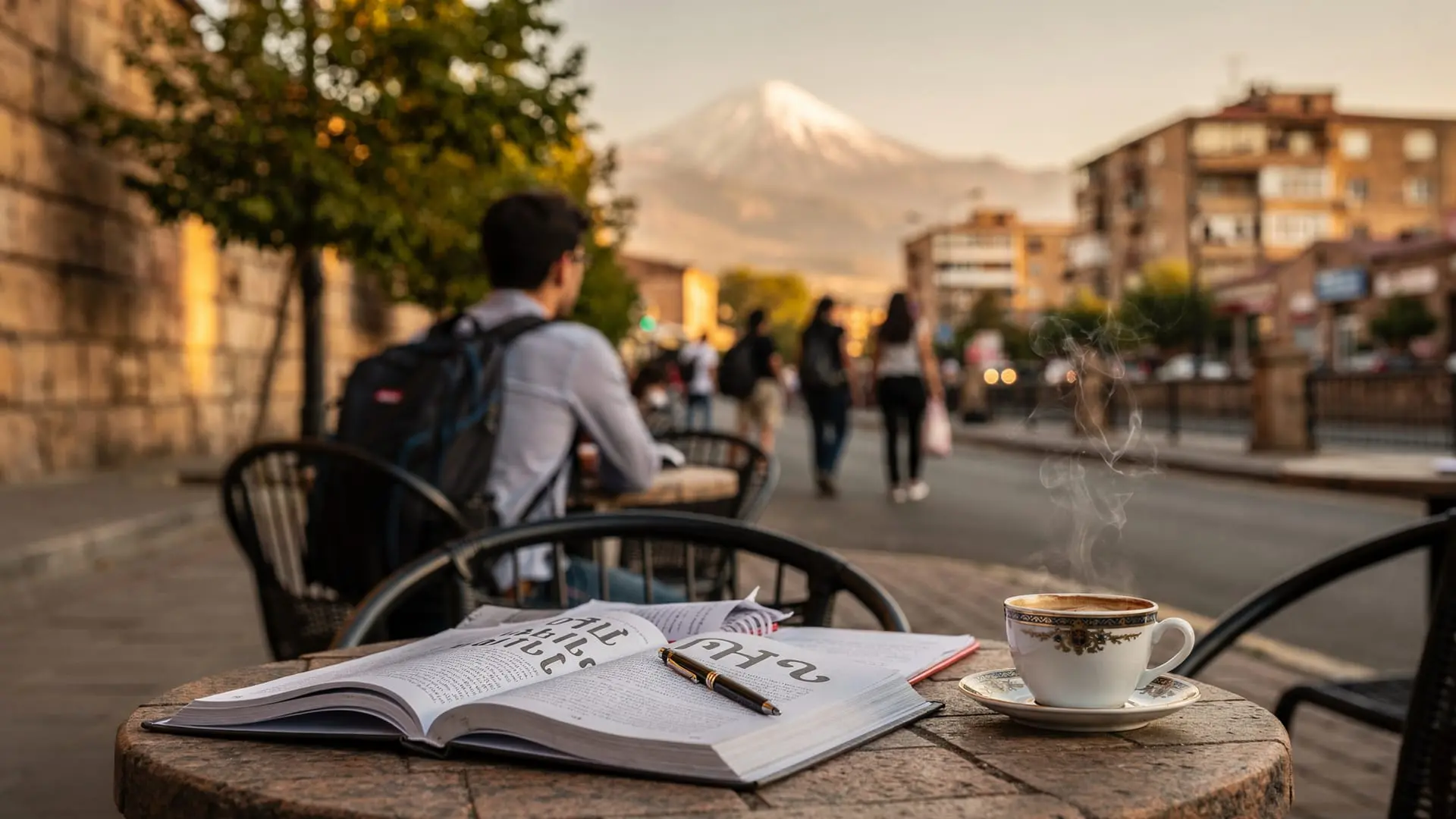
Choosing between a university programme, a summer cultural intensive, and a private tutor depends mostly on how long you’re in Yerevan and whether you want structure or flexibility. The table below gives the quick shape of each option before the detail.
| Format | Typical length | Approx. cost | |
|---|---|---|---|
| YSU | Classroom, structured | 4–12 weeks | 300,000–450,000 AMD |
| AGBU | Classroom + cultural immersion | Summer weeks | Contact for pricing |
| Private tutor | 1-to-1, flexible | As needed | 5,000–12,000 AMD/hour |
The language question for diaspora Armenians
Language is one of the most charged aspects of diaspora identity. Some diaspora Armenians grew up speaking Armenian fluently at home — families in which the language was the primary means of communication, maintained through decades of diaspora life in Beirut or Glendale or Marseille. Many more grew up with partial language — understanding more than they can speak, or speaking a simplified version of the dialect their grandparents brought. And many grew up in communities where Armenian was not actively transmitted, and experience their heritage trip to Armenia with the specific ache of hearing a language that is theirs by right but not fully by practice.
Armenia itself complicates this further: the Armenian spoken in the Republic is Eastern Armenian, the dialect of the former Russian Empire territory. Most Western diaspora communities (Lebanese-Armenian, Syrian-Armenian, French-Armenian, American-Armenian families whose ancestors came from Ottoman Armenia) speak Western Armenian — a closely related but distinctly different dialect. Understanding the difference is important before choosing a language programme.
Eastern Armenian vs Western Armenian: what to know
Eastern Armenian is the official language of the Republic of Armenia. It has been shaped by the Russian Imperial and Soviet periods and differs from Western Armenian in vocabulary, some grammatical structures, and significantly in pronunciation. It is the language you will hear on the streets of Yerevan.
Western Armenian is the dialect preserved by the diaspora, derived from the Ottoman Armenian dialects. UNESCO classifies it as a “definitely endangered language” — its speakers are an aging diaspora community without a state to sustain it institutionally. Western Armenian is spoken in Lebanese-Armenian communities, Syrian-Armenian communities, the Armenian diaspora in France, Argentina, and the older established American-Armenian communities.
For a diaspora visitor to Armenia, Eastern Armenian is what you need to function in daily life. For diaspora Armenians who already speak Western Armenian, acquiring Eastern Armenian typically takes less time than for a complete beginner — the grammatical structure is similar, the vocabulary overlap is substantial, and the phonological differences become manageable within weeks.
Yerevan State University: intensive courses for diaspora
Yerevan State University (YSU) runs Armenian language programmes designed specifically for diaspora learners through its Department of Armenian as a Foreign Language and through summer institutes.
Summer intensive programmes (July–August): 4-week or 8-week intensives offering multiple daily hours of instruction. These are designed for diaspora Armenians and foreign learners of all levels — complete beginners, heritage speakers with limited formal instruction, and those building on existing knowledge. Classes are typically in groups of 8–15. Instruction is in Eastern Armenian. Accommodation assistance is usually available through the university.
Semester programmes (September–January / February–June): 12-week semester courses that go deeper into grammar, reading, and writing. Best for diaspora who plan to stay in Yerevan for several months. These can be combined with volunteer work or part-time employment.
Registration: Contact YSU’s international department directly, or through the Repat Armenia organisation (repatarmenia.org), which can advise on current programme details, costs, and application processes.
Costs (approximate 2026): Summer intensives typically range from 300,000–450,000 AMD (730–1,100 EUR) for the full programme, not including accommodation.
AGBU Armenian language programmes
The Armenian General Benevolent Union (AGBU) runs Armenian language programmes both in Yerevan and at diaspora locations around the world.
In Yerevan, AGBU’s summer youth programmes (primarily for diaspora aged 18–35) combine language instruction with cultural immersion — excursions to monasteries, cooking classes, historical lectures, and community service. These programmes are designed as much for cultural reconnection as for language acquisition, and are particularly appropriate for diaspora young adults on a first heritage trip.
Contact AGBU Armenia’s Yerevan office for current programme details.
Private tutors: the most flexible option
For diaspora visitors who are in Yerevan for a defined period (1–4 weeks) and want targeted language instruction rather than a structured course, private tutors are the most practical option.
Repat Armenia (repatarmenia.org) maintains a network of qualified tutors who have experience working with diaspora learners. They can match you with a tutor suited to your existing knowledge level and learning goals — and crucially, tutors who understand the Western/Eastern Armenian distinction and can help Western Armenian speakers bridge to Eastern Armenian.
Online platforms: Several Armenian language teachers advertise on platforms like iTalki and Preply. Effectiveness varies widely; the advantage is flexibility before and after your trip.
Typical rates: Private tutors in Yerevan typically charge 5,000–12,000 AMD (12–30 EUR) per hour, depending on qualification and demand. Rates have risen with general Yerevan cost-of-living increases since 2022.
How to choose a tutor: Ask specifically whether they have experience teaching Western Armenian speakers or complete beginners, and whether they can hold sessions in cafés or your accommodation rather than requiring you to travel across the city. A short trial session (many tutors offer one at reduced rate) is the fastest way to judge fit before committing to a block of hours.
Learning before you arrive: a practical framework
For diaspora visitors planning a heritage trip, beginning language study before arriving in Armenia significantly enriches the experience.
Free resources:
- Arak29: A free online Eastern Armenian learning resource specifically designed for diaspora learners, with attention to the Western/Eastern distinction.
- Armeniapedia: Extensive Armenian language resources and reference materials.
- YouTube channels: Several diaspora Armenians have created YouTube-based Armenian language instruction. Search for “Eastern Armenian for diaspora.”
Apps: Duolingo does not currently offer Armenian. Transparent Language has an Armenian module. Drops offers basic vocabulary. None are comprehensive, but vocabulary building before your trip makes the immersion experience significantly more productive.
Phrasebook essentials: Even without formal study, these phrases open doors:
- Barev (hello)
- Shnorhakalutyun (thank you)
- Khndrrem (you’re welcome / please)
- Inch bes ek? (how are you?)
- Haytararutyun (sorry / excuse me)
- Yes Armenian em (I am Armenian)
- Du English gides? (do you speak English?)
The last phrase will get you further than you expect in Yerevan’s tourist-oriented districts.
Learning in context: language immersion during your trip
A heritage trip to Armenia is itself a language immersion experience, whether or not you attend a formal class. Practical suggestions for maximising language engagement:
Speak Armenian when you can: Even at a basic level, attempting Armenian in shops, restaurants and taxis is received with warmth and occasionally with surprised delight. Diaspora Armenians who try to speak Armenian in Yerevan are not laughed at — they are encouraged.
Ask for language help: Locals are generally patient with diaspora Armenian learners. Saying “yes Armenian em, bayts vat Armenian gitem” (I am Armenian but I speak Armenian badly) and then attempting the conversation anyway typically works well.
Stay longer in one neighbourhood: Rather than tourist-circuit hopping, spending three or four days in a specific Yerevan neighbourhood — Kond, Malatia-Sebastia, Shengavit — and becoming a regular at a local café or market creates the conditions for genuine language exchange.
Visit Gyumri: Armenia’s second city has a different pace and a somewhat different dialect. Extended visits to Gyumri, away from the tourist circuit, provide rich immersive language experience.
Yerevan: Highlights and Culture Walking Tour with TastingsWestern Armenian speakers: a special note
Western Armenian speakers visiting Armenia for the first time often have a jarring initial experience — the language they learned at home from grandparents sounds different here, and locals may switch to English assuming the diaspora visitor doesn’t understand Armenian. This is a painful irony and a common experience.
The adjustment usually takes a few days. The grammar is similar; the vocabulary gaps are bridgeable; the pronunciation differences become intuitive. Most Western Armenian diaspora visitors who stay more than a week find that their comprehension of Eastern Armenian improves rapidly and that they can communicate effectively, if imperfectly.
Some diaspora visitors find they feel more emotionally connected to Western Armenian than to Eastern Armenian — that Western Armenian feels like the language of their family history and Eastern Armenian feels like someone else’s. This feeling is valid. Both dialects are genuinely Armenian, carrying the same literary tradition from Mesrop Mashtots’ 5th-century alphabet.
The AGBU summer programmes in Yerevan are specifically sensitive to this dimension of the diaspora language experience.
The Armenian alphabet: a gateway to heritage
For many diaspora Armenians, language learning is inseparable from the broader heritage project. The Armenian alphabet — created by the scholar-monk Mesrop Mashtots in 405 AD, uniquely designed to represent the specific sounds of Armenian — is one of the most remarkable acts of cultural preservation in world history. Before the alphabet, Armenian was an oral tradition; after it, the language accumulated 1,600 years of unbroken written literature.
Learning to read the alphabet (there are 38 letters, and most diaspora learners with any existing exposure can achieve reading fluency within 2–3 weeks of focused practice) opens access to:
- 9th-century illuminated manuscripts at the Matenadaran
- Church inscriptions on monastery walls dating back to the 5th century
- Family documents and letters written in the early 20th century that your grandparents may have left
- The classical Armenian liturgical language (Grabar) used in the Apostolic Church
The alphabet is visually celebrated at the Armenian Alphabet Monument on the slopes of Mount Aragats — a large outdoor installation of all 38 letters in stone, set in the landscape 30 km north-west of Yerevan. This is a worthwhile half-day excursion from the capital, and a natural pairing for diaspora learners who want to see the script they’re studying rendered at monumental scale.
What a typical week looks like
For diaspora visitors on a YSU summer intensive, a representative week combines classroom hours with cultural life outside them: mornings are grammar and vocabulary (3–4 hours), afternoons are conversation practice or a cultural excursion, and evenings are unstructured — many students use them to explore Yerevan neighbourhoods or attend Repat Armenia social events where practising with locals is encouraged rather than corrected. AGBU’s format leans further toward the cultural side: expect fewer classroom hours and more excursions, cooking sessions, and community visits woven around the language instruction. Neither format is “harder” than the other — they suit different goals. Choose YSU if grammar and reading are your priority; choose AGBU if reconnecting with community alongside language is the point.
For visitors who also want to explore Armenia’s second city, Gyumri is worth the day trip: its slower pace and distinct regional cadence make it a useful contrast to Yerevan’s more international, English-inflected tourist zones.
Language as identity, not just communication
The role of language in Armenian diaspora identity is distinctive. For communities that have maintained Armenian over three or four generations in the diaspora — the Los Angeles-Armenian community, the Beirut-Armenian community, the Buenos Aires-Armenian community — the language has functioned as the primary carrier of identity in the absence of a homeland. Language retention has been central to diaspora Armenian identity-building in a way that parallels Jewish, Kurdish, and Welsh language preservation movements.
The consequence of this is that “how Armenian is your Armenian?” is a loaded question in diaspora communities, carrying judgments about cultural authenticity that can be painful for those who lost the language generationally. A diaspora Armenian who arrives in Yerevan without the language should feel no shame about this — the language was taken from your family by the same processes that took the village. Recovering it is a possibility, not a requirement.
What language study in Yerevan does offer, beyond practical communication, is an experience of the language in its living context — heard in cafés and markets and churches, spoken by people of all ages, embedded in the street names and the newspapers and the conversations around you. This immersive experience is qualitatively different from classroom learning in the diaspora, and for many learners, it is the experience that makes the language finally feel like their own.
Connecting language to heritage
For the broader heritage trip planning, see the Armenia heritage trip guide for diaspora. For practical social connections during your visit, including Repat Armenia’s networking events where you can practice Armenian in a supported environment, see the Repat Armenia resources guide. For meeting relatives and using language in a family context, see the meeting relatives guide.
A local-guided Yerevan walking tour to practise Armenian in contextFrequently asked questions about Armenian language classes
How long does it take to become conversational in Armenian?
For a complete beginner without heritage exposure: typically 200–300 hours of study to reach basic conversational level in Eastern Armenian. For diaspora Armenians with passive Western Armenian exposure: often significantly less — many report reaching functional conversational level after 4–6 weeks of intensive immersion in Yerevan.
Do Armenians in Yerevan speak English?
Increasingly yes, particularly in the tourist-oriented areas of central Yerevan and among those under 40. Russian is also widely spoken. Outside major cities, English is less reliable; Armenian or Russian is necessary.
Can I study Western Armenian in Yerevan?
YSU and AGBU programmes teach Eastern Armenian. Some private tutors can work with Western Armenian speakers specifically, helping them bridge to Eastern Armenian. For Western Armenian preservation resources, the Western Armenian Digital Network and the AGBU Western Armenian programming (outside Armenia) are more relevant.
Are there language exchange programmes where I can practise with locals?
Yes — language exchange partnerships (Armenian/English or Armenian/French) are common in Yerevan’s diaspora-aware community. Repat Armenia events are a good place to find exchange partners. Several cafés in the Cascade area have informal language exchange meetups.
Is it rude to speak English rather than Armenian in Armenia?
Not at all. Most Armenians in Yerevan’s tourist and professional sectors are comfortable with English visitors. Attempting Armenian is appreciated but not expected. There is no cultural requirement to speak Armenian as a diaspora visitor — you will not be judged for speaking English.
Can children learn Armenian in Armenia-based programmes?
Yes. Several schools and summer camps in Yerevan (particularly AGBU-affiliated and Birthright Armenia-connected programmes) offer Armenian language instruction for diaspora youth.
Is it worth doing a formal course, or is immersion enough?
For most diaspora visitors staying under two weeks, structured immersion (private tutoring plus deliberate daily practice) usually beats a formal course, simply because course logistics eat into limited time. For stays of a month or more, the YSU or AGBU summer intensives are worth the structure — they build vocabulary faster than unguided immersion alone, and the classmates become part of the diaspora social network in Yerevan.