Armenian wine festivals: Areni, Yerevan & more
| When | First Saturday of October (3 Oct 2026) |
| Where | Areni village, Vayots Dzor, ~120 km from Yerevan |
| Cost | Free entry; tasting tokens ~2,000–4,000 AMD |
| Hours | Approx. 11:00–20:00 |
| Book ahead | Accommodation, several months out |
The festival calendar of Armenian wine
Armenia has been making wine for over 6,100 years — a tradition confirmed by the discovery of the Areni-1 cave winery, dated to approximately 4100 BCE. It is perhaps inevitable that a culture with such deep fermented roots would celebrate its wine traditions publicly, loudly, and with considerable style. The annual festival calendar, which peaks in autumn around the harvest, offers a way to experience Armenian wine not just as a tasting exercise but as a living cultural event.
This guide covers all the main wine festivals and events across Armenia, with practical details on dates, locations, costs, what to expect, and how to plan your trip around them.
The Areni Wine Festival
What it is
The Areni Wine Festival is Armenia’s flagship wine event — the oldest, largest, and most atmospherically compelling gathering on the calendar. It takes place annually on the first Saturday of October in the central square of Areni village, Vayots Dzor province, coinciding with the end of the harvest season when the last Areni Noir clusters have been brought in from the high-altitude terraces.
The festival was established in 2011 by the local community and the Armenian Tourism Development Foundation, initially as a regional event to promote Vayots Dzor wines to domestic visitors. Within a few years it had grown into a national celebration drawing producers from across Armenia, food vendors, craftspeople, and international wine journalists.
What happens
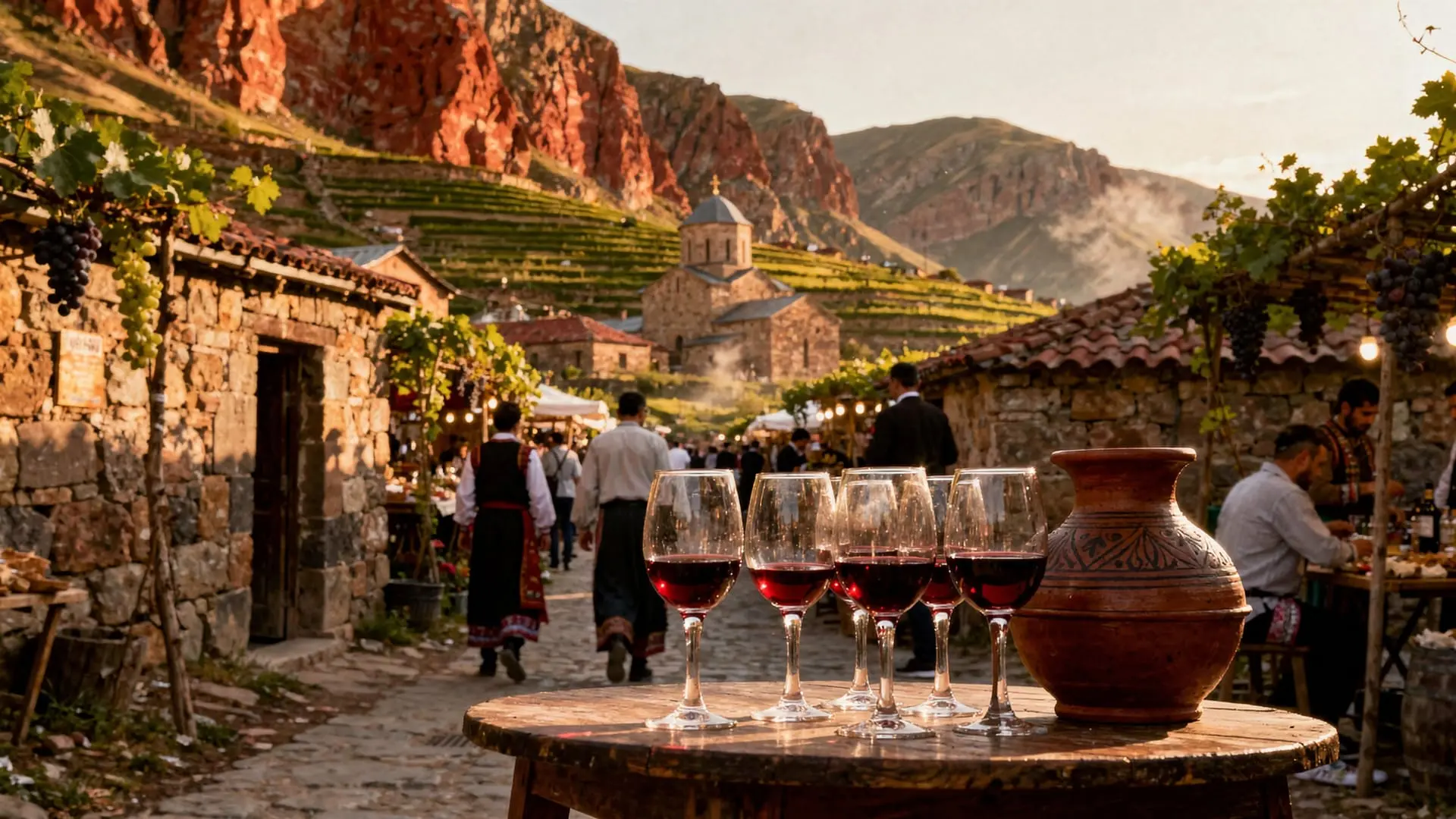
By around 10:00 on festival day, Areni village undergoes a transformation. The main square is lined with wooden stalls manned by wineries and home producers from across Vayots Dzor. Hin Areni, Trinity Canyon Vineyards, Zorah, Van Ardi, Maran, Tariri, and Tushpa are typically all present; smaller family producers and home winemakers (whose output is consumed locally but rarely distributed commercially) set up alongside them.
Tasting tokens purchased at the entrance (typically 2,000 to 3,000 AMD / 5 to 7 EUR for a book of five or ten tastings) are exchanged at any stall. This means you can work your way across the square systematically, comparing the same grape variety across different producers and different styles in a single afternoon.
Alongside the wine stalls, the food presence is substantial: vendors selling tolma, khorovats, local cheeses, dried fruits, fresh lavash, roasted nuts, and pomegranate juice (the fruit appears in both the glass and on the table at every stall). Folk music groups perform throughout the day; traditional dance groups (kochari, yarkhushta) give demonstrations.
The Areni-1 cave — the world’s oldest known winery, dated to approximately 4100 BCE — is open with extended hours on festival day. Combined with the festival itself, the cave visit bookends the day with six thousand years of context.
Practical festival information
Date in 2026: Saturday, 3 October (first Saturday of October each year).
Location: central square, Areni village, Vayots Dzor. GPS coordinates approximately 39.7237° N, 45.1712° E.
Hours: approximately 11:00 to 20:00. Most visitors arrive by noon and leave by 17:00 or 18:00.
Entry: the festival itself is free to enter. Tasting tokens are purchased separately at the entrance.
Getting there: Areni is 120 km from Yerevan via the M2 highway. On festival day, the road becomes congested from about 10:00 onward; arriving before 11:00 avoids the worst traffic. The Vayots Dzor wine route day tour is an efficient option — it departs from Yerevan early and handles the logistics.
Accommodation: book several months in advance for festival weekend. Areni village guesthouses, Yeghegnadzor hotels (20 km), and properties along the road toward Jermuk all fill quickly. Prices double or triple on festival weekend compared to normal rates.
Crowds: the festival attracts 5,000 to 10,000 visitors annually in recent years. The square can be very crowded by early afternoon; arriving early is strongly recommended.
Other wine events in Vayots Dzor
Harvest open days at individual wineries
During the weeks surrounding the harvest (typically mid-September through mid-October), several Vayots Dzor wineries open their doors for harvest-day visitor experiences. These are less structured than the main festival but in some ways more intimate — you can watch the sorting table, the press, and the first fermentation in progress.
Hin Areni and Trinity Canyon Vineyards both offer informal harvest visits on selected weekends in September and October. Enquire directly with the wineries when planning your trip. Zorah and Yacoubian-Hobbs, as appointment-only estates, may offer harvest-period visits to serious enthusiasts who contact them well in advance.
Selim Caravanserai wine events
The medieval Selim Caravanserai, sitting at 2,410 metres on the pass between Vayots Dzor and Gegharkunik, has been used as an occasional setting for outdoor wine events combining cultural heritage and wine tasting. These are irregular; watch for announcements from the regional tourism authority.
Wine events in Yerevan
In Vino tastings
In Vino, the capital’s premier wine bar, runs regular tasting events throughout the year — varietal masterclasses, winemaker dinners, and themed flights focusing on specific regions or varieties. These events are typically small (15 to 25 people) and sell out quickly. Booking through their website or social media channels is essential. The Armenian wine tasting at In Vino on GetYourGuide is available as a standalone experience for independent visitors.
Armenia Wine Talks
The Armenia Wine Talks is an annual multi-day wine conference and public tasting event held in Yerevan, typically in late spring (April or May). It brings together Armenian producers, international importers, and wine writers for panel discussions and masterclasses, with a public tasting session open to any interested visitor (typically on the final day). The Armenia Wine Talks experience is one of the better ways to encounter a wide range of producers in a single afternoon.
Wine walks and tours in Yerevan
Several Yerevan-based guides offer wine-focused walking tours of the capital, combining a walk through the city’s historic centre with stops at wine bars, shops, and the Vernissage market. The Walking city tour with brandy and wines combines an overview of Yerevan’s architecture with tastings at multiple stops.
The wine bar street on Abovyan and Tumanyan in central Yerevan has developed into a cluster of specialist venues worth an evening’s exploration on your own.
The Yerevan Wine Days festival
Yerevan has hosted its own wine event — sometimes called “Yerevan Wine Days” — in the spring (typically May or June) in recent years. Held in the city centre with producers from across Armenia represented, it is a more urban complement to the harvest-season Areni festival. Check current dates with the Yerevan Tourism Office; the format has shifted somewhat year to year.
The 2-day Wine and Brandy Tour from Yeghegnadzor
For visitors who want a structured multi-winery experience without the festival crowds, the 2-day wine and brandy tour with tastings from Yeghegnadzor covers both the wine estates of Vayots Dzor and the brandy culture of the Ararat Valley — a comprehensive introduction to both of Armenia’s great fermented traditions.
Planning your festival visit
The complete Areni festival weekend
Day 1 (Friday): drive from Yerevan to Areni (2 hours). Check in to accommodation. Visit the Areni-1 cave (see Areni-1 cave guide) in the afternoon. Dinner at Hin Areni restaurant or a village cafe with a carafe of local wine.
Day 2 (Saturday — festival day): arrive at the festival by 10:30. Work through the tasting stalls systematically (take notes — with dozens of producers, memory becomes unreliable). Lunch among the food vendors. Watch the folk dance demonstrations in the afternoon. Leave by 17:00 to beat the traffic.
Day 3 (Sunday, optional): visit Noravank monastery (12 km; spectacular red-cliff gorge) and Trinity Canyon Vineyards for a quieter post-festival tasting before returning to Yerevan.
Budget for the Areni festival
- Return transport from Yerevan (marshrutka or shared taxi): 5,000 to 8,000 AMD (12 to 20 EUR)
- Festival tasting tokens: 2,000 to 4,000 AMD (5 to 10 EUR)
- Lunch and food stalls: 4,000 to 7,000 AMD (10 to 17 EUR)
- Areni-1 cave entry: 1,000 AMD (2.40 EUR)
- Accommodation if staying overnight: 12,000 to 30,000 AMD (29 to 73 EUR) per night on festival weekend
- Total for a day trip from Yerevan (no accommodation): approximately 15,000 to 20,000 AMD per person (37 to 49 EUR)
The cultural significance of the Areni festival
The Areni Wine Festival is not simply a commercial showcase. It is an act of cultural assertion. In a country that has seen its people dispersed across the world by genocide and emigration, that endured 70 years of Soviet rule that reduced winemaking to industrial bulk production, and that sits in a geopolitically complicated corner of the Caucasus, the annual gathering in the village where wine was first made 6,100 years ago carries emotional weight.
Walking through the stalls, you will meet winemakers who retrained from engineering or medicine after independence to revive their family’s grape-growing tradition. You will taste wines made from varieties that survived the Soviet period in single old-vine parcels on steep terraces that no industrial tractor could reach. You will drink cups of just-fermenting Areni Noir juice alongside conversations with families for whom wine is not a luxury product but an expression of who they are.
For the context that makes this experience fully legible, the Armenia wine country overview is the essential companion reading.
Frequently asked questions about Armenian wine festivals
Is the Areni Wine Festival suitable for children?
Yes. The festival is a family event with food stalls, folk music, and dancing. Non-alcoholic beverages (pomegranate juice, sparkling mineral water, local fruit drinks) are widely available. Children are welcome and often present.
Does the Areni festival run if it rains?
The festival takes place outdoors and is held regardless of weather in normal circumstances. Bring a waterproof layer in October. In the event of exceptional conditions (very heavy rain or a formal weather warning), check the festival’s official social media channels the week before.
Can I buy wine to take home from the festival?
Yes. Most stall operators sell bottles in addition to offering tastings. Prices are generally equal to or lower than Yerevan retail. Bring a bag — wine racks and bags are not typically provided by the organisers.
Are there ATMs in Areni village?
There is no ATM in Areni village itself. Bring cash from Yerevan. The nearest ATM is in Yeghegnadzor (20 km). Cards are accepted at some festival stalls but not all; cash is essential.
How do I get from the festival to Noravank monastery?
Noravank is 12 km from Areni, accessible by a single road through a spectacular canyon. Taxis from Areni village to Noravank and back cost approximately 5,000 to 7,000 AMD (12 to 17 EUR) return. Some tour operators run shuttle buses on festival day. See /destinations/noravank-monastery/ for visiting details.
Do I need to book a guided tour, or can I visit independently?
Both work. Driving yourself or taking a marshrutka gives more flexibility on timing, but a designated driver is essential if you plan to taste seriously. A guided day tour removes the driving question entirely and usually bundles the festival with Noravank or the Areni-1 cave, which is convenient if you have only one day free. Independent travellers without a car should plan the marshrutka timetable carefully, since services back to Yerevan thin out in the evening as festival crowds disperse.
What should I do if I can’t get accommodation near Areni for festival weekend?
Yeghegnadzor (20 km, the provincial capital) has more rooms than Areni village itself and usually has late availability even when Areni is fully booked. A day trip from Yerevan is also entirely workable — the round drive is about 4 hours, leaving a full afternoon at the festival if you leave the capital by mid-morning. If you’d rather not drive back after an afternoon of tasting, the 2-day wine and brandy tour from Yeghegnadzor solves both the accommodation squeeze and the designated-driver problem in one booking, and adds a second day of unhurried, crowd-free tasting once the festival itself has wound down.
The Areni festival’s role in Armenian wine culture
What makes the Areni Wine Festival significant beyond its function as a commercial showcase is the social role it plays in Armenian wine culture. In a country with a genuinely ancient winemaking tradition, the festival provides an annual occasion for Armenian winemakers — scattered across multiple provinces, working independently throughout the year — to gather and compare.
For producers like the small family operations at Maran and Tariri, the festival is the most important annual opportunity to be seen. These estates do not have the marketing budgets of ArmAs or Karas, and they do not export. Their wines reach beyond Areni village primarily through word of mouth at the festival. Visitors who discover them in the square and make a mental note to visit the winery the following day are the lifeblood of these small operations.
For the larger estates (Hin Areni, Trinity Canyon), the festival serves a different purpose: a chance to present new vintages and to engage directly with the domestic consumer base that forms the bulk of their sales. The conversations that happen at festival stalls — with tourists, with Yerevan restaurant owners, with diaspora visitors who have made a pilgrimage specifically for the event — shape the following year’s production decisions in ways that formal market research cannot.
The diaspora dimension
The Areni Wine Festival has increasingly become a point of convergence for the Armenian diaspora. Visitors from the Armenian communities of Los Angeles, Paris, Beirut, Moscow, and Marseille arrive specifically for the festival, using it as an anchor for a broader “roots” trip to the homeland. For many of them, tasting wine in the village whose name is on the grape variety — Areni Noir — while standing within sight of the cave where wine was first made 6,100 years ago is a deeply emotional experience.
The diaspora connection is also commercial. Several American and French importers have made initial contacts with Armenian producers at the Areni festival, leading to export arrangements that have helped place Hin Areni, Trinity Canyon, and Zorah wines in specialist retailers outside Armenia. The festival functions, informally, as a trade fair as well as a consumer event.
For diaspora visitors planning a heritage trip around the festival, the Armenia wine country overview and the destination page for Vayots Dzor provide the context needed to make the most of the visit.
What to eat at the festival: the food stalls
The non-wine food at the Areni festival deserves its own attention. A selection of what to look for:
Freshly baked lavash: produced in traditional tonir ovens brought to the festival on flatbed trucks. The best lavash in Armenia is made fresh and eaten within minutes; the festival versions, still warm, are exceptional. Watch for the women stretching the thin dough over the roundel before lowering it into the clay oven.
Khorovats: charcoal-grilled lamb, pork, and chicken skewers. The smoke drifts through the festival square from mid-morning onward. Order with fresh herbs, raw onion, and a squeeze of lemon.
Pomegranate everything: pressed juice, molasses drizzled over grilled meats, dried arils in pastry. Pomegranate appears in Areni as naturally as the grape itself — the two fruits are the twin symbols of Vayots Dzor’s agricultural abundance.
Dried fruits and nuts: Vayots Dzor’s dried apricots (less sweet, more intensely flavoured than the commercial variety) and dried mulberries alongside walnut-stuffed fresh dates make excellent wine accompaniments at the stalls.
Gata: Armenia’s traditional sweet bread, leavened with a filling of sweetened flour and butter. The Areni festival versions are baked by village households who bring them on trays. One of the best casual food experiences in Armenia.
The food stalls at the festival are cash-only and priced fairly: expect to pay 500 to 2,000 AMD (1.20 to 5 EUR) for snacks and small dishes. Full sit-down meals are available at the village’s restaurants for 4,000 to 8,000 AMD (10 to 20 EUR).
Comparing the Areni festival to Yerevan’s wine events
Visitors deciding between a trip to Areni and staying closer to the capital should weigh what each format actually offers:
| Areni Wine Festival | Yerevan Wine Days / In Vino tastings | |
|---|---|---|
| Setting | Outdoor village square, harvest atmosphere | Indoor venue or city-centre street |
| Producers present | Dozens, including small family operations | Fewer, more curated |
| Cost | Free entry + cheap tokens | Ticketed, often 15,000–30,000 AMD |
| Crowd size | 5,000–10,000 | Hundreds |
| Best for | Immersive, once-a-year cultural event | Focused tasting, easy to combine with a Yerevan evening |
Neither replaces the other. If you have one free day in October and a car, Areni is the richer, more memorable experience. If you are short on time or based entirely in Yerevan, In Vino or the Wine Talks event deliver a more concentrated, less logistically demanding introduction to the same wines.
If the festival dates don’t align with your trip
Not every visitor can time a trip to the first Saturday of October. If your dates fall outside the festival window, the wine experience is not lost — it simply shifts location and format. A visit to Hin Areni or Trinity Canyon Vineyards any time of year offers a private tasting with the same wines poured at the festival stalls, usually with more attention from staff than a crowded festival afternoon allows. The Areni-1 cave is open year-round regardless of festival dates. And Yerevan’s wine bars, particularly In Vino, pour Vayots Dzor producers’ bottles throughout the year, so the absence of a festival date on your itinerary need not mean the absence of Areni Noir in your glass.