Devil's Bridge, Tatev: the Vorotan gorge's hidden pools
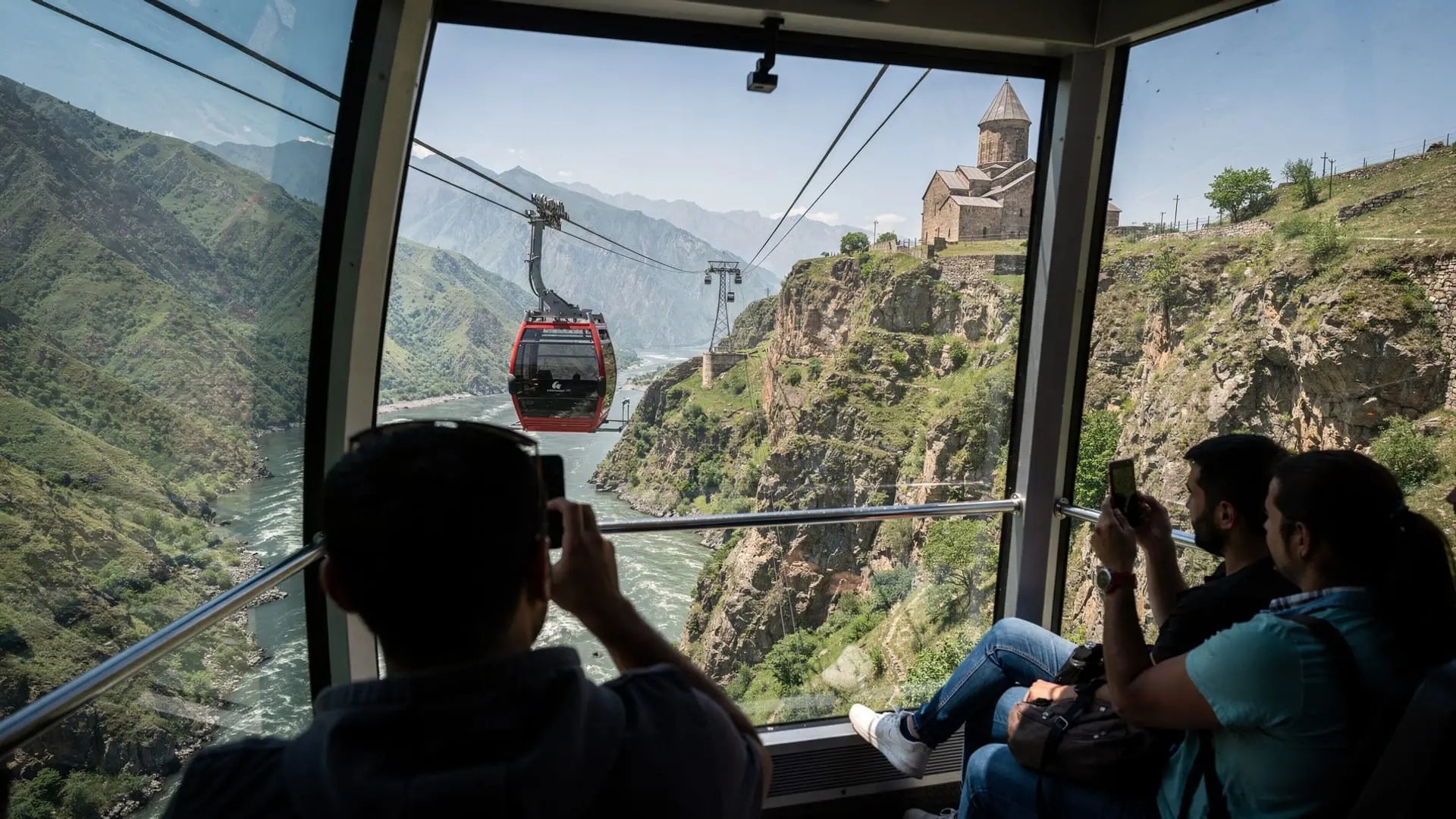
A gorge secret below the Wings of Tatev
Most visitors to the Tatev area arrive by cable car, spend an hour or two at Tatev Monastery, and return the same way. Fewer know that 1 km below the Wings of Tatev ropeway midpoint, tucked into the eastern wall of the Vorotan gorge, a set of travertine mineral pools sits beside a natural basalt arch that locals have called Szatan Kamurj — Devil’s Bridge — since at least the 18th century. The name is dramatic, the place is serene.
The site combines three things in one: a genuine geological curiosity (the arch, formed by millennia of mineral deposition over a collapsed lava tube), a natural spa (four pools of warm sulphur-rich water at approximately 22–26°C), and a photography location of unusual quality (the travertine textures, the gorge walls, and the arch frame an uncommon composition). That it sits within a few kilometres of one of the most visited heritage sites in Armenia — Tatev Monastery — and remains relatively uncrowded is partly a function of access difficulty and partly the general pattern of Armenian tourism: the monument gets the crowds, the landscape gets the thoughtful traveller.
| Where | Vorotan gorge, 2 km below Tatevi Anapat, Syunik |
| Cost | Free — no entrance fee |
| Time needed | 3–4 hours round trip from Tatevi Anapat, including swimming |
| Getting there | Hike from Tatevi Anapat (40 min) or 4WD track from Halidzor (20 min) |
| Best time | Year-round; September–October for foliage, May–June for wildflowers |
Geology: how the pools formed
The Vorotan river canyon in Syunik is carved through a landscape of volcanic basalt and limestone. Geothermal activity in the region heats groundwater as it percolates through the rock, dissolving calcium carbonate and other minerals. Where this water emerges at the surface, the calcium carbonate precipitates as the water cools and loses CO₂, building up the characteristic terraced formations called travertine.
At Devil’s Bridge, this process has been operating for thousands of years. The result is a series of natural terraces and pools cascading down the gorge wall, with a rock bridge — the “Devil’s Bridge” — formed where mineral deposition bridged a gap between two rock faces, reinforced by the collapsed roof of an older flow channel. The bridge span is modest (roughly 15 metres across, 5 metres in height above the pools) but distinctly arch-shaped, and the mineral-encrusted surfaces have a cream-and-ochre colouring that stands out against the dark basalt of the surrounding gorge.
The water temperature in the pools is remarkably stable across seasons: 22–26°C year-round, warm enough for comfortable bathing even in January. The sulphur content is noticeable — a faint rotten-egg smell near the main spring outlets — but not overwhelming. The pools are clear rather than murky; the mineral content colours the travertine floor a pale cream.
The four pools
The pools are arranged in a rough cascade down the hillside below the arch. From top to bottom:
Upper pool: The shallowest (ankle- to knee-deep in most conditions), closest to the main spring outlet. The water here is warmest — up to 26°C at the source. The bottom is sandy travertine, smooth underfoot. This is where the water entering the pools is clearest.
Main arch pool: The largest and deepest pool (chest-deep at the centre), directly below and beside the natural arch. This is the primary photography subject — the arch frames the gorge background behind it. The mineral formations on the pool edges are the most developed here, with white and pale-orange travertine terraces. Enter from the east side where a flat ledge provides a stable entry point.
Middle pool: Slightly smaller and shallower than the main pool, immediately below it on the cascade. Often occupied by families with small children because of its shallow depth and calm water. The mineral floor has a textured quality that is photogenic at close range.
Lower pool: The coolest of the four (around 22°C) and the one most influenced by the Vorotan river’s ambient temperature. Larger but with less mineral activity than the upper pools. Less visited. Good for swimmers who prefer cooler water.
Between pools, short travertine ledges and small waterfalls create a pleasing visual flow. The entire pool complex spans roughly 80 vertical metres of hillside.
How to reach Devil’s Bridge
The site is not directly on a paved road. There are two practical approaches:
From Tatevi Anapat village (recommended): This is the most direct route. Tatevi Anapat (also called Tatev village) sits at the base of the Wings of Tatev cable car on the Halidzor side. From the cable car base station, follow the signposted trail northeast along the gorge wall for approximately 40 minutes (2 km, modest elevation change). The path is clear and marked, though uneven in sections. Appropriate footwear (trail shoes or hiking boots) is advisable. This route gives excellent gorge views throughout.
From Halidzor village: The upper Wings of Tatev station is at Halidzor, 270 metres above the lower station. A 4WD track descends from Halidzor toward the gorge floor and approaches Devil’s Bridge from above, reducing the hiking distance to approximately 20 minutes from the track. The track is rough and should only be attempted with a high-clearance vehicle.
Via the cable car midpoint: The Wings of Tatev ropeway passes over the Devil’s Bridge area during its 5.7 km span. The cable car does not stop at the midpoint, but the view from the gondola directly below gives an aerial perspective of the pools and arch — one of the few ways to see the site from above without a drone.
Distance from Tatev Monastery: From the monastery itself (reached by the cable car from Halidzor), the return hike to Devil’s Bridge is approximately 3 km each way on a trail descending into and returning from the gorge. Allow 3–4 hours round trip including time at the pools.
Yerevan: Khor Virap, Noravank, Devil’s Bridge, and TatevPhotography at Devil’s Bridge
The combination of travertine, mineral pools, rock arch, and gorge depth makes this one of the most compositionally interesting natural sites in Armenia. A few techniques that make the most of the location:
Wide angle for the arch and gorge: A 16–24mm lens captures the arch in the foreground with the Vorotan gorge and distant cliffs behind. Stand at the east edge of the main pool, shooting southwest toward the arch. The gorge walls recede dramatically in depth, creating a layered composition.
Long exposure for the cascade: The small waterfalls between the pools respond well to long-exposure techniques. 1/4 to 1 second shutter speed gives silky water motion. Use a small aperture (f/11–f/16) and a neutral density filter if shooting in daylight.
Detail shots of travertine texture: The mineral formations on the pool edges have a macro-photography quality — surface variations, colour gradations from cream to ochre to rust, and crystalline patterns. Early morning or late afternoon light rakes across these surfaces most effectively.
Reflections: On calm mornings when the wind is low, the pools reflect the arch and gorge walls with clarity. The main arch pool is the best mirror surface.
Best light: The gorge runs roughly east-west at this point. Morning light hits the travertine formations directly from the east; afternoon light illuminates the arch and western gorge wall. Midday light from directly overhead flattens the texture. Plan for early morning (before 10:00) or late afternoon (after 15:00) if photography is a priority.
Drones: A small drone can capture the arch and pool complex from an angle impossible on foot, and the gorge is generally quiet enough to fly without disturbing other visitors — but always check current Armenian drone regulations before travel, avoid flying near the Wings of Tatev cable car line, and never fly if other swimmers object. The aerial view from the cable car gondola itself, noted above, is a legal and reliable alternative if you would rather not carry a drone on the hike.
Safety considerations
The pools are safe for swimming under normal conditions, but several precautions apply:
Slippery edges: Travertine is beautiful but treacherous when wet. The mineral surface is extremely slippery, especially around pool edges and on the cascade ledges between pools. Wear water shoes or sandals with grip. Do not run near the pools.
Edge integrity: The travertine ledges at the pool margins are mineralised rock, not concrete. Some edges overhang slightly and are less solid than they appear. Test before putting full weight on projecting sections.
Gorge access below the pools: The Vorotan river itself, at the gorge floor, is not accessible from the pool area via an easy path. The gorge walls below the pools are steep. Do not attempt to descend to the river except on marked trails.
Water conditions: The mineral content of the water is not hazardous for swimming, but prolonged immersion (more than 30–40 minutes) can cause mild skin irritation in sensitive individuals due to the sulphur compounds. Rinse with fresh water after swimming.
No lifeguard: There are no facilities, no lifeguard, and no medical equipment on site. The nearest hospital is in Goris, approximately 30 km south.
Comparison with Jermuk: Armenia’s other well-known thermal-mineral destination is Jermuk, further north in Vayots Dzor, which offers developed spa infrastructure, sanatoriums, and a mineral-water gallery rather than a wild swimming spot. Devil’s Bridge is the informal, undeveloped counterpart — no facilities, no fees, no schedule, just the pools in their natural setting. Travellers who want both experiences on one trip can combine a Tatev/Devil’s Bridge day with a Jermuk stop further along a southern Armenia route.
When to visit
Devil’s Bridge is accessible year-round, which distinguishes it from many Armenian outdoor sites. The pools are warm in every season; the challenge is the access trail, which can be icy in winter (November–March) and muddy in the spring snowmelt (March–April).
May–June: The gorge vegetation is lush, wildflowers visible on the upper trail sections, water temperature comfortable. Visitor numbers are moderate. This is the best month for combining the pools with spring light for photography.
July–August: Peak season. Visitor numbers at Tatev reach their annual maximum, and the pool area is busier than other months — though still far less crowded than the monastery above. Water temperature is at its peak (26°C). Combine with an early start to avoid the main rush.
September–October: Autumn colours in the Vorotan gorge are excellent, particularly October. Visitor numbers drop sharply after mid-September. The combination of autumn foliage, warm pool water, and quieter trails makes this the most atmospheric time to visit.
November–March: Possible but requiring preparation. The access trail from Tatevi Anapat can be icy. The pools are warm and the gorge in snow and frost is very beautiful. No other visitors. Bring microspikes or crampons if there is snow on the trail, and do not go alone.
| Season | Water temp | Trail condition | Crowds |
|---|---|---|---|
| May–June | ~24°C | Clear, some mud after snowmelt | Moderate |
| July–August | ~26°C | Dry, dusty | Busiest (still light) |
| September–October | ~24°C | Dry, best footing | Low |
| November–March | 22–24°C | Icy in sections, needs care | Very low |
For a fuller seasonal comparison across the whole country, see the best time to visit Armenia guide.
From Yerevan: Tatev Monastery and Wings of Tatev TourCombining with Tatev Monastery and Khndzoresk
Devil’s Bridge sits naturally within the Tatev day-trip circuit from Yerevan. The most logical combination:
From Yerevan (one long day): Drive south via Areni and Noravank monastery (make the most of the morning light on the red cliffs), continue to Halidzor for the Wings of Tatev cable car, visit Tatev Monastery, hike down to Devil’s Bridge for late afternoon swimming, return to Halidzor, and drive back via Goris. Total distance: approximately 480 km, 14 hours including stops. This is demanding but doable for energetic travellers.
As an overnight trip: Stay in Goris (Mirhav Hotel or Hotel Anahit Tatev) to split the programme across two days. Day 1: Yerevan → Areni → Noravank → Goris overnight. Day 2: Devil’s Bridge at 08:00 (before day-trippers arrive from Yerevan), Tatev Monastery by cable car, afternoon at Khndzoresk swinging bridge (30 km north of Goris), return to Yerevan. This is a much more relaxed rhythm and gives both sites the time they deserve.
Khndzoresk: The remarkable cave village 30 km north of Goris, with its 160-metre suspension bridge over the canyon, pairs logically with Tatev and Devil’s Bridge on a southern Syunik itinerary. See the Khndzoresk and Tatev southern loop for a structured route.
Vorotan canyon viewpoints: The road between Goris and Halidzor follows the upper rim of the Vorotan gorge for several kilometres. There are multiple pullouts with views of the gorge and of the Wings of Tatev cable car crossing the canyon. Allow 20 minutes for these viewpoints if driving the route in daylight.
Practical information
Entry fee: None. The pools are on public land and freely accessible.
Facilities: None at the site. Bring water (the mineral spring water is not recommended for drinking), snacks, a towel, and water shoes. The nearest toilets and food are at the Wings of Tatev base stations in Halidzor (upper) or Tatevi Anapat (lower).
Accommodation: Goris is the main base for this area, 30 km south. Hotel Mirhav and Hotel Anahit Tatev (the latter in Tatev village) are the most comfortable options. Halidzor has one or two simple guesthouses.
Mobile signal: Patchy in the gorge itself. Viva-MTS and Ucom have better coverage than Beeline at this elevation. Do not rely on GPS navigation once on the trail.
Combined with Wings of Tatev: The cable car operates Tuesday to Sunday (closed Monday) from 10:00, closing at 19:00 in May–September and 18:00 the rest of the year. Tickets cost 6,500 AMD one-way and 9,000 AMD return per adult from March to November (lower winter fares, December–February). Book in advance or arrive before 11:00 in July–August to avoid queues. The cable car is the most efficient way to reach Tatev Monastery; the Devil’s Bridge hike can be done independently of the cable car from the Tatevi Anapat base.
Extending south: Khndzoresk and the Syunik loop
Devil’s Bridge rarely stands alone on an itinerary — most visitors are already deep into a southern Armenia route, and Syunik rewards a second or third day. Khndzoresk, the cave village with its 160-metre suspension bridge, is 30 km north of Goris and pairs naturally with Tatev on a two-site day. Further south again, Karahunj — Armenia’s prehistoric stone circle, sometimes called the “Armenian Stonehenge” — sits near Sisian and can anchor a longer loop through Syunik for travellers with a rental car. Those planning the whole southern corridor in one trip should read the Khndzoresk–Tatev southern loop guide for a structured route linking all three.
Travellers without their own vehicle should also weigh the private tour vs marshrutka guide before planning a southern Syunik day — public transport reaches Goris and Sisian reliably, but the last-mile connections to Tatev, Devil’s Bridge and Khndzoresk are much easier with a driver or organised tour.
Accessibility and visiting with limited mobility
The hike to Devil’s Bridge is not wheelchair-accessible and involves uneven, sometimes narrow trail sections with drop-offs near the gorge edge — it is not a suitable stop for visitors with significant mobility limitations. For travellers who want the Tatev experience without the descent, the Wings of Tatev cable car itself and the monastery grounds are considerably more accessible, with paved or level surfaces at both stations and around the church complex. Families travelling with very young children or anyone uneasy on uneven ground should treat the monastery and cable car as the main event and consider Devil’s Bridge optional.
The gorge ecology and what you will see on the trail
The Vorotan gorge below Tatev is one of the more biodiverse corridors in Armenia, sheltered from the exposed plateau winds and watered by the river and multiple tributary streams. The access trail from Tatevi Anapat passes through a sequence of microhabitats that changes noticeably over the 2 km descent.
The upper section of the trail (departing the village) crosses open scrub with wild rosehip, blackthorn, and juniper — typical of the exposed upper slopes. In spring (April–May), this section has the most wildflowers: yellow composites, purple vetch, and the occasional wild orchid on the grassy margins. Griffon vultures are resident in the Vorotan gorge and are regularly seen riding thermals above the canyon walls. Their wingspan (up to 2.4 metres) and characteristic blunt tail distinguish them from the eagles and hawks that also patrol the gorge.
The middle section of the trail descends steeply into the gorge proper. Vegetation becomes denser and more varied: walnut, wild pear, hornbeam, and ash replace the open scrub. The temperature drops noticeably as you descend into the shade of the gorge walls. Warblers, flycatchers, and rock nuthatches are common in this section; listen for the characteristic knocking of the nuthatch on limestone faces.
The final 500 metres before the pools runs along a steep-sided section of the gorge where the walls close in to 20–30 metres apart. Here the rock surface is colonised by ferns and mosses in the constant moisture zone near the pools, with occasional patches of maidenhair fern (Adiantum capillus-veneris) at the pool margins — a species associated with calcareous wet surfaces throughout the Mediterranean and Caucasus regions. The combination of basalt walls, travertine deposits, fern colonies, and warm spring water creates a habitat that feels subtropical despite the mountain altitude.
On the return hike (ascending back to Tatevi Anapat), the uphill exertion is real. Allow 50–60 minutes for the ascent versus 40 minutes descending. In July and August, carry at least 1.5 litres of water per person; the gorge is shaded but humid, and the uphill section on the exposed upper trail is warmer than expected.
Folklore: why “Devil’s Bridge”?
The naming convention of attributing natural arches and bridges to the devil is widespread across the Caucasus and the Middle East. The underlying logic is theological: natural constructions of unusual perfection or scale that seemed beyond human capacity were attributed to supernatural agency — and in a Christian cultural context, impressive natural works not made by God were often ascribed to his adversary. Devil’s bridges, devil’s walls, and devil’s gates appear throughout Armenia, Georgia, and Turkey.
At the Tatev site specifically, the folklore is sparse. Local oral tradition in Halidzor and Tatevi Anapat holds that the arch appeared overnight after a storm destroyed a previous crossing point, implying supernatural construction. A secondary story ties the name to a local belief that the warm springs were heated by the underworld below — “devil’s fire” warming the water from beneath. Neither story is documented before the 19th century.
The contrast between the site’s name and its character strikes most visitors. There is nothing demonic or threatening about a warm mineral pool in a beautiful gorge. If anything, the place is unexpectedly pleasant — the kind of discovery that makes Armenian travel at its best feel like finding something the guidebooks forgot to mention. The devil, in this case, made something rather nice.
Frequently asked questions about Devil’s Bridge
Is Devil’s Bridge free to visit?
Yes. There is no entrance fee for the pools or the arch. The access trail from Tatevi Anapat is unmarked but clear, and no payment is required at any point. The only costs are transport to and from the area.
How difficult is the hike to Devil’s Bridge?
The trail from Tatevi Anapat is moderate — approximately 2 km, mostly flat or gently descending, with one short rocky section near the gorge wall. Suitable for reasonably fit adults. Not wheelchair-accessible. Not appropriate for young children without adult supervision due to some exposed sections near the gorge edge. Allow 40 minutes each way at a comfortable pace.
Can you drive to Devil’s Bridge?
Not on a standard vehicle. A rough 4WD track from Halidzor gets within 20 minutes of the pools, but the track requires high clearance and low-range four-wheel drive. Most visitors reach the pools by hiking from Tatevi Anapat. Hiring a local driver with a suitable vehicle from Goris or Halidzor is possible; ask at your accommodation.
Is the water actually warm year-round?
Yes. The geothermal spring that feeds the pools maintains a consistent temperature of 22–26°C regardless of ambient air temperature. Swimming in January in the gorge with snow on the surrounding hillsides is genuinely pleasant in the pools, though the access trail can be icy and the air temperature may be -5°C or below. Dress warmly for the hike and change into something dry immediately after swimming.
Is Devil’s Bridge related to Tatev Monastery architecturally?
No. The “bridge” is entirely natural — a geological formation created by mineral deposition, with no human construction. The name “Devil’s Bridge” (Szatan Kamurj in Armenian) is folkloric, reflecting the local tradition of attributing impressive natural formations to supernatural agency. The monastery is 3 km away by trail; the two sites are in the same gorge landscape but unrelated in origin.
Are there any other Devil’s Bridges in Armenia?
The name is common in Armenian folklore. There are similar formations (natural rock arches associated with thermal activity) at Jermuk and in the Debed valley near Alaverdi. The Tatev formation is the most accessible and most photogenic of these.
What should I bring for the pools?
Towel, water shoes or sandals with grip (essential — the travertine is very slippery), swimwear, a dry change of clothes, sunscreen, and water. A small backpack with a dry bag for electronics is useful. The pool water itself is not potable.
Is Devil’s Bridge suitable for a first trip to Armenia, or is it a repeat-visitor spot?
It works for a first trip if you already plan to visit Tatev Monastery and have half a day to spare — the hike and swim add real texture to what would otherwise be a monument-only stop. It is not essential on a tight one-week itinerary, but on a 10-day or longer trip through Syunik it is one of the best-value additions to the Tatev leg.
Can Devil’s Bridge be combined with Khndzoresk in a single day?
Yes, though it makes for a full day. A realistic plan is Devil’s Bridge and Tatev Monastery in the morning, then Khndzoresk’s suspension bridge and cave village in the afternoon, using Goris as the overnight base either side. See the Khndzoresk–Tatev southern loop for timing.