Noravank monastery: the red-cliff jewel
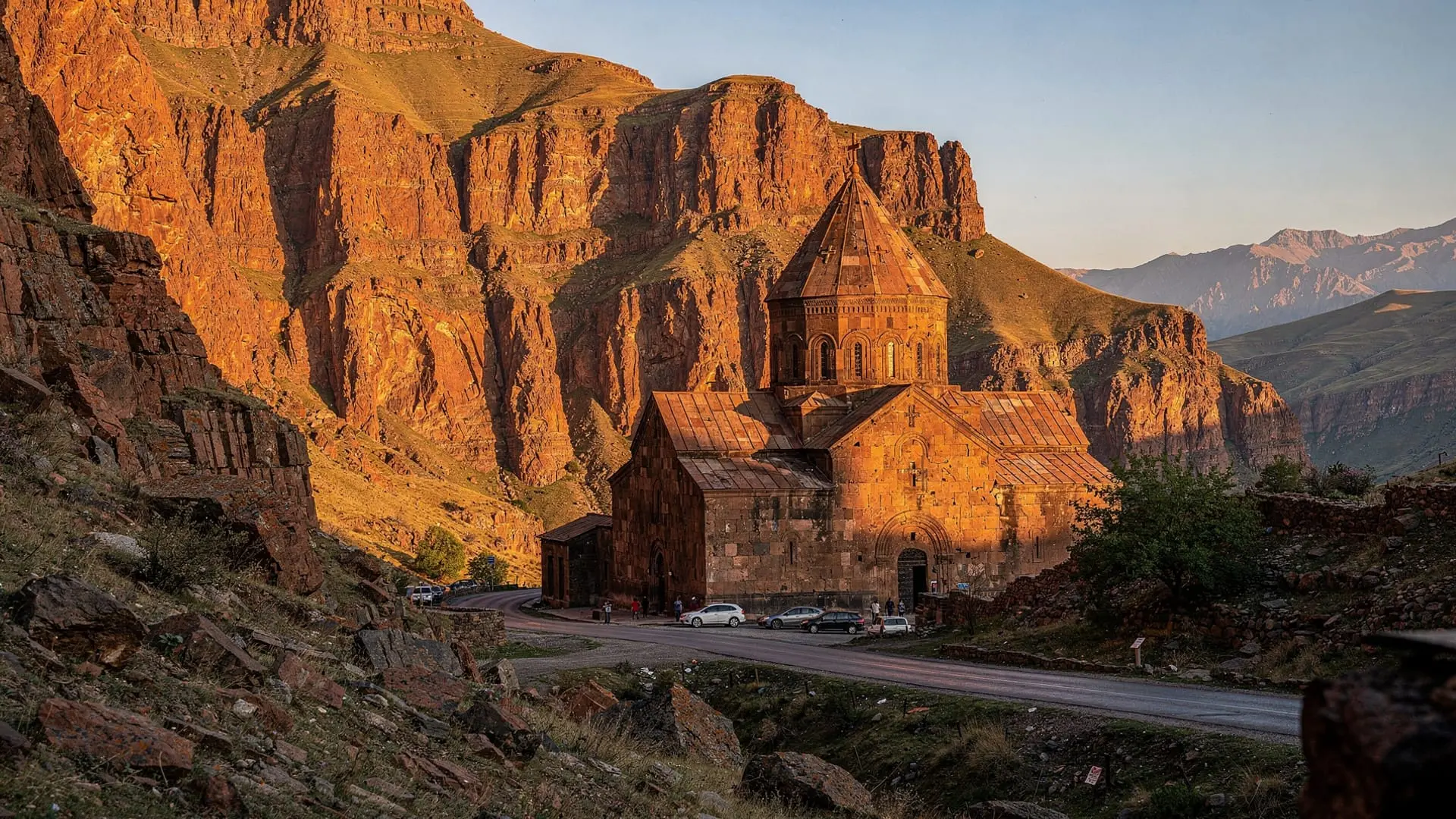
Where medieval architecture meets geological drama
The visual logic of Noravank is simple and devastating: a canyon of iron-red limestone so intensely coloured it looks artificially lit, and at its base, a 13th-century monastery in pale-cream stone whose double exterior staircase rises from a ledge barely wide enough to stand on. At certain times of day — late afternoon in October, say, when the cliffs glow orange behind a cream-white facade — Noravank looks staged. It is not staged. It is exactly as remarkable as the photographs suggest, and unlike several of Armenia’s most famous sites, it fully delivers on the promise of those images.
Noravank is 120 km south of Yerevan in Vayots Dzor province, reachable in about 2 hours by car. It is commonly combined with Khor Virap and the Areni wineries as a southern day trip.
| Where | Amaghu gorge, Vayots Dzor, about 120km (2h) south of Yerevan |
| Cost | Free entry (donation box); parking around 200–300 AMD |
| Time needed | 1.5–2 hours at the site; 6–7 hours round trip if driving from Yerevan alone |
| Getting there | Self-drive, marshrutka to Yeghegnadzor + taxi, or an organised day tour |
| Best time | Late afternoon (15:00–18:00) for light; April–May or September–October for weather |
Why this monastery matters
Noravank was founded in the early 12th century but reached its architectural peak under the patronage of the local Orbelian dynasty of princes in the 13th and 14th centuries. The site became the mausoleum of the Orbelians and, in particular, of the Siunik bishops who served the Armenian Apostolic Church in this region. The sculptor Momik — working in the late 13th and early 14th centuries — was responsible for some of the finest carved stone decoration in medieval Armenian art, and several of his masterpieces are at Noravank.
The monastery represents the apex of the Siunik school of architecture: carved khachkars on every surface, tympanum reliefs of extraordinary refinement, and the double-staircase facade of the Surb Astvatsatsin church, which has no parallel in Armenian religious architecture. It is an active site of the Armenian Apostolic Church, an Oriental Orthodox denomination.
History
- 1105–1106 AD: Founding of the monastery, likely by Bishop Hovhannes of Vayots Dzor.
- 1227: The Surb Karapet church (St John the Baptist) is built, the main church of the complex.
- 1281–1339: The Orbelian princes substantially expand and endow the site. Bishop Stepanos Orbelian (d. 1304), the principal patron, rebuilds the main gavit and commissions monumental khachkars.
- 1289–1331: The sculptor Momik works at Noravank. His masterwork here is the tympanum of the Surb Karapet church — a relief of Christ flanked by Peter and Paul, with unprecedented naturalistic modelling.
- 1339: Construction of the Surb Astvatsatsin (Church of the Mother of God), the two-storey church with the external double staircase — the last major medieval building at the site.
- 14th–17th centuries: The site declines as the Orbelian dynasty fades. Several earthquakes cause damage.
- 19th–20th centuries: Partial restoration.
What to see at the site
Surb Astvatsatsin church (Church of the Mother of God, 1339): The iconic building and the centrepiece of any visit. Two storeys: the ground floor is an arched chapel with carved tympanum (Christ enthroned, flanked by archangels); the upper storey is a small chapel accessible via the narrow double staircase that projects from the south facade. The staircase has no handrail and is about 90 cm wide — genuinely steep. The upper chapel interior is tiny but finely carved. The exterior relief above the ground-floor entrance — the Virgin Mary flanked by archangels — is one of Momik’s finest works.
Surb Karapet church (Church of St John the Baptist, 1227): The oldest and largest structure, a domed basilica. The main carved tympanum above the west portal is attributed to Momik (late 13th century): Christ with Peter and Paul, modelled with a three-dimensionality unusual for the period.
Gavit of Surb Karapet: The large vestibule attached to the west of the main church, built by the Orbelians in the 13th century. Its interior contains burial niches and funerary reliefs of Orbelian princes; look for the polychrome painting fragments near the ceiling.
Zoomed khachkars on the cliff face: Several khachkars (ornamental cross-stones) are carved directly into the cliff to the south of the monastery complex. The scale of the red limestone rising above them gives an immediate sense of why this canyon was chosen as a sacred site.
Amaghu gorge: The 8-km gorge approach from the highway is part of the experience — the road runs between sheer cliffs of red limestone. Several viewpoints on the drive offer dramatic canyon photography. In spring, wildflowers cover the gorge floor.
How to get there
By car: From Yerevan, take the A2/M2 highway south through Ararat province, past Yeraskh, then south along the Arpa river valley. The Noravank turnoff is approximately 115 km from Yerevan — follow signs to “Noravank/Amaghu.” The gorge road is 8 km of well-surfaced tarmac. Total time: approximately 2 hours.
By marshrutka (indirect): Take a marshrutka from Yerevan to Yeghegnadzor (AMD 1,000–1,500, 2h from Kilikia bus station). From Yeghegnadzor, negotiate a shared taxi to the Noravank turnoff or to the monastery entrance — AMD 3,000–5,000 per person depending on the driver. Arrange a return pickup time explicitly.
By tour: Noravank is included in numerous Yerevan-based day tours, typically combined with Khor Virap and Areni winery.
From Yerevan: Khor Virap and Noravank day tour From Yerevan: Khor Virap, Areni winery, and NoravankFrom Areni village: If you are already at the Areni wineries (15 km from the monastery turnoff), combining Noravank as an afternoon stop is natural. Most wine tour drivers will take you there as an extension for an agreed fee.
Photography and best light
Noravank is a west-facing site, meaning the monastery facade is front-lit in the afternoon and back-lit in the morning. The iconic combination of cream stone against red cliffs is most spectacular in late afternoon (15:00–18:00), when the low western sun lights the stone facade and the eastern cliffs simultaneously catch a warm reflected glow.
Autumn (October–November) produces the most intense cliff colours — iron oxide in the limestone saturates as the light drops in angle. Spring (April–May) brings green canyon-floor scrub, creating a three-colour palette of cream, red, and green.
The gorge itself rewards a long lens — pulling in the cliff texture behind the monastery from across the valley floor. For interior shots of the upper staircase chapel, a very wide lens and high ISO are needed (interior is deeply shadowed).
Honest crowds note: Noravank sees significant tourist traffic on weekends between June and September. The monastery terrace can be crowded midday on Saturdays. Arrive before 10:00 or after 15:00 for quieter conditions.
Combining with other sites
Noravank is a natural anchor in the southern Armenia loop:
- Areni village and wineries (15 km north of the gorge entrance) — wine tasting at Hin Areni, Makaravank, or smaller producers — see the Areni destination guide
- Khor Virap (60 km north) — for the Mount Ararat view en route south — see Khor Virap monastery: views of Mount Ararat
- Jermuk (65 km southeast) — spa town and waterfall, workable as an overnight extension — see the Jermuk destination guide
- Tatev (130 km southeast) — full day addition requiring overnight stay — see Tatev monastery: complete guide
- Day-trip planning: Khor Virap and Noravank: the southern monasteries day
Practical visit info
Entry fee: Free. Donation box at the main gate.
Opening hours: Dawn to dusk daily. No official hours enforced. The monastery is accessed via an 8-km gorge road that closes only in extreme weather.
Dress code: Shoulders and knees covered; women must cover heads. A small supply of headscarves may be available at the gate, but bring your own to be safe.
Facilities: A small café operates in the parking area. Toilets (pay, AMD 100) near the parking area. No ATM — carry cash from Areni or Yeghegnadzor.
Staircase warning: The external double staircase of the Surb Astvatsatsin church has no guardrail and is genuinely narrow and steep. Use caution. Children should be held by an adult. In wet weather the stone becomes slippery — descent requires care.
Accessibility: The monastery grounds are on a flat terrace. The main churches are accessible at ground level. The staircase chapel is not accessible to people with limited mobility. The gorge road can be driven in any standard car.
Best season: April–May and September–October. November–March offers very low visitor numbers and beautiful winter cliff light. Summer (July–August) is hot and crowded at weekends.
Self-drive vs guided tour: an honest comparison
Both approaches work well at Noravank, and the right choice depends mainly on how much you value timing control versus logistics being handled for you. A self-drive or private taxi lets you choose the late-afternoon light window deliberately, linger at the upper viewpoint without a group waiting, and combine stops in whatever order suits you — Areni first for lunch, or Khor Virap first to catch the morning haze clearing. The trade-off is that you are responsible for fuel, navigation and finding parking, and a rental car in Armenia typically runs 15,000–25,000 AMD per day.
A guided day tour removes all of that planning and usually costs less per person than a private car once you account for fuel and a driver, but you are locked into the tour’s schedule — which is very often a midday arrival, since operators optimise for covering Khor Virap, Areni and Noravank in one day rather than for photography light. For a first visit to southern Armenia with limited time, a tour is the pragmatic choice. For photographers, or anyone who has already done the “highlights” circuit once and wants to return with more control, self-drive is worth the extra logistics.
Vayots Dzor: the province context
Noravank sits in Vayots Dzor (“Gorge of Woes” or, more poetically, “Province of the Valley of Caves”), one of Armenia’s most distinctive provinces. It combines dramatic canyon topography with the oldest confirmed wine-making tradition in the world (the Areni-1 cave site, dated to 4100 BC), a medieval caravanserai route across the mountains to Iran, and a spa town (Jermuk) fed by mineral springs at altitude.
The Amaghu gorge that contains Noravank is a tributary valley of the Arpa river, which eventually enters the Aras and forms part of the Armenian-Turkish border. The geology of the gorge is predominantly limestone and clay — very different from the volcanic basalt of northern Armenia. The characteristic red-orange colour comes from iron oxide in the limestone, the same mineral process that creates the red cliffs of the American Southwest.
Understanding Vayots Dzor as a province helps with trip planning. A well-structured southern Armenia itinerary can move logically through the region: Khor Virap (north, plain edge) → Areni and wineries (mid-valley) → Noravank (gorge) → Jermuk (southeast highlands) → Tatev (deep south). Each stage adds a different dimension — religious, viticultural, geological, thermal, medieval — to what would otherwise be a monotonous monastery list.
The Orbelian dynasty and medieval Siunik
Noravank’s patrons, the Orbelian princes, were one of the most powerful noble families in medieval Armenia. The Orbelians ruled the province of Siunik (roughly corresponding to modern Vayots Dzor and Syunik) and served as an autonomous power under successive Persian, Georgian, and Mongol overlords. Their patronage of Noravank was part of a broader programme of cultural investment that included the commissioning of manuscripts, the foundation of schools, and the building of the Selim caravanserai (on the mountain road between Vayots Dzor and Gegharkunik, still standing in excellent condition).
Bishop Stepanos Orbelian (d. 1304), the most intellectually significant of the dynasty, wrote a history of Siunik that is one of the most important medieval Armenian chronicles. He is buried at Noravank. His History of the Province of Siunik describes the monastery’s construction and the artistic ambitions of the Orbelian patrons — a rare instance where we can read the intentions of medieval Armenian patrons directly.
The Orbelians’ religious allegiance was to the Armenian Apostolic Church, an Oriental Orthodox denomination. Their patronage of Momik the sculptor and the investment in Noravank’s carved ornament represents a specifically Armenian tradition of theological expression through stone carving rather than painted icons.
Areni wine: the natural pairing
Any visit to Noravank that does not include a stop at Areni village is missing half the experience. Areni is 15 km north of the gorge entrance, a 15-minute drive. The village sits at the junction of the Arpa and Arpa-chai rivers, and this confluence has produced conditions for viticulture since at least 4100 BC — the date of the Areni-1 cave winery, the oldest confirmed wine-making installation in the world.
The dominant grape variety of Vayots Dzor is the Areni Noir, a tannic, deeply coloured red variety with distinctive pomegranate and sour cherry characteristics. It produces wines of genuine quality in the hands of good producers. The main options near the monastery:
- Hin Areni Winery (on the main road in Areni village): the most established operation, with guided tours and tasting; AMD 2,000–4,000 per person for a standard tasting. See the Hin Areni winery guide.
- Small roadside producers: Several family operations sell directly from the roadside, particularly around the Areni-1 cave site. These are often the best value and the most interesting, with producers who can explain their methods directly.
- Areni-1 cave: The actual ancient winery site is accessible (AMD 1,000 entry). It is now primarily an archaeological site rather than an active winery, but walking inside and seeing the wine vat where fermentation was conducted 6,000 years ago is a particular experience. See the Areni-1 cave guide.
The geology of the Amaghu gorge
The red cliffs of the Amaghu gorge are geologically distinct from most Armenian landscapes. While northern and central Armenia are predominantly volcanic (basalt, andesite, tuff), the Vayots Dzor region features significant sedimentary formations including limestone, dolomite, and red siltstones rich in iron oxide. The iron gives the characteristic colour; the layering shows the sedimentary history of the region when it lay under a shallow Tethys Sea in the Cretaceous period.
The canyon was carved by the Amaghu river, a small tributary of the Arpa. The rate of erosion in the relatively soft limestone has been fast enough to cut deeply, but the harder iron-rich beds have resisted in places, creating the vertical cliff faces that frame the monastery. In spring meltwater, the Amaghu runs high and churns orange-brown with dissolved iron; by midsummer it reduces to a modest stream.
The geology also explains the vegetation. The limestone cliff faces support a specialised flora of crevice plants and saxifrages. In April and May, the canyon floor is covered with wildflowers that take advantage of the rich alluvial soil: poppies, white anemones, yellow composites. This spring wildflower show, combined with the red cliffs and the cream monastery, makes Noravank particularly striking in May.
Winter transforms the gorge in a different way. Snow rarely settles for long on the red limestone itself, since the iron-rich rock absorbs heat and sheds a light dusting quickly, but the surrounding highlands and the cliff tops above the monastery often carry snow well into March, creating a striking contrast between the white rim and the warm red walls below. Visitor numbers drop to near zero in January and February, and the gorge road remains open in all but the heaviest snowfall — this is arguably the quietest, most contemplative version of Noravank available, though the light is flatter and the café at the parking area may not be operating.
How to read the Surb Astvatsatsin staircase
The double external staircase of the Surb Astvatsatsin church is so unusual that it warrants explanation. Most Armenian medieval churches have a single portal at the west end, often preceded by a gavit or vestibule. A church with a two-storey facade accessed by external staircases has no parallel in Armenian religious architecture.
The lower level of the church (1339) is a chapel in its own right: a rectangular barrel-vaulted space with carved tympanum and small apse. It functions as a mausoleum — the burial place of the Orbelian princes.
The upper level is accessed by the two staircases, which meet on a small platform at the upper west portal. This upper chapel (dedicated to the Mother of God, smaller and more austere than the lower level) seems to have served as a private oratory — a space for contemplative prayer separate from the lower funerary chapel. The external access emphasises the spatial separation between the two levels: you approach the upper chapel literally by climbing, physically enacting a movement toward the sacred.
The symbolism is not accidental. Armenian medieval church patrons were sophisticated theological thinkers who chose architectural forms to express doctrinal ideas. The lower chapel for the dead; the upper chapel for the living seeking communion with the divine — the building is a vertical cosmology.
Practical tips for the staircase
The stairs are genuinely narrow (about 90 cm) and steep. In wet weather the stone becomes slippery. The original medieval surface was replaced with modern non-slip stone in a 20th-century restoration, but caution is still required on the descent. There is no guardrail; a fall from the upper landing would be serious. Visitors with limited mobility, vertigo, or who are carrying small children in arms should consider whether the upper chapel is worth the risk. The lower chapel and the exterior tympanum carvings are the most significant elements and do not require the staircase at all.
Practical visit info for independent travellers
For travellers arriving independently at Noravank without a tour:
From Yerevan by car (the most practical option): The M2 highway south covers 120 km to the Noravank junction in approximately 2 hours. The gorge road is 8 km; parking at the monastery end is informal (AMD 200–300 charged by an attendant in season).
Fuel: Fill up before entering the gorge. The nearest petrol station is in Yeghegnadzor (25 km north of the junction) or Areni (15 km north). No fuel is available in the gorge.
Food: A small café at the parking area sells drinks and snacks in season. No sit-down restaurant. The best option is to eat at one of the roadside restaurants near Areni village before or after the monastery visit. Several serve good Armenian grilled food (khorovats) and fresh pomegranate juice.
Mobile coverage: Signal is variable in the gorge. Download offline maps before leaving Yeghegnadzor.
Hiking above the monastery
Beyond the standard photography stops, a short unmarked trail climbs the ridge to the south-east of the monastery complex, offering a higher vantage point over the full gorge and the monastery roofline below. The climb takes 20–30 minutes on loose, rocky ground — sturdy shoes are recommended, and it is not suitable in wet weather when the limestone becomes slippery. Few visitors make the effort, which means the upper viewpoint is usually empty even when the monastery terrace below is busy with weekend tour groups. This is also one of the better spots for a genuinely wide shot that captures the full scale of the red cliffs behind the cream-coloured church, rather than the tighter compositions possible from the terrace itself.
From Yerevan: Khor Virap, the Areni-1 cave and Noravank in a single dayFrequently asked questions about Noravank
Who was the sculptor Momik and why does he matter?
Momik (active c. 1281–1339) was the most gifted Armenian sculptor of the medieval period and one of the most significant artists of the medieval Caucasus. He worked at Noravank for the Orbelian patrons, producing miniature manuscript paintings, khachkars, and monumental stone carvings. His tympanum reliefs are remarkable for their three-dimensional modelling, departing from the flatter relief tradition. Several of his khachkars are preserved in the Matenadaran manuscript repository in Yerevan. Noravank is the best place to see his work in context.
Is there wine tasting near Noravank?
Yes — the Areni wine region begins at Areni village, 15 km north of the Noravank gorge entrance. Hin Areni Winery is the largest established operation with tours and tastings; several smaller producers operate from roadside stalls. The Vayots Dzor wine route guide covers tasting options in detail.
How long should I spend at Noravank?
Allow 1.5–2 hours at the monastery itself. Add driving time from Yerevan (2h each way) and any other stops. A Noravank-only day trip from Yerevan is possible but very long (6–7 hours driving total). Combining with Khor Virap and Areni makes the drive worthwhile.
Does Noravank get crowded, and when is quietest?
Yes, especially on summer weekends when Yerevan-based tour groups arrive between 11am and 2pm. The quietest windows are early morning before 10am, weekday visits generally, and the November–March off-season, when the crowds thin to almost nothing even though the site remains fully open. Late afternoon after 4pm also empties out considerably as most day tours head back toward Yerevan.
Can I walk from Areni village to Noravank?
Technically yes — the gorge entrance is walkable from the main highway near Areni (about 8 km flat road + 8 km gorge road = 16 km each way). This is a pleasant hike in the gorge section, but the full round trip of 32 km is a serious commitment. More practical is walking the gorge section one-way (8 km from the highway) while arranging transport for the return.
Is Noravank more impressive than Tatev or Geghard?
Noravank is architecturally the most refined of Armenia’s medieval monasteries, particularly for its sculptural decoration. Geghard impresses more through its unique cave setting and rock-cut chambers. Tatev impresses through scale and the cable car approach. All three reward individual visits. The Tatev vs Noravank comparison guide weighs these in more detail.
| Monastery | Setting | Standout feature | Time needed |
|---|---|---|---|
| Noravank | Red-cliff canyon, Vayots Dzor | Momik’s carved tympanums, double staircase | 1.5–2h |
| Tatev | Clifftop, Syunik, reached by cable car | Scale, Wings of Tatev ropeway, gorge views | Half day |
| Geghard | Rock-cut caves, Kotayk | Chambers carved directly into the cliff | 1–1.5h |
Is Noravank suitable for visitors with mobility limitations?
The main terrace and the lower level of the Surb Astvatsatsin church are accessible on flat ground, so most of the site’s highlights — including the famous carved tympanums — do not require the staircase. Only the small upper chapel, reached by the narrow external stairs, is off-limits to visitors with limited mobility or balance concerns. The 8km gorge road itself is smoothly paved and manageable by any standard vehicle.