Dilijan vs Jermuk: which mountain town?
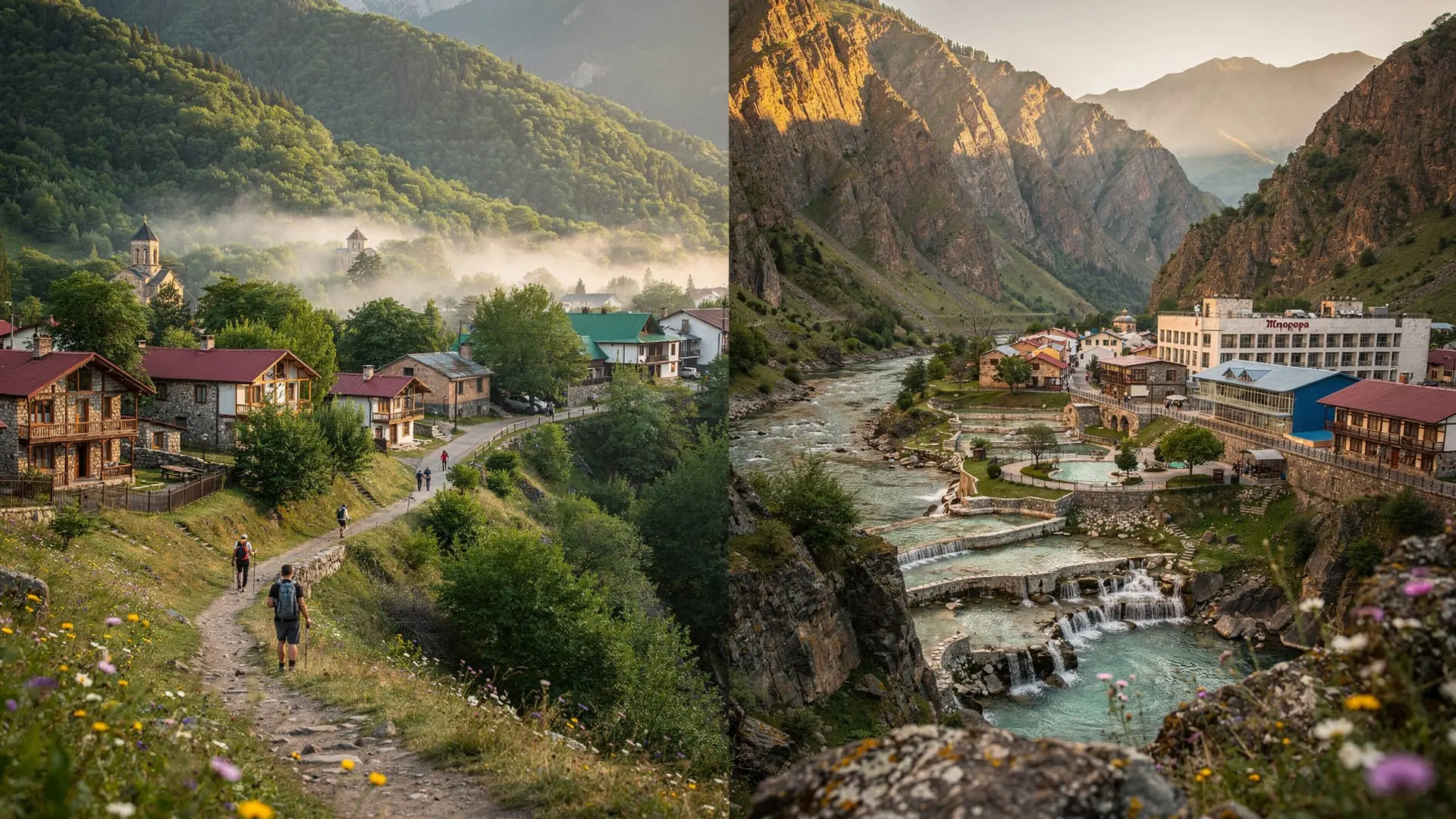
Two mountain escapes, two different personalities
When Yerevan bakes in July at 35°C, Armenians have two traditional escapes: Dilijan in the forested north, where the air is cool and the hiking trails are shaded, and Jermuk in the southern highlands, where thermal springs have been drawing visitors since Soviet times.
For travellers, both towns offer a genuine change of pace from Yerevan’s city energy. But they deliver very different experiences.
| Dilijan | Jermuk | |
|---|---|---|
| Where | Tavush province, 95 km from Yerevan | Vayots Dzor, 170 km from Yerevan |
| Cost | Guesthouses from ~15,000 AMD/night | Spa hotels from ~40,000 AMD/night |
| Time needed | 1–2 nights | 1–2 nights |
| Getting there | Marshrutka ~1h45, ~2,000 AMD | Marshrutka ~3h, ~2,500 AMD |
| Best time | May–October, peak autumn colour | June–September, some hotels close in winter |
Dilijan: the “Armenian Switzerland”
Dilijan sits in the Tavush province, 95 km northeast of Yerevan, tucked into the Agstev river valley at about 1,500 metres elevation. It is known for its dense oak and beech forests (Dilijan National Park covers 240 square kilometres), its cool summer climate (typically 10–12°C cooler than Yerevan), and its well-preserved 19th-century artisan quarter.
The nickname “Armenian Switzerland” is a local marketing invention, but it captures something real: this is a green, lush, mountain town that feels nothing like the sun-baked Armenian plateau. In the late Soviet period, Dilijan was a creative retreat for Armenian artists, composers, and writers — a tradition that has given the town a cultural dimension unusual for its size.
What Dilijan offers:
Hiking in Dilijan National Park. Several marked trails range from easy 2-hour forest walks to full-day hikes to Lake Parz (2 km from town, accessible even for families) and longer routes into the park. The Dilijan National Park hike guide covers the best routes.
Old Sharambeyan Street. The restored artisan quarter is genuinely picturesque — stone houses with carved wooden balconies, small studios, a ceramics workshop, and a good café or two. It is not large (you can walk it in 20 minutes), but it is authentically beautiful.
Haghartsin and Goshavank monasteries. Two outstanding monasteries are within 15–20 km of Dilijan. Haghartsin, a 12th–13th century complex in a forest clearing, is one of the most atmospheric monastery sites in Armenia — the combination of ancient stone and surrounding forest is unlike anything near Yerevan. Goshavank, founded by the medieval jurist and fabulist Mkhitar Gosh, is equally worthwhile.
Hotel Old Dilijan Complex. The most celebrated accommodation option in the Tavush region — a cluster of restored historic houses around a central courtyard, run as a boutique guesthouse with excellent local food.
Best for: Families, hikers, nature-seekers, those who want a cultural village atmosphere alongside scenery.
Jermuk: the spa town
Jermuk lies in Vayots Dzor province at 2,080 metres elevation, 170 km southeast of Yerevan. It is the highest city in Armenia and was developed during the Soviet period as a health resort — the mineral springs here were (and are) bottled and sold across Armenia. The distinctive glass bottles of Jermuk mineral water are on every restaurant table in the country.
What Jermuk offers:
Thermal waters and spa treatments. Jermuk’s raison d’être. The town has several sanatoriums (sanatoria — Soviet-era health resorts) and more modern spa hotels that offer hydrotherapy, mineral baths, and medical wellness treatments. These range from genuinely therapeutic multi-day programmes to simple day-use spa facilities. The thermal water is naturally carbonated and mildly sulphurous; locals drink it for digestive health.
The mineral water gallery (Pitnakayl). A covered walking gallery where visitors can drink from multiple mineral spring taps for free. Each tap has a slightly different mineral composition; the gallery is a pleasant walk (about 500 metres) along the gorge.
Jermuk waterfall. One of Armenia’s most impressive waterfalls, a 72-metre drop on the Arpa river just outside town. The viewing platform is a 20-minute walk from the centre; the sight (and sound) is dramatic particularly in spring when snowmelt feeds the river.
Alpine scenery. At over 2,000 metres, Jermuk sits among bare highland meadows and basalt formations — starkly beautiful in a way that is completely different from Dilijan’s forest. The surrounding Vayots Dzor plateau is excellent for hiking in summer (the same routes become ski-touring territory in winter, though developed ski infrastructure is minimal compared to Tsaghkadzor).
Proximity to Tatev and Noravank. Jermuk is conveniently positioned between Noravank (70 km west) and Tatev (80 km east) — making it a natural overnight stop for travellers doing the southern Armenia circuit.
Jermuk waterfall, mineral water gallery & Tatev ropeway day tour
Best for: Spa and wellness seekers, those doing the southern Armenia circuit, couples, and travellers who want high-altitude scenery.
Head-to-head comparison
| Factor | Dilijan | Jermuk |
|---|---|---|
| Distance from Yerevan | 95 km (1h45 drive) | 170 km (2h30 drive) |
| Elevation | ~1,500 m | ~2,080 m |
| Best for | Hiking, nature, culture, families | Spa, wellness, thermal waters |
| Summer temperature | ~22–26°C (very pleasant) | ~18–22°C (cool) |
| Winter access | Year-round, quiet | Limited (some hotels close Nov–Mar) |
| Key attraction | Dilijan National Park, Haghartsin | Jermuk waterfall, mineral spring gallery |
| Accommodation | Hotel Old Dilijan, guesthouses | Sanatoriums, spa hotels |
| Nearby monasteries | Haghartsin, Goshavank | Noravank (70 km), combined with Tatev |
| Food scene | Good local guesthouses | Hotel restaurants, few independent options |
| Marshrutka from Kilikia | Yes (2,000 AMD, 1h45) | Yes (2,500 AMD, 3h) |
What to eat in Dilijan and Jermuk
Dilijan food: The town has several guesthouses and small restaurants serving traditional Armenian mountain food. Grilled trout (ishkhan) from the nearby Agstev river, herb-stuffed flatbreads, and homemade fruit compotes are the local specialties. Hotel Old Dilijan Complex serves particularly good food — the evening set menu uses local seasonal ingredients. In the old artisan quarter, there are small cafés serving Armenian coffee (soorj) and pastries suitable for a mid-morning break between monastery visits.
Jermuk food: The spa-hotel dining rooms serve standard Armenian fare in large buffet-style settings designed for sanatorium guests — serviceable but not inspired. The best meals in Jermuk are at independent restaurants in the town centre, where grilled meats and fresh salads reflect the highland pastoral tradition. Jermuk’s mineral water is the local liquid — served at every table and available free from the gallery taps. Do not leave without trying it.
Both towns: Fresh fruit — particularly the cherries, apricots, and peaches from Tavush/Vayots Dzor orchards — is available from roadside stalls in season (June–September) and is exceptional in quality.
Accommodation options
Dilijan:
- Hotel Old Dilijan Complex: The premium option — restored 19th-century artisan houses, beautiful courtyard, excellent food. Book well ahead for summer weekends. 80,000–150,000 AMD per night.
- Magnolia Hotel: Mid-range, clean, central. 25,000–50,000 AMD.
- Family guesthouses (marderi tun): Numerous options offering simple rooms with breakfast for 15,000–25,000 AMD. Often the warmest hospitality.
Jermuk:
- Jermuk Grand Hotel: Soviet-era sanatorium renovated to a functional mid-range standard, with spa access included. 40,000–80,000 AMD.
- Olimpia Hotel Jermuk: Modern hotel with good spa facilities. 50,000–100,000 AMD.
- Smaller guesthouses: Available from 15,000–25,000 AMD; spa access typically not included.
Can you visit both in one trip?
Easily, if you are doing a southern Armenia circuit by car. The most logical route from Yerevan:
Day 1: Yerevan → Khor Virap → Noravank → Areni → Jermuk (overnight)
Day 2: Jermuk waterfall and mineral gallery → east toward Goris → Tatev (Wings of Tatev)
Day 3: From Goris or Tatev area → back north via different route toward Dilijan (overnight)
Day 4: Dilijan national park hike + Haghartsin → return to Yerevan
This 4-day circuit by rental car is one of the best possible Armenia itineraries. The Armenia in 10 days guide includes this circuit in the 10-day option.
Nearby attractions from each town
From Dilijan:
- Haghartsin monastery (16 km east): A 12th–13th century complex in a forest clearing — one of the most atmospheric monastery visits in Armenia. The surrounding beech and oak forest makes it unlike any other monastery in the country. Allow 1.5–2 hours; combine with a forest walk.
- Goshavank monastery (18 km east): A 12th-century monastery founded by the Armenian jurist and fabulist Mkhitar Gosh. The khachkar collection here includes some of the most intricate stone carvings in Armenia.
- Lake Parz (2 km from Dilijan centre): A small forest lake accessible on foot or by short drive. Paddleboats and a small café in summer; mirror-still reflections of the trees are the draw in autumn.
- Ijevan (30 km north): A small town known for its brandy production (the Ijevan Winery) and the Vitasar mountain off-road trail. A half-day extension from Dilijan.
From Jermuk:
- Shaki waterfall (80 km west, en route back to Yerevan): A 18-metre-high waterfall on the Vorotan river near Sisian. Easily added to the return trip from Jermuk toward Yerevan.
- Noravank monastery (70 km west): The red-cliff monastery of Vayots Dzor is a natural combination with Jermuk — both are in the same province. See the Tatev vs Noravank comparison for full details.
- Selim caravanserai (40 km north): A medieval mountain-pass caravanserai at 2,400 m elevation — one of Armenia’s best-preserved and most dramatic medieval road buildings. On the route between Jermuk and Sevan/Dilijan.
- Tatev monastery (80 km east): The Wings of Tatev cable car is within reach of Jermuk as a day trip, though the drive is on mountain roads and takes about 1.5–2 hours.
Seasonal considerations
Dilijan is best from May to October. The forests are at their best in autumn (late September–October), when the foliage turns and the light is golden. Winter is quiet and peaceful but some trails are muddy; the national park remains accessible.
Jermuk has a shorter comfortable season. The mineral gallery and spa facilities operate year-round, but the high altitude means cold winters (below -10°C is possible in January). Some spa hotels and sanatoriums close or reduce operations from November to March. Check before booking in the off-season. Summer (June–September) is the prime season, with temperatures that feel refreshingly cool compared to the Armenian lowlands.
Which is better for families with children?
Dilijan is the easier choice for most families. The Lake Parz loop is stroller-friendly, the Old Town craft workshops give children something hands-on to do, and the forest setting is engaging without being demanding. Jermuk works well for families whose children enjoy the novelty of drinking mineral water from the gallery taps and the waterfall viewpoint, but the spa-hotel focus and higher altitude (cold even in June evenings) make it less naturally suited to younger children than Dilijan’s gentler, greener setting. Families combining both should see the Armenia family itinerary for how each town fits a week-long trip, and the kid-friendly monasteries guide for which nearby sites work best with children in tow.
Which is better on a budget?
Dilijan generally offers better value at the lower end — family guesthouses from 15,000 AMD with genuinely warm hospitality are common, and the Old Town’s cafés are inexpensive. Jermuk’s budget guesthouses exist at similar prices, but the town’s character is built around its sanatoriums and spa hotels, so budget travellers can feel like they’re missing the point of the place if they skip spa access entirely. If cost is the primary constraint, Dilijan delivers a fuller experience per AMD spent; Jermuk rewards travellers willing to pay for at least a day-use spa pass.
Frequently asked questions about Dilijan and Jermuk
Dilijan or Jermuk — which is better for a weekend escape from Yerevan?
For a weekend relaxation trip, Dilijan wins on accessibility (2 hours from Yerevan vs. 3 hours for Jermuk) and variety — hiking, the old town, and monastery visits make for a well-rounded two-day trip. Jermuk is better if your primary goal is spa treatments or you are combining it with the Tatev/Noravank circuit.
Is Jermuk worth visiting in winter?
The mineral water gallery and the waterfall are accessible year-round. Some spa hotels offer winter packages, and the snowy highland scenery is striking. However, some accommodation options reduce capacity in winter, and the altitude makes it genuinely cold. Check hotel availability before planning a winter visit.
How do I get from Yerevan to Dilijan by marshrutka?
A marshrutka from Kilikia terminal in Yerevan runs to Dilijan for 2,000 AMD and takes about 1 hour 45 minutes via the Sevan–Dilijan tunnel. Departures are from early morning; check timings at the terminal. There is no fixed schedule — marshrutkas depart when full.
How do I get from Yerevan to Jermuk by marshrutka?
A marshrutka from Kilikia runs to Jermuk for approximately 2,500 AMD and takes about 3 hours. Frequency is lower than the Dilijan route — typically 2–3 departures per day, mostly in the morning.
What hotel is best in Dilijan?
Hotel Old Dilijan Complex is the standout option — restored 19th-century houses, excellent food, and a beautiful courtyard. Book well in advance for summer weekends. For budget options, several guesthouses (marderi tun — family houses) offer simple rooms from 15,000–25,000 AMD per night.
What are the thermal baths in Jermuk like?
Jermuk’s thermal bathing facilities range from Soviet-era sanatoriums (functional but dated) to newer spa hotels with modern facilities. Day-use spa access typically costs 5,000–15,000 AMD depending on the facility. The mineral water temperature at source is 52–65°C; bathing pools are typically at 36–40°C.
Can I visit Haghartsin monastery from Dilijan without a car?
Haghartsin is 16 km from Dilijan. You can take a local taxi from Dilijan for about 3,000–5,000 AMD return including waiting time. Alternatively, join a guided tour that combines Dilijan with Haghartsin and Goshavank.
If I can only pick one, which town suits a first-time visitor to Armenia better?
Dilijan, for most first-time itineraries. It’s closer to Yerevan, easier to combine with Lake Sevan on the way, and offers a wider range of things to do — hiking, an old town, two major monasteries — without needing a specific wellness interest. Jermuk earns its place on longer trips, especially if you’re already driving the southern circuit through Noravank and Tatev, where it sits conveniently en route. See the 7 vs 10 vs 14-day Armenia trip guide for how each fits different trip lengths.
Is Dilijan or Jermuk better paired with Lake Sevan?
Dilijan, decisively — the two sit less than 40 km apart via the Sevan–Dilijan tunnel, making them a natural double stop. See the Lake Sevan and Dilijan day trip guide for the logistics. Jermuk is much further from Sevan and better paired with Vayots Dzor and Syunik instead.