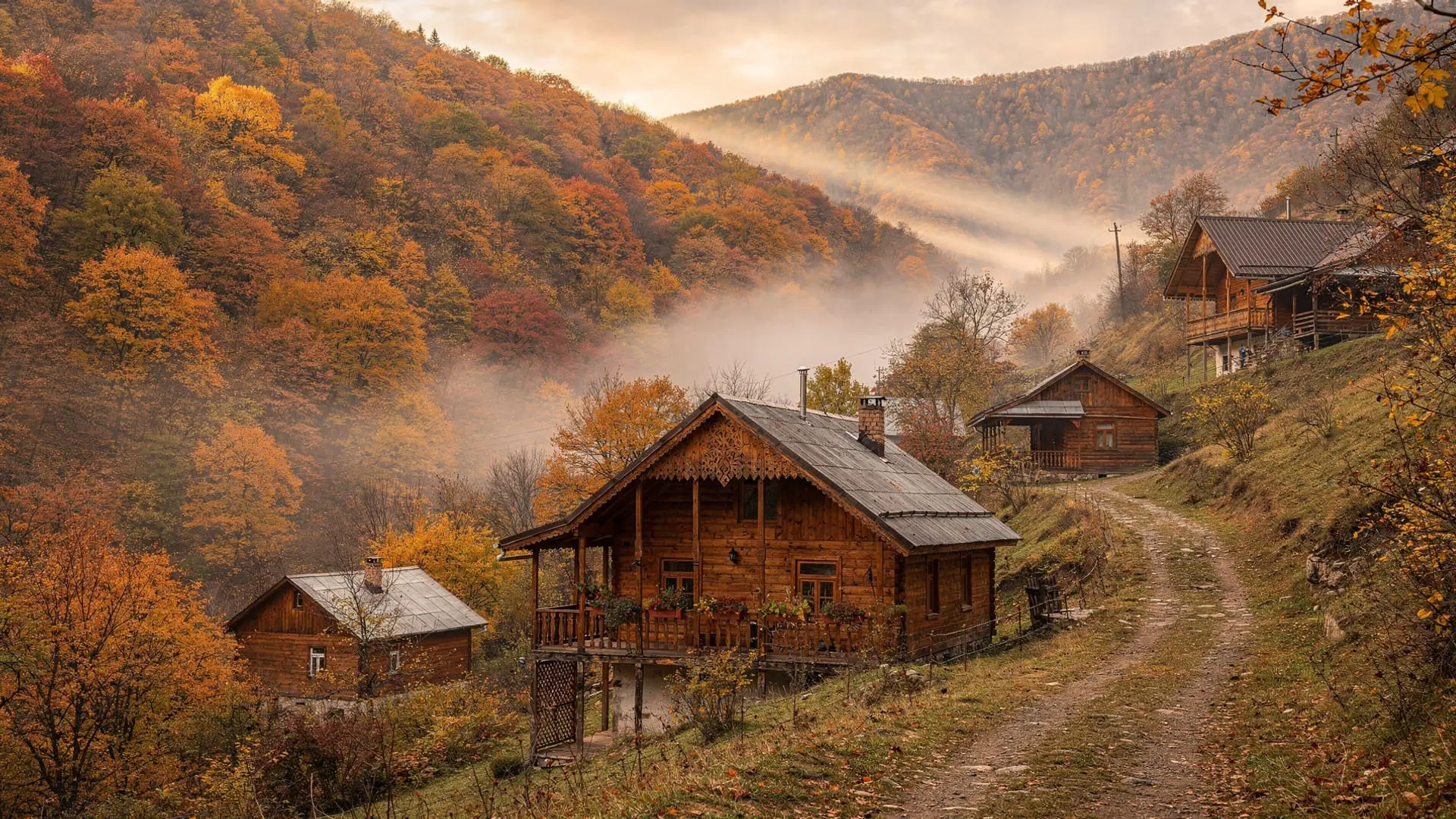
Armenia’s green breathing space
Dilijan has acquired the nickname “Armenian Switzerland” — a comparison that is both apt and slightly misleading. The forested Tavush highlands here do recall Alpine scenery more than the arid, mountainous landscapes of most of Armenia. But Dilijan has something Switzerland lacks: a crumbling, photogenic 19th-century old town of carved wooden balconies and stone courtyards, a community of international arts students at the nearby United World College, and a sense of creative quiet that draws Yerevan professionals for weekend escapes.
The town sits at 1,500 metres in a valley carved by the Aghstev River, surrounded by oak, beech, and hornbeam forest that changes colour dramatically in October. Dilijan National Park, established in 2002, covers 24,000 hectares of these mountains — and within it, two medieval monasteries (Haghartsin and Goshavank), the forest lake of Lake Parz, and a network of hiking trails that range from gentle river-valley walks to full-day ridge traverses.
In summer, Dilijan is where Yerevan families come to breathe. Temperatures here run 8–10°C cooler than the capital — important when Yerevan is sitting at 35°C in August.
| Where | Tavush province, 95 km northeast of Yerevan |
| Cost | Old town free; Lake Parz gate ~1,000 AMD; hotels from ~15,000 AMD |
| Time needed | 1–2 days (day trip possible, overnight recommended) |
| Getting there | Car via Sevan tunnel (~1h45); marshrutka from Kilikia (~1h45) |
| Best time | Jul–Aug for cool air; Sep–Oct for autumn colour |
Getting to Dilijan from Yerevan
By car: 95 km via the M4 highway, passing Lake Sevan and then through the Sevan-Dilijan tunnel (the mountain shortcut that reduced the journey significantly). Drive time: 1 hour 45 minutes in normal traffic.
By marshrutka: Marshrutkas from Kilikia Station, Yerevan to Dilijan run several times daily (fare around 1,200–1,500 AMD, approximately 1h45). There are also marshrutkas continuing north to Ijevan and Vanadzor. No fixed schedule — they leave when full.
By tour from Yerevan: many operators combine Dilijan with Lake Sevan and sometimes Haghartsin or Goshavank monasteries in a full-day excursion. A popular and sensible circuit.
From Tbilisi: if you’re entering or exiting Armenia via the Georgian border, Dilijan is almost directly on the route. Several Tbilisi–Yerevan transfer services stop here on request. See our Yerevan–Tbilisi overland guide.
What to see and do in Dilijan
Old Town Dilijan (Myasnikyan Street)
The restored old town is small but genuinely atmospheric: a pedestrianised lane of stone and timber buildings housing art workshops, a ceramic studio, a forge, and a small ethnography museum. The craftsmanship on display — carvers, potters, jewellers — is authentic rather than purely commercial. This is not a theme park reconstruction; some of these buildings were used for their original trades within living memory, and the restoration was done carefully.
Grab a coffee at one of the courtyard cafés and spend an hour wandering.
Dilijan National Park hiking trails
The national park has marked trail networks accessible from the town. Key hikes:
Dilijan to Lake Parz: 7 km round trip from town, through oak-beech forest to a small natural lake at 1,400 metres. The lakeside has a zipline and café (summer only). Easy enough for older children.
Goshavank loop: 6 km from the park entrance, through forest to the 12th-century Goshavank monastery. The monastery was the main campus of the medieval scholar and law-giver Mkhitar Gosh. Stone-carved detail on the gavit (narthex) is among the finest in Armenia.
Haghartsin via forest trail: 12 km from Dilijan centre (or drive 18 km to the monastery and hike from there). The forest-monastery combination on this trail is extraordinary in autumn.
Ridge trail to the national park boundary: for experienced hikers, trails continue to elevations above 2,000 metres with views over the Tavush forest and, on clear days, toward Georgia.
See Dilijan National Park hikes guide for detailed route descriptions and difficulty ratings.
Haghartsin Monastery
18 km northeast of Dilijan (drive or hike), Haghartsin is a 10th–13th-century monastery complex in a deep forest clearing. Three churches, a refectory with vaulted ceiling, and extensive carved decoration make it one of Tavush’s highlights. The forest setting in autumn — orange and gold leaves against grey stone — is stunning. Admission free. See our guide /guides/haghartsin-forest-monastery/.
Goshavank Monastery
20 km north of Dilijan, this 12th-century complex was the academic seat of Mkhitar Gosh, the medieval lawyer who codified Armenian common law. The gavit has extraordinary carved reliefs. Admission free. Often combined with Dilijan and Haghartsin on day trips from Yerevan. See /guides/goshavank-medieval-academy/.
Lake Parz (Parz Lch)
A small mountain lake within Dilijan National Park, 7 km from town. The lake has a café, boat rentals, and a zipline in summer. The surrounding beech forest is beautiful — this is primarily a family and couples destination. Admission to the park gate: 1,000 AMD. See /destinations/lake-parz/.
Combine with Lake Sevan
Lake Sevan is 50 km south of Dilijan (45 minutes), making the two natural partners for a day trip from Yerevan: Sevan (morning, beach and monastery) + Dilijan (afternoon, old town and forest walk). See our Lake Sevan and Dilijan day trip guide.
Where to stay in Dilijan
Dilijan has several strong accommodation options that make an overnight stay worthwhile.
Hotel Old Dilijan Complex — the showpiece accommodation of the old town, occupying the restored traditional buildings on Myasnikyan Street. The rooms are atmospheric, the service thoughtful, and the breakfast spread generous. This is the best hotel in Dilijan. Prices: 50,000–80,000 AMD per room (~120–195 €). Book ahead May–October.
Tufenkian Avan Dilijan Hotel — another Tufenkian group property (the same family runs Tufenkian Avan Dzoraget near Haghpat). Beautifully designed with Armenian craft materials, spa facilities, pool in summer. On the outskirts of town. Prices: 40,000–70,000 AMD.
Dilijan Guest House Kamohayk — excellent value mid-range option. Clean rooms, very helpful hosts, home-cooked dinners available on request. 15,000–25,000 AMD per room.
Dalan Hotel — comfortable, good location, reliable. A solid mid-range choice.
Where to eat in Dilijan
Hotel Old Dilijan Complex restaurant — the best restaurant in town. The menu is Armenian with careful sourcing: local trout, forest mushroom dishes in season, excellent lavash, good wine list. Prices are high by local standards but reasonable for quality.
Agulis — a popular local restaurant near the park entrance, serving generous portions of khorovats (barbecue) and Armenian salads at honest prices. The outdoor terrace overlooking the forest is excellent in good weather. 3,000–6,000 AMD per person.
Roadside trout stalls — numerous small operations between Dilijan and Lake Sevan sell freshly grilled trout from local farms. Not Instagram-ready, but excellent value and genuinely delicious. Around 2,000–3,000 AMD for a whole fish.
Cafés on Myasnikyan Street — coffee, pastries, churchkhela. The craft café at the ceramics workshop in the old town complex is the most atmospheric.
Tours and tickets
For a Dilijan walking tour with a local guide: Dilijan walking tour with a local guide — a 2-3 hour exploration of the old town, monastery, and forest edges with storytelling about the town’s artistic heritage.
If you want to include Haghartsin and Goshavank monasteries in a day trip from Yerevan: Sevan, Dilijan, Haghartsin, Goshavank, and Lake Parz covers an ambitious but rewarding full-day circuit.
For the Dilijan–Ijevan cultural day: heritage and art tour of Dilijan and Ijevan .
From Tbilisi: Dilijan & Sevan Lake Full-Day TourBest time to visit Dilijan
July–August: peak season. Yerevan families fill the hotels, the forest is at full lushness, and Lake Parz is busy. The cooler air is a major draw. Book accommodation well ahead.
May–June: excellent. Spring growth, wildflowers, quiet trails, good weather.
September–October: the finest season for photography. The beech and oak forests turn gold and amber from late September; peak colour is typically mid-October. Fewer crowds than summer. Arguably the best overall.
November–March: cold (often below freezing) and quiet. Haghartsin and Goshavank are accessible year-round. The forest in light snow is beautiful but require waterproof boots and warm layers.
| Season | Weather | Crowds | Verdict |
|---|---|---|---|
| Jul–Aug | Warm, 8–10°C cooler than Yerevan | Busiest, book ahead | Best for escaping the heat |
| May–Jun | Mild, wildflowers | Quiet | Best value, good hiking |
| Sep–Oct | Cool, golden forest | Moderate, dropping through Oct | Best overall for photography |
| Nov–Mar | Cold, occasional snow | Very quiet | Monasteries still open; pack layers |
See also: Armenia in autumn guide.
Practical tips
- Driving: the Sevan-Dilijan tunnel (about 2.2 km) shortens the drive considerably compared to the old mountain road. The tunnel has a toll: around 100 AMD.
- Mobile data: Tavush province generally has decent 4G coverage in the town and along main roads. Deep forest hikes may lose signal.
- Hiking footwear: the national park trails can be muddy April–June and after rain. Proper hiking shoes are worth it for anything beyond the old town walk.
- Combine strategically: Dilijan + Lake Sevan (southward), or Dilijan + Haghartsin + Goshavank (in-park), or Dilijan + Ijevan (northward toward Georgian border).
- Cross-link to Georgia: if you’re continuing north to Georgia, the Dilijan–Ijevan–Bagratashen border crossing route passes directly through this region. See Bagratashen border crossing guide.
Frequently asked questions about Dilijan
Why is Dilijan called “Armenian Switzerland”?
The comparison refers to the mountain forests, cooler climate, and 19th-century wooden architecture, which are unusual in the Armenian landscape context. The nickname is decades old. It is a fair comparison in the limited sense of “forested mountain town in a predominantly arid Caucasian country” — not in terms of wealth, infrastructure, or skiing.
Is Dilijan worth an overnight stay?
For many travellers, yes. Staying overnight lets you walk the national park trails without time pressure, visit Haghartsin monastery at its most peaceful (early morning before day-trippers arrive), and experience the forest at dusk. If you only have a day trip from Yerevan, the old town and Lake Parz are the priorities.
What are the best hikes in Dilijan National Park?
For a gentle half-day: the trail to Lake Parz (7 km return). For a full day: the Haghartsin trail through forest (about 12 km return from town) or the ridge trail toward the 2,000-metre mark. See our Dilijan National Park hikes guide for detailed descriptions.
When does Dilijan National Park turn autumn colours?
Peak autumn colour in the beech and oak forests typically occurs between late September and mid-October. Timing varies by year and elevation. A warm September can push peak colour into the third week of October.
Is there good food in Dilijan?
Better than you’d expect. The Hotel Old Dilijan Complex restaurant is genuinely good. Several local restaurants along the national park road serve excellent grilled meats and trout at honest prices. The old town cafés are pleasant for coffee and light snacks.
Should I choose Dilijan or Jermuk if I only have time for one mountain town?
Choose Dilijan for forest hiking, old-town crafts, and easy pairing with Lake Sevan on a single day trip. Choose Jermuk for mineral-spring spa culture and a dramatic waterfall gorge. Dilijan is the more convenient add-on for most Yerevan-based itineraries since it sits directly on the route east; Jermuk requires its own detour south. See the Dilijan vs Jermuk guide for a full comparison.
Dilijan in depth: what makes this town different
Every country has its “mountain escape” — the place where city residents flee for clean air, forest walks, and a slower pace. In Armenia, Dilijan is that place. But unlike similar destinations in the region that have been over-developed for tourism, Dilijan retains an authenticity that partly comes from the sustained investment in the arts and crafts community.
The United World College influence
Dilijan is home to the UWC Dilijan college, an international boarding school opened in 2014 as part of the UWC movement’s global network. The presence of hundreds of international students and international faculty has had a measurable effect on the town: a small cosmopolitan layer has developed, with cafés and guesthouses catering to visiting parents, multilingual conversations in the old town, and a cultural dialogue that would have been unusual in a provincial Armenian town a decade ago. This is not a negative development — it has raised general quality standards and introduced modest cultural diversity without erasing the town’s character.
The old town restoration
The Myasnikyan Street restoration project was funded partly through Armenian diaspora investment and managed by the Tufenkian Foundation. The approach was unusual for the region: rather than building replicas of demolished structures, the restoration used original building techniques, sourced period-appropriate timber, and hired craftspeople who could work in traditional methods. The result is a small heritage precinct that feels genuinely inhabited rather than staged.
The crafts workshops — ceramics, blacksmithing, traditional jewellery, wood carving — are operational businesses, not museum displays. You can commission work, buy directly from makers, and in some cases watch production. Prices are reasonable; the quality of hand-made pieces is high.
Dilijan National Park in detail
The park covers 24,000 hectares and includes both the forested valley floors and the ridgelines above. The most important ecological feature is the contiguous beech-oak-hornbeam forest, a type increasingly rare in the Caucasus and central to regional biodiversity. The park has resident populations of brown bear, lynx, wolf, and several raptor species including the short-toed eagle.
For birdwatching, the park is one of the better sites in Armenia — the forest edges around Lake Parz and the Haghartsin approach road are particularly productive in spring (April–May) when migrant warblers and flycatchers pass through. A local birding guide can be arranged through the park administration.
The trail network has improved significantly since 2020 — several routes are now marked with colour-coded blazes on trees, and the Lake Parz trail has been cleared and maintained. Hiking without a guide is straightforward on the main trails.
Combining Dilijan with Ijevan
30 km north of Dilijan (45 minutes on the main road), Ijevan is the second town of Tavush province — less polished than Dilijan but with its own wine country credentials (Ijevan Winery, founded 1951, produces the region’s traditional wines and cherry wine), a small art scene, and excellent hiking terrain around the Vitasar peak. For those with two days in the region, a Dilijan–Ijevan circuit makes good use of the time. See /destinations/ijevan/.
Wildlife and nature notes
The forest around Dilijan is one of the few places in Armenia where you have a realistic chance of hearing a nightingale in spring — the dense woodland provides perfect habitat. From late April to early June, the morning chorus in the national park forest is extraordinary by Caucasian standards.
The rivers that flow through the park — the Aghstev and its tributaries — support populations of native brown trout. Roadside restaurants between Dilijan and the Georgian border serve this trout freshly grilled; it tastes markedly different from farmed fish and is worth seeking out.
Sourcing local crafts responsibly
The Myasnikyan Street workshops sell directly to visitors, which means buying here puts money straight into the makers’ hands rather than into a middleman’s margin. Ceramics, hand-forged ironwork, and wood carving are the strongest categories; prices typically run from a few thousand AMD for small items to tens of thousands for larger commissioned pieces. If you want something made to order, allow a day or two — most craftspeople work to their own schedule alongside other commissions, and rushing a request rarely gets the best result. Compare this to the mass-produced souvenir stalls near Yerevan’s central attractions: the difference in quality and authenticity is immediately obvious once you have seen both.
Getting from Dilijan to Georgia
If you’re continuing north to Georgia, the journey from Dilijan to the Bagratashen border crossing takes about 1.5 hours. The crossing at Bagratashen–Sadakhlo is one of the busier Armenia–Georgia border points — waits vary from 15 minutes to 2+ hours depending on time of day and day of week. From the border, it’s another 2 hours to Tbilisi. See our Bagratashen border crossing guide and the Yerevan–Tbilisi overland guide for full logistics.
For the cross-border perspective, if you’re planning a combined Armenia–Georgia trip, Dilijan sits naturally between the two capitals and is often used as a break point on the drive. See our Armenia and Georgia combined trip planner.
Wellness and retreats around Dilijan
The town’s cool climate, forest setting, and relative quiet have made it a natural fit for Armenia’s small but growing wellness and retreat scene. Several properties around Dilijan run yoga weeks, meditation retreats, and spa programmes built around the forest air rather than imported wellness formulas — a genuine point of difference from the more mineral-water-focused spa offerings around Jermuk. If a slower, restorative few days rather than a sightseeing-packed itinerary is what you’re after, this is one of the better bases in Armenia for it. See our Dilijan wellness retreats guide for specific properties and programme lengths.
Dilijan vs Jermuk: choosing your mountain town
Travellers weighing up Armenia’s two best-known mountain towns often ask which to prioritise if time only allows one. The short answer: Dilijan for forest, hiking, and old-town character; Jermuk for mineral springs, spa culture, and a dramatic waterfall gorge. Dilijan is also the easier add-on to a Lake Sevan day trip, since both sit on the same eastern route out of Yerevan, whereas Jermuk requires a separate detour south. See the full Dilijan vs Jermuk comparison for a fuller breakdown.