Tatev vs Noravank: which monastery?
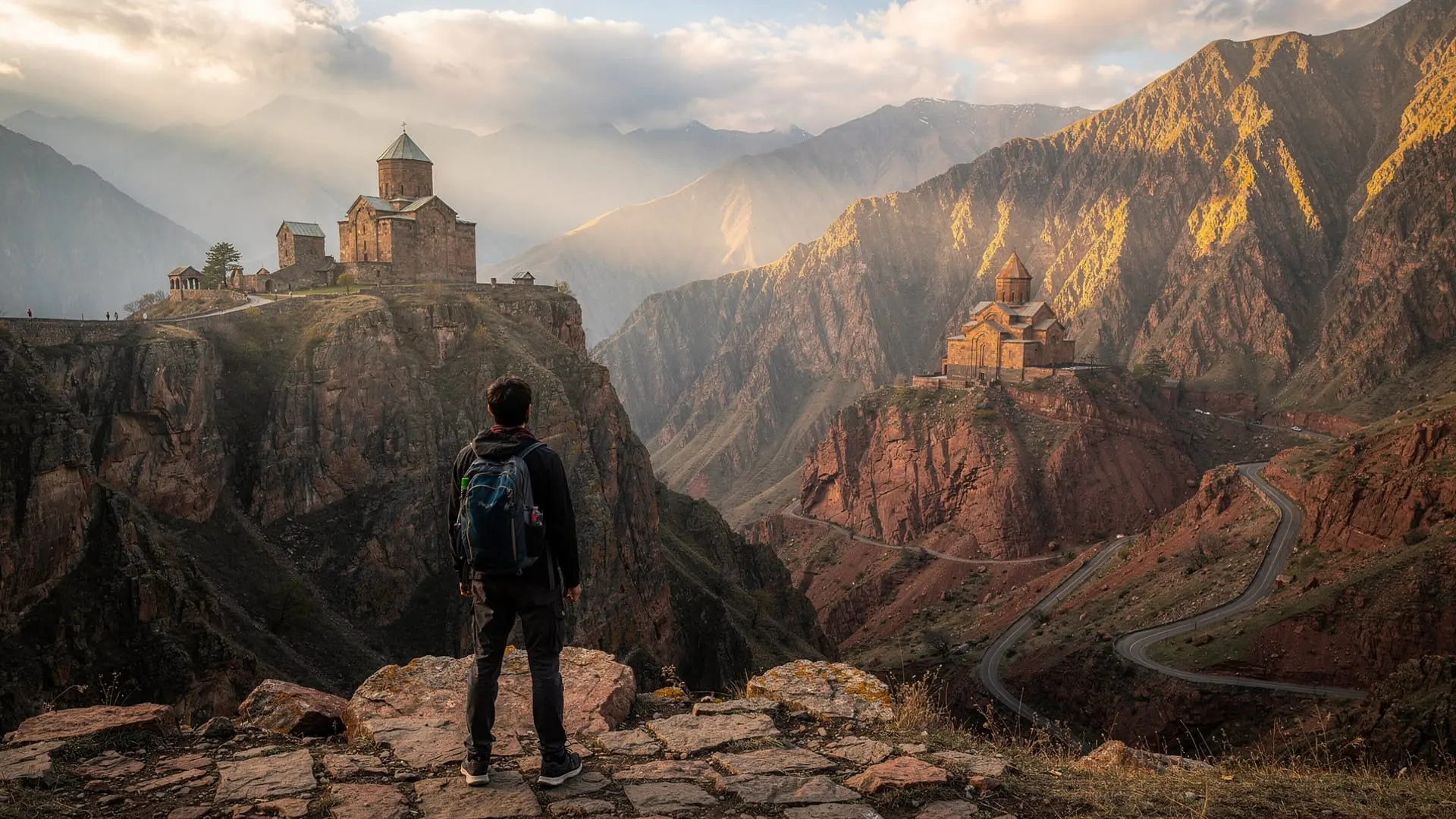
Two monasteries, two very different experiences
Ask any visitor to Armenia which monastery they would recommend, and most will pause. Both Tatev and Noravank are exceptional. But they offer different experiences — different in logistics, atmosphere, scenery, and what surrounding the visit makes it worthwhile.
This guide is for travellers who have limited time and need to choose, or who want to understand what each site actually offers before deciding.
| Noravank | Tatev | |
|---|---|---|
| Where | Vayots Dzor, 125 km from Yerevan | Syunik, 250 km from Yerevan |
| Cost | ~5,500 AMD incl. Areni wine extras | ~2,500 AMD entry + ~2,500 AMD cable car |
| Time needed | Half day from Yerevan | Full day, or overnight in Goris |
| Getting there | Comfortable day trip, self-drive or tour | Better as an overnight; long day trip otherwise |
Noravank: the red-cliff jewel
Noravank monastery sits at the end of a narrow gorge in Vayots Dzor province, 125 km south of Yerevan. The approach road cuts through vertical red-orange limestone walls that frame the church perfectly — particularly in the golden light of late afternoon.
The monastery was built primarily in the 13th–14th centuries and is associated with the sculptor Momik, who carved the intricate khachkars (cross-stones) and the remarkable two-level church of Surb Astvatsatsin, with its staircase that doubles as an architectural feature and a practical challenge: the narrow exterior stairs leading to the upper chapel require some nerve.
What makes Noravank unmissable:
- The setting: arguably the most photogenic monastery in Armenia.
- The red-limestone gorge, which turns amber at sunset.
- Accessibility: 2.5–3 hours from Yerevan by car or marshrutka connection.
- Combination potential: Noravank is naturally paired with Khor Virap (35 km back toward Yerevan), the Areni wine cave (7 km along the same road), and a winery tasting at Hin Areni or Areni Wine Factory.
Day-trip logic from Yerevan: A southern Armenia day from Yerevan runs naturally: depart 08:30 → Khor Virap (50 min from Yerevan, 1-hour visit) → Areni village and cave (~1.5 hours) → Noravank (~2 hours visit, 30-min drive from Areni) → return to Yerevan (2.5–3 hours). This is doable in a single day by rental car or private tour.
From Yerevan: Khor Virap and Noravank monastery tour
Tatev: the remote giant
Tatev monastery sits at the edge of a dramatic plateau above the Vorotan gorge in Syunik province, 250 km from Yerevan. It is one of the most historically significant monastery complexes in Armenia — a former seat of learning, political power, and episcopal authority with a history stretching to the 9th century.
The monastery would be extraordinary even without the cable car. With it, the journey becomes an event in itself.
The Wings of Tatev cable car (officially: the world’s longest non-stop double track reversible cable car, at 5.7 km) crosses the Vorotan gorge in 12 minutes, descending from the village of Halidzor to the monastery plateau. The views of the gorge, the river far below, and the monastery emerging from the cliff edge are genuinely breath-taking. Rides run approximately every 20 minutes; tickets are separate from the monastery entry.
What makes Tatev unmissable:
- The Wings of Tatev cable car experience over the Vorotan gorge.
- The monastery complex itself: larger and more layered than Noravank, with multiple churches, a refectory, an oil press, and the famous Gavazan column (an 8th-century earthquake-warning device).
- The remote Syunik landscape: dramatic, austere, very different from the wine-country valleys of Vayots Dzor.
- Proximity to Khndzoresk cave village and the Shaki waterfall.
The logistics challenge: Tatev is 250 km from Yerevan — a 4-hour drive in good conditions. As a pure day trip, this means 8 hours of driving for perhaps 4 hours at the monastery. Most travellers who have done this say it is achievable but exhausting. The better approach is to overnight in Goris (the gateway town, 30 km from Tatev) and return the following day. Hotel Mirhav and Hotel Old Caravanserai in Goris are both good options.
By marshrutka, the journey from Yerevan to Goris takes 4.5–5 hours (4,000 AMD); from Goris to Tatev/Halidzor, you take a local taxi (around 3,000–4,000 AMD). The Tatev complete guide covers this in detail.
From Yerevan: Tatev monastery and Wings of Tatev tour
What surrounds each monastery
Part of what makes a monastery visit satisfying or merely adequate is the surrounding experience — the drive, the nearby sites, the food options, the character of the nearest town.
Around Noravank: The approach road through the Amaghu gorge is one of the most dramatic drives in Armenia. The red cliffs rise 40–60 metres above the narrow road; the scale is humbling before you even see the monastery. The gorge is home to wild orchids in April–May and sharp hawks that circle the limestone walls year-round.
After the monastery, most visitors continue 7 km back to Areni village — the capital of Armenian wine culture. The Areni-1 cave (Birds Cave) nearby contains the world’s oldest known winery installation (4000 BCE); a tour of the cave takes 45 minutes and costs around 1,500 AMD. The Areni Wine Factory and Hin Areni winery are both within 2 km and offer tastings.
Returning toward Yerevan via the Ararat valley, Khor Virap monastery sits 50 km northwest of Noravank — with Mount Ararat behind it when the sky is clear. This combination (Noravank + Areni + Khor Virap) is the most satisfying single day trip in Armenia.
Around Tatev: The Wings of Tatev cable car station is in Halidzor village, 30 km from Goris. The gorge viewed from the cable car — 320 metres above the Vorotan river, spanning 5.7 km — is the centrepiece. After the monastery, the most logical extension is Khndzoresk, a cave village 12 km from Goris where families lived in rock-cut dwellings until the 1950s. A swinging pedestrian bridge (100 AMD to cross) connects the modern village to the abandoned cave settlement — surreal, atmospheric, and unlike anything else in the country.
Goris itself is a pleasant town with the best accommodation in Syunik province. The mirhav hotel and Hotel Old Caravanserai are both solid options for an overnight. Several restaurants serve the regional cuisine — grilled meats, flatbreads, the distinctive sour plum sauce of southern Armenia. The town also has a small museum and a Saturday market that draws villages from across the region.
Side-by-side comparison
| Factor | Noravank | Tatev |
|---|---|---|
| Distance from Yerevan | 125 km (2.5–3h drive) | 250 km (4h drive) |
| As a day trip | Yes, comfortably | Possible but exhausting; better as overnight |
| Visual drama | Red limestone gorge, exceptional | Vorotan gorge from cable car, exceptional |
| Size of complex | Medium — 3 main churches | Large — multiple churches, outbuildings |
| Historical significance | High (Momik, Orbelyan princes) | Very high (episcopal seat, university) |
| The cable car | No | Yes — Wings of Tatev |
| Combination potential | Khor Virap + Areni + Noravank (excellent 1-day loop) | Khndzoresk + Goris + Shaki (1–2 day circuit) |
| Crowds | Moderate | High in July–August (cable car queues) |
| Photography | Best in afternoon light, gorge backdrop | Dawn or dusk, gorge views from cable car |
| Budget (excluding car) | ~5,500 AMD entry + Areni wine extras | ~2,500 AMD monastery + ~2,500 AMD cable car return + transport |
Deep dive: Tatev monastery
Tatev monastery was founded in the 9th century CE, with the main Church of Saints Paul and Peter (Surb Poghos-Petros) completed in 895–906. For several centuries it was one of the most important monastic universities in the medieval Armenian world — a centre of manuscript production, theological scholarship, and political power. At its height in the 13th–14th centuries, the monastery housed over 600 monks and operated as a major seat of learning, attracting scholars from across Armenian territories.
The monastery complex includes multiple structures accumulated over a millennium. The primary elements: the Cathedral of Saint Gregory the Illuminator (9th century, rebuilt and expanded multiple times), the Church of Saints Paul and Peter (late 9th century), the refectory, the oil press, the defensive walls, and the extraordinary Gavazan column — an 8th-century free-standing column connected to the monastery wall by a pivot mechanism, designed to tip and ring a bell in response to seismic activity, making it one of the earliest known earthquake warning devices in the world.
The monastery’s history includes several destructions and restorations: Mongolian raids in the 13th century, Timurid devastation in the early 15th century, a catastrophic earthquake in 1931 that damaged the main cathedral significantly. The current state reflects layered restoration work from different periods, and the monastery is an active religious site — Armenian Apostolic services are held here, particularly during major feast days.
The Vorotan gorge context: The gorge below the monastery is the Vorotan River canyon, one of the deepest in the southern Caucasus. The plateau on which Tatev sits is approximately 1,000 metres above sea level; the gorge drops dramatically on three sides, making the monastery effectively unassailable from below. This defensive geography explains why it became such an important centre during periods of foreign invasion — it was simply very hard to attack.
The Wings of Tatev cable car: Opened in 2010, the cable car was built as a Guinness World Record-holding achievement (longest non-stop reversible ropeway at 5.7 km) and as genuine infrastructure — before it opened, reaching Tatev required a mountain road descent and reascent that was impassable in winter and time-consuming in any season. The cable car runs from Halidzor village to the monastery plateau in 12 minutes. Tickets (purchased at Halidzor) are approximately 2,000–2,500 AMD return as of 2026. The views during the crossing — 320 metres above the Vorotan River at the gorge’s deepest point — are the defining visual experience of the journey.
Devil’s Bridge (Satani Kamurj): Below the Tatev complex, a 30-minute walk down from the cable car lower station, is a natural stone bridge over the Vorotan — a dramatic geological formation where the river has undercut a basalt ridge to leave an arch. The walk to the bridge passes through the gorge bottom and requires some scrambling; sturdy shoes essential. The bridge itself is a surreal sight — an arch of black rock over turquoise water in a narrow canyon.
Deep dive: Noravank monastery
Noravank was founded in the 12th century on land granted by the Orbelian princes, the ruling family of Vayots Dzor. The monastery’s greatest period was the 13th–14th centuries, when the master sculptor and architect Momik (1250s–1339) worked here, producing some of the finest khachkars (cross-stones) and carved relief sculpture in Armenian art.
Momik’s defining contribution to Noravank is the Church of Surb Astvatsatsin (Holy Mother of God), completed in 1339 — the year of his death, according to tradition. It is a two-storey church: the ground floor houses a gavit (antechamber/vestibule), and the upper chapel is reached by a narrow external stone staircase that juts from the church facade at a dramatic angle. The staircase is functional but theatrical: ascending it requires some nerve as there is no railing at the top, and the view from the upper doorway over the red gorge below is vertiginous. Most visitors attempt it; it is safe for those not afraid of heights.
The main church (Surb Karapet, 12th century) is the larger structure, with Momik’s khachkars integrated into the exterior walls — his carved interlace patterns, animal motifs, and portrait reliefs represent the apex of medieval Armenian stone carving. Look for the tympanum of the upper church door: a carved relief of the Virgin and Child flanked by archangels, considered one of Momik’s masterworks.
The Amaghu gorge approach: The road to Noravank cuts through the Amaghu river gorge for approximately 7 km — a narrow canyon of vertical red-orange limestone walls rising 40–60 metres above the road. In April–May, the gorge floor is carpeted with wild orchids and poppies; in summer, red-tailed hawks and Egyptian vultures circle the cliff tops. The gorge itself is a significant visual experience independent of the monastery.
The Areni wine connection: 7 km back along the Noravank road is Areni village, the heartland of Armenian wine culture. The Areni grape variety is native to this specific valley and has been cultivated here for at least 6,000 years — the Areni-1 cave (also called the Birds Cave) 1 km from the village contains the world’s oldest known winery installation (approximately 4000 BCE). The cave tour (45 minutes, ~1,500 AMD entry) includes the original wine press, fermentation vats, and the shoe and textile finds from the Chalcolithic period. The Areni Wine Factory and Hin Areni winery are both within 2 km and offer tastings of the native grape in its modern expressions.
From Yerevan: Khor Virap, Areni Winery, and Noravank TourThe two-day combination strategy
If you have two days available for southern Armenia — the optimal approach — the following sequence covers both monasteries at their best:
Day 1 (Noravank circuit from Yerevan):
- Depart Yerevan 08:30
- Khor Virap monastery and Ararat view (50 min drive, 1 hour visit) — best in morning before haze
- Areni village: Areni-1 cave tour (45 min), winery tasting at Hin Areni or Areni Wine Factory (1 hour)
- Lunch in Areni village (~13:00) — several small restaurants serving regional Armenian food
- Noravank monastery via the Amaghu gorge (30 min drive, 2 hours visit) — afternoon light from the west turns the cliffs golden after 15:00
- Return to Yerevan (2.5 hours) or overnight in Yeghegnadzor (closer base)
Day 2 (Tatev circuit):
- Depart Yerevan or Yeghegnadzor early
- Drive to Goris (4 hours from Yerevan, or 2.5 hours from Yeghegnadzor) — overnight in Goris if doing this as a 2-day trip from Yerevan
- Halidzor cable car station by 09:00 (first cable car, shortest queues)
- Wings of Tatev crossing, monastery visit (3–4 hours)
- Lunch at monastery restaurant or back in Halidzor
- Khndzoresk cave village (12 km from Goris, 1.5 hours including swinging bridge) — afternoon
- Return to Goris, overnight or drive back to Yerevan
This sequence avoids the exhausting one-day marathon and allows each site the time it deserves. The 2-day guided trip to Tatev and Khndzoresk builds this circuit with a guide and transport included.
2 Day Guided Trip to Tatev wings & monastery, KhndzoreskBudget travellers vs those with more flexibility
The choice between Noravank and Tatev is also, in practice, a budget and time question as much as an aesthetic one.
On a tight budget with limited time: Noravank is the clear pick. A Khor Virap, Areni, and Noravank tour can be done for a fraction of the cost and time commitment of a Tatev overnight, and it delivers three strong sites in a single comfortable day using shared group transport, marshrutka connections, or a modestly priced private taxi.
With a rental car and more flexibility: Tatev becomes far more attractive, because the extra cost is mostly time rather than money — a private car for the round trip runs 60,000–80,000 AMD regardless of group size, so splitting it between three or four people brings the per-person cost close to a group tour anyway. The renting a car in Armenia guide covers what to expect from self-drive logistics on this route.
Group tours vs independent travel: For Noravank, independent travel by rental car is straightforward and arguably preferable — the site is compact and well-signed. For Tatev, a first-time visitor benefits more from a guide, given the complexity of the monastery’s history and the logistics of timing the cable car crossing around queues.
Solo travellers without a car: Both sites are reachable by marshrutka plus local taxi combinations, but the practical difficulty scales with distance. A solo traveller relying on public transport will find Noravank far more forgiving — the connections through Areni are frequent and the total journey is manageable in a day. Reaching Tatev without a car realistically means booking a seat on a group tour rather than improvising the marshrutka-to-taxi chain solo, simply because the margin for error over a 250 km one-way journey is much smaller.
Photo potential and the best shots at each
At Noravank: The iconic shot is the entire monastery complex from the approach road, with the vertical red limestone cliffs filling the frame behind the two churches. This requires a position about 200 metres south of the monastery on the road. Use a wide lens (equivalent 24–35mm) and shoot in the hour before sunset when warm light hits the west-facing stone. The upper chapel staircase, with the gorge below and the cliff above, is the second defining shot. Early morning is better for avoiding crowds at this specific angle.
At Tatev: The three great photographs are: (1) the monastery at the cliff edge, best shot from a position on the road before the cable car station looking across the gorge — this requires a long lens (100mm+); (2) the view downward from the cable car mid-crossing, showing the Vorotan River 320 metres below — use a wide lens and steady your arms against the gondola wall; (3) the Gavazan column in the monastery courtyard, framed against the gorge edge and sky. At Tatev, golden hour is dawn (the plateau faces east), which means the first cable car of the morning also catches the best light.
The drive itself: which route is more scenic
Neither monastery is a destination reached quickly, and the drive is genuinely part of the experience for both.
The road to Noravank runs south through the Ararat valley — flat, with Mount Ararat filling the rearview mirror on clear days — before narrowing into the Vayots Dzor canyon country around Areni. The final approach through the Amaghu gorge is the visual highlight: vertical red-orange cliffs closing in on a narrow road for the final few kilometres. Total driving time from Yerevan is 2.5–3 hours, easily done in a single push.
The road to Tatev continues south past the Noravank turnoff, climbing over the Selim pass (2,410 m) before descending into the Vorotan basin and Syunik province. This section is more dramatic in scale — genuine high mountain terrain, sparser settlement, a sense of leaving the country’s populated core behind. The final stretch from Goris to Halidzor threads through gorge scenery that previews the Wings of Tatev crossing itself.
For travellers who enjoy road-tripping as much as the destination, the extra distance to Tatev is not a cost to be minimised — the Selim pass and the approach to Syunik are among the most rewarding stretches of driving in the country. For those who see the drive purely as a means to an end, Noravank’s shorter, faster approach is the more efficient choice.
Seasonal advice
Noravank is accessible year-round. The gorge road is paved and remains open in winter; in snow or frost, the red cliffs against white becomes an extraordinary sight. Late afternoon visits (16:00–18:00) in spring and autumn maximise the warm light on the limestone.
Tatev is also accessible year-round thanks to the cable car (which can close for maintenance — occasionally in November). The monastery itself is on a high plateau that gets cold and windy in winter; bring layers. In July–August, the cable car lines can be 30–60 minutes at peak times. Visit on a weekday or in the first cable car of the morning.
Which should you choose?
Choose Noravank if:
- You are based in Yerevan for a standard 5–7 day trip.
- You want to combine a monastery with a wine tasting at Areni and a Khor Virap visit in a single day.
- You care most about photography and visual beauty.
- You have already seen a few Armenian monasteries and want variety (the red limestone setting is unlike anything else in the country).
Choose Tatev if:
- You are willing to make it an overnight trip (the right approach).
- You want the peak experience — the combination of cable car, gorge, and monastery is the most dramatic single day in Armenia.
- You are doing a south Armenia loop (Tatev–Goris–Khndzoresk–Areni–back).
- You have already visited Noravank on a previous trip.
Do both if: You have 10 or more days and are making a serious circuit of southern Armenia. The Armenia in 10 days itinerary builds this circuit into the plan.
Frequently asked questions about Tatev and Noravank
Tatev or Noravank — which monastery is more impressive?
Tatev’s overall experience (cable car + monastery complex + landscape) edges it out in terms of spectacle. But Noravank’s setting is arguably more beautiful in a purely visual sense. If you could only see one photograph, it would probably be Noravank. If you could only have one memory, it would probably be the Wings of Tatev.
Can I visit both in one day from Yerevan?
In theory, yes — Tatev + Noravank in one day is approximately 600 km round trip and would require leaving Yerevan at 06:00 and returning after 22:00. In practice, this is exhausting and you would see neither site at its best. Two separate day trips — or better, an overnight for Tatev — is the right approach.
How much does the Wings of Tatev cable car cost?
The cable car return ticket (from Halidzor to Tatev and back) costs approximately 2,000–2,500 AMD per person as of 2026. Check current pricing at the ticket office at Halidzor. The monastery entry is a separate fee (~1,000 AMD).
Does Noravank require a tour guide?
No — you can visit independently by rental car. The monastery is well signed and the site is small enough to explore alone in 1.5–2 hours. An audio guide or a knowledgeable private guide adds context but is not essential.
Is Noravank open in winter?
Yes. The gorge road remains open in winter (snow is rare at this altitude), and the monastery is accessible year-round. The site is far less crowded in November–March, which makes for a more atmospheric visit.
How early should I arrive at Tatev in summer to avoid queues?
Arrive at Halidzor cable car station at or before 09:00. The first cable cars of the day (around 09:00) have the shortest queues. By 11:00, lines of 30–45 minutes are common in July and August.
Which is better for photography — Noravank or Tatev?
Noravank, for most photographers: the red-limestone gorge framing the church facade is one of the most reliably spectacular compositions in Armenia, especially in late-afternoon light. Tatev offers a different kind of photograph — the cable car crossing the Vorotan gorge — which is harder to compose well from the ground but extraordinary from inside the gondola itself.
Is either monastery accessible for visitors with mobility difficulties?
Noravank’s main courtyard is reasonably flat and accessible, though the famous external staircase to the upper chapel is not. At Tatev, the cable car itself has a ramp and is wheelchair-accessible, and the monastery’s main courtyard is relatively flat, though some areas are unpaved. Neither site has formal accessible facilities in the way a major museum would.