Haghartsin: the forest monastery of Dilijan
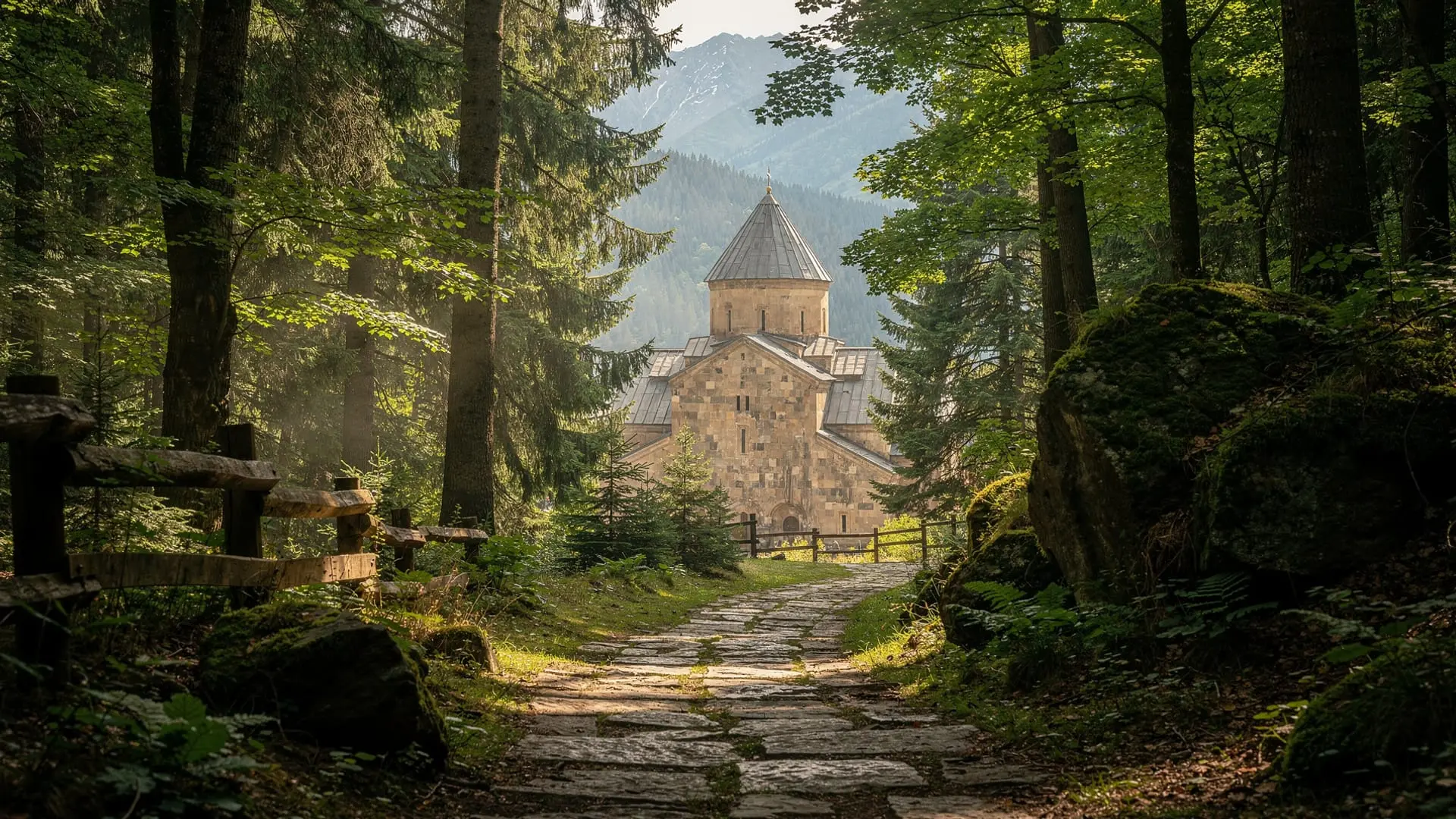
Three churches in a beech forest
Haghartsin is 18 km from Dilijan, down a road that descends from the highway into a river valley increasingly dense with beech, oak, and hornbeam. The forest thickens as the road narrows. Then, in a clearing where the valley floor widens slightly, three medieval churches appear — dark basalt, forest on every side, no visible urban presence.
| Where | 18 km from Dilijan, 95 km / ~1h45 from Yerevan |
| Cost | Free entry; donation box at the gavit |
| Time needed | 1.5–2 hours |
| Getting there | Car, tour, or taxi from Dilijan (~AMD 5,000–8,000 round trip) |
| Best time | October for autumn colour; overcast days for photography |
This setting is Haghartsin’s primary distinguishing feature. Most Armenian monasteries occupy dramatic elevated positions — cliff edges, hilltops, canyon walls. Haghartsin is in a valley, embedded in trees, sheltered rather than exposed. The atmosphere is correspondingly more intimate, more meditative, less theatrical than Tatev or Noravank.
The monastery is 18 km northeast of Dilijan and 95 km from Yerevan. It belongs to the Armenian Apostolic Church and is in active liturgical use.
Why this monastery matters
Haghartsin was founded in the 10th century by the Bagratid dynasty and expanded substantially under Zakarian patronage in the 12th and 13th centuries. Its three churches — dedicated to the Mother of God, St Gregory, and St Stephen — reflect successive building campaigns, each adding to a complex that grew organically rather than through a single systematic plan.
The name Haghartsin is believed to derive from an Armenian phrase related to the play of eagles (haghk = eagle, artsin = eagle or game), though the etymology is disputed. The forest setting supports a legend that the founding monks chose the location by following an eagle.
The monastery was an important centre of the Diocese of Tavush and maintained a scriptorium that produced manuscripts for the broader Zakarian cultural network. Several Haghartsin manuscripts are preserved in the Matenadaran library in Yerevan.
History
- 10th century: Founding under Bagratid patronage; the earliest church structure dates to this period.
- 1148 AD: The Church of the Mother of God (Surb Astvatsatsin) is recorded in inscriptions; construction or major expansion likely in this period.
- Early 13th century: Under Zakarian patronage, the Church of St Gregory and the main gavit are built. The refectory — one of the finest surviving examples of a medieval Armenian monastic dining hall — dates to the same campaign.
- 1248 AD: The Church of St Stephen (Surb Stepanos) is completed. Its carved portal decoration is the finest of the three.
- 13th–14th centuries: The manuscript scriptorium is active; the monastery accumulates significant endowments.
- 14th–17th centuries: Periodic damage from raids and earthquakes; the community contracts but persists.
- 20th century: Restoration work and renewed religious activity post-independence.
What to see at the site
Church of the Mother of God (Surb Astvatsatsin, 12th century): The largest and oldest of the three churches. A domed basilica with an unusual interior — the crossing area is wider than the nave arms, creating a spacious central space. The khachkars embedded in the exterior walls include some fine examples from the 12th–13th centuries.
Church of St Gregory (Surb Grigor, early 13th century): The middle church in the complex. More restrained in decoration than the others, but the portal carving — Christ in a mandorla with flanking figures — is well-preserved.
Church of St Stephen (Surb Stepanos, 1248): The finest single building at Haghartsin. The west portal has a carved tympanum with exceptional detail: angels, a central medallion, and a frieze of interlace that shows the peak of Zakarian-period ornamental stone-cutting. The interior is intimate and dimly lit.
The gavit (13th century): The large narthex-hall attached to the west of the main church complex. The interior has carved stone tombs of Zakarian princes and officials. The ceiling system — a characteristic Zakarian star vault — is well-preserved.
The refectory (13th century): One of the most significant surviving structures. The refectory is a long hall with a table platform cut from stone running its length — the monks ate here communally. The carved blind arching along the interior walls is decorative. Very few medieval Armenian monastery refectories survive in this condition.
How to get there
By car: From Dilijan town, follow the road northeast through the forest (18 km, about 25 minutes). The road is paved throughout. From Yerevan, the total journey is 95 km (about 1h 45min via the Sevan-Dilijan tunnel).
By tour: Haghartsin is frequently included in Tavush day trips from Yerevan, often combined with Goshavank, Lake Parz, and Dilijan.
From Yerevan: Haghartsin and Yell Extreme Park private tour Sevan, Dilijan, Haghartsin, Goshavank, and Lake Parz tourFrom Dilijan by taxi: A round-trip taxi from Dilijan costs AMD 5,000–8,000. Most drivers will wait 1.5 hours while you explore. The Old Dilijan Hotel can arrange this.
Photography and best light
Haghartsin receives very limited direct sunlight because of the forest canopy and valley position. The best natural light is on overcast days or in very early morning when shafts of light penetrate the trees. Autumn (October) transforms the setting completely: the beech canopy turns vivid gold and orange, the light filtering through the leaves bathes the stone in warm diffused colour. It is arguably the most beautiful month to visit any Armenian monastery and Haghartsin in particular.
The carved portal of the Church of St Stephen photographs best in flat light (avoid midday sun at any angle, which creates harsh shadows across the carving). The refectory interior requires a wide lens and a high ISO.
Combining with other sites
Haghartsin anchors the Tavush monastery circuit:
- Goshavank (23 km south via Dilijan): the medieval academy of Mkhitar Gosh — see Goshavank: medieval academy of Mkhitar Gosh
- Lake Parz (8 km from Dilijan): small forest lake with trails, popular for kayaking
- Dilijan town: walking the Old Town restoration area, cafes, and the Hotel Old Dilijan Complex for an overnight
- Yell Extreme Park (Yenokavan, 25 km from Dilijan): ziplines and adventure activities if you have children or teenagers
For day-trip planning from Yerevan: Lake Sevan and Dilijan day trip.
Practical visit info
Entry fee: Free. Donation box at the main gavit.
Opening hours: Dawn to dusk daily. The monastery is in active use; all three churches are generally accessible outside of services.
Dress code: Shoulders and knees covered; women cover heads. Spare headscarves may be available.
Facilities: A small refreshment stand operates at the parking area in summer. No ATM. Dilijan town (18 km) has restaurants and ATMs.
Road conditions: Fully paved to the monastery entrance. Standard cars manage the drive easily in all seasons.
Best season: September–October (autumn foliage, excellent light, manageable temperatures). May–June for wildflowers in the forest. Winter is accessible but dark and cold; the forest is beautiful in snow.
Understanding the Zakarian artistic tradition
Haghartsin’s carved ornament is worth examining in detail because it represents the Zakarian school of Armenian stonework at a high level of development. The key features to identify are:
Interlace patterns (hatching): The tympanum carving above the entrance to the Church of St Stephen shows an interlocking knot pattern that has no gaps or breaks — a single continuous line that weaves over and under itself across the entire surface. This is not a decorative flourish but a theological statement: the unbreakable continuity of divine creation. Armenian medieval stonemasons were consummate geometers.
Rosette motifs: Circular flower patterns appear on the drum exterior and on the gavit corbels. They are carved in high relief, giving a strong shadow effect. The rosette is an ancient symbol that the Armenian Christian tradition absorbed and retained.
Figural tympana: The Church of St Gregory has figures above its portal — unusual in Armenian churches, which generally avoided figurative sculpture in favour of geometric and vegetal ornament. The influence here is likely Georgian, reflecting the political and cultural integration of Armenian and Georgian noble culture under the Zakarian administration.
The star vault ceiling: The gavit at Haghartsin uses the characteristic Zakarian ceiling system: a series of intersecting arches rising from corner columns to create a ribbed vault with a central oculus open to the sky. This system — sometimes called the “Armenian vault” in architectural history — appears at Haghpat, Sanahin, Hovhannavank, Goshavank, and Geghard. It is one of the most distinctive technical contributions of medieval Armenian architecture.
The monastery and Dilijan National Park
Haghartsin sits within the borders of Dilijan National Park, established in 2002 to protect the forest ecosystem of northeastern Tavush. The park covers approximately 28,000 hectares and includes the Haghartsin watershed, Parz Lake, and several forest reserves. It is administered jointly by the Ministry of Environment and international conservation bodies.
The park has a visitor centre in Dilijan town that provides maps, trail information, and guided hike bookings. Several marked trails connect the main Dilijan area to Haghartsin and Goshavank through forest; these are the best way to experience the monasteries within their natural context rather than simply driving to the car park. The Parz Lake–Goshavank hiking trail (about 12 km one way) is the most rewarding.
Wildlife in the park includes brown bear, lynx, wolf, and Caucasian red deer — all present but rarely seen. The birdlife is excellent; the forest harbours species found nowhere else in the South Caucasus. If you are interested in wildlife as well as monasteries, allocate an extra day in Dilijan.
Dilijan town: where to stay and eat
Dilijan is a small town with a growing tourist infrastructure. Key options:
Accommodation: Hotel Old Dilijan Complex (Sharambeyan 27) — the best address, a restored historic building with courtyard and garden, mid-range prices (AMD 30,000–50,000 per night, EUR 73–122). Several guesthouses operate in the nearby village area at AMD 15,000–25,000 per night.
Restaurants: The Old Dilijan Hotel has a good restaurant. Achajour restaurant on the main road is a local favourite for traditional Armenian food (khorovats, tolma, lavash). The coffee shops along Sharambeyan Street serve good coffee and light food.
Practical: Dilijan has ATMs (Ameriabank on the main street), a supermarket, and a petrol station. It is the last well-equipped town before Ijevan to the northeast.
The three-church plan: what it means
Three churches in a single monastery complex is not unusual in Armenia — many major foundations have secondary chapels attached or nearby. But at Haghartsin, the three churches were built in successive campaigns over roughly a century, each representing a distinct phase of the monastery’s development. Reading them together tells the story of how Haghartsin grew.
The oldest church (Surb Astvatsatsin, 12th century) is the largest and most conservative architecturally — a straightforward domed basilica in the Bagratid manner. It represents the monastery’s original establishment under modest patronage.
The middle church (Surb Grigor, early 13th century) shows the influence of the Zakarian period and its accompanying stylistic elaboration. The portal carving is more ambitious; the proportions slightly more refined.
The youngest church (Surb Stepanos, 1248) is the most sophisticated of the three — the work of a mature Zakarian atelier working with complete confidence. The portal tympanum, the blind arcading of the drum, and the interior proportions all show a level of control that the earlier buildings do not have. It is the architectural capstone of the complex.
This chronological progression — from modest founding to confident peak — is visible in many Armenian monastic complexes. At Haghartsin it is unusually legible because the three phases are clearly distinct in style and closely grouped in space.
Independent travel to Haghartsin from Dilijan
Visiting Haghartsin without a car or tour requires some planning but is genuinely feasible. From Dilijan:
By shared taxi: Dilijan taxi drivers offer the round trip to Haghartsin (18 km each way, 1.5 hour wait) for AMD 5,000–8,000. Negotiate the price and the wait time explicitly before departing. This is the most practical option.
By marshrutka (indirect): No direct marshrutka serves Haghartsin from Dilijan. However, the road to Haghartsin passes through the village of Aghavnavank and on toward Ijevan; occasional vehicles make this run. Hitchhiking (with appropriate caution) is culturally accepted in Armenia and works reasonably well on this road in summer.
By hiking: The Dilijan-to-Haghartsin route through the forest (marked trails in Dilijan National Park, approximately 12 km) is a proper half-day hike. Ask at the Dilijan National Park visitor centre on Sharambeyan Street for current trail conditions and a map. The trail passes through outstanding beech forest and is one of the best day hikes in northern Armenia.
The return trip by the same hiking route makes a full day. Alternatively, walk one way and arrange a pickup from the monastery car park for the return.
Yell Extreme Park: the contrast option for families
For families or groups with mixed interests (one person wants monasteries, another wants adrenaline), the Yell Extreme Park at Yenokavan (25 km from Haghartsin via Dilijan) makes a good combination. Yell has ziplines, ropes courses, and adventure activities that appeal to teenagers and active adults. It is the most developed adventure tourism facility in northern Armenia. See the Yenokavan and Yell Extreme Park guide.
A Haghartsin morning followed by a Yell Extreme Park afternoon is a workable family day from a Dilijan base.
The Armenian Apostolic Church in Tavush
Haghartsin and Goshavank are both administered by the Diocese of Tavush of the Armenian Apostolic Church. The diocese covers the entire province, including its cross-border zones with Georgia and Azerbaijan. The Oriental Orthodox tradition — the theological family to which the Armenian church belongs — emphasises continuous liturgical use of sacred spaces; a church that has been in use for 700 years is understood to carry accumulated sanctity from the prayers offered within it.
This theological attitude to continuity is one reason Armenian monasteries are so well-maintained relative to abandoned churches in secular European countries. The communities that preserve them understand them not as historical monuments but as living places of prayer.
Practical checklist for Haghartsin
Before visiting:
- Withdraw cash in Dilijan (no ATM at the monastery)
- Bring water (no water source at the site)
- Wear layers (the forest is significantly cooler than the plain — 3–5°C lower in summer)
- Bring a small torch if you want to photograph the refectory interior
- Check road conditions in winter (the monastery road can be icy in January–February)
- Headscarf for women (required inside the churches)
Approximate costs:
- Entry: Free
- Taxi round trip from Dilijan: AMD 5,000–8,000
- Lunch in Dilijan before/after: AMD 3,000–6,000 per person at a sit-down restaurant
Seasonality at a glance
| Season | Conditions | Notes |
|---|---|---|
| May–June | Mild, wildflowers in the forest understorey | Good hiking weather from Dilijan |
| July–August | Warm, forest canopy full and green | Comfortable even when the plains are hot |
| September–October | Cool, beech canopy turns gold | The best month for photography |
| November–February | Cold, possible snow, road can ice up | Quiet, atmospheric, check conditions first |
Why the valley setting changes the experience
It is worth dwelling on how much Haghartsin’s valley position shapes the visit compared with Armenia’s cliff-top and gorge monasteries. At Tatev or Khor Virap, the drama comes from exposure — a view that opens suddenly, a drop that inspires vertigo. At Haghartsin, the effect is the opposite: enclosure. The forest closes around you as you approach, sound is muffled by the canopy, and the churches appear almost domestic in scale against the trees. Visitors who arrive expecting the theatrical grandeur of Armenia’s headline monasteries sometimes need a moment to recalibrate — Haghartsin’s power is quieter and takes longer to register, but for many visitors it lingers longer in memory precisely because of that.
This same enclosure also affects sound. Without the wind and open air of a cliff-top site, the acoustics inside each church are noticeably close and resonant — a single voice or a few notes of chant carry differently than they would at Tatev or Geghard. If you happen to be there when a small service or a visiting choir is present, it is worth pausing rather than moving straight on to the next building; the forest setting amplifies rather than diminishes the experience of hearing it.
What makes the refectory worth the extra attention
Most visitors move quickly through the refectory on their way between the three churches, but it rewards a slower look than it typically gets. The stone table platform running the length of the hall is not a reconstruction — it is the surviving medieval furniture, worn smooth by centuries of use before the monastery’s community contracted in the post-medieval period. Standing at one end and looking down the hall gives a rare, concrete sense of how a working monastic community actually lived day to day, in a way that the churches themselves — designed for liturgy rather than daily life — do not convey. Very few Armenian monasteries preserve this kind of domestic architecture at all, which is part of why specialists regard Haghartsin’s refectory as one of the country’s more significant surviving structures, even though it draws less attention from casual visitors than the carved church portals.
Frequently asked questions about Haghartsin
How long does it take to explore Haghartsin thoroughly?
Allow 1.5–2 hours for a thorough visit: all three churches, the gavit, the refectory, and a walk around the exterior perimeter. A rushed visit is 45 minutes. If you want to photograph the carved portals and the refectory in detail, allow 2.5 hours.
Is Haghartsin more impressive than Goshavank?
They offer different things. Haghartsin has three churches, a refectory, and more elaborate carved ornament — more to see architecturally. Goshavank is smaller but historically more significant (Mkhitar Gosh’s legacy). Both monasteries are in the same forest setting. Most visitors who see both prefer Haghartsin for architectural interest and Goshavank for historical resonance. They work best as a pair. See Goshavank: medieval academy of Mkhitar Gosh.
Can I hike from Dilijan to Haghartsin?
Yes. The road through the forest is walkable (18 km, approximately 3.5–4 hours one way). A more interesting hiking route follows forest paths in Dilijan National Park — ask at the park visitor centre in Dilijan for the marked trail options toward Haghartsin. Allow a full day for a walking visit from Dilijan. The Dilijan National Park guided hike tour also covers this route.
Is there food available at Haghartsin?
Only a basic refreshment stand in summer. Plan to eat in Dilijan before or after your visit. Dilijan has several good options: the restaurant at Hotel Old Dilijan Complex is reliable; Achajour on the main road is excellent for traditional Armenian food. The dining scene in Dilijan has improved significantly in recent years.
What is the refectory and why is it significant?
The refectory (khorhurd) at Haghartsin is a communal dining hall — the room where the monastic community ate together. Surviving medieval refectories are rare in Armenia; most monasteries preserved their churches but not their auxiliary buildings. Haghartsin’s 13th-century refectory retains its stone table platform, carved blind arching, and roof — a nearly complete example of a type of building that otherwise exists only in fragments. It gives a vivid sense of what monastic daily life looked like in the Zakarian period.
Is Haghartsin suitable for visiting in winter?
Yes, with caveats. The road from Dilijan is paved and maintained. The forest in winter — snow on the branches, silence, cold air — makes a very different experience from the autumn visit but one that some travellers find even more affecting. The monastery grounds may have snow on the paths; wear appropriate footwear. Temperatures in January at Haghartsin are -2 to -8°C. Some of the forest trail approaches from Dilijan may be impassable in deep snow.
How does Haghartsin fit into an Armenia pilgrimage route?
For those following an Armenia monastery pilgrimage — Etchmiadzin, Khor Virap, Geghard, Tatev, Haghpat, Sanahin — Haghartsin and Goshavank make a natural Tavush extension that adds the forest dimension missing from the other sites. The Armenia monastery pilgrimage 5-day itinerary includes a Tavush day with both monasteries.
Are guided tours available on-site at Haghartsin?
No formal guide service operates at the monastery itself, similar to most Armenian religious sites. A driver or private guide arranged in Dilijan or Yerevan can provide historical commentary; otherwise, this guide and the Dilijan National Park visitor centre are your best sources of context before arriving.
Is Haghartsin accessible for visitors with limited mobility?
Partially. The paths between the three churches and the gavit are relatively flat and unpaved gravel/stone, manageable for most visitors but not wheelchair-friendly. There are no steps at the main entrances, but the terrain within the forest clearing is uneven in places. Visitors with significant mobility limitations should expect to see the exteriors comfortably but may find some interior thresholds challenging.
Can I combine Haghartsin with Yell Extreme Park in one day?
Yes — a Haghartsin morning followed by an afternoon at Yell Extreme Park in Yenokavan (about 25 km via Dilijan) works well for families or mixed-interest groups, pairing the monastery’s calm with adventure activities like ziplines and ropes courses.