Goshavank: medieval academy of Mkhitar Gosh
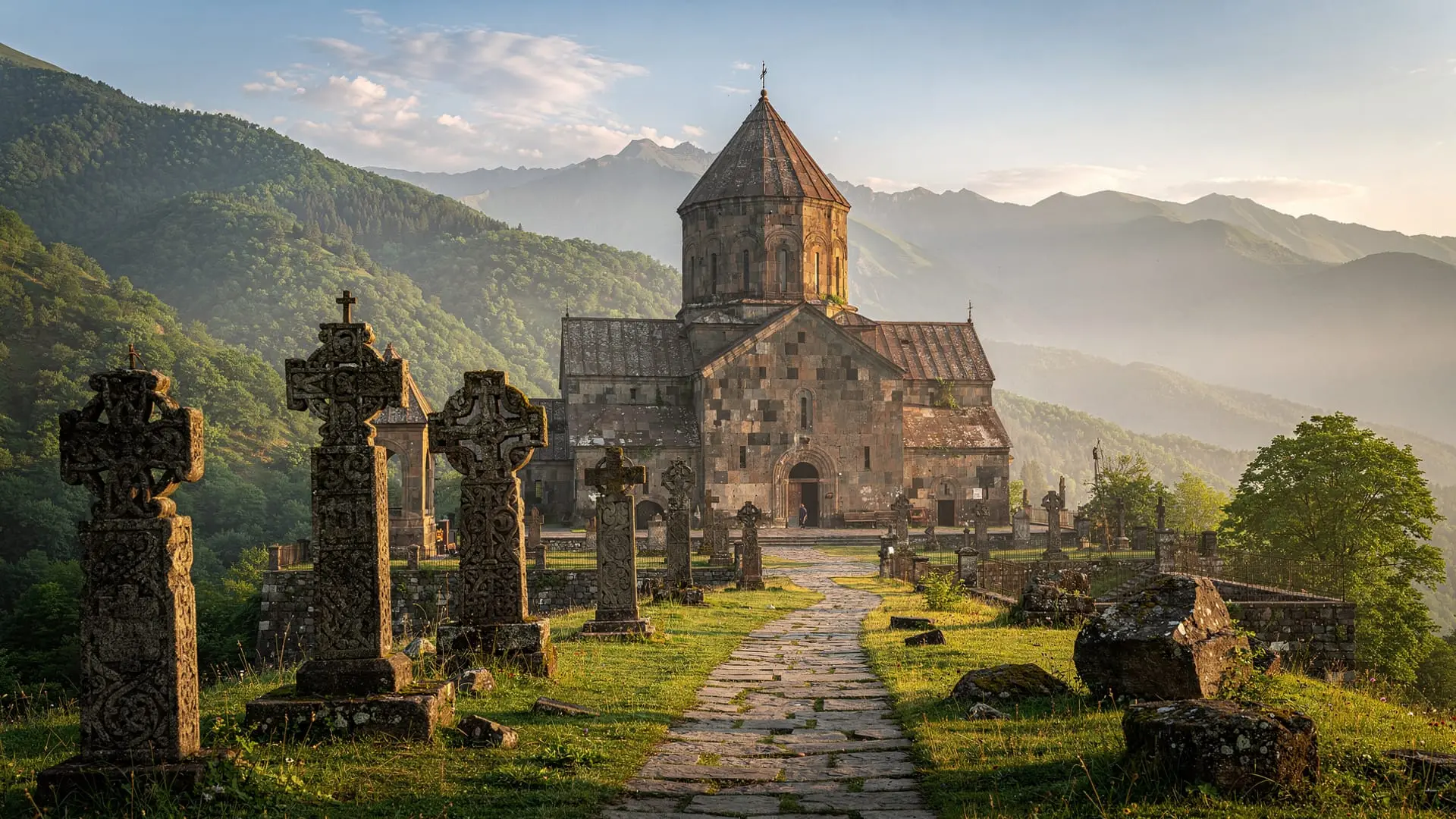
Where Armenian law was written
Goshavank monastery sits in the forests of Tavush province, 23 km from Dilijan and about 110 km from Yerevan. It is not the most spectacular monastery in Armenia — no vertiginous cliffs, no cable cars, no UNESCO inscription — but it occupies a unique intellectual position. It was the home of Mkhitar Gosh, the scholar who wrote the first comprehensive Armenian legal code in the 12th century, and the site of an active academy that trained jurists, clergy, and scribes for two generations. For those interested in medieval Armenian culture beyond stone-cutting, Goshavank is irreplaceable.
| Where | Gosh village, Tavush, 23 km from Dilijan (~110 km / 1h45 from Yerevan) |
| Cost | Free entry; donation box at the gavit |
| Time needed | 1–1.5 hours |
| Getting there | Car, tour, or marshrutka to Dilijan + shared taxi |
| Best time | May–June or September–October; October forest colour is best |
The village that surrounds the monastery was renamed Gosh in Mkhitar’s honour, a 20th-century recognition of his importance.
Why this monastery matters
Mkhitar Gosh (c. 1130–1213) is one of the essential figures of medieval Armenia. He was a theologian, jurist, fable-writer (his Girk Aghbiurats, or Book of Fables, is the Armenian equivalent of Aesop), and legal philosopher whose Datastanagirk established the principles of Armenian civil and ecclesiastical law for centuries. He founded Goshavank in the late 12th century under the patronage of the Zakarian prince Ivane I, specifically to serve as an academy — a place not just of prayer but of systematic education.
The Datastanagirk was copied, circulated, and used as the basis of Armenian legal practice through the late medieval period. It drew on both Roman law (via Byzantine channels) and the specific traditions of Armenian customary law, producing a synthesis that was unusually sophisticated for its time and place. The monastery trained the men who administered justice in the Zakarian-controlled territories of northern Armenia and what is now northern Iran.
Goshavank belongs to the Armenian Apostolic Church, an Oriental Orthodox denomination.
History
- 1188 AD: Mkhitar Gosh begins construction of Goshavank on a site chosen with Zakarian prince Ivane I.
- 1196–1197 AD: The principal church, Surb Astvatsatsin (Church of the Mother of God), is completed.
- 1196–1213 AD: Mkhitar writes the Datastanagirk, the Book of Fables, and other works here. He dies at Goshavank in 1213 and is buried in the gavit.
- Early 13th century: Additional construction by successive patrons — the gavit, church of St Gregory, and the library building.
- 1241: Mongol raids damage much of northern Armenia; Goshavank survives but the community is disrupted.
- 13th–14th centuries: Continued manuscript production despite political turmoil.
- Post-medieval: Gradual decline; the monastery falls into partial ruin.
- 20th century: Soviet-era restoration; Mkhitar Gosh’s burial site identified and marked.
What to see at the site
Church of the Mother of God (Surb Astvatsatsin, 1196–1197): The main church, a compact domed basilica with fine carved ornament on the drum and portal tympanum. The khachkar embedded in the exterior north wall (13th century) is one of the most intricate in Tavush — the interlace pattern is so dense it seems woven rather than carved.
Church of St Gregory (early 13th century): A secondary chapel to the north. Its carved tympanum portrait figures — rare in Armenian monastic iconography — suggest the influence of a sculptor who had exposure to Georgian artistic traditions.
The gavit (narthex-hall): The large vestibule attached to the west of the main church contains Mkhitar Gosh’s burial tomb — a simple stone marker. The funerary inscriptions of Zakarian noble patrons ring the walls. The ceiling is a characteristic Zakarian star pattern of interlocking arches.
Library building (13th century): A separate structure to the north of the main church complex — the physical repository of the academy. The shelved niches where manuscripts were stored are still visible in the interior walls. The library building is one of very few surviving medieval Armenian monastic library structures.
Bell tower (13th century): A free-standing tower to the northeast, adding vertical interest to the complex. Less ornamented than the towers at Haghpat but well-proportioned.
How to get there
By car: From Yerevan, take the Sevan-Dilijan tunnel road and then the road toward Ijevan. Before reaching Ijevan, follow signs to Gosh village (23 km from Dilijan, total approximately 110 km from Yerevan, 1h 45min).
By tour: Goshavank is frequently combined with Lake Sevan, Dilijan, Haghartsin, and Lake Parz as a Tavush day trip.
Sevan, Dilijan, Haghartsin, Goshavank, and Lake Parz day tour Hiking in Dilijan National Park: from Parz Lake to GoshavankBy marshrutka: Take a marshrutka to Dilijan (AMD 700–800, 1h 30min from Yerevan). From Dilijan, a shared taxi to Gosh village costs AMD 2,000–3,000 per person (arrange return pickup). No direct marshrutka serves Gosh village.
Photography and best light
The monastery faces roughly south, receiving good light from late morning to early afternoon. The forest surroundings — a dense mix of beech, oak, and hornbeam — provide a green backdrop in summer and brilliant colour in October.
Autumn (late September–October) is the most photogenic season: the Tavush forest turns golden-orange, and the warm foliage contrast against the dark stone is striking. The forest light at this time is diffused and warm even in mid-afternoon.
The intricate khachkar on the north exterior wall of the main church is best photographed in flat overcast light (shadows destroy the interlace detail in strong sunlight).
Combining with other sites
Goshavank is the anchor of a Tavush monastery circuit:
- Haghartsin (20 km north of Dilijan): the forest monastery with three medieval churches in a river gorge — see Haghartsin: the forest monastery of Dilijan
- Lake Parz (8 km from Dilijan): a small forest lake with walking trails
- Dilijan town: the “Armenian Switzerland” with Old Town architecture and good restaurants — see the Dilijan destination guide
- Lake Sevan (30 km west via the tunnel): natural pairing for a Sevan-Dilijan-Goshavank day
For the full Tavush circuit: Lake Sevan and Dilijan day trip.
Practical visit info
Entry fee: Free. Donation box at the gavit entrance.
Opening hours: Dawn to dusk daily. The main church may be locked; the grounds are always accessible.
Dress code: Standard monastery requirements — shoulders and knees covered, women cover heads.
Facilities: Minimal on site. Gosh village has a small shop. Dilijan (23 km) has restaurants, cafes, and ATMs.
Accommodation: Dilijan is the natural base for a Goshavank visit — Old Dilijan Hotel Complex is a beautifully restored historic property in the town centre. Mid-range rooms cost AMD 30,000–50,000 per night (EUR 73–122).
Best season: May–June and September–October. The forest is most spectacular in October. Winter access is possible but the road can be icy.
Armenian medieval law and its context
Understanding why the Datastanagirk mattered requires a sense of the legal vacuum it filled. By the late 12th century, when Mkhitar Gosh began writing, Armenian society was divided between multiple political authorities — Georgian noble overlords, surviving Armenian princes, Persian and Seljuk influences, and the ecclesiastical jurisdiction of the Armenian Apostolic Church. Each of these operated by different legal principles; a commercial dispute between an Armenian merchant and a Georgian noble involved at least two incompatible legal frameworks.
The Datastanagirk was not just a codification of existing custom — it was a synthetic argument for a unified Armenian legal identity. Mkhitar drew on the Mosaic law (transmitted through biblical commentary), the Syro-Roman law book (a Byzantine compilation available in Classical Armenian), and the specific practices of Armenian commercial and family law. He arranged these into a systematic structure covering:
- Marriage, divorce, and inheritance
- Contract law and commercial disputes
- Criminal law (with the Armenian tradition of composition payments — monetary settlement for offences — rather than the lex talionis principle)
- The rights and duties of clergy
- The legal status of foreigners and slaves
- Evidence and procedure
The Datastanagirk was adopted in the Armenian kingdom of Cilicia (the medieval Armenian state in what is now southern Turkey) and used there until the kingdom’s fall in 1375. It was revised and translated in subsequent centuries. It is the single most important legal document of medieval Armenia and Mkhitar Gosh’s principal claim to historical significance.
The Tavush forest and its significance
Goshavank’s forest setting is not incidental. Tavush province occupies the northeastern corner of Armenia, where the elevation and the proximity to the humid air coming off the Caspian basin produces a different ecology from the rest of the country. The forests of Tavush — beech, hornbeam, oak, lime, and conifer — are among the most biodiverse in the South Caucasus, part of the Hyrcanian forest belt that once extended from northern Iran across Azerbaijan and into Armenia.
For medieval monks, the forest offered both practical and spiritual resources. Timber for construction, fuel, and tools; herbs for medicine; game; clear streams. The isolation of the forest monastery — protected by trees rather than cliff walls — gave Goshavank its character as an academic rather than a military institution. It did not need high walls; it had the forest.
This forest context also means that Goshavank ages differently from the volcanic stone monasteries of Syunik or Lori. The lichens grow differently on the pale tuff stone. The trees press against the walls. In autumn, the beech canopy drops leaves directly into the monastery courtyard. The place feels embedded in its landscape in a way that Tatev, perched above its gorge, deliberately does not.
Medieval Armenian law and the Datastanagirk
The Datastanagirk (Book of Laws) that Mkhitar Gosh compiled at this monastery deserves more than a passing mention. It was a genuinely original legal synthesis written in a political situation of extraordinary complexity. Armenia in the late 12th century was divided between Byzantine, Seljuk, Georgian, and local Armenian noble authorities; no unified legal system governed Armenian communities. The existing canon law was ecclesiastical and applied only within the church; secular disputes were adjudicated by local custom that varied by region and by the power of local lords.
Mkhitar drew on the Mosaic law transmitted through biblical and patristic sources, Roman law preserved in Byzantine channels, and the customary practices of Armenian noble and commercial society to produce a code that could function across jurisdictions. The result was practical, specific, and remarkably sophisticated for its time: it addressed inheritance, contracts, criminal procedure, the rights of women, the status of clergy, and the treatment of foreigners. It became the foundational legal document of Armenian communities throughout the medieval period and was adapted and used in the Armenian kingdom of Cilicia (what is now southern Turkey) for over a century after Mkhitar’s death.
The Datastanagirk is preserved in multiple manuscript copies. Several are in the Matenadaran repository in Yerevan — the national manuscript library that is itself a UNESCO-listed institution and a rewarding half-day visit. See the Matenadaran manuscripts guide.
The medieval academic tradition in the Caucasus
Goshavank was part of a broader intellectual culture that flourished in the South Caucasus during the Zakarian period. The Zakarids, as administrators of territory for the Georgian crown, created conditions for a remarkable exchange of ideas between Armenian, Georgian, Persian, and Byzantine intellectual traditions.
In the late 12th and early 13th centuries, the period of Goshavank’s founding and Mkhitar Gosh’s activity, the Caucasus region was one of the most culturally productive areas in the world. The Georgian court at Tbilisi — under Queen Tamar (r. 1184–1213) — patronised both Georgian and Armenian poets, jurists, and philosophers simultaneously. The Armenian scholar Shnorhali (Nersesian, 1102–1173) was corresponding with Byzantine theologians. The Persian mathematical and astronomical tradition was available through translations circulating in Armenian-speaking communities.
Mkhitar Gosh was writing the Datastanagirk during exactly the same years that Shota Rustaveli was composing the Georgian national epic, The Knight in the Panther’s Skin, at the court of Queen Tamar. These are not coincidences. They reflect a moment of cultural convergence in the Caucasus that had no direct parallel before or since.
Understanding Goshavank as part of this broader intellectual moment — not just as an Armenian monastery but as a Caucasian academic institution — gives the Library building and the monastery complex a larger significance. This was a node in an intellectual network that stretched from Cappadocia to Persia.
Dilijan as a base
If you are visiting Goshavank, Dilijan is the obvious overnight base. The town has improved dramatically as a tourist destination since the mid-2010s. The Old Town (Sharambeyan Street) has been restored as a craft and cultural district with a handful of excellent small restaurants and coffee shops. The Old Dilijan Hotel Complex — a restored 19th-century caravanserai — is the best lodging option in the area and the most atmospheric place to stay in all of Tavush.
From Dilijan, Goshavank (23 km, 30 minutes) and Haghartsin (18 km, 25 minutes) are both within easy reach. Lake Parz is 8 km from town. The Dilijan National Park visitor centre has maps of forest hiking trails. You can construct a highly satisfying two-day Tavush programme using Dilijan as your base without returning to Yerevan in the middle.
Mkhitar Gosh’s fables and their literary legacy
Alongside the Datastanagirk, Mkhitar Gosh’s Girk Aghbiurats (Book of Fables) deserves attention in its own right. Its roughly 190 short moral fables — animals standing in for human vices and virtues, each closing with a pointed lesson — sit in the same broad tradition as Aesop and later European fable collections, but draw on distinctly Armenian idiom and concerns: the abuse of power by local lords, the corruption of judges, the obligations of hospitality. Armenian schoolchildren still encounter a handful of these fables today, making Mkhitar as present in Armenia’s literary memory as in its legal history. Reading even a few in translation before visiting adds a layer of personality to what can otherwise read as a purely architectural stop.
Several editions of the fables have been translated into English and other European languages over the past century, and Armenian cultural institutions occasionally publish illustrated versions aimed at introducing the text to a wider readership. For a visitor with only a passing interest, even a short summary of two or three fables — read aloud standing in the gavit where Mkhitar is buried — turns an abstract literary reference into something felt on the spot.
Goshavank’s carving compared to Geghard’s
Visitors who have already seen Geghard’s rock-cut chambers sometimes expect similar drama at Goshavank and are surprised to find a freestanding, forest-set complex instead. The comparison is still worth making, because it highlights two different strands of the same Zakarian-era carving tradition. Geghard’s carvers worked in negative space, cutting decoration directly from a cliff face under low light. Goshavank’s carvers worked in the open, on dressed stone blocks, with the freedom to use larger compositions — the north-wall khachkar on the Church of the Mother of God is a case in point, with interlace dense enough to read as woven fabric from a few metres away. Seeing both within the same trip gives a genuinely rounded sense of what 12th–13th century Armenian stonework was capable of in two very different settings.
A half-day Goshavank and Old Dilijan itinerary
If you are based in Dilijan, a satisfying half-day looks like this: leave town by mid-morning for the 30-minute drive to Gosh village, spend an unhurried hour at the monastery (the site is small enough that lingering rather than rushing is the right approach), then return to Dilijan for lunch in the restored Old Town around Sharambeyan Street, followed by a slow walk through the craft district. This leaves the afternoon free for Lake Parz or a shorter forest walk if you have energy left, and avoids the common mistake of trying to cram Goshavank, Haghartsin, and Lake Sevan into a single rushed day from Yerevan.
Frequently asked questions about Goshavank
Who was Mkhitar Gosh and why does he matter?
Mkhitar Gosh (c. 1130–1213) was the most significant legal scholar of medieval Armenia. His Datastanagirk (Book of Laws, completed c. 1184) was the first systematic Armenian legal code, drawing on Byzantine, biblical, and Armenian customary sources. He also wrote the Girk Aghbiurats (Book of Fables), a collection of 190 moral fables in the tradition of Aesop, which became a classic of Armenian literature. He is buried in the gavit at Goshavank.
Is the library building from Goshavank the one where Mkhitar wrote?
The current library building dates to the early 13th century, built shortly after Mkhitar founded the monastery. Mkhitar wrote the Datastanagirk at Goshavank over a period of years; the library building that survives is the repository that housed copies of his work and the manuscripts of the academy. Whether Mkhitar personally used this specific building or an earlier structure is uncertain from the historical record.
How does Goshavank compare to Haghartsin?
Both are Tavush forest monasteries of the Zakarian period, similar in architectural style. Goshavank is historically more significant as an intellectual centre; Haghartsin is architecturally more elaborate, with three main churches. They work excellently as a pair. See Haghartsin: the forest monastery of Dilijan.
Can I combine Goshavank and Haghartsin in one day from Yerevan?
Yes. The two monasteries are 30 km apart via Dilijan (about 40 minutes). A Yerevan–Sevan–Goshavank–Haghartsin–Dilijan route covers all major Tavush sites in a full day. See the Sevan and Dilijan day trip guide.
What are the entry fees and opening hours for Goshavank?
Entry is free. No ticket purchase required. The monastery grounds are accessible from dawn to dusk daily. The main church may be locked on weekdays when no monks are present, but the grounds, the library building, and the gavit exterior are always accessible. The library building interior may also be locked — if so, the façade architecture is visible from the courtyard.
Is Goshavank suitable for visiting in winter?
Yes. The road from Dilijan to Gosh village is paved and maintained; it can be icy in January but is rarely impassable. The forest in winter — bare beech branches against grey sky, possible snow on the ground — provides a very different atmosphere from the golden October version. The monastery is quiet in winter; you may be the only visitor. Temperatures at Gosh in January average -3 to -8°C; dress warmly.
What else is there to do in the Gosh area?
The Gosh village area is quiet. The monastery is the main draw. If you have a car and extra time, the road continues past Gosh toward Ijevan, passing through forests and small villages. Ijevan itself is a provincial town with a small wine and spirits industry (the Ijevan brandy factory is the most notable producer in the area) and a growing craft culture. See the Ijevan destination guide.
Is Goshavank appropriate for children?
Yes. The monastery grounds are flat and accessible. The library building and gavit have low doorways that children find interesting rather than difficult. The forest setting is appealing to most children. There are no dangerous drops or confined spaces. Allow 1.5 hours for a visit with children who have some interest in old buildings; 45 minutes if they do not.
What is the relationship between Goshavank and the Matenadaran in Yerevan?
Several manuscripts that originated at or passed through Goshavank are now held in the Matenadaran (Mesrop Mashtots Institute of Ancient Manuscripts) in Yerevan. The Matenadaran holds over 23,000 manuscripts, including unique copies of Mkhitar Gosh’s works and the finest surviving examples of Armenian illuminated manuscript art. Visiting the Matenadaran (on Mashtots Avenue, a 20-minute walk from Republic Square) before or after Goshavank gives the monastery’s scholarly significance a visible, tangible anchor. See the Matenadaran manuscripts visitor guide.
Is Goshavank worth visiting if I’m not especially interested in history?
Yes, though for different reasons than the history-minded visitor. The forest setting, the intricate khachkar carving, and the quiet of the site (it receives far fewer visitors than Geghard or Khor Virap) make it a pleasant stop even without deep interest in Mkhitar Gosh’s legal legacy. Pair it with a short walk in Dilijan National Park to round out a Tavush day around nature rather than history.
How does Goshavank compare to Geghard for someone choosing one or the other?
They are different experiences rather than competing versions of the same thing. Geghard offers dramatic rock-cut architecture and is more accessible from Yerevan (40 km vs. 110 km); Goshavank offers a quieter, forested setting and a stronger claim to intellectual-historical significance. If your itinerary allows only one Kotayk-or-Tavush monastery, Geghard is the more visually striking choice; if you have several days and want a fuller picture of medieval Armenia, both are worth the trip.