Armenia monastery pilgrimage: 5-day spiritual route
Who this itinerary is for
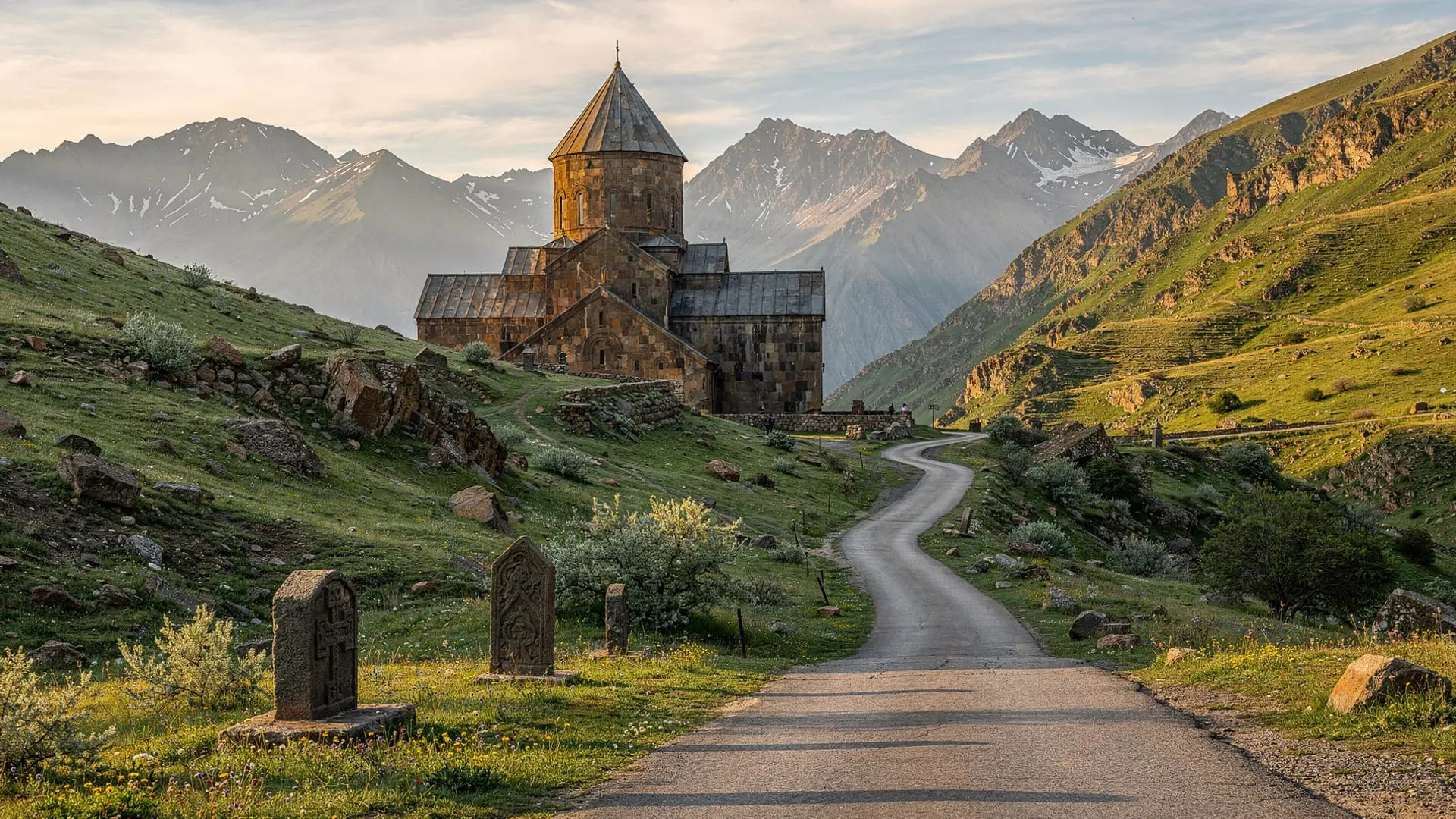
Armenia is the world’s first Christian nation — a fact that carries enormous resonance for pilgrims and spiritual travellers. The Christianity here is not the Roman or Byzantine variety familiar to most Western travellers. The Armenian Apostolic Church is Oriental Orthodox, autocephalous (independent of both Rome and Constantinople), and has preserved a liturgical tradition, an architectural heritage, and a visual vocabulary that is entirely its own.
The monastery pilgrimage circuit covers the five sites that, together, tell the entire story of Armenian Christianity: Etchmiadzin (where it began in 301 CE), Khor Virap (where Gregory the Illuminator was imprisoned before the conversion), Geghard (the rock-carved cave monastery with its spring), Sevanavank (the lakeside monastery of retreat), and Tatev (the great fortress-monastery of medieval Syunik).
This itinerary is for travellers of any Christian tradition — or none — who want to understand how one of the world’s oldest continuously practiced Christian cultures expresses itself in stone, fresco, light, and incense. It is a slow itinerary by design: each monastery deserves more than the 20 minutes a standard day trip allows.
No car is required. Every stop is accessible by guided tour or marshrutka. The pace assumes approximately 3-4 hours at each major site rather than a rushed circuit.
| Where | Ararat plain, Kotayk, Gegharkunik, Vayots Dzor, Syunik — a loop from Yerevan |
| Cost | Around 875-1,325 EUR mid-range for 5 days, tours + hotel included |
| Time needed | 5 days minimum; add 1-2 days for Haghpat/Sanahin |
| Getting there | Guided day tours or marshrutka from Yerevan, no rental car needed |
| Best time | April-June or September-October for clear Ararat views and mild weather |
Quick overview
| Day | Monastery | Site | Duration |
|---|---|---|---|
| Day 1 | Etchmiadzin | The mother cathedral — origin of Armenian Christianity | 5h |
| Day 2 | Khor Virap + Geghard | Prison of Gregory, cave church carved from cliff | Full day |
| Day 3 | Lake Sevan + Sevanavank | Lakeside monastery, Noratus khachkar cemetery | Full day |
| Day 4 | Noravank + Areni cave | Red-cliff monastery, the world’s oldest winery | Full day |
| Day 5 | Tatev | The great medieval fortress-monastery, Wings cable car | Full day |
Day 1: Etchmiadzin — where it began
Historical context
The Armenian Apostolic Church dates its foundation to 301 CE, when King Tiridates III converted to Christianity after Saint Gregory the Illuminator was freed from 13 years in a pit dungeon (Khor Virap, Day 2) and healed the king of a madness. In his vision, Gregory saw Christ descend to earth (Etchmiadzin means “descent of the Only-Begotten”) and strike the ground to indicate where the first cathedral should be built.
The Cathedral of Holy Etchmiadzin stands on that very spot. The current structure incorporates building campaigns from the 4th, 5th, and 17th centuries but the site has been continuously sacred since 301 CE. UNESCO World Heritage status since 2000.
The cathedral visit
Etchmiadzin is 25 km west of Yerevan (30 min by shared taxi toward Vagharshapat, or by guided tour).
The approach: the main gateway into the cathedral precinct is through a monumental arch. The peacocks in the courtyard belong to the Catholicos — an ancient tradition. The main cathedral church faces east (as all Armenian churches do — the altar end always faces east, toward Jerusalem and the sunrise).
Inside: the original 4th-century foundations are marked on the floor. The 17th-century frescoes (repainted in the 20th century) line the walls. The altar area is separated from the nave by an iconostasis — but simpler than Russian Orthodox equivalents. The liturgy (in Classical Armenian, Grabar) is one of the oldest unbroken Christian liturgical traditions anywhere.
Private Day Trip: Etchmiadzin & ZvartnotsThe Treasury Museum: in the separate building behind the cathedral. Contains:
- The Lance of Longinus (the Spear of Destiny — though Tatev also claims this relic)
- A fragment of wood claimed to be from Noah’s Ark (found on Ararat)
- The mausoleum of Saint Gregory the Illuminator
- Extraordinary jewelled reliquaries, ecclesiastical vestments, and illuminated manuscripts
- The miter of Saint Gregory
Allow 90 minutes for the Treasury alone. This is the most significant collection of Armenian Christian relics in the world.
Zvartnots Cathedral ruins (5 min from Etchmiadzin): built 641-661 CE by Catholicos Nerses III “the Builder,” intended as the largest and most magnificent church in the Armenian world. Circular in plan (unusual in Armenian architecture), it collapsed in the 10th century. The ruins are extensive; the museum reconstructs what the original building must have looked like. UNESCO World Heritage. Allow 45 minutes.
Evening reflection
Return to Yerevan. If you have been moved by the Etchmiadzin visit, seek out the Armenian churches in Yerevan itself — the Cathedral of St Gregory the Illuminator (central Yerevan, new but architecturally interesting) and the Church of Surb Zoravor (15th century, one of Yerevan’s oldest surviving buildings) both have active liturgical lives.
Day 2: Khor Virap and Geghard
Khor Virap — the pit of imprisonment
Khor Virap (“deep pit” in Armenian) is the most emotionally resonant single site for Christian pilgrims. This is the specific location where Gregory the Illuminator was imprisoned for 13 years (between approximately 288-301 CE) by King Tiridates III — condemned to die in a subterranean pit for refusing to perform pagan rituals.
The dungeon is accessible: a vertical metal ladder descends 6 metres into the pit chamber. It is small (about 2.5m diameter), dark, and entirely below ground. To descend into it is to occupy the same space where the founder of Armenian Christianity was held for more than a decade. The emotional weight is extraordinary for Christian pilgrims.
Private Tour to Khor Virap with Mt Ararat ViewThe monastery above the pit (5th-17th century) is architecturally significant but the dungeon is the pilgrimage objective. Allow 2 hours. Come early (before 09:00) to have it to yourself — by mid-morning the tour groups arrive.
Mount Ararat fills the southern horizon from Khor Virap — the twin peaks of Greater and Lesser Ararat, 40 km away in Turkey, dominate the view. For a Christian pilgrim, this is a multilayered symbol: the resting place of Noah’s Ark, the sacred mountain of Armenian identity, and the unreachable homeland behind a closed border. On clear mornings (April-June, September) the mountain is extraordinary.
Geghard — the cave church
Geghard (40 min from Khor Virap via Garni) is the most architecturally extraordinary monastic site in Armenia. The name means “spear” — the Lance of Longinus, which pierced Christ’s side at the crucifixion, was reportedly brought here before being transferred to Etchmiadzin.
The 4th-century monastic site was expanded in the 12th-13th centuries. What makes it unique: multiple churches are carved directly from the living cliff face — not built against the rock but cut into it, so that the rock walls are the church walls. The spring inside was sacred before Christianity and was incorporated into the church’s symbolic geography.
Garni Temple, Geghard Monastery & Symphony of StonesThe interior atmosphere — incense, candlelight, medieval carved stone, the smell of the living rock — is unlike any other church in the world. If you are fortunate enough to arrive during a service, the acoustics of the carved stone chambers resonate differently from any free-standing building.
Allow 2 hours minimum. The carved khachkars on every surface reward close examination — each is unique, each was carved by a named craftsman, each is a meditation on the cross and on the Christian cosmos.
Day 3: Lake Sevan + Sevanavank
Sevanavank — monastic retreat
Sevanavank monastery on Lake Sevan was founded in 874 CE by Princess Mariam, daughter of King Ashot I, on what was then a genuine island (the lake level has dropped significantly since Soviet-era water extraction). The two 9th-century churches — Surb Arakelots (Holy Apostles) and Surb Astvatsatsin (Holy Mother of God) — are compact and severe in the classic Armenian architectural style.
The monastery was a retreat in the literal sense: built on an island, accessible only by boat, dedicated to monastic contemplation away from the world. Walking up the 225 steps from the lakeshore (on what is now a peninsula) replicates the sense of arrival by boat — a steep, breathless ascent to a sacred high place above an immense lake.
Lake Sevan Sevanavank Monastery Private TourLake Sevan itself is one of the world’s highest large lakes (1,900m altitude, 1,240 km²). The light on the water at different times of day is extraordinary — deep blue in direct sun, silver in overcast, grey-green before a storm. The lake is a natural space for contemplation.
Noratus khachkar cemetery
Noratus (20 km south of Sevan town) has the world’s largest collection of intact medieval khachkars — over 900 carved stone crosses, dating from the 8th to 18th centuries, in a village cemetery. Walking through the Noratus khachkar forest is one of the most unusual spiritual experiences in Armenia — the variety of carving styles and the density of sacred stone is overwhelming.
The khachkar (cross-stone) is the most characteristic expression of Armenian Christian art. Each one is unique — no two Armenian khachkars are carved the same pattern, as each craftsman’s work was considered an act of individual devotion and creativity.
Return to Yerevan via the M4 highway.
Day 4: Noravank — the red-cliff monastery
Spiritual geography
Noravank is perhaps the most visually dramatic monastic site in the country — a 14th-century complex set in a narrow limestone gorge with 200-metre sheer red cliffs on three sides. The approach road from the north passes through the narrowest part of the gorge where the cliffs close in on both sides.
The monastery was founded in the 9th century but the main buildings are 13th-14th century, built under the patronage of the Orbelian princes. The most remarkable feature: the Church of St John the Baptist (Surb Karapet) has a carved stone relief of God the Father on the upper exterior — an extremely rare representation of the Creator in Armenian religious art, given the tradition of avoiding direct divine representation.
From Yerevan: Khor Virap, NoravankAreni-1 cave — the ancient winery
Areni-1 cave (15 min from Noravank): the 6,100-year-old winery is not a spiritual site in the Christian sense, but it is deeply meaningful in the context of Armenian heritage. Wine is central to Armenian Christian practice (the Eucharist, the feast days, the hospitality culture) and the deep antiquity of Armenian winemaking — starting millennia before Christianity — gives the spiritual culture a pre-Christian root that complements the pilgrimage context.
The guide at the cave explains the archaeological evidence for winemaking, pressing, and storage in the Bronze Age complex. The cave itself has several chambers and is genuinely impressive.
Evening
Return to Yerevan. The pilgrimage has now covered the Ararat region (Khor Virap), the cave tradition (Geghard), the lake monastery (Sevanavank), and the Vayots Dzor tradition (Noravank). Tomorrow: the great mountain monastery of the south.
Day 5: Tatev — the mountain stronghold
The fortress-monastery
Tatev Monastery was one of the most powerful monastic institutions in medieval Armenia — not just a place of prayer but a university, a centre of manuscript production, and a fortress. At its peak in the 10th-14th centuries, it housed several hundred monks and was the seat of the Bishop of Syunik.
The site: a promontory of basalt rock at the edge of the Vorotan gorge, with 320-metre cliffs on three sides. The fortifications are integrated with the monastery buildings so that the complex is simultaneously a sacred space and a military one — a reflection of the perpetual need to defend Armenian Christianity.
Key elements:
- The main Cathedral of Sts Paul and Peter (895-906 CE): the largest building, with a gavit (vestibule) and extensive carved decoration
- The Church of St Gregory the Illuminator (836 CE): the oldest building on the site
- The “Gavazan” (swing column): a 9th-century stone seismograph — a freestanding column with a ball joint at the base that sways with earth tremors. It was used as a warning system for earthquakes and enemy approach
- The oil press building
- The treasury and library complex
Allow 3 hours minimum. Tatev rewards slow exploration — the carved capitals, the inscriptions recording donors and craftsmen, and the view from the cliff edge over the Vorotan gorge are all worth sustained attention.
Wings of Tatev
The cable car crossing from the lower station (Halidzor village) to the monastery (5.7 km, 12 min) is both practical and spiritually resonant — the sense of arriving at the monastery from above the gorge is how medieval pilgrims might have imagined the journey to a sacred high place. Buy tickets in advance.
Return to Yerevan (4h drive, or guided return tour). The pilgrimage is complete.
Understanding the khachkar: Armenia’s carved crosses
No pilgrimage through Armenia’s monasteries makes full sense without understanding the khachkar (literally “cross-stone”). You will see thousands of them across the five days — leaning against monastery walls, embedded above doorways, standing in the Noratus cemetery field on Day 3 — and each one repays a closer look than most visitors give it.
A khachkar is a carved stone stele, usually of tuff or basalt, with a cross as its central motif surrounded by geometric interlace, rosettes, and vine patterns that echo the illuminated manuscripts produced at places like the Etchmiadzin scriptorium. The earliest surviving examples date to the 9th century; the tradition continued into the 18th century and, in a modern revival, into the present day. UNESCO inscribed the khachkar tradition — the symbolism and craftsmanship, not just the objects — on its Intangible Cultural Heritage list in 2010.
What distinguishes a fine khachkar from an ordinary one: the depth and precision of the interlace carving (the best work reads as lace in stone, undercut so light passes through the gaps), an inscription naming the patron and the reason for commissioning it (a death, a military victory, the founding of a church), and originality — a master carver was expected to avoid repeating another’s design exactly. At Noravank and Sevanavank, look for the carver’s signature worked into a lower corner of the stone; at Noratus, ask your guide to point out the “wedding” khachkars, whose reliefs show feasting scenes rather than pure geometry.
What to wear and bring on a monastery pilgrimage
Dress modestly at every site on this itinerary: shoulders and knees covered for both men and women, and a headscarf for women is expected inside the working churches at Etchmiadzin and Tatev (scarves are sold or lent at the door if you arrive without one). Long trousers travel better than shorts across five days of stone floors, gravel courtyards, and the occasional uneven step.
Footwear matters more here than on a typical city itinerary. The descent into the Khor Virap pit uses a near-vertical metal ladder — trainers or hiking shoes with grip are far safer than sandals. Tatev’s site involves walking on basalt rock that is smooth and can be slippery after rain; the same applies to the steps up to Sevanavank.
Small notes of AMD cash are worth carrying for candles (a few hundred dram each at most monasteries) and for the small donation boxes that fund upkeep — card payment is rarely available inside the churches themselves, even where it is common elsewhere in Armenia. A scarf doubles as sun protection at exposed sites like Khor Virap and Noratus, where there is little shade at midday.
Attending a service, if your dates align
If your five days happen to fall on a Sunday or a feast day, attending an actual Divine Liturgy (Soorp Badarak) — most commonly at Etchmiadzin on Day 1 — adds a dimension no amount of daytime sightseeing provides. Services typically begin mid-morning; arrive at least 20 minutes early, stand or sit quietly at the back if you are not participating, and avoid crossing in front of the altar area during the liturgy. Photography during the service itself should be avoided or kept extremely discreet — no flash, no positioning yourself in the congregation’s sightline.
The Divine Liturgy is sung almost entirely in Grabar (Classical Armenian), a language most contemporary Armenians do not speak fluently either — so the experience of incomprehension is shared, not something that marks you out as an outsider. The incense, the antiphonal chanting between choir and clergy, and the curtain drawn across the altar at certain points in the service (a practice unique to Armenian and a few other Oriental Orthodox traditions) are worth knowing about in advance simply so you can watch for them.
Where to stay
| Night | Location | Hotel | Price |
|---|---|---|---|
| 1-5 | Yerevan | Republica Hotel Yerevan | 90-130 EUR |
Keeping Yerevan as base for all 5 nights simplifies logistics. Day trips to Tatev (250 km each way) are long but feasible; overnight in Goris is an option for Day 4-5 if you want more time at Tatev without a rushed return.
Total budget estimate
| Category | Budget/day | Mid-range/day |
|---|---|---|
| Accommodation | 30-50 EUR | 90-130 EUR |
| Meals | 15-25 EUR | 35-55 EUR |
| Tours | 30-50 EUR | 50-80 EUR |
| Daily total | 75-125 EUR | 175-265 EUR |
| 5-day total | 375-625 EUR | 875-1325 EUR |
Variations
Add Haghpat and Sanahin: For pilgrims with more time, the UNESCO monasteries of Lori (Haghpat and Sanahin, 3h30 from Yerevan) complete the circuit. Add 1-2 days.
Focus on Etchmiadzin: Some pilgrims spend 2 full days at Etchmiadzin — attending multiple services, visiting all the churches in the complex (Hripsime, Gayane, Shoghakat as well as the main cathedral). This deepens the understanding of the early Christian period substantially.
Add the Diaspora dimension: Combine this itinerary with Days 1-2 of the Armenia diaspora heritage 5-day for a combined spiritual and memorial pilgrimage.
Booking tips and GYG tours
The Tatev guided day trip (Day 5) is the most logistically complex — 250 km each way from Yerevan. Book a guided tour that handles all transport. The Wings of Tatev cable car requires advance ticket booking in peak season.
For the Etchmiadzin visit, a private tour guide with deep knowledge of Armenian church history is worth the upgrade. The UNESCO context and the treasury deserve more than a standard group tour allows.
Frequently asked questions about this itinerary
What is the Armenian Apostolic Church?
The Armenian Apostolic Church is a branch of Oriental Orthodox Christianity — the same family as the Coptic, Syriac, and Ethiopian Orthodox churches. It differs from Eastern Orthodox churches (Greek, Russian, Serbian) in that it rejected the Council of Chalcedon (451 CE) on Christological grounds. It is entirely autocephalous — not under the authority of Rome, Constantinople, Moscow, or any other external patriarchate. The Catholicos of All Armenians resides at Etchmiadzin.
Can non-Christians attend services at Armenian monasteries?
Yes. Services at Armenian churches are open to all visitors who observe appropriate dress and behaviour (no shorts, head covering for women, silence during the liturgy). Photography during services should be done discreetly, with silence and minimal disruption. The liturgical language is Grabar (Classical Armenian) — a linguistic experience unlike any modern language.
What is the liturgical year in the Armenian church?
The Armenian church follows its own liturgical calendar. Christmas is celebrated on January 6 (not December 25). Easter timing follows the Julian-based Oriental Orthodox calculation. Major feast days include Vardevar (Transfiguration, midsummer), the Feast of Holy Etchmiadzin, and the feast of St Gregory the Illuminator. If your travel dates coincide with a major feast day, services at Etchmiadzin can be extraordinary.
How difficult is the descent into the Khor Virap pit?
The descent via a near-vertical metal ladder is about 6 metres (20 ft). It requires agility and no fear of confined spaces. Children under 8, elderly pilgrims with mobility concerns, and claustrophobic individuals should not attempt it. The ladder has rungs at approximately 30cm intervals.
Can I buy religious souvenirs at Armenian monasteries?
Yes. Most major monasteries have small shops selling candles, cross-stones (khachkars in miniature), religious icons, and prayer books in Armenian and English. Etchmiadzin has the largest selection. Items sold at the monasteries directly benefit the monastic community; the same items are sometimes cheaper in Yerevan but the context of buying at the site has obvious meaning for pilgrims.
Is Tatev accessible as a day trip from Yerevan?
Yes, but barely. The round trip is 500 km and 8 hours of driving. A guided tour starting at 07:00 and returning by 21:00 gives about 3-4 hours at Tatev itself — acceptable but not leisurely. An overnight in Goris (Day 4) and a return to Yerevan on Day 5 (via Noravank) is a better approach if time allows.
What is a khachkar and why does it matter to this itinerary?
A khachkar is a carved stone stele centred on a cross, surrounded by geometric and vine interlace, produced from the 9th century onward and inscribed on UNESCO’s Intangible Cultural Heritage list. You encounter them at every stop on this pilgrimage, most densely at the Noratus cemetery on Day 3, and understanding the tradition — no two designs are meant to repeat, and the carving records a specific donor and occasion — turns what could look like generic old stones into a readable record of individual devotion across a thousand years.
Do I need to dress differently for this itinerary than for a normal Armenia trip?
Somewhat. Because every day of this itinerary centres on active places of worship rather than ruins, dress modestly throughout — shoulders and knees covered, and a headscarf for women at Etchmiadzin and Tatev in particular. A standard sightseeing outfit works at Noravank or the Areni cave, but pack at least one modest outfit you are happy to wear repeatedly across the five days.