Lavash baking: the UNESCO bread experience
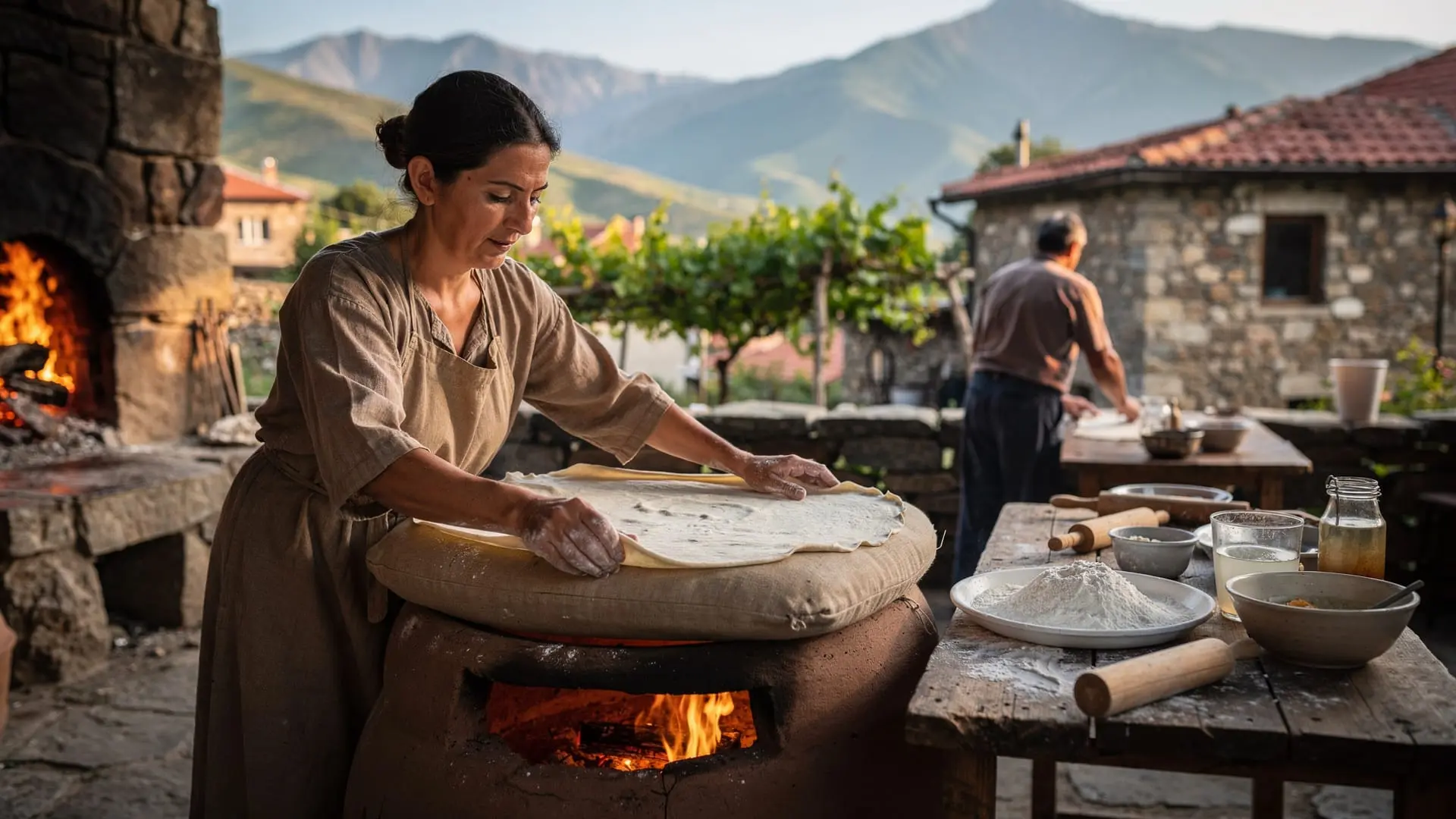
The bread that UNESCO made famous
There are flatbreads all over the Middle East and Caucasus, but none carry the cultural weight of Armenian lavash. Paper-thin, blistered from extreme heat, flexible enough to wrap a whole khorovats spread, lavash has been the constant at every Armenian table for at least three millennia. In 2014 UNESCO formally recognised lavash-making on its Representative List of the Intangible Cultural Heritage of Humanity — making it the first food practice from the South Caucasus to receive this designation.
What UNESCO recognised was not a recipe. It was a social ritual: women gathering around a shared tonir (underground clay oven), dividing the work between rolling, stretching, and slapping the dough onto the oven wall, and passing this choreography intact from mother to daughter. If you eat lavash in Armenia, you are tasting something with an unbroken thread to the Bronze Age.
At a glance
| Where | Garni village and Goght, 28 km east of Yerevan (Kotayk province) |
| Cost | Usually included in a Garni gastro-cultural tour; free demos at some guesthouses |
| Time needed | 45–60 minutes for a demonstration; a full day combined with Garni + Geghard |
| Getting there | 40 min by taxi/car, or marshrutka from Garegin Nzhdeh Square |
| Best time | Spring or autumn for comfortable temperatures near the tonir |
What is a tonir?
The tonir is a cylindrical clay pit sunk into the ground or built into the floor of a bakehouse, heated from below by wood or charcoal. Its walls reach temperatures above 400°C. Lavash is baked by slapping the stretched dough — draped over a cushion-shaped pad called a hakots — against the inner wall of the tonir. The bread bakes in 20–30 seconds. An experienced baker can produce hundreds of sheets in an hour.
The tonir is not only a bread oven. It is also the heat source for slow-cooked dishes (meats and vegetables are lowered in clay pots), and in traditional households it provided winter warmth for the room. Archaeological evidence of tonir-type ovens has been found at Bronze Age sites throughout the Armenian Highlands, placing the technology well before written records.
The ritual around the bread
A traditional lavash-baking session is social by design. Several women work simultaneously: one manages the dough, one stretches it over the hakots pad, one bakes, one stacks and folds the finished sheets. The bread emerges in a coordinated rhythm that requires wordless cooperation developed over years.
This is not a closed ritual — guests and children are drawn in and given roles to try. Lavash baking was specifically designed to be inclusive, and the communal character is exactly what UNESCO’s nomination emphasised. The Armenia submission to UNESCO described it as “a symbol of family, peace, and life.”
Lavash in Armenian ceremonies
Lavash appears at every significant moment in Armenian life:
Weddings: Sheets of lavash are draped over the shoulders of the bride and groom after the ceremony, symbolising prosperity and good fortune. Guests press money into the folds.
Funerals and memorials: Lavash is baked in large quantities and distributed to neighbours and mourners. In some regions, sheets are laid on graves.
Everyday hospitality: Any guest who arrives at an Armenian home will be offered bread before anything else. Lavash is the gesture of welcome.
Religious fasts: During Orthodox Lent, lavash accompanies the Lenten table as the only carbohydrate most families eat daily.
Where to experience lavash baking near Garni
The Garni area — roughly 28 km from Yerevan — is the most accessible place to see or participate in lavash baking as a visitor. Several local families and small guesthouses in the village of Garni and nearby Goght offer demonstrations that go beyond performance; you roll dough, you burn your wrists slightly on the edge of the tonir, you eat bread you made yourself.
The Garni gastro-cultural tour combines the Garni temple, a drive through the Garni gorge toward Geghard Monastery, and a lavash-baking session — a practical full-day format that lets you see the historical context before the food experience.
Standalone baking experiences are also arranged by some Yerevan guesthouses and homestay operators. Ask your accommodation to connect you with a local family; the more informal versions often involve sitting in someone’s actual kitchen and leaving with a stack of lavash wrapped in cloth.
What to expect at a demonstration
Most visits follow a pattern:
- Brief explanation of the tonir, the tools, and the dough (usually already prepared)
- Watching the host stretch dough and slap it onto the oven wall
- Trying it yourself — most visitors get a few successful sheets on the second attempt
- Eating the fresh bread with white cheese, herbs, matsun, and honey
- Taking home a folded bundle of the lavash you made
Dress for heat. The tonir radiates significant warmth and you will lean over it. Loose long sleeves protect against the radiant heat; nothing needs to be heatproof since you do not put your hands inside. Tie back long hair.
Getting to Garni from Yerevan
Garni is 28 km east of Yerevan — roughly 40 minutes by car. The most straightforward option is a taxi or private driver; use GG Taxi or arrange through your hotel. The ride should cost 3,000–4,500 AMD (7–11 €) each way depending on the car and the time of day.
Marshrutkas to Garni depart from Garegin Nzhdeh Square metro station, not Kilikia bus station. The journey takes about an hour and costs 300 AMD. They depart when full rather than on a schedule, so morning departures (8–10 am) are most reliable.
From Garni, Geghard Monastery is a further 9 km — a 15-minute drive. If you are combining both sites (strongly recommended), pre-arrange a driver or take a tour. See the Garni and Geghard day trip guide for the logistics in detail.
Garni Temple: the site before the bread
Any visit to the Garni area starts at the Garni Temple — a first-century Hellenistic temple to Mihr (a sun deity), the only pre-Christian Greco-Roman structure remaining in Armenia. It was reconstructed from fallen blocks in the 1970s and sits dramatically on a basalt promontory above the Azat River gorge. Admission is approximately 1,500 AMD (3.50 €).
Below the temple, the Garni gorge reveals the Symphony of Stones — a geological formation of perfectly hexagonal basalt columns stacked like an enormous pipe organ. The walk down (15 minutes) is the most photographed single view in the Kotayk province. See Symphony of Stones for more.
Combining with Geghard Monastery
Geghard Monastery (a UNESCO World Heritage Site) is carved partly into the rock face 9 km above Garni. It was built in the 4th century and expanded through the 13th century; the rock-hewn chambers have a cathedral-like acoustic that stuns visitors expecting ruins. Monks still maintain the site. At the entrance road, local vendors sell gata — the sweet bread ring associated with the monastery — and fresh lavash. See the Geghard guide and the gata guide for full detail.
A day structured as Garni temple → Symphony of Stones → lavash baking lunch → Geghard afternoon covers the essential Kotayk experience in a single day. Most organised tours from Yerevan follow exactly this sequence.
Lavash in the rest of Armenia
While Garni is the easiest access point, lavash baking happens across the country. In rural Lori, Tavush, and Aragatsotn, you are likely to encounter it as background domestic activity rather than a visitor experience. If you have a local connection — a guesthouse host, a guide from the region — ask whether you can watch rather than booking a formalised demonstration; the informal version is always more vivid.
Yerevan’s GUM market sells fresh lavash by the sheet from early morning (look for the bread section near the main entrance); the sheets are warm, blistered, and cost almost nothing. Buying a few sheets and eating them with white cheese from the cheese vendors upstairs is the fastest food experience the city offers. The Armenian coffee (soorj) tradition guide covers the café culture that typically accompanies lavash in traditional settings.
Lavash vs other Armenian breads
Matnakash — thicker, leavened, oval bread with a pulled surface pattern. Served when lavash is too delicate for the dish (e.g., stews). Less ceremonial weight than lavash but daily importance.
Jingalov hats — a herb-stuffed flatbread from the Artsakh tradition, now widely available in Yerevan. Prepared on a flat griddle rather than a tonir.
Tash gata — a thicker sweet flatbread from the Geghard area; different from gata (the yeasted sweet roll) in technique and texture.
Lavash’s place at the top of this hierarchy is not just about flavour. It is about portability, ceremony, and adaptability. No other bread wraps a meal, drapes a bride’s shoulders, and gets crumbled into soup with equal authority.
Seasonality and the best time to visit for lavash baking
Lavash demonstrations run year-round near Garni, but the experience is heightened in certain seasons. Spring (April–May) is ideal: the gorge at Garni is green, the almond trees are in blossom on the lower slopes, and the temperature is pleasant for standing near a tonir. The light is also excellent for photography.
Autumn (September–October) is the other peak: the vines are heavy with grapes, the harvest is underway in nearby villages, and the vine wood used in some tonir fires is freshly cut. The atmosphere around a rural baking session in autumn is particularly vivid.
In summer (July–August), the heat from the tonir added to a 35°C day can be challenging. Demonstrations still run but start earlier in the morning — aim for a 9 am session rather than an afternoon one. In winter, lavash baking continues indoors and the warmth of the tonir becomes a benefit rather than a problem; village demonstrations in January and February often feel more authentic than the peak-season versions because the audience is smaller and less performative.
Lavash and Armenian hospitality: the deeper meaning
In Armenia, offering bread is offering connection. When you arrive at any Armenian home — a guesthouse, a village house, a relative’s apartment — bread appears on the table before you have sat down. This is not a catering decision; it is a social obligation encoded over centuries. Lavash, being the bread most present in every Armenian kitchen at any moment, is the default expression of this hospitality.
The phrase “bread and salt” (hats u agh) describes the minimal offering that no Armenian host would fail to make. It has parallels in Russian and Georgian culture but in Armenia the bread is always lavash, which makes the phrase feel more specific and more ancient.
Understanding this changes how lavash baking looks as an activity. When you participate in a baking demonstration, you are not watching a craft performance. You are being inducted, briefly, into a practice that Armenians associate with the most fundamental expressions of care and welcome. The bread you carry home wrapped in cloth is a souvenir that carries this weight.
Practical packing: taking lavash home
Lavash travels better than almost any other artisan bread. Once fully dried (allow it to dry flat for 24 hours), it can be stacked, wrapped in paper, and packed flat in a suitcase. Border and customs rules in most European countries allow bringing commercially produced bread; hand-baked lavash may occasionally be questioned. In practice, a few sheets of flat dried lavash in paper wrapping rarely attracts attention.
At Zvartnots Airport in Yerevan, the duty-free and specialty food shops sell vacuum-packed lavash that has been through commercial food safety processing and travels without issue. Buy some for those who cannot make the Garni trip.
The tonir and Armenian architecture
The tonir’s influence on Armenian domestic architecture is worth noting. Traditional Armenian stone houses (gyugh tun) incorporated the tonir into the floor of the main room — the kitchen and hearth room were the same space. The pit was sunk in the centre of packed earth floor and covered with a removable stone or wooden cap when not in use. The room around it was designed to circulate the heat efficiently. In surviving examples in the ethnographic museums (the Sardarapat Ethnography Museum and the Folk Art section of the History Museum of Armenia), you can see the architectural integration of the tonir into the house plan.
This built-in quality means the tonir was not a piece of equipment you could move; it was part of the house. A family’s tonir was the family’s. Village communities often maintained shared tonirs — larger pits used by multiple households for communal baking days — which reinforced the social dimension that UNESCO recognised.
Making the most of a lavash session as a visitor
The single best way to elevate a lavash demonstration from “watched a craft” to “participated in a tradition” is to ask questions while you’re there — about the specific family’s tonir, how long it’s been in use, whether it’s shared with neighbours. Hosts near Garni are generally happy to talk while working, and the conversation often reveals more than the baking itself. If you’re combining the experience with Garni temple and Geghard in a single day (see the Garni and Geghard day trip guide for logistics), schedule the lavash stop for lunchtime rather than as a rushed final activity — you’ll want the unhurried version, not the version squeezed in before the drive back to Yerevan.
A different regional angle: Gyumri’s bread and craft traditions on a day trip from YerevanFrequently asked questions about lavash baking
Can I bake lavash myself as a visitor?
Yes. Organised demonstrations near Garni and private cooking classes in Yerevan specifically invite visitors to try. The learning curve is in the stretching — getting the dough thin enough without tearing it is the skill. Most visitors achieve a passable result within a few attempts, and the failures taste just as good.
How long does lavash last?
Fresh lavash is best within hours. Once dried and stiff (which takes a day at room temperature), it keeps for months if stored flat and dry. Armenians use dried lavash as a cracker, crumble it into khash, and re-hydrate sheets by lightly wetting them. You can pack dried lavash in your luggage without issue.
Is lavash available in Yerevan restaurants?
Everywhere. It arrives automatically at the table in most Armenian restaurants. The restaurant version is generally bought from a central supplier rather than baked on premises; if you want fresh tonir lavash, go to GUM market in the morning or visit Garni.
Why is lavash called UNESCO bread?
Because UNESCO added the traditional Armenian lavash baking practice to its List of Intangible Cultural Heritage of Humanity in 2014. The nomination was submitted jointly by Armenia, Azerbaijan, Iran, Kazakhstan, Kyrgyzstan, and Turkey (for their shared flatbread traditions), but the Armenian-specific nomination emphasising the tonir and communal female practice was separate and earlier.
Is there a lavash festival?
The Bread Festival in Yerevan (usually September) celebrates lavash alongside other Armenian breads and food traditions. Timing varies; check the City of Yerevan events calendar closer to your visit date.
How does baking in a tonir differ from commercial lavash?
Commercial lavash is baked on conveyor rollers in large ovens; the result is consistent but lacks the irregular blistering and slightly smoky character of tonir bread. The best tonir lavash has dark spots, a faint wood-smoke note, and a texture that shifts from chewy at the edges to paper-crisp in the centre. Once you have eaten tonir lavash, the supermarket version is a different product.